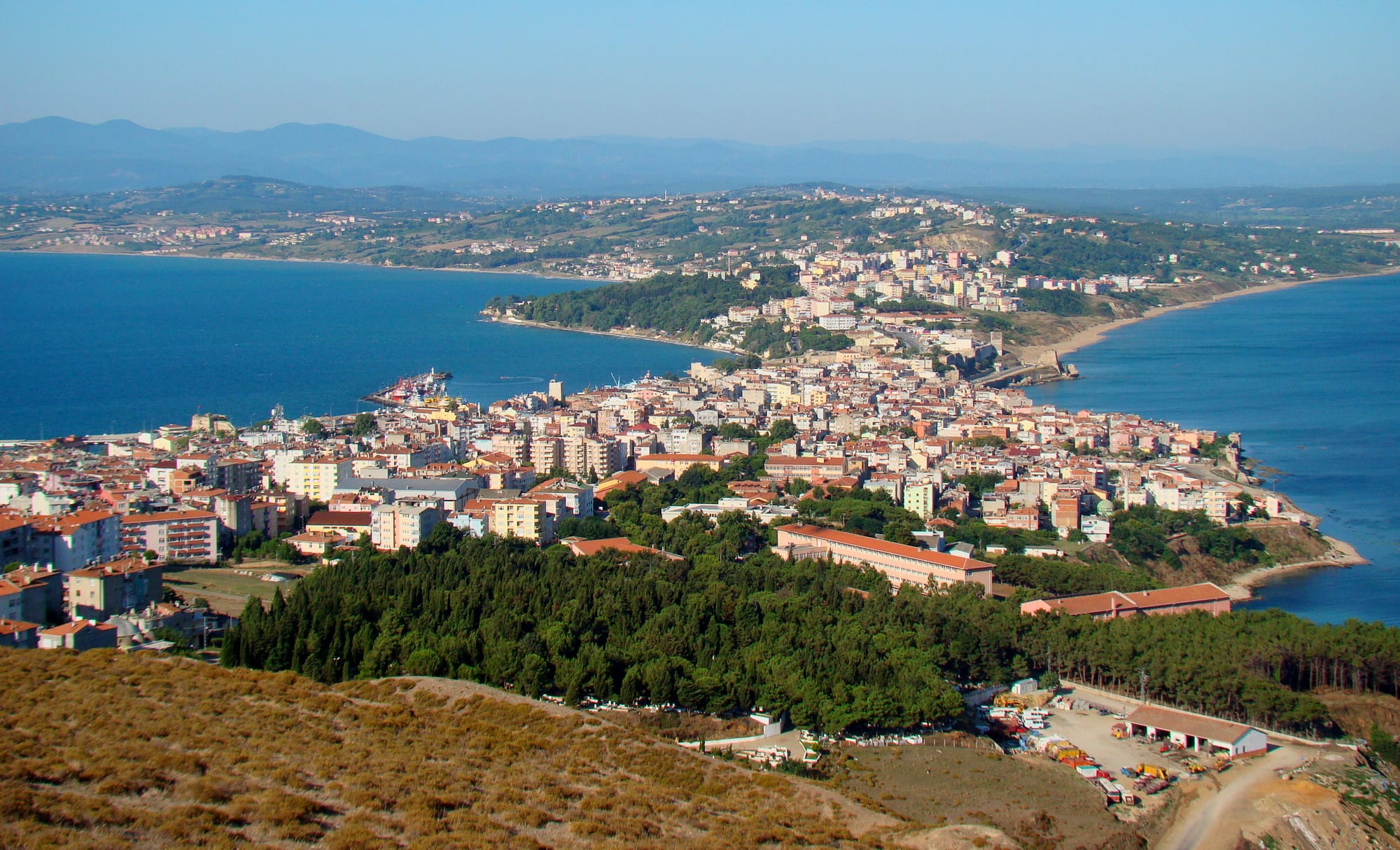
A low town of red roofs on a narrow neck of land with deep blue sea on both sides and wooded hills behind

The Black Sea Coast, Turkey

Sinop

Sinop spread across its isthmus, with the harbour on one side and open sea on the other. (Bjørn Christian Tørrissen / Wikimedia Commons · CC BY-SA 3.0)

A small provincial capital on the narrow neck of a peninsula that reaches further north than anywhere else in Turkey. Founded by Greek colonists as Sinope, birthplace of the philosopher Diogenes, it has a sheltered natural harbour, long stone fortress walls, a prison turned museum and quiet beaches on both sides of the isthmus.

Neighbourhoods

  • The old town inside the walls
    • First-time visitors
    • Historic district
    • Close to public transport

    The centre sits on the isthmus within the remains of the fortress walls, a grid of low streets holding the mosques, the museums, the prison and most of the shops. Everything is within a few minutes' walk, and both shores are close.

    Open in Maps
  • The harbour and the waterfront
    • Seafood
    • Boats
    • Evening walks

    The sheltered south-facing bay where fishing boats and small craft tie up below a stretch of fortress wall. Fish restaurants, tea gardens and boat trips line the quay, and wooden boatbuilding yards still work at its edges.

    Open in Maps
  • The eastern shore
    • Beaches
    • Quiet and residential

    The coast east of the centre, where a long municipal beach and a wooded recreation area look out on the open sea. It is a short walk or minibus ride from town, and much of the newer housing is on the slopes above it.

    Open in Maps

Things to do

The fortress town

  • Sinop Fortresslandmark

    The walls that close the isthmus, first built in antiquity and rebuilt by the Byzantines, Seljuks and Ottomans, with bastions that can be climbed for views over both shores.

    Open in Maps
  • Sinop Fortress Prisonmuseum

    A prison built inside the fortress in 1887 and used until 1997, holding writers among its inmates, now open as a museum of cells, workshops and courtyards.

    Open in Maps
  • Alâeddin Mosquelandmark

    The town's main mosque, of Seljuk foundation, rebuilt in 1268 after the fighting of the preceding years, with a stone courtyard and a fountain at its centre.

    Open in Maps
  • Pervane Medreselandmark

    A 13th-century Seljuk religious college beside the mosque, endowed by the vizier Muineddin Süleyman Pervane and closed as a school under the republic, its courtyard now open to visitors.

    Open in Maps
  • Balatlar Churchlandmark

    A Roman bath of the 2nd century, converted into a church in the late 4th or early 5th and later used as an Orthodox burial ground, on the hillside above the town; its frescoes survive only in damaged fragments.

    Open in Maps

Museums and the sea

  • Sinop Archaeological Museummuseum

    Finds from ancient Sinope and the surrounding coast, including amphorae from the town's wine and oil trade, and the ruins of a temple of Serapis in its grounds.

    Open in Maps
  • Sinop harbourtransit hub

    The natural harbour that gave the town its importance, with fishing boats, small shipyards building wooden craft, and trips out along the peninsula in summer.

    Open in Maps
  • Sinop Ethnographic Museummuseum

    A collection of ethnographic material from the cultural history of the region and the coast, in the centre of the town.

    Open in Maps

Beaches and nature

  • Aklimanbeach

    A broad bay of sand and pine woods about ten kilometres north-west of the town, with picnic areas and calm water.

    Open in Maps
  • Hamsilos Bayattraction

    A narrow inlet reaching inland between wooded slopes north-west of the town, often described as a fjord, with paths around its shore.

    Open in Maps
  • Sarıkum Lakepark

    A coastal lagoon and dune system west of Sinop, protected for its birdlife and reached by a road through the forest.

    Open in Maps

Short trips from the town

  • İnceburunviewpoint

    The cape at the tip of the peninsula, the northernmost point of Turkey, with a lighthouse and empty coastline.

    Open in Maps
  • Erfelek Waterfallsattraction

    A chain of 28 small waterfalls in a wooded valley about 40 kilometres south-west of the town, linked by wooden walkways and footbridges.

    Open in Maps
  • Boyabat Castlelandmark

    A castle on a rock above the Gökırmak valley in the town of Boyabat, about 70 kilometres inland from Sinop, built in antiquity and rebuilt under Roman, Byzantine and Ottoman rule.

    Open in Maps

Seasonal events

  • Hamsi seasonNovember to January

    The winter anchovy run, when boats land the fish in quantity and the harbour restaurants cook little else.

  • Summer beach seasonJune to September

    The months when the beaches, boat trips and seafront tea gardens fill with Turkish holidaymakers, many of them returning families.

  • Hıdrellezearly May

    The spring festival, marked along the coast with picnics, bonfires and wishes left by the water.

Eat and drink

Long-standing places and food districts in Sinop. Hours, ratings and directions come from your maps app, always current.

Sinop classics

  • Harbour fish restaurantsneighborhood

    The quayside is lined with places grilling and frying whatever the boats have landed — anchovy in cornmeal in winter, bonito, bluefish and turbot at other times, usually with cornbread and rocket.

    Open in Maps
  • Sinop mantısıneighborhood

    The local version of the filled pasta is larger than the Kayseri kind and often baked before being served with yoghurt and butter; small kitchens in the old town make it by hand.

    Open in Maps
  • Old town bakeries and marketsmarket

    Bakeries and market stalls inside the walls sell cornbread, layered börek, nokul rolls filled with walnuts, and the honey, nuts and pickles brought in from the villages.

    Open in Maps

Experience Sinop

History

Greek colonists from Miletus settled the peninsula in the 7th century BC, choosing it for a harbour that offers shelter in almost any wind. Sinope grew into the leading Greek city of the southern Black Sea, minting its own coins, trading grain, timber, salted fish and the red earth pigment known as sinopia, and founding colonies of its own along the shore. Its best-known son is Diogenes the Cynic, born here in about 412 BC, who left for Athens and a life of deliberate poverty.

In 183 BC Pharnaces I took the city and made it the capital of the Kingdom of Pontus; Mithridates VI was born here, and after Rome's victory the town continued as a Roman and then Byzantine port. The Seljuks captured it in 1214, and the Alâeddin Mosque and the Pervane Medrese date from the century that followed, when Sinop was a shipbuilding centre and briefly the seat of a small principality before the Ottomans absorbed it.

Its most remembered modern day is 30 November 1853, when a Russian fleet destroyed an Ottoman squadron anchored in the harbour, an action that helped draw Britain and France into the Crimean War. From 1887 the fortress housed a state prison whose inmates included the writers Sabahattin Ali and Nâzım Hikmet, closed in 1997 and now a museum, and an American listening station operated on the hills above the town during the Cold War. Road building along the coast came late, which left Sinop quieter and less developed than Samsun or Trabzon.

Culture & Customs

Sinop's identity is maritime and unhurried. Wooden boatbuilding has been practised here for centuries and yards still make small craft by hand along the harbour; fishing families, ferry crews and shipwrights give the waterfront its working character even in the holiday months. The town's other tradition is craft in wood and bone — spoons, model boats and inlaid boxes sold in the courtyard of the medrese.

Black Sea music and dance are less dominant here than further east, but the kemençe, the tulum and the horon appear at weddings and summer festivals, and the region shares the broader Black Sea taste for quick humour and plain speech. Diogenes is the town's adopted emblem, and a statue of him stands in the town.

Daily manners are those of a conservative but easy-going provincial town. People greet strangers, shopkeepers press tea on visitors, and the evening promenade along the harbour is a social institution in which nearly everyone takes part. Summer brings back families whose parents or grandparents left for Istanbul, and the population and mood of the town change noticeably between August and February.

Daily Life

About 57,000 people live in the central district and roughly 220,000 in Sinop province, one of the least populated in Turkey. The walled centre holds the offices, schools and shops, while newer housing climbs the slopes behind the isthmus and spreads along the coast road in both directions.

Fishing and fish processing, small-scale boatbuilding, forestry, farming in the river valleys and the public sector — the provincial administration, a university and hospitals — carry the economy, with summer tourism increasingly important. The province sends more people away than it attracts: young adults leave for Istanbul, Ankara and Samsun, and many houses in the villages are used only in summer, which gives Sinop one of the older population profiles in the country.

The rhythm of the year is set by the sea and the weather: boats out in the dark and fish sold in the morning, quiet wet winters, a crowded summer, and an autumn of preserving and preparing. Recurring local issues are the slow coastal road, the loss of young people, the effect of building on the shoreline, and long-running public debate about a proposed nuclear power station in the province.

Food

Fish leads the table. Hamsi, the Black Sea anchovy, dominates from late autumn to midwinter, fried in a coating of cornmeal, baked with rice or worked into bread; bonito, bluefish, mullet and turbot appear at other times, usually grilled simply and eaten with rocket, onion and cornbread. The harbour restaurants set their menus by what has been landed rather than by a fixed list.

Sinop mantısı is the town's own dish: pasta parcels filled with meat, larger than the tiny Kayseri version, often baked before boiling and served with yoghurt, garlic and melted butter. Nokul, a rolled yeast-dough bread filled with walnuts and raisins, or with cheese or minced meat, is the local baking speciality, sold in the bakeries inside the walls. Corn appears as bread and as kuymak, cornmeal cooked in butter with cheese until it stretches.

The forests and valleys of the province supply the rest: wild mushrooms, chestnuts, walnuts, honey, cranberry-like wild fruits and preserves. Dark cabbage is simmered into soup or wrapped around rice, as it is all along the Black Sea. Tea is drunk continuously, the beans and pickles are home-made, and in cold weather the tea gardens serve salep.

Planning tools

Budget

Sinop is one of the cheaper places on the Turkish coast, with modest hotels and pensions and inexpensive fish restaurants. Prices climb in July and August, when Turkish families fill the town, and fall sharply out of season. Transport costs little within the town; a car is the main expense for reaching the beaches and waterfalls.

Daily Budget Midrange
USD 80–160 (good hotel, fish dinners, a hire car for the peninsula)
Daily Budget Shoestring
USD 25–45 (pension or simple hotel, lokanta meals, minibuses)

Book ahead for midsummer weekends; the walls, the harbour and the beaches cost nothing, and museum entries are small.

Best Time to Visit

June to September for the beaches and boat trips, with August the busiest month. May and October are mild and quiet and good for walking the peninsula. Winter is grey and wet but is the anchovy season, when the harbour is at its most active and rooms are cheap.

Suggested Number of Days

A day is enough for the walled town and the harbour. Two or three allow the beaches, the bays along the peninsula and the waterfalls inland. Weather is the main variable, since much of the appeal is outdoors.

First Visit
1–2 days
With Surroundings
3 days

Transportation

The centre is small and walkable. Minibuses run to Karakum, Akliman and the villages along the coast, and intercity buses leave from the station on the edge of town. Taxis are easy to find at the harbour. A hire car is the practical way to reach İnceburun, Sarıkum and the Erfelek valley, where services are infrequent.

Coastal roads are winding and slow: Samsun is a longer drive than the distance suggests, and journeys inland take longer still.

Airport & Station Connections

Sinop Airport lies just outside the town, with a small number of flights to Istanbul. Most visitors arrive by bus: Samsun is about three hours away, Ankara seven to eight and Istanbul around ten. The coastal road connects the town westwards to Amasra and eastwards towards Samsun. There is no passenger railway.

Walkability

Very good in the centre, which is flat and compact: the walls, the museums, the mosques and both shores are within about a kilometre of each other. Karakum beach is a walk of a couple of kilometres along the coast, and the hillside districts behind the town are steep. Seafront paths are exposed in bad weather.

Safety

Sinop is a quiet town with very little crime, and walking at night in the centre is normal. The hazards are natural: strong currents and sudden swell on the open northern shore, slippery rocks and unfenced drops on the fortress walls, and storms that can make boat trips uncomfortable. Heavy rain brings the risk of flooding and landslides on the coast road.

Swim only on supervised beaches and take local advice about currents, keep away from wall edges in wind, and check the forecast before driving the coastal roads. Check current official travel advice before travelling.

Climate

Surrounded by sea on three sides, Sinop has the mildest and most even climate on the Turkish Black Sea coast: cool summers by national standards, mild wet winters and rain spread through the year. Fog and strong winds are common, and the sea keeps frost rare.

Summer
warm and humid, usually 24–27°C by day, tempered by sea breezes
Winter
mild and wet, usually 7–11°C by day, with wind and occasional snow that does not last

Local Customs

Small-town manners prevail: greetings on the street, tea offered in shops and repeated invitations that are meant seriously. Dress is relaxed on the beaches but modest in the town, and more so at the mosques, where shoes come off and heads are covered by women. Fishing families keep their own routines and boats are private property, not backdrops.

Ask before photographing people or boat crews, dress modestly away from the beach, and accept at least one glass of tea when it is offered.

Common Payment Methods

The currency is the Turkish lira. Cards are taken in hotels, restaurants and shops in the centre, and ATMs are clustered in the old town. Cash is useful for minibuses, village shops, market stalls and small boat trips along the coast.