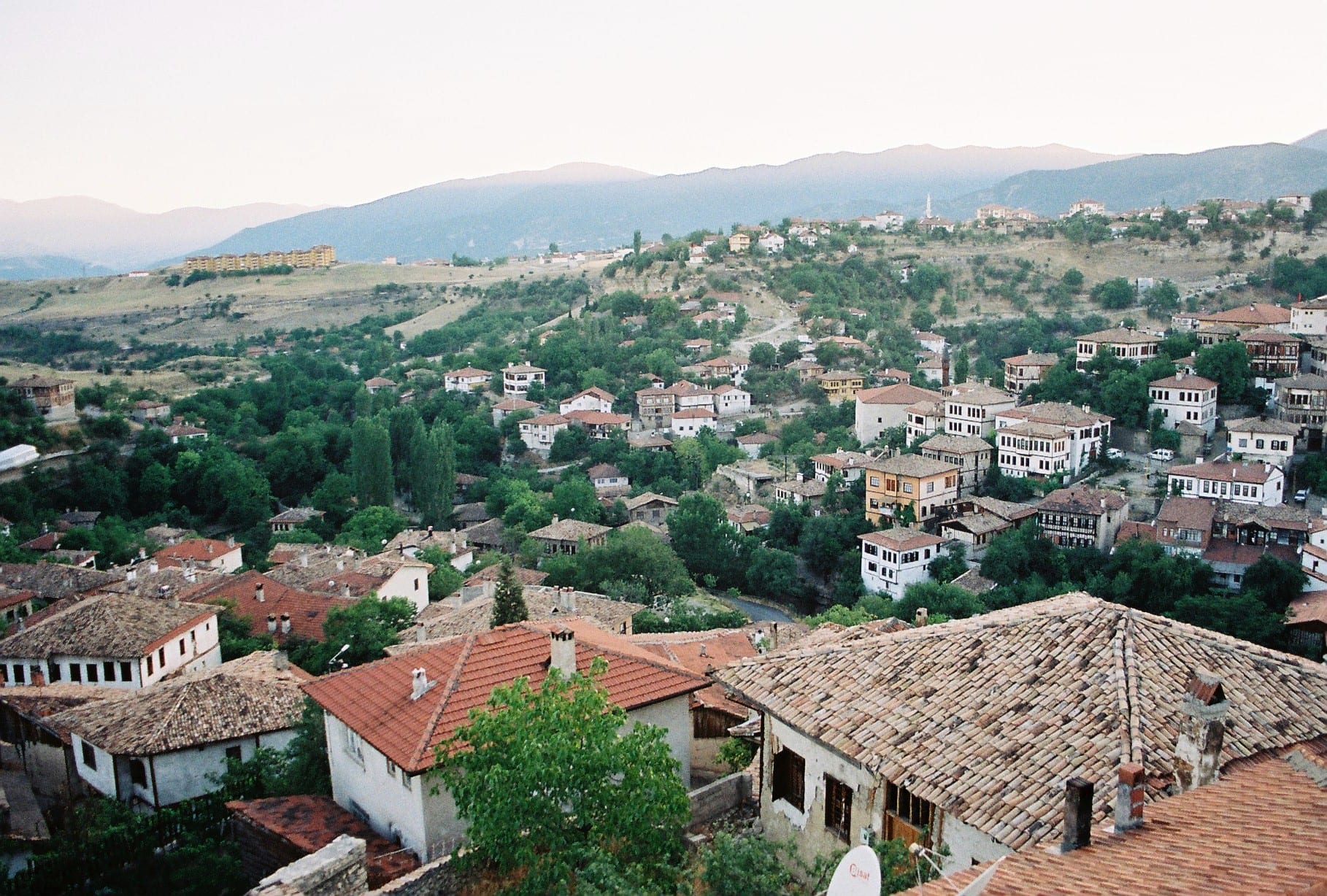
White Ottoman houses with red tiled roofs spread across a wooded valley below bare hills at dusk

The Black Sea Coast, Turkey

Safranbolu

Safranbolu's timber-framed houses in their valley in Karabük province. (Makalp / Wikimedia Commons · CC BY-SA 3.0)

A small town in Karabük province, inland from the western Black Sea coast, whose timber-framed merchant houses, caravanserais, mosques and cobbled lanes have been protected as a UNESCO World Heritage Site since 1994. Grown rich on the caravan trade and on the saffron that gave it its name, it now lives largely from visitors to its preserved Ottoman streets.

Neighbourhoods

  • Çarşı
    • First-time visitors
    • Historic district
    • Best for food

    The old market quarter in the bottom of the valley, where the caravanserai, the hamam, the main mosques and the craft workshops stand along cobbled lanes. Most of the restored mansions now working as guesthouses are here, and almost everything of interest is within a few minutes' walk.

    Open in Maps
  • Bağlar
    • Quiet and residential
    • Gardens

    The higher quarter of vineyards and orchards where the merchant families spent the summers, a couple of kilometres above Çarşı. Its houses stand in large walled gardens and are more spread out, and the views back over the valley are wide.

    Open in Maps
  • Kıranköy
    • Shops and services
    • Close to public transport

    The modern centre on the plateau, historically the quarter of the town's Greek Orthodox community. Banks, shops, the bus connections and everyday services are here, and it is a short downhill walk or minibus ride from the old town.

    Open in Maps

Things to do

The Ottoman town

  • Cinci Hanlandmark

    A caravanserai built in the 1640s for Cinci Hoca, a favourite of Sultan İbrahim, in the middle of Çarşı, with a courtyard section and a stable section; it has been restored and works as a hotel.

    Open in Maps
  • Cinci Hamamlandmark

    The town's 17th-century bath house, built by the same patron as the caravanserai, with separate sections for men and women.

    Open in Maps
  • İzzet Mehmed Pasha Mosquelandmark

    The main mosque of the old town, an 18th-century building completed in the 1790s for a grand vizier born in Safranbolu, built over a stream at the foot of the market.

    Open in Maps
  • Köprülü Mehmed Pasha Mosquelandmark

    A mosque built in 1661–62 for the grand vizier Köprülü Mehmed Pasha, at the centre of a complex that also held a medrese, a library and a bath, and among the town's most important historic buildings.

    Open in Maps
  • Safranbolu Clock Towerlandmark

    A square stone tower about 20 metres high, built in 1797 for İzzet Mehmed Pasha and counted as the earliest known clock tower in Anatolia; its original clock, brought from London, still runs.

    Open in Maps

Walks and viewpoints

  • Tokatlı Canyonattraction

    One of three limestone gorges cut by the streams that run through the town, with walking paths and viewpoints along its rim.

    Open in Maps
  • İncekaya Aqueductlandmark

    A stone aqueduct of the 1790s striding across the Tokatlı gorge, built to carry water to the town.

    Open in Maps

Short trips from the town

  • Yörük Köyüattraction

    A village of grand old houses, a communal laundry and a mosque east of the town, named after the Yörük nomads settled here and preserved much as Safranbolu is.

    Open in Maps
  • Bulak Mencilis Caveattraction

    A cave over two and a half kilometres long outside the town, of which a few hundred metres are lit and open to visitors.

    Open in Maps
  • Amasraattraction

    A small fortified port on the Black Sea coast north of the town, with a Genoese-era castle, two bays and fish restaurants.

    Open in Maps

Seasonal events

  • Saffron harvestOctober and November

    The short harvest in the villages around the town, when the purple crocus flowers are picked by hand and their threads dried.

  • Hıdrellezearly May

    The spring festival, marked with picnics, music and wishes written and left by water or under a rose bush.

  • Summer heritage seasonJune to September

    The busiest months, when the old town's courtyards host concerts, craft demonstrations and folk performances for visitors.

Eat and drink

Long-standing places and food districts in Safranbolu. Hours, ratings and directions come from your maps app, always current.

Safranbolu classics

  • Safranbolu lokum shopsneighborhood

    The old town is lined with confectioners boiling and cutting Turkish delight, many flavours of it scented with the local saffron, alongside walnut-studded slabs and sugared almonds.

    Open in Maps
  • Çarşı restaurants in the old mansionsneighborhood

    Restored merchant houses and courtyards serve the local kitchen — stuffed vine leaves, lamb dishes and the wedding soup known as düğün çorbası — around the caravanserai and the main square.

    Open in Maps
  • Saffron and spice stallsmarket

    Shops around Cinci Han sell the town's saffron by the gram, along with dried fruit, walnuts, herbal teas and the copperware and wooden goods made nearby.

    Open in Maps

Experience Safranbolu

History

Settlement on this site is old — the area lay within Paphlagonia and passed through Hittite, Phrygian, Lydian, Persian, Roman and Byzantine hands — but the town visible today is a product of the Ottoman centuries. Safranbolu stood on the caravan road between Gerede and the Black Sea port of Amasra, and later on the routes linking Istanbul with the interior, and it grew as a place where merchants, muleteers and craftsmen gathered.

Trade paid for the buildings that define it. The Köprülü Mehmed Pasha Mosque went up in the 17th century, and in the same period the caravanserai known as Cinci Han and the bath beside it were built. Local families sent sons into Ottoman service — the grand vizier İzzet Mehmed Pasha, who endowed the largest mosque in the town in the 1790s, was born here — and the tanners, saddlers, coppersmiths and shoemakers of the market quarter supplied the caravans. The town's name records saffron, grown in the surrounding villages and traded as a luxury.

Safranbolu's population long included a Greek Orthodox community, concentrated in Kıranköy, which left in the 1923 population exchange with Greece. The caravan trade had already faded when the railway and the new roads bypassed the town, and in the 1930s the republic built a large steelworks at neighbouring Karabük, which drew away work and people. That decline preserved the old houses: too poor to rebuild, the town kept them. From the 1970s conservation efforts gathered pace, and in 1994 UNESCO inscribed Safranbolu on the World Heritage List as an example of an Ottoman caravan town.

Culture & Customs

The town's culture is built around its houses. A Safranbolu konak typically has a stone lower floor for storage and animals and timber upper floors that project over the lane, with shuttered windows, a wide central hall, built-in cupboards, carved wooden ceilings and a rotating cupboard door that allowed food to be passed without the women of the house being seen. Families kept two homes — a winter house in the valley and a summer house among the vineyards of Bağlar — and the habit shaped the layout of the whole town.

Crafts survive in the market quarter, where the old guild streets are still named for leatherworkers, blacksmiths and coppersmiths. Wood turning, felt making, hand-woven cloth and the making of Turkish delight are practised for visitors as much as for locals now, but the workshops are real ones. Folk music and craft demonstrations appear at summer events in the courtyards.

Manners are those of a conservative Anatolian town: neighbours know one another, hospitality is close to obligatory, and tea is the basis of social life. Residents are used to being photographed but not always pleased by it, and conservation rules govern what can be altered on almost every building, a subject of constant local discussion. Saffron, once a trade good, has returned as a badge of identity, appearing in sweets, soaps and the town's festivals.

Daily Life

About 50,000 people live in the district, most of them in the town and its modern quarters rather than in the protected old streets, where many buildings are guesthouses, museums or shops. Karabük, about 9 kilometres away, is the provincial capital and far larger, and the two places function as one labour market.

Work comes from three sources: tourism in the old town, the steelworks and related industry at Karabük, and the university and public offices. Farming in the surrounding villages produces saffron in small quantities, along with fruit, walnuts and livestock, and forestry matters in the hills. Young people leave for Ankara and Istanbul, as in most Anatolian towns, although the visitor trade has kept more of them at home than in similar places.

Daily rhythm is slow and domestic: shopping in Kıranköy, tea in the courtyards, and a steady flow of day visitors that swells at weekends and in summer and thins out in the middle of winter. The town's recurring concerns are the cost and difficulty of maintaining timber houses under heritage rules, parking and coach traffic pressing on narrow lanes, and the balance between living town and open-air museum.

Food

Safranbolu is known above all for its sweets. Lokum, Turkish delight, is boiled and cut in shops all over Çarşı, often perfumed with the town's saffron and studded with walnuts or pistachios; slabs of it are sold beside sugared almonds and thin sheets of dried fruit pulp. Saffron itself turns up in tea, in rice and in a saffron-scented version of zerde, the sweet yellow rice pudding served at weddings.

The savoury kitchen is inland Anatolian rather than coastal. Düğün çorbası, a wedding soup of meat stock thickened with flour and egg and finished with peppery butter, is a local staple, and etli yaprak sarma, vine leaves stuffed with rice and meat, appears at every celebration. Peruhi, a filled pasta close to mantı and served with yoghurt and garlic, is the dish most associated with Safranbolu's own households, alongside the pastry known as Safranbolu bükmesi.

Bakeries sell flatbread and börek layered with cheese or meat, and the surrounding villages supply walnuts, honey and fruit. Tea is drunk constantly, with Turkish coffee in the courtyard cafés of the old town; in the cold months salep, a thick hot drink dusted with cinnamon, is sold in the market lanes.

Planning tools

Budget

Safranbolu is cheap to visit by European standards but a little dearer than the surrounding towns, because so much of its accommodation is in restored mansions run as small hotels. Meals, museum entries and the minibus between the quarters all cost little. Weekends and public holidays, when visitors arrive from Ankara and Istanbul, are the expensive times.

Daily Budget Midrange
USD 80–160 (a room in a restored konak, restaurant dinners, a hire car for the villages)
Daily Budget Shoestring
USD 30–50 (simple pension, lokanta meals, minibuses)

Midweek stays are cheaper and much quieter; the old town and its lanes cost nothing to walk.

Best Time to Visit

May, June, September and October are the most comfortable months, with mild days and fewer crowds than midsummer. October and November bring the saffron harvest and autumn colour in the gorge. Winter is cold and often snowy, which suits the wooden houses but makes the steep cobbles slippery; summer weekends are the busiest time of the year.

Suggested Number of Days

A day covers the old town, and a night in one of its houses is much of the point of coming. Three days allow the nearby villages, the canyon and a run out to the coast. Winter weather and weekend crowds both slow movement around the lanes.

First Visit
1–2 days
With Surroundings
3 days

Transportation

The town is small enough to cross on foot, though the quarters sit at different heights and the gradients are steep. Minibuses link Çarşı, Kıranköy and Bağlar and run to Karabük, and taxis wait near the main square. A car is useful for the villages, the cave and the coast, but parking in the old town is limited and most lanes are closed to it.

Leave a car in a designated car park above Çarşı rather than trying to drive the cobbled lanes.

Airport & Station Connections

Most visitors come by bus: Ankara is about three hours away and Istanbul six to seven, with services arriving at Karabük or at the Safranbolu bus station, from where minibuses run into the old town. Karabük, roughly 9 kilometres away, has a railway station on the line towards Zonguldak. The nearest airports are at Kastamonu and Zonguldak, both around two hours by road.

Walkability

Excellent within Çarşı, where the whole old town is a short walk and cars are largely kept out, but the surface is rough cobble and the lanes rise and fall sharply. Bağlar and Kıranköy are uphill from the centre and involve a climb of a couple of kilometres, which many people take by minibus or taxi. Sturdy shoes matter more here than in most Turkish towns.

Safety

Safranbolu is a quiet, safe town with very little crime. The real hazards are underfoot: steep cobbled lanes that are slippery in rain, snow and ice in winter, and unlit alleys at night. Traffic squeezes through some narrow streets, and the canyon paths and viewpoints have steep drops.

Wear shoes with grip, take care on the cobbles after rain, and keep to marked paths and railings at the gorge. Check current official travel advice before travelling.

Climate

Inland and higher than the coast, Safranbolu has warmer summers and much colder winters than the shore an hour to the north. Rain falls through the year but less heavily than on the eastern Black Sea, and snow lies in the town most winters.

Summer
warm and mostly dry, usually 25–30°C by day, with cool evenings
Winter
cold, often around 0–6°C by day, with frost and periods of snow

Local Customs

This is a conservative small town where modest dress is normal and appreciated, particularly in the old quarters. Many houses are private homes as well as heritage buildings, so doorways and courtyards should not be entered or photographed without asking. Shoes come off at the door of a house or a guesthouse room, and in mosques; guests are offered tea and are expected to accept.

Ask before photographing people or private houses, dress modestly at mosques, and bargain politely rather than firmly in the craft shops.

Common Payment Methods

The currency is the Turkish lira. Hotels, restaurants and the larger sweet shops take cards, and there are ATMs in Kıranköy and around the main square in Çarşı. Cash is useful for minibuses, small stalls, village shops and some museum entries.