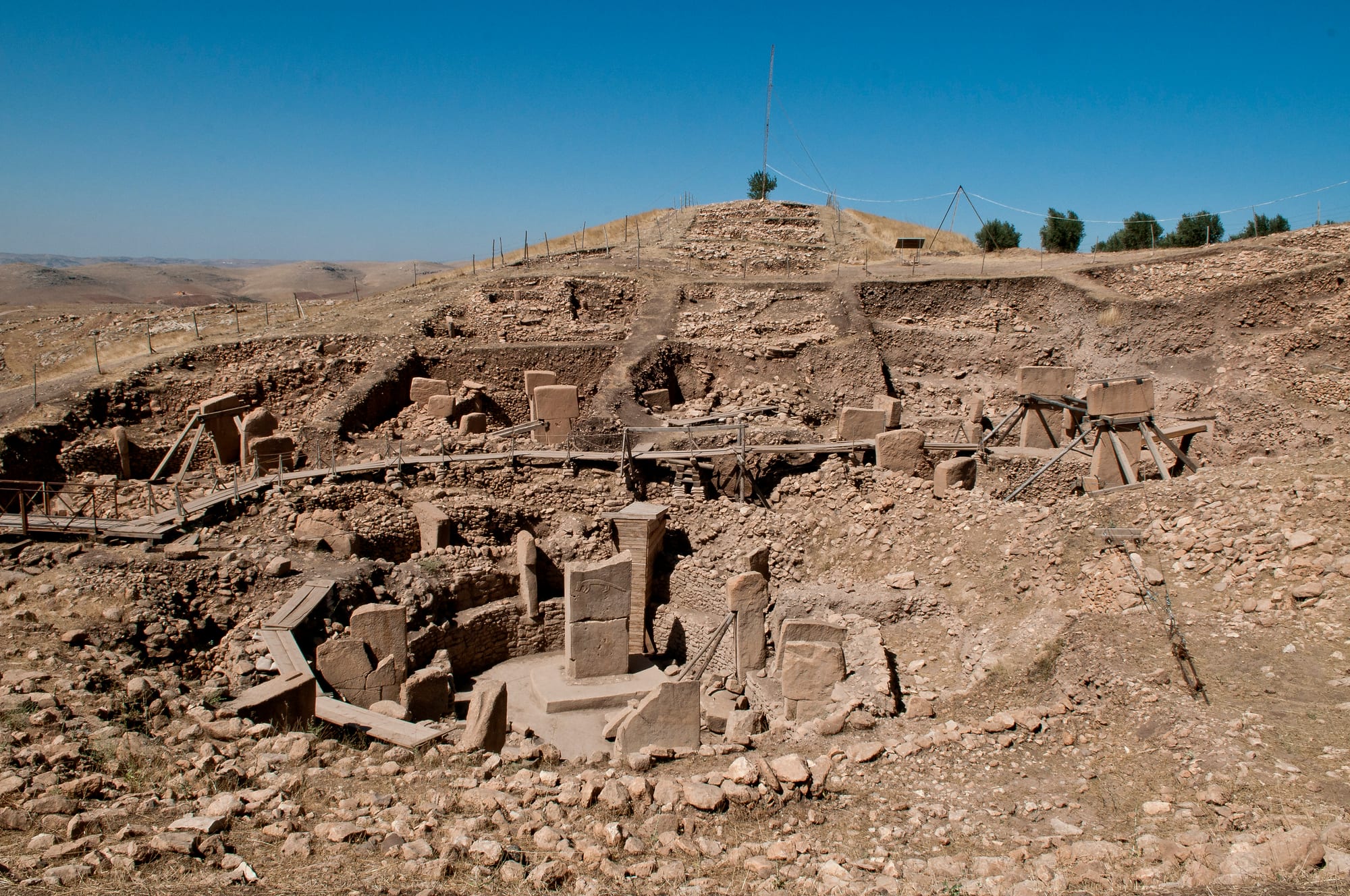
Excavated circular enclosures of stone walls and T-shaped pillars on a dry hilltop under a clear blue sky

Turkey

Southeastern Anatolia

The excavated stone enclosures of Göbekli Tepe on a ridge north-east of Şanlıurfa. (Teomancimit / Wikimedia Commons · CC BY-SA 3.0)

Turkey's share of Upper Mesopotamia, the hot, rolling plateau between the Euphrates and the Tigris that borders Syria and Iraq, from Gaziantep and Şanlıurfa east to Diyarbakır, Mardin and Şırnak — a region of Neolithic temples, early Christian monasteries, stone-built old towns and famous food, with a largely Kurdish, Arab, Syriac and Turkish population.

Explore Southeastern Anatolia

History

The region lies in the northern arc of the Fertile Crescent, where some of the world's earliest farming began. Göbekli Tepe, north-east of Şanlıurfa, was built around 9600 BC by people who had not yet adopted farming, and related sites such as Karahan Tepe dot the surrounding hills. Harran, on the plain to the south, was an ancient centre of the moon god Sin and is named in the Bible's story of Abraham, whom local tradition says was born in Urfa.

In the classical age, Zeugma on the Euphrates grew rich as a Roman garrison town, and the small kingdom of Commagene built its royal sanctuary on Mount Nemrut in the 1st century BC. Edessa, today's Şanlıurfa, became one of the first centres of Syriac Christianity, and monasteries such as Mor Gabriel, founded in 397 in the Tur Abdin hills near Midyat, still stand. Amida, now Diyarbakır, was a fortress city between Rome and Persia.

After the Arab conquests, the Artuqid Turkmen dynasty ruled Mardin, Diyarbakır and Hasankeyf in the 12th to 14th centuries, followed by the Aq Qoyunlu, and the Ottomans took the region in the early 16th century. Gaziantep earned the prefix "gazi" (veteran) for its resistance to French forces in 1920–21. Since the 1980s the Southeastern Anatolia Project, known as GAP, has dammed the Euphrates and Tigris, creating the Atatürk Dam and, in 2020, flooding Hasankeyf. The region was a centre of the conflict between the army and the PKK, and fighting in 2015–16 destroyed parts of Diyarbakır's old Sur district.

Culture & Customs

The south-east is Turkey's most diverse region. Diyarbakır is regarded by many Kurds as their cultural capital, and Kurdish is the everyday language in much of Diyarbakır, Mardin, Batman, Siirt and Şırnak. Arabic is spoken in parts of Şanlıurfa and Mardin, Gaziantep is largely Turkish, and Syriac Christians keep their Aramaic language, Turoyo, and their liturgy in the villages and monasteries of Tur Abdin. Nevruz on 21 March is a major celebration, especially in Diyarbakır.

Şanlıurfa is known for its sıra gecesi, long evenings of music, conversation and food held in homes among friends, and for its devotional role as the "city of prophets", which draws pilgrims to Balıklıgöl. Diyarbakır has a house dedicated to dengbêj, the Kurdish singers of long narrative songs.

Crafts vary by city. Gaziantep's coppersmiths still hammer trays and pots in the copper bazaar, Midyat is known for telkari, fine silver filigree. Society is more traditional than in western Turkey, family and tribal ties matter, and hospitality to guests is taken seriously.

Daily Life

Gaziantep and Şanlıurfa each have around two million people in their provinces, and Diyarbakır nearly as many. Mardin, Batman, Adıyaman, Siirt, Şırnak and Kilis are smaller. The region has Turkey's highest birth rates, and it hosts many Syrian refugees, particularly in Gaziantep.

Gaziantep is a major industrial city, making textiles, machine-woven carpets, plastics and food products, and processing the region's pistachios. Irrigation from the GAP dams has turned the Harran plain into a major cotton-growing area. Batman produces much of Turkey's oil. Elsewhere, farming, livestock, border trade and public-sector jobs sustain most families, and unemployment is high.

Summer heat shapes the day, with business done in the morning and evening, and flat roofs are traditionally used for sleeping on hot nights. Recovery from the 2023 earthquakes, the long-term effects of the PKK conflict, and the future of Syrian refugees are the main current issues.

Food

Gaziantep is widely regarded as Turkey's food capital. Its pistachio baklava, Antep baklavası, was registered as a Protected Geographical Indication in the European Union in 2013; katmer is a paper-thin pastry filled with pistachio and clotted cream, and beyran, a spicy soup of lamb and rice, is eaten even at breakfast. Other local dishes include ali nazik, grilled meat on a smoky aubergine and yoghurt purée, and yuvarlama, small rice-and-meat dumplings in yoghurt soup.

Şanlıurfa gives its name to Urfa kebap, milder than Adana's, and to isot, a dark, smoky dried pepper. The region is also the home of çiğ köfte, fine bulgur kneaded with pepper paste and spices, traditionally made with raw meat but now often meatless. Mırra, a very bitter, concentrated coffee, is served in tiny cups in Şanlıurfa and Mardin.

Diyarbakır is known for kaburga dolması, lamb ribs stuffed with spiced rice, and for its large watermelons. Mardin makes içli köfte, bulgur shells stuffed with meat, and Siirt perde pilavı, rice with chicken baked inside a pastry crust. Syriac families in Midyat make wine, and Kilis is known for olive oil.

Attractions & Natural Wonders

Gaziantep has its castle, the copper bazaar and restored caravanserais, and the Zeugma Mosaic Museum; the castle of Rumkale above the Euphrates is nearby. In Şanlıurfa, Balıklıgöl's sacred fish pools lie below the citadel, the archaeology museum holds finds from Göbekli Tepe, and Göbekli Tepe itself lies about 12 kilometres from the city. Harran's beehive mud-brick houses and ruined university stand on the plain to the south, and Halfeti, partly submerged by a dam, is reached by boat on the Euphrates.

Mardin's old town looks south across the Mesopotamian plain, with the Zinciriye and Kasımiye madrasas and the Syriac monastery of Deyrulzafaran nearby. Midyat, with its carved stone houses, is the gateway to Mor Gabriel and the Tur Abdin villages, and the Roman frontier city of Dara lies near the Syrian border.

Diyarbakır's basalt walls and the Hevsel Gardens along the Tigris form a UNESCO World Heritage Site, with the Great Mosque and the ten-arched Dicle Bridge nearby. At Hasankeyf, the old town and its cliffs were largely flooded by the Ilısu Dam; several monuments, including the tomb of Zeynel Bey, were moved to a cultural park near the new town. In Adıyaman, the statues of Mount Nemrut stand on the mountain's summit.

Cities in Southeastern Anatolia

Planning basics

Budget

The south-east is inexpensive, and eating well costs very little — kebabs, lahmacun and baklava here are cheaper and often better than in Istanbul. Mardin's restored boutique hotels in old stone mansions are the main exception, and Gaziantep has a growing range of mid-range hotels. Many visitors hire a driver for Göbekli Tepe, Harran and Nemrut.

Daily Budget Midrange
USD 70–150 (boutique hotel in Mardin or Gaziantep, restaurants, a car and driver for day trips)
Daily Budget Shoestring
USD 25–45 (simple hotel, kebab and lokanta meals, buses and dolmuş)

Eat breakfast the local way — beyran soup or katmer in Gaziantep — and book Mardin's stone-mansion hotels ahead for spring weekends.

Safety

The main cities — Gaziantep, Şanlıurfa, Mardin and Diyarbakır — receive many domestic tourists and are usually calm, but the region has seen bombings and clashes linked to the PKK conflict and the war in Syria in the past decade. Governments advise against travel to the areas close to the Syrian and Iraqi borders, including much of Şırnak, and caution over the wider region. The February 2023 earthquakes badly damaged Adıyaman, Gaziantep, Kilis and Şanlıurfa. Summer heat is a serious health risk.

Stay away from the Syrian and Iraqi border areas and from demonstrations, carry identification, and avoid sightseeing in the midday heat. Check current official travel advice before travelling.

Climate

The region has the hottest summers in Turkey. Şanlıurfa, Diyarbakır and the Tigris valley regularly pass 40°C in July and August, and the heat is dry. Winters are cool and wet, with occasional snow in Diyarbakır and on the higher ground, while Mardin, on its ridge, is a little cooler in summer than the plain below.

Summer
very hot and dry, 38–45°C on the plains; slightly cooler in Mardin and Gaziantep
Winter
cool and rainy, 2–12°C, with frost and occasional snow, especially around Diyarbakır

Transportation

Gaziantep, Şanlıurfa (GAP airport), Diyarbakır, Mardin, Batman and Adıyaman have airports with flights to Istanbul and Ankara. Intercity buses link all the cities, and minibuses reach the towns. Distances are moderate: Şanlıurfa is about two hours from Gaziantep and about three from Mardin by road. Military and police checkpoints are routine, especially near the borders.

Hire a car and driver or join a tour for Göbekli Tepe, Harran and Halfeti in one day, and carry a passport for checkpoints.

Best Time to Visit

April to early June and late September to November are the best months, when the plains are green or harvested and the heat bearable. Spring brings wild flowers to the Harran plain and the Nevruz celebrations of 21 March. High summer is punishing for sightseeing, and the sunrise and sunset visits to Mount Nemrut are only practical from about May to October.