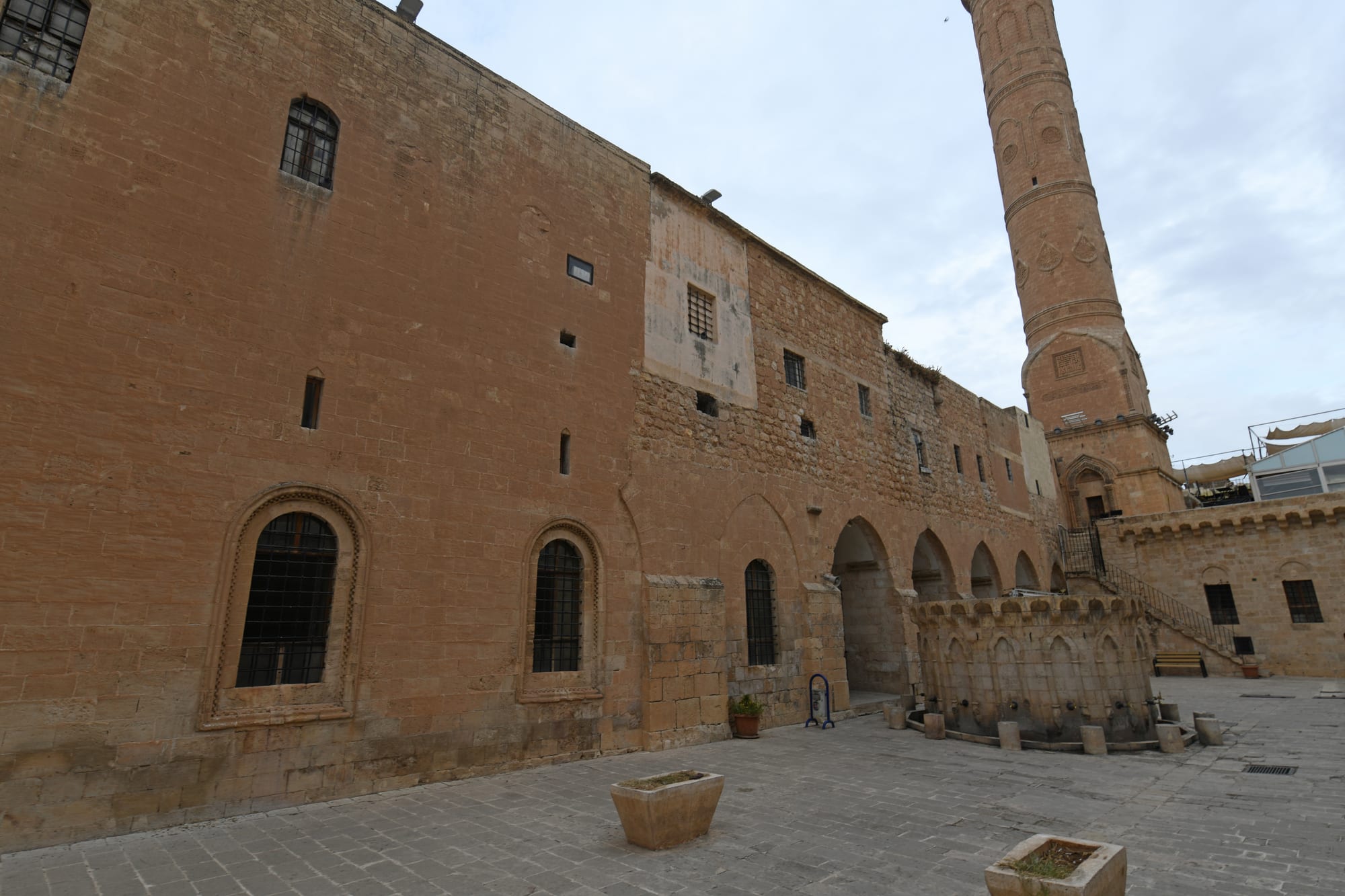
A wide stone courtyard of pale honey-coloured masonry with arched windows, an arcade and a ribbed medieval minaret rising behind it

Southeastern Anatolia, Turkey

Mardin

The courtyard and minaret of the Great Mosque of Mardin in the old town. (Dosseman / Wikimedia Commons · CC BY-SA 4.0)

A terraced town of honey-coloured stone built in tiers down a steep bluff above the Mesopotamian plain in south-eastern Turkey. Artuqid mosques and madrasas, carved merchant houses and Syriac Orthodox churches and monasteries stand within a few streets of one another, and the plain stretching towards Syria fills the view from almost every roof.

Neighbourhoods

  • The old town along Birinci Cadde
    • First-time visitors
    • Historic district
    • Best for food

    A single long street runs the length of the bluff, with the bazaar lanes dropping below it and stepped alleys climbing above. Most of the carved stone houses, the mosques, the madrasas, the boutique hotels and the terrace restaurants are on or just off it.

    Open in Maps
  • The bazaar and the lower terraces
    • Shopping
    • Local life
    • Views

    Below the main street, vaulted market lanes hold coppersmiths, soap and spice sellers, saddlers and grocers, with staircases and tunnels cutting between the levels. Roof terraces at this height look straight out over the plain.

    Open in Maps
  • The upper slopes below the castle
    • Quiet and residential
    • Walks and viewpoints

    Steep residential lanes climb towards the rock crowned by the castle, which is a military area and closed to visitors. The walk up is demanding but gives the best sense of how the town is stacked in terraces.

    Open in Maps
  • Yenişehir
    • Close to public transport
    • Modern city life

    The modern district on the plain a few kilometres below the old town, with wide avenues, the university, the bus terminal, chain shops and most of the everyday services. Minibuses shuttle constantly between it and the historic streets.

    Open in Maps

Things to do

The old town

  • Kasımiye Madrasalandmark

    A madrasa at the western edge of the town, begun under the Artuqids and completed in 1445 under the Akkoyunlu, built around a courtyard with a pool and a domed prayer hall.

    Open in Maps
  • Mardin Castlelandmark

    The fortress on the crag directly above the town, built under the Hamdanids in the 10th century and later held by the Artuqids and the Ottomans; it is a military zone and cannot be entered, but its rock wall is the backdrop to every street.

    Open in Maps

Churches and monasteries

  • Mor Hananyo Monasterylandmark

    Known in Turkish as Deyrulzafaran, the saffron monastery, a Syriac Orthodox house founded in late antiquity a few kilometres east of the town, and for centuries the seat of its patriarchs.

    Open in Maps
  • Mor Gabriel Monasterylandmark

    One of the oldest working Syriac Orthodox monasteries in the world, founded in 397, standing on a hillside beyond Midyat to the east.

    Open in Maps

Short trips from the town

  • Daralandmark

    A Byzantine frontier fortress city south-east of Mardin, rebuilt by the emperor Anastasius I in 505, with great water cisterns and rock-cut remains spread around a village on the plain.

    Open in Maps
  • Midyatattraction

    A stone-built town east of Mardin, long regarded as the capital of the Tur Abdin plateau and historically the main Syriac Christian town of the region.

    Open in Maps
  • Savurattraction

    A small terraced town north-east of Mardin, built of the same pale stone above a green valley, much quieter than the main road towns.

    Open in Maps
  • Kızıltepeattraction

    A market town on the plain below Mardin, with a 13th-century great mosque built by the Artuqids.

    Open in Maps

Seasonal events

  • Nevruz21 March

    The spring new year, marked across the south-east with fires, music and family gatherings on the plain.

  • Syriac Orthodox feastsEaster and Christmas

    The small remaining Syriac community and visitors from its diaspora fill the churches of the old town and the monasteries for the main feasts of the church year.

Eat and drink

Long-standing places and food districts in Mardin. Hours, ratings and directions come from your maps app, always current.

Mardin classics

  • Kaburga dolmasırestaurant

    Lamb ribs stuffed with spiced rice and almonds and slowly roasted, the dish Mardin puts at the centre of a celebration meal, served in the old town's larger restaurants.

    Open in Maps
  • İçli köfte and sembusekrestaurant

    Bulgur shells filled with spiced meat and walnuts, and sembusek, small baked pastries of meat and onion, both everyday food in the bazaar streets.

    Open in Maps
  • Terrace restaurants on Birinci Caddeneighborhood

    Restaurants built into old houses open onto roof terraces above the plain, serving mezes, grills and regional stews.

    Open in Maps

Bazaar and coffee

  • The covered bazaarmarket

    Vaulted lanes below the main street where coppersmiths hammer trays, and stalls sell olive-oil soap, almond sweets, spices and dried fruit.

    Open in Maps
  • Mırra and menengiç coffeecafe

    Bitter mırra, boiled repeatedly and drunk from tiny cups, and menengiç, a milky drink made from roasted terebinth berries, are both served in the old town's coffee houses.

    Open in Maps

Experience Mardin

History

The rock above the plain has been fortified since antiquity, when the castle guarded the frontier between Rome and Persia and the surrounding hills, known as Tur Abdin, filled with monasteries. Syriac Christianity took deep root here from the 4th century, and the monastery of Mor Hananyo outside the town became a seat of the Syriac Orthodox patriarchate, a position it held for centuries.

Mardin's built character comes from the Artuqids, a Turkmen dynasty that ruled from the town between the 12th and 15th centuries and gave it the Great Mosque, madrasas, baths and the terraced plan that still defines it. Their masons worked the soft local limestone into the carved doorways, arcades and lattices that run through the town. Mongol and Turkmen powers followed, and the Ottomans took Mardin in the 16th century, after which it settled into the role of a trading town on the caravan routes between Diyarbakır, Aleppo and Mosul, its merchants Muslim, Christian and Jewish.

The 20th century emptied much of that mixture. The First World War brought the massacre and deportation of Armenians and of large numbers of Syriac Christians across the province, an episode Syriacs call Sayfo; later decades brought emigration to Istanbul and to Europe, especially Sweden and Germany, and the PKK conflict from the 1980s further drained the countryside. The town itself was spared major destruction, and its stone fabric survived almost intact. Since the 2000s restoration, a new university and the arrival of domestic tourism have revived the old streets, and a small number of Syriac families have returned from the diaspora.

Culture & Customs

Mardin presents itself as a town of many tongues, and with reason: Arabic has long been the everyday language of many old Mardin families, Kurdish is spoken widely across the province, Turkish is the language of administration and schooling, and Syriac survives in the liturgy of the churches and in a few villages of the Tur Abdin. Calls to prayer and church bells are heard in the same streets, and the town's self-image rests on that coexistence.

The visible craft traditions are silver and copper work in the bazaar and olive-oil soap. Stone carving is the old trade of the town itself, and restoration work has kept a number of masons employed. Syriac families have historically made wine in the villages of the plateau, a rarity in the region.

Social life is formal and hospitable. Visitors are offered coffee — bitter mırra poured in small measures, or milky menengiç made from terebinth berries — and guests are expected to accept at least a little. Extended families remain strong, weddings are large and public, and in summer much of life moves onto roof terraces after dark. Domestic visitors are now a familiar presence in the old streets, particularly at weekends and in spring.

Daily Life

About 130,000 people live in the town and its immediate district, and roughly 870,000 in the province. The historic terraces hold only a fraction of them; most of the population is in Yenişehir on the plain below, a modern grid of flats built since the 1980s, or in the towns of the plain such as Kızıltepe. Mardin Artuklu University, founded in 2007, has added several thousand students and a younger tone to the new districts.

The provincial economy rests on agriculture on the irrigated plain — cotton, wheat, lentils and pistachios — on trade with the border, on public employment and increasingly on tourism, which fills the old town's hotels, restaurants and craft shops at weekends and in spring. Incomes are below the national average, and the Syriac population of the province has fallen to a few thousand as families have left for Europe and Istanbul since the 1980s.

Daily rhythms divide between the two towns. The old streets wake early with deliveries by handcart and donkey, because vehicles cannot reach many doors, and empty in the hottest hours; in the cool of the evening the terraces and tea gardens fill. Yenişehir runs on a more ordinary Turkish schedule of offices, schools and shopping centres. Water supply, parking and the pressures of restoration on a fragile stone town are recurring local concerns.

Food

Mardin's cooking belongs to Upper Mesopotamia rather than to Anatolia, and its flavours lean on lamb, bulgur, almonds, pistachios and warm spices. The dish of honour is kaburga dolması, a rack of lamb ribs stuffed with spiced rice and almonds and roasted slowly until the meat falls from the bone, served on a tray for a table of guests. Dobo, lamb slow-cooked with garlic, is a related celebration dish.

Everyday food is bulgur-based. İçli köfte, thin shells of bulgur filled with minced meat, onion and walnuts, are boiled or fried; sembusek are small baked meat pastries sold from bakeries; firikli pilav uses green roasted wheat, smoky and chewy, in place of rice. Stuffed vegetables, lentil soups and flatbreads baked in a tandır fill out the table, and pomegranate syrup and sumac give many dishes their sourness.

Sweets and drinks carry the town's reputation. Almond sugar sweets, walnut pastries and syrup-soaked kadayıf are sold in the bazaar alongside olive-oil soap and spices. The drinks are distinctive: mırra, an intensely bitter coffee boiled several times and served in small handleless cups; menengiç, made from ground terebinth berries and milk; and, uniquely for the region, wine made by Syriac communities in the villages of the Tur Abdin, whose vineyards were famous in antiquity.

Planning tools

Budget

Mardin is inexpensive to eat and travel in, but its accommodation is the exception in the region: the restored stone mansions of the old town are the most expensive rooms in south-eastern Turkey and fill quickly at weekends and in spring. Simple hotels in Yenişehir below cost far less. Hiring a car and driver for the monasteries and Dara is the other main expense.

Daily Budget Midrange
USD 70–150 (boutique hotel in a stone mansion, restaurants, a car and driver for day trips)
Daily Budget Shoestring
USD 25–45 (simple hotel in the new town, lokanta meals, minibuses)

Book the old-town hotels well ahead for spring weekends and public holidays, and carry cash for the bazaar.

Best Time to Visit

April to early June and late September to November are the best months, when the plain is green or harvested and the stone streets are warm rather than baking. Spring brings wild flowers and the Nevruz celebrations in March. July and August are very hot, although Mardin on its ridge is a little cooler than the plain below, and winter is cool, damp and quiet.

Suggested Number of Days

The old town is small, and one full day covers it comfortably, with a second for a slower pace and the views at different times of day. Three days suit visitors who want the monasteries, ruins and stone towns of the surrounding province as well.

First Visit
1–2 days
With Surroundings
3 days

Transportation

The historic town is a single long street with stepped lanes off it, so it is walked; minibuses and taxis run between it and Yenişehir on the plain, where the bus terminal is. Intercity buses reach Diyarbakır in about ninety minutes, Şanlıurfa in around three hours and Midyat in about an hour. A hire car or a driver makes the monasteries, Dara and Savur far easier.

Leave a car in the car parks at either end of the old town rather than driving the main street, and carry a passport for checkpoints.

Airport & Station Connections

Mardin Airport, renamed in 2022 after the chemist Aziz Sancar, lies about 20 kilometres from the town out on the plain, with flights to Istanbul and Ankara. Many visitors instead fly to Diyarbakır or Şanlıurfa and come on by bus or hire car. Buses arrive at the terminal in Yenişehir, from where minibuses climb to the old town. Air travel across the wider region has been disrupted since the war that began in February 2026, and flight schedules can change at short notice.

Walkability

Mardin is walkable but steep. The main street runs level along the slope, while everything above and below it is reached by stairs, ramps and tunnels, and the climb between terraces is hard work in heat. Surfaces are stone and often polished smooth, so footing needs care, and the old town is largely unsuitable for wheelchairs or prams. Luggage is best left at a hotel rather than wheeled up the lanes.

Safety

Mardin receives many domestic tourists and is usually calm, with little crime beyond occasional pickpocketing in the bazaar. The province reaches the Syrian border, and governments advise against travel to the border areas; military and police checkpoints are routine on the roads, and the castle above the town is a military zone. Summer heat is a serious health risk, and the stepped lanes are slippery after rain.

Stay away from the Syrian border area and from demonstrations, carry identification for checkpoints, do not photograph military positions, and avoid walking the terraces in the midday heat. Check current official travel advice before travelling.

Climate

A hot-summer Mediterranean climate, tempered slightly by the town's position at about 1,000 metres on the ridge, so nights are cooler and breezier than on the plain below. Rain falls almost entirely between November and April.

Summer
hot and dry — July and August days are usually around 33–38°C, with warm evenings on the terraces
Winter
cool and wet — January days around 5–9°C, with fog, rain and occasional snow on the ridge

Local Customs

Mardin has long been a mixed town of Muslim and Christian communities, with Arabic, Kurdish, Turkish and Syriac all spoken, and it is proud of that mixture. Dress is conservative by Turkish standards, and modest clothing is expected in mosques, churches and monasteries alike, with a head covering for women in mosques. Monasteries are working religious houses rather than museums.

Ask before photographing people or inside places of worship, keep quiet during services at the monasteries, and dress to cover shoulders and knees.

Common Payment Methods

The currency is the Turkish lira. Cards and contactless payment are accepted in hotels, restaurants and larger shops in the old town, and ATMs are on the main street and in Yenişehir. Bazaar stalls, minibuses, village shops and monastery donation boxes work in cash, so lira in small notes is worth carrying.