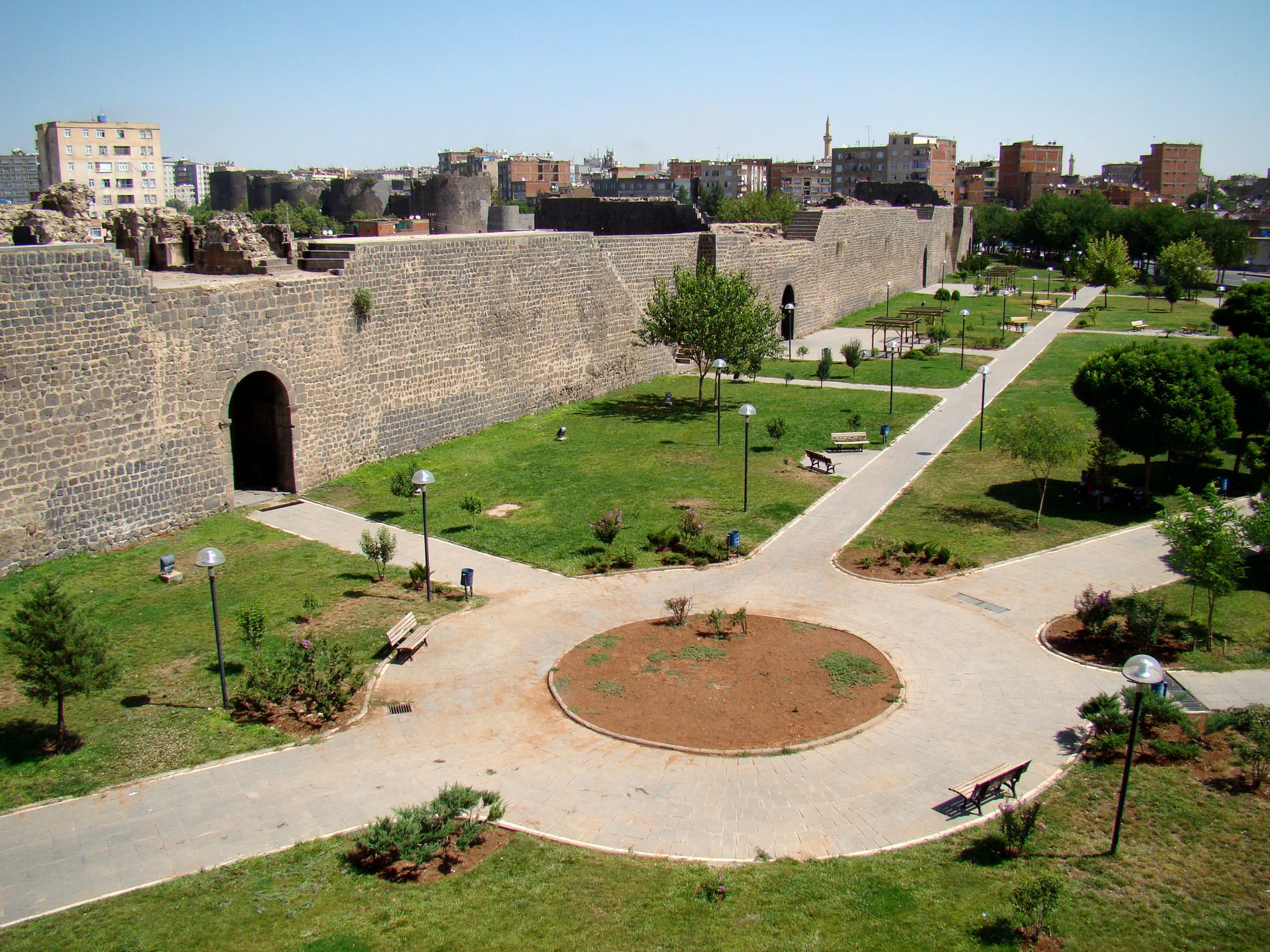
A long high stone city wall with a round tower and an arched gate, with lawns and paths in front of it and city blocks beyond

Southeastern Anatolia, Turkey

Diyarbakır

The western stretch of the old city walls of Diyarbakır, seen from the park inside them. (Bjørn Christian Tørrissen / Wikimedia Commons · CC BY-SA 3.0)

The largest city of south-eastern Turkey, set on a basalt plateau above a bend of the Tigris and enclosed by nearly six kilometres of dark medieval walls. Inside them stand one of the oldest mosques in Anatolia, Armenian and Syriac churches and a dense old quarter; below the walls the terraced Hevsel Gardens have been cultivated for many centuries.

Neighbourhoods

  • Sur, the walled old city
    • First-time visitors
    • Historic district
    • Best for food

    Everything historic is inside the walls: the Great Mosque, the old churches, stone-built courtyard mansions, covered markets and the main avenue that crosses the city between two gates. Much of the district was demolished and rebuilt after the fighting of 2015 and 2016, so old lanes and new construction stand side by side.

    Open in Maps
  • The walls and the Tigris slope
    • Walks and viewpoints
    • Parks

    A path follows the ramparts around much of the old city, and the eastern bastions look down on the river, the terraced Hevsel Gardens and the old stone bridge over the Tigris. Tea gardens sit on the slope where people come for the view in the evening.

    Open in Maps
  • Ofis and the modern centre
    • Close to public transport
    • Restaurants
    • Hotels

    The main modern district north-west of the walls, laid out on wide avenues with most of the city's hotels, banks, bookshops, cafés and restaurants. It is where business is done and where visitors usually sleep.

    Open in Maps
  • Kayapınar and Bağlar
    • Quiet and residential
    • Local life

    The newer residential districts spreading west and south, Kayapınar built in recent decades with parks, blocks of flats and shopping centres, Bağlar older and more crowded. Little is aimed at visitors, but this is where most of the city lives.

    Open in Maps

Things to do

The walls and the river

  • Diyarbakır Fortresslandmark

    The circuit of dark basalt walls and towers around the old city, carrying inscriptions from Roman, Byzantine, Islamic and Ottoman rulers; with the Hevsel Gardens it is a UNESCO World Heritage Site.

    Open in Maps
  • Hevsel Gardenspark

    Terraced market gardens on the slope between the walls and the Tigris, watered from the river and worked for centuries, inscribed by UNESCO together with the fortress.

    Open in Maps

Mosques, churches and hans

  • Great Mosque of Diyarbakırlandmark

    The oldest mosque in Anatolia, founded after the Arab conquest of 639 and rebuilt in 1091–92 by the Seljuk sultan Malik-Shah, with a broad courtyard framed by reused Roman columns and carved stonework.

    Open in Maps
  • Surp Giragos Churchlandmark

    The largest Armenian church in the Middle East, reopened for worship in 2011 after decades of abandonment, damaged in the fighting in Sur and reopened again after restoration in 2022.

    Open in Maps
  • Hasan Pasha Hanlandmark

    A 16th-century caravanserai of banded black and white stone opposite the Great Mosque, its courtyard now filled with tea and breakfast tables.

    Open in Maps

Museums

  • Diyarbakır Archaeological Museummuseum

    The provincial archaeology collection, holding finds from the upper Tigris basin.

    Open in Maps
  • Cahit Sıtkı Tarancı Museummuseum

    The restored basalt courtyard house where the poet Cahit Sıtkı Tarancı was born in 1910, now a museum of his life and of old Diyarbakır domestic architecture.

    Open in Maps

Short trips from the city

  • Zerzevan Castlelandmark

    An Eastern Roman garrison settlement on the old road south towards Mardin, built in the 4th century, with long walls, a tall watchtower and underground structures including a temple of Mithras.

    Open in Maps
  • Eğilattraction

    A small town north of the city above the reservoir of the Dicle Dam, with rock-cut tombs in the cliffs and a tomb venerated as that of the prophet Elisha.

    Open in Maps
  • Çayönülandmark

    An early farming settlement of the Pre-Pottery Neolithic, occupied from about 8600 BC, excavated north-west of the city near Ergani.

    Open in Maps
  • Malabadi Bridgelandmark

    An Artuqid bridge east of the city, begun in 1146–47, whose single great pointed arch carries the road over the Batman river.

    Open in Maps
  • Silvanattraction

    A town east of the city, the medieval Mayyafariqin, a seat of the Marwanid and then the Artuqid rulers of the upper Tigris.

    Open in Maps
  • Hasankeyflandmark

    An ancient town on the Tigris downstream, covered by the reservoir of the Ilısu dam in 2020, whose main monuments were moved to higher ground beside the new settlement.

    Open in Maps

Seasonal events

  • Nevruz21 March

    The spring new year and the largest public celebration of the Kurdish calendar, marked in Diyarbakır with a mass gathering, bonfires, music and dancing.

  • Watermelon seasonAugust and September

    The city is known across Turkey for very large watermelons grown in the Tigris valley, which fill the markets at the end of summer and are the subject of local competitions.

  • Ramadan nightsvaries with the lunar calendar

    The fasting month changes the rhythm of the old city; the markets are quiet by day and the courtyards of the hans fill after the evening meal.

Eat and drink

Long-standing places and food districts in Diyarbakır. Hours, ratings and directions come from your maps app, always current.

Diyarbakır classics

  • Ciğer kebabı grillsrestaurant

    Skewered lamb liver grilled over charcoal and eaten with flatbread, onion, parsley and hot pepper, a speciality of the city eaten at almost any hour.

    Open in Maps
  • Kaburga dolmasırestaurant

    Lamb ribs stuffed with spiced rice and almonds and slowly roasted, a dish for guests and celebrations, served in the larger restaurants of the old city.

    Open in Maps
  • Meftune and regional stewsrestaurant

    Meat stewed with aubergine, garlic and sumac water, one of several sour-edged local dishes served in family restaurants inside the walls.

    Open in Maps

Markets and courtyards

  • The old city marketsmarket

    Covered lanes near the Great Mosque sell watermelons in season, copper, spices, cheese pressed in skins and the local flat breads.

    Open in Maps
  • Han courtyards for breakfastcafe

    The stone caravanserai courtyards opposite the Great Mosque are the city's breakfast institution, with long tables of cheese, honey, eggs and tea.

    Open in Maps

Experience Diyarbakır

History

The basalt plateau above the Tigris has held a walled town for at least three thousand years. It appears in Assyrian records as Amid, and under Rome it became Amida, a frontier fortress rebuilt on a grand scale by Constantius II in the 4th century; the walls that still ring the old city grew from that Roman circuit, extended and repaired by Byzantine, Arab, Marwanid, Artuqid, Ottoman and later rulers, each leaving inscriptions and reliefs on the towers. The Sasanian capture of Amida in 359, after a long siege, was recorded in detail by the soldier and historian Ammianus Marcellinus.

Arab rule from the 7th century gave the city its present name, from the Bakr tribe that settled here, and the Great Mosque was founded soon afterwards and rebuilt in 1091–92 using columns and stone from earlier buildings. The Artuqids made Diyarbakır a capital and added bridges, palaces and madrasas, and the Ottomans took it in 1514, governing a large province from behind the walls. For centuries the population was mixed, with Armenian, Syriac and Chaldean Christian communities alongside Muslims, and the churches of the old city date from that period.

The 20th century transformed it. The Christian communities were destroyed or driven out during the First World War; the city then grew as a provincial centre, and from the 1980s it became the focus of the conflict between the Turkish state and the PKK, drawing hundreds of thousands of villagers displaced from the countryside. Fighting in the Sur district between November 2015 and May 2016 destroyed several neighbourhoods inside the walls, much of which was then demolished and redeveloped. In 2015 the fortress and the Hevsel Gardens were inscribed as a UNESCO World Heritage Site.

Culture & Customs

Diyarbakır is the cultural capital of Turkey's Kurds, and that shapes almost everything about public life. Kurdish is spoken widely alongside Turkish, the city's musicians and writers are known across the Kurdish-speaking world, and Nevruz on 21 March brings one of the largest crowds in the country to a field outside the city for bonfires, speeches and dancing. The dengbêj tradition of unaccompanied narrative singing has a dedicated house in the old city where older singers perform.

The city's identity is also built on its stone. Black basalt gives the walls, mosques, churches and courtyard houses a sombre uniformity, often banded with pale limestone, and the craft of cutting and laying it has been handed down locally. Inside the old houses, life turns inward to a shaded courtyard with a pool and an iwan open to the north, an arrangement designed for a place where summer heat is punishing.

Social manners are formal and hospitable, and family networks matter a great deal; guests are fed generously and repeatedly. The city carries a heavy political memory, and residents are used to visitors asking about it, but the subject is best left for hosts to raise. Alongside that, there is considerable civic pride in the walls, in the restored churches and hans, and in the food, which Diyarbakır considers a match for its better-known neighbours.

Daily Life

About 1.1 million people live in the built-up city and roughly 1.8 million in the province. It is young, with a birth rate well above the Turkish average, and it grew very quickly from the 1990s as families left the countryside during the conflict, producing crowded districts such as Bağlar and, more recently, the planned expansion of Kayapınar. Unemployment is high and incomes are among the lowest in the country.

The regional economy rests on agriculture in the Tigris basin — wheat, cotton, lentils, melons and livestock — on trade and transport, on public employment and on services for the surrounding provinces, including a large university and hospitals that draw patients from across the south-east. Small workshops in and around the old city still produce jewellery, copper and textiles.

Daily life bends around the summer. Work begins early, the middle of the day empties the streets from June to September, and the city reappears in the evening in the tea gardens along the walls and beside the river. Winter is short and grey. The rebuilding of the Sur district, housing costs, water supply and employment for the young are the recurring subjects of local conversation.

Food

Diyarbakır's cooking is the food of the upper Tigris: lamb, bulgur, aubergine, garlic and sour flavourings. The city's own dish is ciğer kebabı, cubes of lamb liver wrapped in tail fat and grilled over charcoal, eaten with raw onion, parsley, hot pepper and thin bread — a breakfast in the markets and a late-night meal in the old city. Kaburga dolması, lamb ribs stuffed with spiced rice and almonds, is the celebration dish, and meftune, meat stewed with aubergine and garlic in sumac water, carries the sour note that runs through the local table.

Bulgur does the work that rice does elsewhere: in içli köfte, in pilavs and in soups thickened with pulses. Flatbreads are baked in tandır ovens, and cheeses pressed and matured in skins come from the surrounding pastures. Summer brings the melons the city is famous for, grown in the alluvial ground by the river and sold from carts and pavement stacks at the end of the season.

Breakfast is the meal visitors remember. Long tables are laid in the courtyards of the old caravanserais with cheeses, honey and clotted cream, olives, eggs cooked in butter, tomato and pepper stews, several breads and endless tea. The tea itself is drunk very strong and dark in small glasses; mırra, the bitter boiled coffee of the south-east, is served after heavy meals and at gatherings.

Planning tools

Budget

Diyarbakır is one of the cheaper Turkish cities. Hotels in the modern centre are mostly simple and mid-range business places, meals in the old city cost very little, and the walls, gardens and mosques are free or charge modest entry. Hiring a car or driver for the Roman and Neolithic sites in the province is the main extra expense.

Daily Budget Midrange
USD 70–150 (comfortable hotel, restaurants, a car and driver for day trips)
Daily Budget Shoestring
USD 25–45 (simple hotel, kebab and lokanta meals, city buses and dolmuş)

Stay in Ofis for hotels and eat inside the walls, and carry cash for the markets and village stops.

Best Time to Visit

April to early June and late September to November are the best months, when the Tigris valley is green or harvested and walking the walls is pleasant. Nevruz in March draws very large crowds. July and August are extremely hot, often above 40°C, and winter is cool, wet and sometimes snowy.

Suggested Number of Days

One full day covers the walled city at a steady pace, and a second allows a slower look and time by the river. Three days suit visitors who add the Roman and prehistoric sites of the province. Summer heat slows everything.

First Visit
1–2 days
With Surroundings
3 days

Transportation

The walled city is walked; city buses, minibuses and taxis link it with Ofis, Kayapınar and the outer districts. Intercity buses reach Mardin in about ninety minutes, Şanlıurfa in around three hours and Batman in about two, and trains leave from the city's railway station.

Use taxis after dark rather than walking between districts, and carry a passport for checkpoints on roads in the province.

Airport & Station Connections

Diyarbakır Airport, a military airbase that also handles civil flights, lies just outside the city, with frequent flights to Istanbul, Ankara and Izmir, making it the usual way in. Buses connect the city with the whole of the south-east and with western Turkey overnight. Air travel across the wider region has been disrupted since the war that began in February 2026, and flight schedules can change at short notice.

Walkability

The old city is compact and flat, and the main avenue between the gates can be walked in half an hour, with the Great Mosque, the hans and the churches just off it. The rampart walk is uneven, exposed and without railings in places, so it needs care and sensible shoes. The modern districts are spread out and better covered by bus or taxi, and summer heat makes midday walking unwise.

Safety

Diyarbakır is the main city of a region that saw decades of fighting between the army and the PKK, including urban fighting in the Sur district in 2015 and 2016; the PKK declared a ceasefire in March 2025 and announced its dissolution in May 2025. The city is calm and receives domestic visitors, but a heavy police presence, checkpoints and occasional demonstrations are part of daily life, and governments advise caution across the south-east and against travel near the Syrian and Iraqi borders. Petty theft occurs in crowded markets, and summer heat is a serious health risk.

Avoid demonstrations and political gatherings, do not photograph police or military positions, carry identification for checkpoints, and stay out of the midday sun in summer. Check current official travel advice before travelling.

Climate

A hot-summer Mediterranean climate with extreme seasonal contrast: long, very hot and dry summers on the basalt plateau, and cool, wet winters with most of the year's rain between November and April.

Summer
very hot and dry — July and August days commonly reach 38–42°C, with warm nights
Winter
cool and wet — January days around 4–8°C, with frost at night and occasional snow

Local Customs

Diyarbakır is a largely Kurdish city, and Kurdish is heard alongside Turkish in the streets and markets; a few words of greeting are appreciated. It is socially conservative, so modest dress is expected, with a head covering for women entering mosques, and alcohol is served in relatively few places. Politics is a sensitive subject best left to hosts to raise.

Ask before photographing people, especially women and children, remove shoes before entering a mosque, and treat the churches as working places of worship.

Common Payment Methods

The currency is the Turkish lira. Cards and contactless payment are accepted in hotels, restaurants and shops in the modern centre and in the larger places inside the walls, and ATMs are common. Market stalls, small grills, minibuses and village shops work in cash, so lira in small notes is worth carrying.