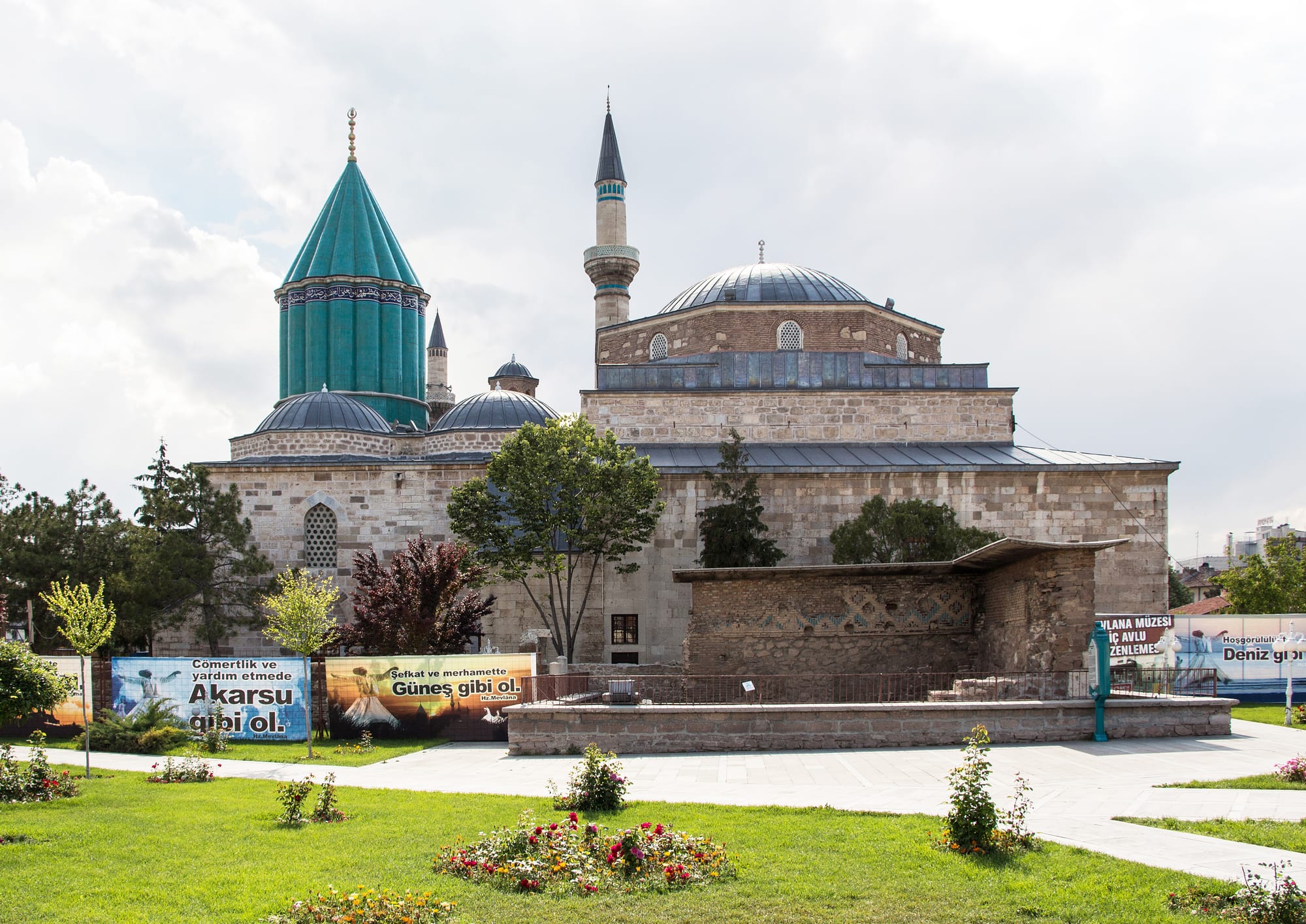
A stone mosque and mausoleum complex with grey domes, a slender minaret and a fluted turquoise-tiled conical tower, behind a lawn with flower beds

Turkey

Ankara, Cappadocia & Central Anatolia

The Mevlana Museum in Konya, the mausoleum of Rumi, with its turquoise-tiled dome. (Bernard Gagnon / Wikimedia Commons · CC BY-SA 3.0)

The high plateau at the centre of Turkey, a land of wheat fields, steppe and volcanic mountains stretching from Eskişehir and Ankara east to Sivas and south to Konya and Karaman — home to the capital, the eroded valleys and rock churches of Cappadocia, the Seljuk city of Konya and some of the oldest settlements on earth.

Explore Ankara, Cappadocia & Central Anatolia

History

The plateau holds some of humanity's earliest towns. Çatalhöyük, on the Konya plain, was a crowded Neolithic settlement of mud-brick houses entered through their roofs, occupied from around 7500 BC. In the Bronze Age, Assyrian merchants traded at Kültepe near Kayseri, leaving thousands of clay tablets, and the Hittites ruled an empire from Hattusa, just beyond the region's northern edge in Çorum. The Phrygians followed, with their capital at Gordion west of Ankara, the city of King Midas.

Celtic Galatians settled around Ancyra, today's Ankara, in the 3rd century BC, and Augustus's temple there carries the best-surviving copy of his account of his own reign. In Byzantine times Cappadocia became a centre of monastic Christianity; Basil of Caesarea, now Kayseri, was among the Church Fathers, and communities cut churches and entire underground cities into the soft tuff.

After the Seljuk victory at Manzikert in 1071, Konya became the capital of the Seljuk Sultanate of Rum, which filled the plateau with mosques, madrasas and caravanserais; the poet Jalal al-Din Rumi, known in Turkey as Mevlana, died there in 1273. Timur defeated the Ottomans outside Ankara in 1402. The plateau was the heartland of the national struggle after 1918: the Sivas Congress met in 1919, and Ankara, then a small town, was declared the capital of the new republic in 1923. In 1993 an arson attack on a hotel in Sivas during an Alevi cultural festival killed 35 people, an event still commemorated every year.

Culture & Customs

Central Anatolia is often described as the conservative heart of Turkey, and Konya especially is known as a devout city. It is also the home of the Mevlevi order founded by Rumi's followers, whose Sema ceremony — the turning dance of the whirling dervishes, in white robes and tall felt hats — is listed as UNESCO intangible heritage and is performed in Konya each December on the anniversary of his death.

The plateau also has deep Alevi roots. The town of Hacıbektaş in Nevşehir province is the shrine of Hacı Bektaş Veli, a central figure for Alevis and Bektashis, and an annual festival there draws pilgrims. Kırşehir is the home of the bozlak, a long, high lament sung to the bağlama, made famous by Neşet Ertaş, and of the Ahi brotherhoods, medieval craft guilds.

Local reputations are strong: Kayseri people are proverbially shrewd traders, Eskişehir is a relaxed university city, and Ankara is seen as orderly, bureaucratic and quieter than Istanbul. Crafts include the pottery of Avanos, made from the red clay of the Kızılırmak, Konya and Kayseri carpets, and Sivas's large Kangal sheepdogs, bred to guard flocks against wolves.

Daily Life

Ankara is Turkey's second city, with around five and a half million people in its province and a centre built largely in the 20th century around ministries, embassies and universities. Konya, with over two million in its province, and Kayseri, with about one and a half million, are big industrial cities; Eskişehir, Sivas, Aksaray and Nevşehir follow.

The capital runs on government, universities, defence industries and services. Kayseri and Konya are both industrial cities among the "Anatolian tigers" that grew rapidly from the 1980s. Eskişehir builds aircraft engines and railway equipment, and Kırıkkale has the state arms factory. The Konya plain is the country's breadbasket for wheat and sugar beet, and Niğde grows potatoes and apples.

Water is the plateau's pressing issue. Heavy irrigation has lowered groundwater on the Konya plain, sinkholes have opened in the fields, and lakes such as Tuz Gölü, the great salt lake, have shrunk in dry years. In Cappadocia, tourism now shapes village life, with cave houses turned into hotels.

Food

The central plateau is the land of wheat, lamb and dough. Kayseri is famous for mantı, tiny meat dumplings topped with garlic yoghurt and red-pepper butter, and for pastırma, air-dried beef cured in a paste of fenugreek, garlic and paprika, together with its spiced sucuk sausage. Konya's specialities are etli ekmek, a long, thin flatbread topped with minced meat, and fırın kebabı, lamb slow-roasted in a wood oven, along with an okra soup.

In Cappadocia, testi kebabı is meat and vegetables sealed in a clay pot and cooked slowly, then cracked open at the table. Eskişehir, with its Crimean Tatar community, gave Turkey çiğ börek, a fried half-moon pastry filled with minced meat, and Sivas has its own grilled köfte. Bulgur, chickpeas, dried apricots and pekmez, a thick grape molasses, fill the pantry.

The plateau makes wine too. Cappadocia's volcanic soil grows the white Emir grape and has been planted with vines since antiquity, while the red Kalecik Karası grape takes its name from a town in Ankara province.

Attractions & Natural Wonders

Ankara has Anıtkabir, Atatürk's mausoleum; the Museum of Anatolian Civilisations below the citadel, with Hittite and Phrygian treasures; and the Temple of Augustus. Gordion, with its great burial mound, lies west of the city and is a UNESCO World Heritage Site. Hattusa, the Hittite capital, with its Lion Gate, its rock sanctuary of Yazılıkaya, is a two-to-three-hour drive east of Ankara, just across the line in Çorum province.

Cappadocia centres on Nevşehir province. Its fairy chimneys, cave hotels and rock churches — the frescoed Göreme Open-Air Museum, the pinnacles of Paşabağ and Zelve, the Rose and Red valleys, the rock castles of Uçhisar and Ortahisar, and the towns of Ürgüp and Avanos — lie in and around a UNESCO World Heritage Site, and dawn balloon flights fill the sky over Göreme. The underground cities of Derinkuyu and Kaymaklı lie to the south, and the Ihlara Valley in Aksaray.

Konya has the Mevlana Museum, the Alaeddin Mosque, the Karatay Madrasa's tile museum and, south-east of the city, Çatalhöyük. Kayseri has Seljuk tombs, the ski slopes of Mount Erciyes and Kültepe, with the Sultanhanı caravanserai on the road west in Aksaray. Further afield are Sivas's Seljuk madrasas and the Divriği mosque and hospital, Eskişehir's Odunpazarı quarter, and the Aladağlar peaks in Niğde.

Cities in Ankara, Cappadocia & Central Anatolia

Planning basics

Budget

Central Anatolia is cheap, with one large exception: Cappadocia. Cave hotels in Göreme, Uçhisar and Ürgüp charge resort prices, and a hot-air balloon flight is one of the single biggest expenses of a trip to Turkey. Ankara is mid-priced for a capital, and Konya, Kayseri, Sivas and Eskişehir are inexpensive, with good lokantas and business hotels.

Daily Budget Midrange
USD 100–250 (boutique cave hotel, restaurants, a guided tour, plus a balloon flight)
Daily Budget Shoestring
USD 30–50 (pension or simple cave hotel, lokanta meals, intercity buses)

Book the balloon flight for the first morning of a stay so that a weather cancellation can be moved to the next day, and use Ankara or Kayseri as cheaper bases for the cities.

Safety

The region is safe for visitors. The main risks are winter driving on icy plateau roads, uneven ground and unlit drops in the Cappadocian valleys, and, rarely, balloon accidents; licensed operators are the norm. Ankara sees political demonstrations and has suffered bomb attacks in past years, so crowds around government buildings are best avoided.

Choose a licensed balloon operator, walk the valleys with a map and water, and avoid demonstrations in Ankara. Check current official travel advice before travelling.

Climate

The plateau sits at around 900–1,300 metres and is continental and dry: hot, sunny summers with cool nights, and cold winters with snow and frost. Konya's plain is one of the driest parts of Turkey, while Sivas and the eastern edge are colder in winter. Erciyes, the volcano above Kayseri, holds snow for skiing through the winter.

Summer
hot and dry by day, 28–33°C, with cool nights in the 10s
Winter
cold, often below freezing at night, with snow across the plateau, especially around Sivas and Kayseri

Transportation

Ankara is the hub of the high-speed rail network, with fast trains to Istanbul, Eskişehir, Konya, Karaman and Sivas. Cappadocia is served by the airports at Kayseri and at Nevşehir, and by overnight buses from Istanbul. Within Cappadocia, local buses, tours and hire cars link the villages. Intercity buses cover every town on the plateau.

Ankara to Konya takes about two hours by high-speed train; a hire car or a day tour is the practical way to reach Ihlara, the underground cities and Soğanlı.

Best Time to Visit

April to June and September to October are best, with mild days for walking Cappadocia's valleys and calm mornings for balloon flights. Summer is hot but dry and pleasant in the evenings. Winter brings snow to the fairy chimneys, which is striking, and the Şeb-i Arus commemoration of Rumi's death is held in Konya each December, when the whirling ceremonies draw large crowds.