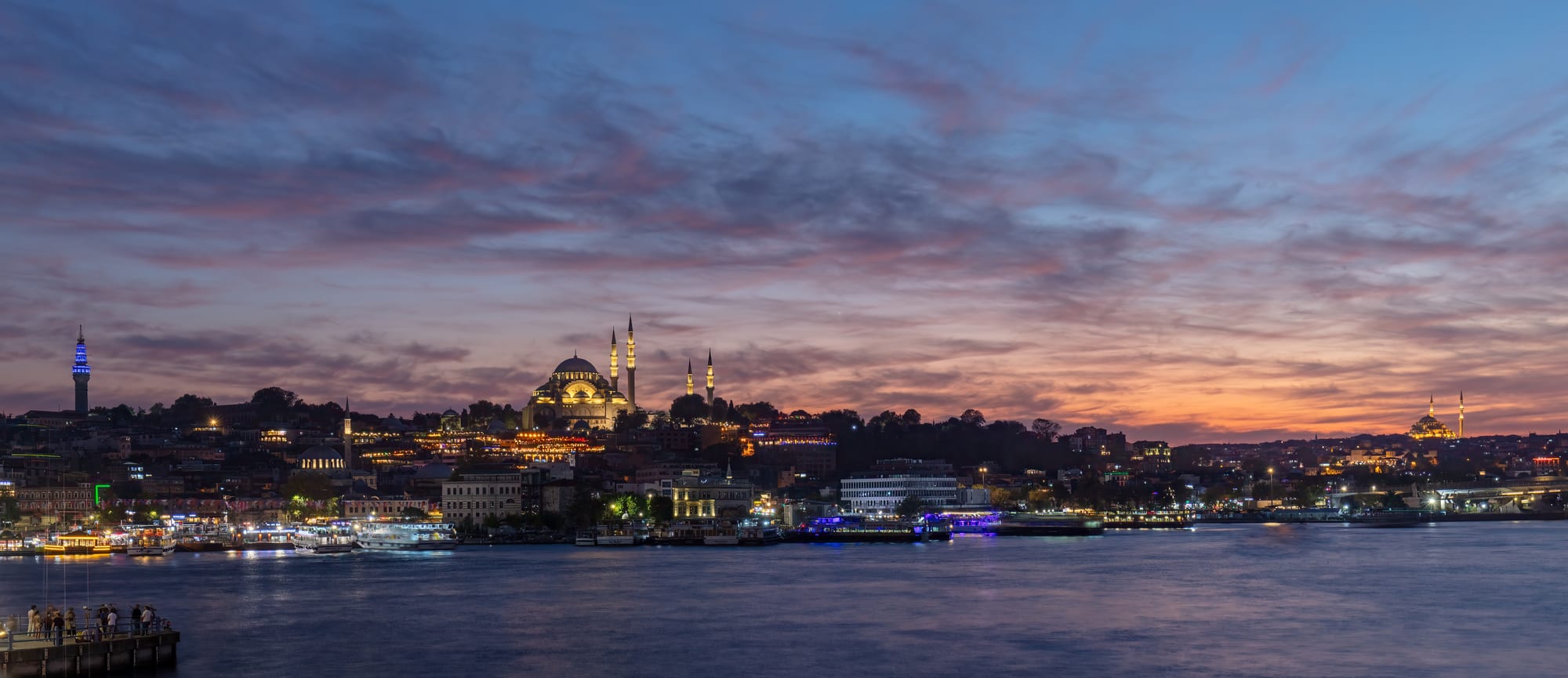
The Süleymaniye Mosque lit up on a hill above the Golden Horn at dusk, with ferries at the quays and a pink and orange sky

Istanbul & the Marmara Region, Turkey

Istanbul

The Golden Horn at dusk, with the Süleymaniye Mosque above the Istanbul waterfront. (Diego Delso / Wikimedia Commons · CC BY-SA 4.0)

Turkey's largest city, spread over both sides of the Bosphorus where Europe meets Asia. Capital in turn of the Roman, Byzantine and Ottoman empires, it keeps Hagia Sophia, the Blue Mosque, Topkapı Palace and the Grand Bazaar on its old peninsula, while ferries, tower blocks and a metro network serve a metropolis of some fifteen million people.

Neighbourhoods

  • Sultanahmet and the historic peninsula
    • First-time visitors
    • Historic district
    • Museums

    The walled old city between the Golden Horn and the Sea of Marmara, in the district of Fatih. Hagia Sophia, the Blue Mosque, Topkapı Palace, the Basilica Cistern and the Grand Bazaar stand within a short walk of one another, along with most of the small hotels aimed at visitors. It empties of residents in the evening.

    Open in Maps
  • Beyoğlu
    • Nightlife
    • Shopping
    • Arts and culture

    The 19th-century European quarter on the hill north of the Golden Horn, built around İstiklal Avenue and its nostalgic tram. Galleries, cinemas, bookshops, meyhane taverns and bars fill the side streets, and Taksim Square at the top is the city's main transport and protest ground.

    Open in Maps
  • Galata and Karaköy
    • Cafés
    • Close to public transport
    • Waterfront

    The steep slope below Beyoğlu, crowned by the medieval Galata Tower and ending at the ferry piers and fish restaurants of the Galata Bridge. Old hardware workshops and Genoese and Ottoman banking halls now sit among coffee houses, design shops and small hotels.

    Open in Maps
  • Beşiktaş and the Bosphorus shore
    • Local life
    • Nightlife
    • Waterfront

    A busy market and student quarter on the European shore, with Dolmabahçe Palace and the Beşiktaş football club at its edges. Ferries leave for the Asian side, and the road north runs through Ortaköy, Bebek and the waterside villages that line the strait.

    Open in Maps
  • Kadıköy
    • Best for food
    • Nightlife
    • Local life

    The main centre of the Asian side, reached by ferry in about twenty minutes. Its market streets are among the best places in the city to eat, the bars of Kadife Street draw a young crowd, and the coast road leads to the seafront parks of Moda.

    Open in Maps
  • Üsküdar
    • Quiet and residential
    • Historic district
    • Views

    A conservative, mosque-rich district facing the old city across the water, with Sinan mosques on its square and the Maiden's Tower offshore. The waterfront promenade gives the classic evening view back towards the historic peninsula.

    Open in Maps
  • Balat and Fener
    • Historic district
    • Photography
    • Cafés

    Two old neighbourhoods along the Golden Horn, historically Jewish and Greek, with steep lanes of painted timber houses, the Ecumenical Patriarchate, synagogues and an iron-built Bulgarian church. Antique shops and cafés have moved in over the past two decades.

    Open in Maps

Things to do

Byzantine and Ottoman landmarks

  • Hagia Sophialandmark

    The great domed church built by Justinian in 537, later an imperial mosque, then a museum, and a mosque again since 2020.

    Open in Maps
  • Blue Mosquelandmark

    The early 17th-century mosque of Sultan Ahmed I, named in English for the İznik tiles inside and known for its six minarets.

    Open in Maps
  • Topkapı Palacemuseum

    The Ottoman sultans' palace from the 1460s until the 19th century, a series of courtyards holding the harem, the treasury and the sacred relics.

    Open in Maps
  • Süleymaniye Mosquelandmark

    Mimar Sinan's mosque complex of the 1550s on the third hill, with the tombs of Süleyman the Magnificent and his wife Hürrem in its garden.

    Open in Maps
  • Basilica Cisternlandmark

    A 6th-century underground reservoir beneath Sultanahmet, its vaults carried on 336 columns, two of them resting on carved Medusa heads.

    Open in Maps
  • Chora Churchlandmark

    A small Byzantine church near the land walls, a mosque again since 2020, covered inside with 14th-century mosaics and frescoes of the life of Christ and the Virgin.

    Open in Maps
  • Walls of Constantinoplelandmark

    The Theodosian land walls of the 5th century, running several kilometres from the Sea of Marmara to the Golden Horn.

    Open in Maps
  • Galata Towerviewpoint

    A stone tower raised by the Genoese in 1348 above their walled colony, with a gallery looking over the Golden Horn and the old city.

    Open in Maps

Palaces and the Bosphorus

  • Dolmabahçe Palacemuseum

    The sultans' European-style palace of 1856 on the Bosphorus shore, with a crystal staircase and the room where Atatürk died in 1938.

    Open in Maps
  • Maiden's Towerlandmark

    A small tower on an islet off Üsküdar, rebuilt many times since antiquity and long used as a lighthouse.

    Open in Maps
  • Rumelihisarılandmark

    The fortress Mehmed II built in 1452 at the narrowest point of the Bosphorus to cut Constantinople off from the Black Sea.

    Open in Maps
  • Beylerbeyi Palacemuseum

    A summer palace of the 1860s on the Asian shore of the Bosphorus, built for Sultan Abdülaziz and used to lodge visiting heads of state.

    Open in Maps

Museums and galleries

  • Istanbul Archaeology Museumsmuseum

    Three buildings below Topkapı holding the Alexander Sarcophagus, ancient Near Eastern collections and a museum of Islamic tilework.

    Open in Maps
  • Istanbul Modernmuseum

    The city's museum of modern and contemporary Turkish art, in a Renzo Piano building on the Karaköy waterfront.

    Open in Maps
  • Pera Museummuseum

    A private museum in Beyoğlu known for its Orientalist paintings, among them Osman Hamdi Bey's The Tortoise Trainer.

    Open in Maps
  • Museum of Innocencemuseum

    Orhan Pamuk's museum in a Çukurcuma house, displaying the everyday objects of the novel of the same name.

    Open in Maps
  • Rahmi M. Koç Museummuseum

    A museum of transport, industry and communications at Hasköy on the northern shore of the Golden Horn, with boats, aircraft, trams and locomotives.

    Open in Maps
  • Sakıp Sabancı Museummuseum

    A collection of Ottoman calligraphy and Turkish painting in a former waterside mansion at Emirgan, with large visiting exhibitions.

    Open in Maps

Bazaars and markets

  • Grand Bazaarmarket

    One of the world's oldest and largest covered markets, a roofed grid of streets begun in the 1450s with thousands of shops for carpets, gold and antiques.

    Open in Maps
  • Spice Bazaarmarket

    The L-shaped Egyptian market of the 1660s beside the New Mosque at Eminönü, selling spices, dried fruit, lokum and cheese.

    Open in Maps

Parks, walks and viewpoints

  • Gülhane Parkpark

    The former outer garden of Topkapı Palace, open to the public since 1912 and known for its tulips in April.

    Open in Maps
  • Emirgan Parkpark

    A hillside park on the upper Bosphorus with three Ottoman pavilions and an annual tulip festival each April.

    Open in Maps
  • Eyüp Sultan Mosquelandmark

    One of the holiest Islamic sites in Turkey, built over the tomb of a companion of the Prophet at the head of the Golden Horn.

    Open in Maps

Short trips from the city

  • Princes' Islandsattraction

    Nine islands in the Sea of Marmara, reached by ferry, where motor traffic is restricted and pine woods surround Ottoman-era timber villas.

    Open in Maps
  • Anadolu Kavağıattraction

    A fishing village at the Black Sea end of the Bosphorus, the turning point of the long public ferry cruise, below the ruined Byzantine castle of Yoros, long known as the Genoese Castle.

    Open in Maps

Seasonal events

  • Istanbul Film FestivalApril

    Turkey's leading film festival, held in Beyoğlu cinemas since 1982.

  • Tulip seasonApril

    Millions of tulips are planted in the city's parks each spring, a flower long associated with Ottoman Istanbul.

  • Istanbul Music FestivalJune

    Classical concerts in churches, palaces and concert halls, run by the city's arts foundation since 1973.

  • Istanbul Jazz FestivalJuly

    Jazz, along with pop, blues and world music, in venues across the city each July.

  • Istanbul Biennialautumn, in odd-numbered years

    A large contemporary art exhibition spread through warehouses, historic buildings and museums.

  • Ramadan eveningsthe lunar month of Ramadan

    Iftar crowds gather in Sultanahmet after sunset, with lights strung between minarets and stalls selling pide bread.

Eat and drink

Long-standing places and food districts in Istanbul. Hours, ratings and directions come from your maps app, always current.

Istanbul classics

  • Balık ekmek at Eminönüneighborhood

    Grilled fish in half a loaf with onion and lettuce, sold from boats and stalls at the Eminönü end of the Galata Bridge.

    Open in Maps
  • Çiya Sofrasırestaurant

    A Kadıköy restaurant known for reviving regional dishes from south-eastern Anatolia, from wild herb salads to sour kebabs.

    Open in Maps

Food districts and markets

  • Kadıköy market streetsneighborhood

    The lanes behind the Kadıköy ferry pier, packed with fishmongers, pickle shops, delicatessens, bakeries and meyhane taverns.

    Open in Maps
  • Spice Bazaar and the Eminönü side streetsmarket

    Spices, dried fruit, nuts, cheese and sweets inside the 17th-century hall, with coffee roasters and fish stalls in the streets around it.

    Open in Maps
  • Nevizade and the Beyoğlu meyhanesneighborhood

    A tight grid of alleys off İstiklal Avenue where tables of meze and rakı fill the pavements in the evening.

    Open in Maps
  • Karaköyneighborhood

    Fish restaurants under the Galata Bridge, long-established baklava shops and a dense cluster of coffee houses in the old workshop streets.

    Open in Maps

Experience Istanbul

History

A Greek colony called Byzantion was founded on the point where the Golden Horn meets the Sea of Marmara in the 7th century BC, on a site whose defences and control of the strait mattered more than its size. In 330 AD Constantine the Great refounded it as his new capital, and as Constantinople it became the richest city in Europe: the seat of the Eastern Roman emperors, the centre of Orthodox Christianity, and the place where Justinian raised Hagia Sophia in 537. Walls built under Theodosius II kept out siege after siege for a thousand years.

On 29 May 1453, after a siege of several weeks, the army of the Ottoman sultan Mehmed II broke through the walls. Constantinople became the Ottoman capital and was repopulated with Turks, Greeks, Armenians and Jews, many of the last invited after their expulsion from Spain. Sultans and their architects, above all Mimar Sinan in the 16th century, filled the hills with mosque complexes, and Topkapı governed an empire across three continents. By the 19th century the sultans had moved to European-style palaces on the Bosphorus, and Pera, today's Beyoğlu, filled with embassies, banks and the terminus of the Orient Express.

Allied troops occupied the city after the First World War, and when the republic was declared in 1923 the capital moved to Ankara; the name Istanbul became official in 1930. Its Greek, Armenian and Jewish communities shrank through the 20th century, sharply after the riots of September 1955. From the 1950s migrants from Anatolia arrived in enormous numbers and the population grew from about a million to more than fifteen, spreading the city far along both shores.

Culture & Customs

Istanbul produces most of Turkey's books, films, newspapers and television, and its dialect is the basis of standard Turkish. The city's manners — fast, ironic, formally polite — are admired and resented in equal measure elsewhere in the country. Hospitality is unfailing: tea arrives before business is discussed, and refusing it is harder than accepting.

Religion is present but unevenly. Call to prayer sounds over every district, Friday fills the great mosques, and Ramadan changes the rhythm of the whole city, yet Beyoğlu and Kadıköy keep a secular, alcohol-drinking nightlife a few kilometres away from conservative Fatih and Üsküdar. The Ecumenical Patriarchate of the Orthodox Church still sits at Fener on the Golden Horn, and Armenian churches, synagogues and Catholic churches survive among the mosques, remnants of a far more mixed population.

Music runs from Ottoman classical and Sufi ceremonies to Turkish pop, arabesk, rock and a large electronic scene; the summer festivals bring international acts to open-air stages. Football divides the city three ways between Galatasaray, Fenerbahçe and Beşiktaş, and derby days empty the streets. The hamam, the public bathhouse, remains a working institution as well as a tourist experience, and backgammon, card games and long conversations over tea in a kıraathane are the standard way of passing an afternoon.

Daily Life

About fifteen million people live in the province, making it the largest city in Europe by population. Most live far from the historic centre, in dense apartment districts that run for tens of kilometres along both shores and inland, and daily life is defined by the commute: metrobus, Marmaray, metro and ferry, or an hour in traffic on one of the Bosphorus bridges. Rents have risen faster than wages, and many households share flats or live with family for longer than they once did.

The city generates a large share of the national economy — finance, trade, media, textiles, shipping and tourism — and its port and airport handle much of Turkey's traffic with the world. Work runs late, shops stay open into the evening, and breakfast, a long spread of cheeses, olives, eggs and bread, is the meal families take seriously at weekends.

Two issues sit constantly in the background. One is the expected earthquake on the fault beneath the Sea of Marmara, which drives a continuing programme of demolition and rebuilding of older blocks. The other is the pressure of growth: water supply, traffic, building on the northern forests and the arrival of large numbers of migrants and refugees are all argued over in local politics. Weekends mean family breakfasts, the ferry, the seaside promenades and picnics in whatever green space is nearest.

Food

Istanbul's kitchen gathered the whole empire and then the whole country. The day begins with simit, the sesame-crusted bread ring sold from red carts, or with a full kahvaltı breakfast of white cheese, olives, tomato, honey and clotted kaymak. Street food is a serious business: balık ekmek, grilled fish in bread at the Eminönü quay; midye dolma, mussels stuffed with spiced rice and squeezed with lemon; kokoreç, seasoned offal grilled on a spit and chopped into bread; and kumpir, a baked potato mashed with butter and cheese, associated with Ortaköy.

Sit-down eating runs from the lokanta, where ready-cooked stews and vegetables in olive oil are chosen from a counter, to the meyhane, where small plates of meze — stuffed vine leaves, smoked aubergine, fried liver, hummus — are eaten slowly with rakı, the aniseed spirit that clouds when water is added. Kebab houses serve Adana and Urfa from the south-east; palace cooking survives in dishes such as hünkar beğendi, lamb stew over a smoky aubergine purée. Fish is seasonal, with bluefish and bonito from the autumn Bosphorus runs.

Sweets and drinks are their own world: baklava in pistachio and walnut, künefe of shredded pastry and stretchy cheese, milk puddings such as sütlaç and the caramelised kazandibi, and lokum from confectioners trading since Ottoman times. Turkish coffee is served in small cups with a glass of water, tea arrives in tulip-shaped glasses all day, and in winter street sellers carry boza, a thick fermented millet drink dusted with cinnamon.

Planning tools

Budget

Istanbul is the most expensive city in Turkey. Hotel rates in Sultanahmet, Galata and Beyoğlu, restaurant bills along the Bosphorus and museum tickets, which are priced separately for foreign visitors and have risen sharply, are the main costs. Public transport, street food and lokanta meals remain cheap, and inflation means prices quoted more than a few months ago are usually out of date.

Daily Budget Midrange
USD 110–220 (boutique hotel, restaurant dinners, museum tickets, a Bosphorus cruise)
Daily Budget Shoestring
USD 40–70 (hostel bed or simple hotel, street food and lokanta meals, Istanbulkart transport)

Buy an Istanbulkart at any station for the metro, trams, buses and ferries, and set money aside for the major museums, which are ticketed individually.

Best Time to Visit

April to early June and September to October, when the weather is mild and the light is clear. April brings the tulip plantings in the parks. July and August are hot, humid and crowded, though the ferries and the shaded Bosphorus villages help. Winter is grey and wet, with occasional snow, but hotels are cheaper and the museums and bathhouses are quiet.

Suggested Number of Days

Three to four days is the usual length for a first visit. A week suits anyone wanting the Asian shore, the upper strait and the islands as well. Traffic and the sheer size of the city slow everything down, so allow more time than the distances suggest.

First Visit
3–4 days
With Surroundings
5–7 days

Transportation

Trams, metro lines, funiculars, the Marmaray rail tunnel under the Bosphorus and a large ferry network cover most of what visitors need, all paid for with a single Istanbulkart. Ferries are the quickest and pleasantest way between the European and Asian sides. Taxis and app-booked cars are plentiful but slow in traffic, and the metrobus runs in its own lane across the city.

Insist on the meter or use a booking app for taxis, and cross to the Asian side by ferry rather than by road at rush hour.

Airport & Station Connections

Istanbul Airport, in the Arnavutköy district north-west of the centre on the European side, is the main hub and is linked by metro and airport buses; Sabiha Gökçen serves the Asian side. High-speed trains run to Ankara and Konya from Söğütlüçeşme and Halkalı, and intercity buses reach every part of Turkey from the Esenler and Dudullu terminals. Flights onward to the Middle East have been disrupted since the war that began in February 2026, so schedules can change at short notice.

Walkability

Individual neighbourhoods are very walkable and best seen on foot — Sultanahmet, Balat, Galata and Kadıköy all reward wandering — but the city as a whole is vast and hilly, cut by water and motorways. Pavements are often narrow, uneven or parked on, and the climbs from the waterfronts are steep; funiculars and short tram rides save a good deal of effort.

Safety

Istanbul is generally safe, and violent crime rarely touches visitors. The practical risks are pickpocketing on crowded trams and in the bazaars, taxi overcharging, and the well-known scam in which a friendly stranger leads a visitor to a bar with an enormous bill. Political demonstrations are policed forcefully. The North Anatolian Fault runs beneath the Sea of Marmara, and a major earthquake is expected in the Istanbul area at some point.

Use metered or app-booked taxis, decline invitations from strangers to bars or clubs, stay away from demonstrations, and note the hotel's earthquake assembly point. Check current official travel advice before travelling.

Climate

A temperate climate between the Mediterranean and the Black Sea, with warm humid summers, cool wet winters and changeable weather in between. The northern wind called the poyraz can drop the temperature quickly, and heavy rain sometimes floods the lower streets.

Summer
warm and humid, typically 26–31°C by day, with little rain and hot spells in July and August
Winter
cool and damp, typically 3–10°C, with several days of snow in most years

Local Customs

Mosques welcome visitors outside prayer times: shoes come off at the door, shoulders and knees are covered, and women cover their hair, with scarves usually available at the entrance. Photography inside is generally allowed but not of people at prayer. Tea is offered constantly in shops and is not an obligation to buy. Tipping is around 10 per cent in restaurants, and small change is left for taxi drivers and bath attendants.

Dress more modestly in Fatih, Üsküdar and Eyüp than in Beyoğlu or Kadıköy, remove shoes when entering a home, and expect alcohol to be served in some districts and absent in others.

Common Payment Methods

The currency is the Turkish lira. Cards and contactless payment are taken almost everywhere, including in taxis and at ticket machines, and ATMs are plentiful. Cash is still useful in markets, small lokantas and for street food, and exchange offices in Eminönü and Beyoğlu usually give better rates than the airport.