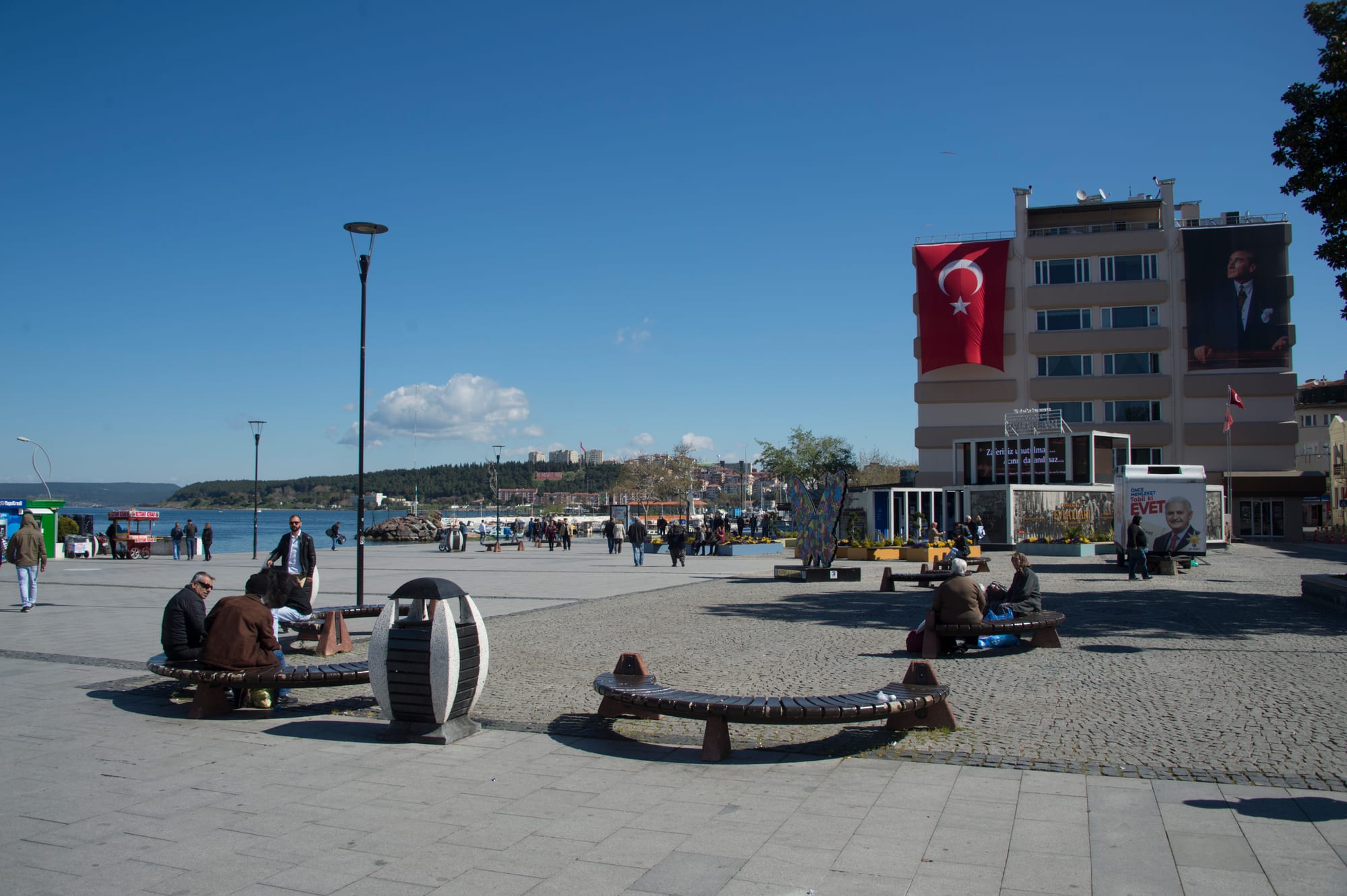
A paved waterfront square in Çanakkale with benches and trees, the blue Dardanelles strait and the green far shore behind it

Istanbul & the Marmara Region, Turkey

Çanakkale

The seafront promenade in Çanakkale, looking across the Dardanelles. (Dosseman / Wikimedia Commons · CC BY-SA 4.0)

A port city on the Asian shore of the Dardanelles, at the narrowest point of the strait that links the Aegean to the Sea of Marmara. Fortresses built to close the channel, the 1915 battlefields of the Gallipoli peninsula opposite and the ruins of Troy to the south make it Turkey's main base for military and archaeological visitors, around a university town with a long seafront promenade.

Neighbourhoods

  • The Kordon and the ferry piers
    • First-time visitors
    • Waterfront
    • Best for food

    The long seafront promenade where the town gathers in the evening, lined with fish restaurants, cafés and hotels. Car ferries and passenger boats leave from here for the Gallipoli side, and the replica wooden horse from the 2004 film Troy stands on the quay.

    Open in Maps
  • The bazaar quarter
    • Markets
    • Historic district
    • Close to public transport

    The grid of shopping streets running inland from the waterfront around the 19th-century clock tower, with grocers, cheese shops, jewellers and small lokantas. Most of the town's everyday business happens here, and it is busiest on market days.

    Open in Maps
  • Çimenlik and the old town
    • Historic district
    • Quiet and residential

    The southern end of the seafront around the Ottoman fortress and the naval museum, with a park, older houses and the remains of the town's Greek and Jewish quarters in the lanes behind.

    Open in Maps
  • Barbaros and the university side
    • Local life
    • Cafés
    • Nightlife

    North and inland of the centre, where the campus of Çanakkale Onsekiz Mart University shapes the neighbourhood — cheaper cafés and bars, student flats and a livelier term-time atmosphere than the seafront.

    Open in Maps
  • Güzelyalı
    • Beaches
    • Quiet and residential

    A small coastal settlement a short way south-west along the Dardanelles shore, with pebble and sand beaches, summer houses and seasonal fish restaurants used by residents escaping the town in August.

    Open in Maps

Things to do

The strait and its forts

  • Çimenlik Castlelandmark

    The fortress built by Mehmed II in 1462 on the Asian shore to close the Dardanelles, now part of the Çanakkale Naval Museum, with cannon used in the fighting for the strait displayed in its garden.

    Open in Maps
  • Kilitbahir Castlelandmark

    The fortress on the European bank directly across the strait, built in 1463 and named the lock of the sea, its guns paired with Çimenlik to bar the channel.

    Open in Maps
  • 1915 Çanakkale Bridgelandmark

    The suspension bridge opened on 18 March 2022 north of the town, its main span of 2,023 metres the longest of any suspension bridge in the world, carrying the motorway across the Dardanelles.

    Open in Maps

The Gallipoli battlefields

  • Anzac Covelandmark

    The small beach on the Aegean side of the peninsula where Australian and New Zealand troops landed on 25 April 1915, with cemeteries above it.

    Open in Maps
  • Lone Pinelandmark

    An Australian cemetery and memorial on the ridge above Anzac Cove, on the site of heavy fighting in August 1915.

    Open in Maps
  • Chunuk Bairviewpoint

    The high ground briefly taken by New Zealand troops in August 1915, now holding a New Zealand memorial and a monument to Mustafa Kemal.

    Open in Maps
  • Çanakkale Martyrs' Memoriallandmark

    A tall four-legged monument above Morto Bay at the southern tip of the peninsula, commemorating the Ottoman dead of the campaign.

    Open in Maps
  • Cape Helleslandmark

    The southern tip of the peninsula, where British and French forces landed in April 1915, with the Helles Memorial to the missing on the headland.

    Open in Maps
  • Eceabatattraction

    The small ferry town on the European shore, the nearest town to the battlefields and their cemeteries and memorials.

    Open in Maps

Ancient sites

  • Troylandmark

    The mound of Hisarlık about 25 kilometres south, on the UNESCO World Heritage list since 1998, with nine layers of settlement from the Bronze Age to Roman times.

    Open in Maps
  • Troy Museummuseum

    A rust-coloured cube of a museum near the ruins, opened in 2018, displaying finds from the site and the story of its excavation.

    Open in Maps
  • Archaeological Museum of Çanakkalemuseum

    Finds from Troy, Assos and the Troad region, from Bronze Age pottery to Roman sculpture and grave goods.

    Open in Maps

Short trips from the city

  • Bozcaadaattraction

    A vineyard island in the Aegean reached by ferry from Geyikli, with a much-rebuilt harbour castle, a Greek quarter and quiet beaches.

    Open in Maps
  • Alexandria Troaslandmark

    The remains of a Hellenistic and Roman port city in fields and pine woods on the Aegean coast about 50 kilometres south.

    Open in Maps
  • Assoslandmark

    A hilltop town on the Aegean coast with a Doric temple of Athena looking over to Lesbos, and a small harbour below the ancient acropolis.

    Open in Maps
  • Gökçeadaattraction

    Turkey's largest island, north-west in the Aegean, with abandoned Greek villages, olive groves and a coast used for diving and windsurfing.

    Open in Maps

Seasonal events

  • Anzac Day services25 April

    Dawn and daytime ceremonies at Anzac Cove, Lone Pine and Chunuk Bair mark the 1915 landings and fill the hotels in Çanakkale and Eceabat.

  • Çanakkale Naval Victory commemorations18 March

    Ceremonies and crowds at the memorials recall the Ottoman defence of the strait against the Allied fleet in 1915.

  • Bozcaada grape harvestSeptember

    The island's wine makers open their cellars as the vineyards are picked, drawing weekend visitors from the mainland.

Eat and drink

Long-standing places and food districts in Çanakkale. Hours, ratings and directions come from your maps app, always current.

Çanakkale classics

  • Fish restaurants on the Kordonneighborhood

    Sardines, bonito, sea bass and meze served along the promenade, with the strait and the passing ships in front of the tables.

    Open in Maps
  • Ezine cheese shopsmarket

    White brined cheese from the nearby district of Ezine, made with sheep, goat or cow's milk, sold in the bazaar's dairy shops.

    Open in Maps
  • Peynir helvası makersmarket

    A cheese helva of fresh unsalted cheese, semolina and syrup, baked and served warm, sold by confectioners in the centre.

    Open in Maps

Food districts and markets

  • The bazaar streetsneighborhood

    Grocers, bakeries, pickle sellers and small lokantas serving stews and soups inland from the clock tower, cheaper than the waterfront.

    Open in Maps
  • Bozcaada wine cellarsneighborhood

    Small wineries on the island south-west of the town, where grapes have been grown since antiquity and tasting rooms open onto the old streets.

    Open in Maps

Experience Çanakkale

History

The narrows here have been strategic for as long as ships have used them. The strait, the Hellespont of Greek writers, was crossed by Xerxes' army on a bridge of boats in 480 BC and by Alexander the Great going the other way, and Troy stood a day's walk to the south, guarding the same passage. The town itself is much younger: it grew around the fortress that Mehmed II built at the narrowest point in 1462, paired with another on the European bank, and took its Turkish name, meaning roughly the castle of pots, from the glazed ceramics made here.

Under the Ottomans it was a customs post and a mixed port of Turks, Greeks, Armenians and Jews. Its defining moment came in 1915, when an Allied fleet tried to force the Dardanelles and was stopped on 18 March by mines and shore batteries, a day still commemorated across Turkey. The land campaign that followed on the Gallipoli peninsula opposite lasted until January 1916 and cost enormous casualties on both sides. A divisional commander, Mustafa Kemal, later Atatürk, made his reputation on the ridges above Anzac Cove.

The 20th century brought the population exchange with Greece, which emptied much of the local Greek community, and a slow rebuilding of the town around its port. A university opened in 1992 and changed its character, and the Gallipoli Peninsula Historical National Park and the excavations at Troy made visitors a mainstay. The 1915 Çanakkale Bridge, opened in 2022, ended the town's role as a compulsory ferry crossing on the road between Europe and the Aegean.

Culture & Customs

For Turkish visitors this is a place of pilgrimage. School groups, veterans' families and coach parties come year-round to the memorials, and the 18 March anniversary is marked with ceremonies, flags on every street and recitations of poems written about the defence of the strait. Australians and New Zealanders arrive for Anzac Day in April, and the town has grown used to hosting two different national memories of the same battle side by side.

Away from the monuments, Çanakkale is a relaxed Aegean university town. Term time fills the cafés and bars around the campus and the seafront, and the promenade at sunset — families walking, tea glasses on the benches, fishermen on the wall — is the fixed social ritual. Sea and wind shape the calendar: fishing, sailing and windsurfing on the coast, and ferry crossings that everyone plans around.

The province keeps older traditions in its villages: the olive harvest in the Troad, the vineyards of Bozcaada, and the mixed Greek, Turkish and Balkan heritage of the islands and the coast, visible in stone houses and church buildings on Gökçeada and Bozcaada. Ceramics, the craft that gave the town its name, are still made and sold locally. Manners are more coastal than conservative, though modest dress is usual away from the beaches.

Daily Life

About 145,000 people live in the city, a small population for a place with this much traffic passing through it. The university adds tens of thousands of students in term time and empties the bars and cheaper restaurants in the summer holidays, when their place is taken by Turkish holidaymakers heading for the Aegean coast and the islands.

The economy rests on the port and shipping trade through the strait, on agriculture and food processing — olives, tomatoes, wheat and the dairies around Ezine — on fishing, and on the visitors who come for the battlefields and Troy. Ceramics and small manufacturing add to it, and a share of the province's workforce commutes to mines, quarries and wind farms in the hinterland.

Days are ordered by the ferries and the wind. The market streets are busy in the morning, the seafront in the evening, and weekends mean the beaches south of the town or a boat to an island. Local debates turn on coastal development, mining and quarrying in the Troad, wildfire risk in the pine forests, and how the bridge has changed a town that for centuries made its living from people waiting to cross.

Food

The strait supplies the table. Sardines, sardalya, are the local speciality, grilled or wrapped in vine leaves, alongside bonito, sea bass and calamari at the seafront restaurants, usually eaten with meze of beans, aubergine and wild greens and with rakı or a bottle from the islands. The wind-blown Aegean coast nearby produces olives and olive oil, and vegetables cooked in oil and served cool are a standard part of any meal.

Cheese is the province's best-known product. Ezine peyniri, a white brined cheese from the district south of the town, made with sheep, goat or cow's milk, is sold across Turkey. It turns up at breakfast with olives, tomatoes and bread, and in peynir helvası, the local sweet of fresh unsalted cheese cooked with semolina and syrup and eaten warm, often with ice cream.

Bozcaada has grown wine grapes since antiquity, and its small wineries are the usual accompaniment to a fish dinner. Other local names are worth knowing: kavun, the melons of the plains, tomatoes that the province exports in quantity, and the honey and chestnuts of the mountain villages. In the bazaar, lokantas serve the ordinary Turkish repertoire of bean stew, stuffed vegetables and grilled köfte at prices well below the waterfront.

Planning tools

Budget

Çanakkale is inexpensive by Turkish standards outside a few fixed peaks. Rooms cost little for most of the year, but prices rise sharply around 18 March and 25 April and in high summer, when Turkish holidaymakers fill the coast. The main extra cost is transport to the battlefields and Troy, usually a guided day trip or a hire car.

Daily Budget Midrange
USD 60–120 (seafront hotel, fish dinners, a guided Gallipoli or Troy tour)
Daily Budget Shoestring
USD 25–45 (hostel or pension, lokanta meals, public ferries and buses)

Book far ahead for Anzac Day and the March commemorations, when rooms in the town and in Eceabat sell out.

Best Time to Visit

April to June and September to October, when the battlefields and Troy are comfortable to walk and the Aegean coast is warm but not crowded. Late April brings the Anzac Day crowds. July and August are hot and busy on the islands and beaches. Winter is mild but wet and windy, and rough weather occasionally interrupts the ferries.

Suggested Number of Days

Two days is the common length, one for each side of the strait. Three or four allow the Aegean coast and an island as well. Anyone touring the battlefields in detail rather than on a single tour needs the extra time.

First Visit
2 days
With Surroundings
3–4 days

Transportation

Car and passenger ferries cross the strait to Eceabat and Kilitbahir through the day and are the normal way to reach the Gallipoli peninsula; the bridge north of the town carries road traffic. Minibuses run south to Troy and along the Aegean coast, and town buses serve the university and the suburbs. Many visitors join a half-day or full-day tour of the battlefields or the ruins.

Ferry departures are frequent but can be suspended in strong winds, so allow slack if a bus or flight has to be met.

Airport & Station Connections

Most arrivals are by intercity bus: about five hours from Istanbul by way of the bridge, four to five from İzmir and two and a half from Bursa. The bus terminal is a short taxi ride from the seafront. Çanakkale Airport, three kilometres from the centre, is small and lightly served, and drivers from Europe cross at Eceabat or over the 1915 Çanakkale Bridge.

Walkability

The town centre is flat, compact and easy to cross on foot: the ferry piers, the clock tower, the bazaar, the castle and the seafront restaurants are all within about a kilometre of one another, and the promenade is the main evening walk. Everything beyond — Troy, the battlefields, the beaches — needs a bus, a tour or a car.

Safety

The town is safe and low-key, with little crime affecting visitors. The practical hazards are traffic, strong currents and shipping in the strait, which is not a place to swim, and summer heat on the exposed battlefield ridges. The region lies in an earthquake zone, and wildfires can close roads in the pine country to the south in high summer.

Carry water and sun protection for the battlefields and Troy, swim only at marked beaches away from the strait, and note the hotel's earthquake assembly point. Check current official travel advice before travelling.

Climate

A Mediterranean climate cooled by the wind that funnels through the Dardanelles almost year-round. Summers are hot and dry, winters mild and wet, and the strait keeps the town a little fresher than the interior.

Summer
hot and dry, typically 28–32°C by day, with a persistent northerly breeze
Winter
mild and wet, typically 5–12°C, with rain and occasional storms

Local Customs

The battlefields and cemeteries are war graves and places of mourning for Turkish, Australian, New Zealand, British, French and other families; quiet behaviour, covered shoulders and respect for ceremonies are expected, and climbing on monuments or trenches is not. In the town itself manners are relaxed and coastal, with alcohol served openly along the seafront. Mosques ask for shoes off and modest dress.

Do not remove anything from the battlefield ground, which is protected, and ask before photographing people at ceremonies or in the villages.

Common Payment Methods

The currency is the Turkish lira. Cards are accepted in hotels, restaurants and larger shops, and ATMs are easy to find along the waterfront and in the bazaar. Cash is useful for ferries, minibuses, village cafés and small stalls at the sites.