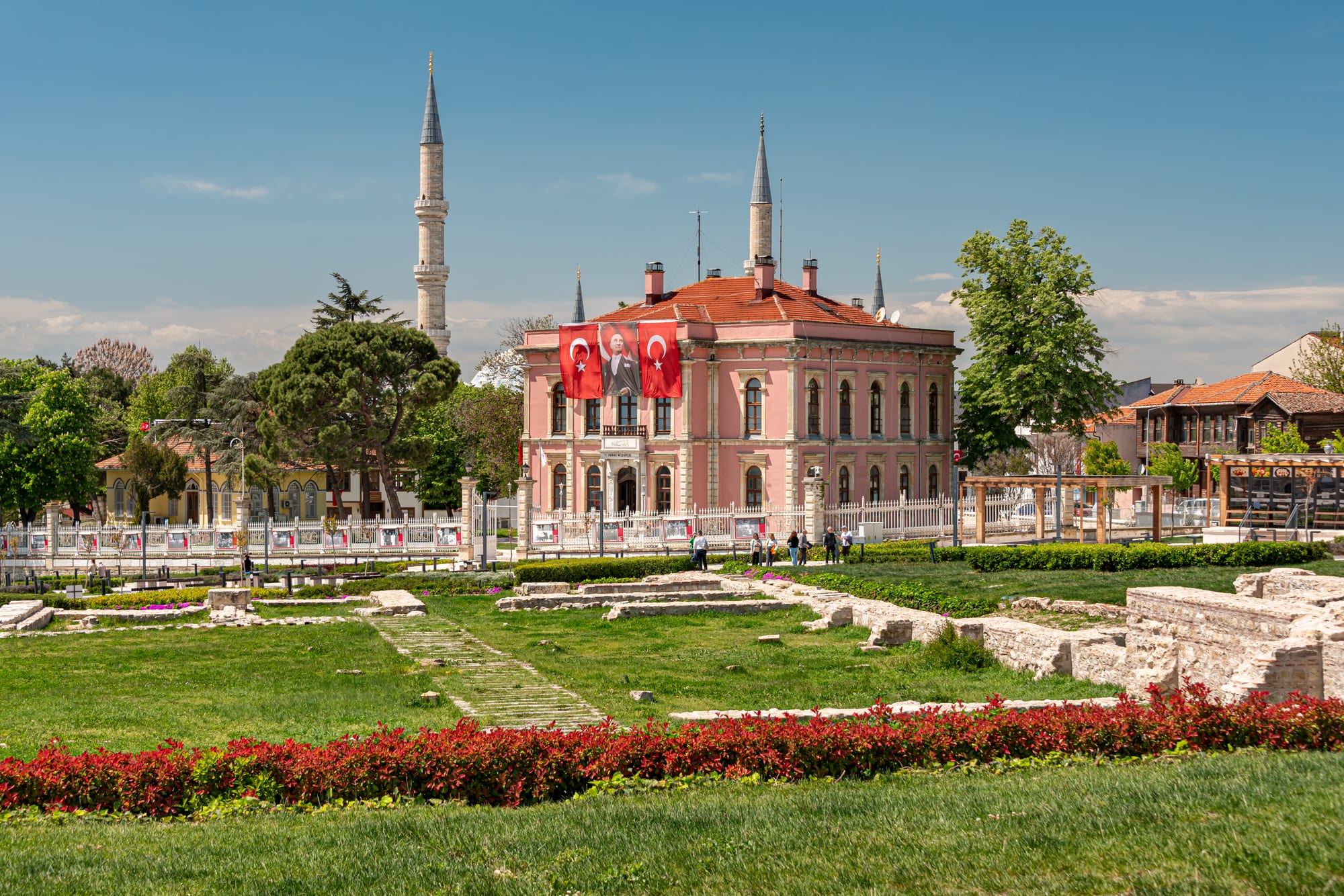
A pink 19th-century municipal building with a red roof, with the tall slim minarets of the Selimiye Mosque rising behind it above gardens

Istanbul & the Marmara Region, Turkey

Edirne

The city hall in central Edirne, with the minarets of the Selimiye Mosque behind. (Jorge Franganillo / Wikimedia Commons · CC BY 4.0)

A provincial capital in Turkish Thrace where the Tunca and Meriç rivers meet, close to both the Greek and the Bulgarian borders. Roman Adrianople and later the Ottoman capital before Constantinople, it keeps a dense group of imperial mosques, bridges and market halls, crowned by Mimar Sinan's Selimiye Mosque, and holds the Kırkpınar oil-wrestling tournament each summer.

Neighbourhoods

  • The Selimiye quarter and the centre
    • First-time visitors
    • Historic district
    • Close to public transport

    The raised ground around the Selimiye Mosque and its former medreses, with the city hall, museums and the main square below it. Almost everything visitors come for is within a few streets, and the hotels of the centre are here.

    Open in Maps
  • Saraçlar Street and the bazaars
    • Markets
    • Best for food
    • Shopping

    The pedestrian spine running south from the mosques, lined with cafés, liver restaurants and sweet shops, and joined by the 16th-century Ali Paşa covered market. This is where the city shops and takes its evening walk.

    Open in Maps
  • Karaağaç
    • Quiet and residential
    • Cafés
    • Local life

    A separate quarter across the Meriç river, reached over a long Ottoman bridge, with tree-lined streets, garden restaurants and the old railway station now used by the university. The Treaty of Lausanne monument stands nearby.

    Open in Maps
  • Sarayiçi and the riverside meadows
    • Parks
    • Sport
    • Historic district

    The flat island ground between the Tunca's branches north of the centre, where the Ottoman palace once stood and where the Kırkpınar wrestling arena and its stadium now sit among grass and poplars.

    Open in Maps
  • Yıldırım and the outer districts
    • Local life
    • Quiet and residential

    The residential neighbourhoods spreading east and north of the old core, with apartment blocks, the university campuses, markets and the bus terminal, where most of the city's population actually lives.

    Open in Maps

Things to do

Imperial mosques

  • Selimiye Mosquelandmark

    Mimar Sinan's masterpiece, finished in 1575 for Selim II, whose single dome and four slender minarets dominate the city; a UNESCO World Heritage Site.

    Open in Maps
  • Old Mosquelandmark

    The Eski Cami, the city's first great Ottoman mosque, built in the early 15th century, with nine domes and enormous calligraphy panels on its walls.

    Open in Maps
  • Üç Şerefeli Mosquelandmark

    A mid-15th-century mosque named for the minaret with three balconies, an experimental step towards the great domed mosques that followed.

    Open in Maps
  • Muradiye Mosquelandmark

    A small hillside mosque completed in 1435, built as part of a Mevlevi dervish complex, known for the tile panels around its prayer niche made by the craftsmen called the masters of Tabriz.

    Open in Maps
  • Bayezid II Complexmuseum

    A late 15th-century mosque, hospital, kitchen and medrese beside the Tunca, whose domed hospital treated patients with water and music and now houses a health museum.

    Open in Maps

Bridges, markets and other monuments

  • Meriç Bridgelandmark

    A twelve-arched Ottoman stone bridge completed in 1843, carrying the old road over the Meriç towards Karaağaç until a new bridge took the traffic, with riverside cafés at either end.

    Open in Maps
  • Great Synagogue of Edirnelandmark

    A large synagogue of 1909 built for a Jewish community that has since left the city, restored and reopened in 2015.

    Open in Maps
  • Edirne Palacelandmark

    The remains of the sprawling Ottoman palace begun in 1450 at Sarayiçi, blown up during the Russo-Turkish War of 1877–78 and partly excavated, with a restored bathhouse.

    Open in Maps
  • Lausanne Monumentlandmark

    A monument and small museum at Karaağaç marking the 1923 treaty that fixed the Turkish republic's borders.

    Open in Maps

Museums

  • Edirne Museummuseum

    Thracian funerary steles, Hellenistic, Roman and Byzantine finds and ethnographic rooms of carpets, costume and household objects, beside the Selimiye.

    Open in Maps
  • Karaağaçneighborhood

    The quarter across the Meriç, with its old railway station, tree-lined streets and garden restaurants, reached over the long Ottoman bridge.

    Open in Maps

Short trips from the city

  • Uzunköprülandmark

    A town on the Ergene river south of Edirne named for its 15th-century stone bridge of more than a hundred arches, one of the longest of its kind.

    Open in Maps
  • Enezattraction

    A small town on the Aegean at the mouth of the Meriç, its Byzantine castle enclosing the old church of Hagia Sophia, with long shallow beaches used by Edirne families in summer.

    Open in Maps

Seasonal events

  • Kırkpınar oil wrestlinglate June or early July

    One of the world's oldest continuously held sporting competitions, in which wrestlers in leather breeches and coated in olive oil compete over several days at Sarayiçi, the ground used since 1924.

  • Kakava and Hıdırellezearly May

    The spring festival, kept with particular energy by Edirne's Roma community, with fires, music and processions on the riverbanks.

  • Ramadan at the Selimiyethe lunar month of Ramadan

    Lights strung between the minarets and crowds for evening prayers and iftar meals in the mosque's courtyard and surrounding squares.

Eat and drink

Long-standing places and food districts in Edirne. Hours, ratings and directions come from your maps app, always current.

Edirne classics

  • Ciğerci restaurants on Saraçlar Streetrestaurant

    Tava ciğer, calf's liver sliced very thin, floured and deep-fried, served with fried dried red peppers and a raw onion salad, is the city's dish and is cooked in a row of specialist restaurants in the centre.

    Open in Maps
  • Almond paste confectionersmarket

    Badem ezmesi, a soft marzipan-like sweet of ground almonds and sugar, is sold boxed by shops around the bazaars, alongside deva-i misk, a spiced paste of old apothecary origin.

    Open in Maps
  • Ali Pasha Bazaarmarket

    Fruit-shaped scented soaps, dried fruit, spices, cheese and sweets under the vaults of the 16th-century Ali Pasha covered market.

    Open in Maps

Riverside and market eating

  • Karaağaç garden restaurantsneighborhood

    Meze, grills and rakı in leafy gardens across the Meriç, the usual place for a long evening meal away from the centre.

    Open in Maps
  • Edirne market hallsmarket

    Cheese counters selling Edirne's white brined cheese, butchers, pickle sellers and stalls of hardaliye, the sweet non-alcoholic drink of grape juice and mustard seed made in Thrace.

    Open in Maps

Experience Edirne

History

The city was founded as Hadrianopolis by the emperor Hadrian in the 2nd century AD, on an older Thracian settlement where the Tunca and Meriç rivers join. Its position on the road between the Danube and Constantinople made it a permanent military prize: a great battle outside the walls in 378 destroyed a Roman army and killed the emperor Valens, and the town changed hands repeatedly during the Byzantine, Bulgarian and Crusader wars that followed.

The Ottomans took it in the 1360s, and for roughly ninety years Edirne was their capital. Sultans built the Old Mosque, the Üç Şerefeli and a palace on the river meadows, and Mehmed II set out from here in 1453 to besiege Constantinople. Even after the court moved, the city remained an imperial residence and hunting seat, and in 1575 Sinan, then in his eighties, completed the Selimiye Mosque, the building he himself considered his masterwork.

Decline came with war. Russian armies occupied the city in 1829 and 1878, and it was besieged and taken in the First Balkan War of 1912–13, then held briefly by Greece after the First World War before returning to Turkey under the 1923 Treaty of Lausanne, signed by delegates who travelled through its Karaağaç station. The population exchange and successive Balkan migrations remade the city's communities, its Jewish and Greek populations all but disappearing. Today Edirne is a provincial capital and university town on the edge of the European Union, with the Selimiye inscribed by UNESCO in 2011.

Culture & Customs

Kırkpınar shapes the city's self-image more than anything else. Held on the meadows at Sarayiçi in early summer, the tournament sets wrestlers in leather kispet breeches and slicked with olive oil against each other in a hierarchy of weights, with drums and pipes, ceremonial prayers and a chief wrestler crowned each year. Its organisers date the tournament to 1360, which the Guinness Book of World Records has counted as the world's oldest continuously sanctioned sporting competition.

Edirne is also a Balkan city in its manners and its music. Families here descend from migrants who arrived from Bulgaria, Greece and the former Yugoslavia over the past century and a half, and Roma communities in the riverside neighbourhoods keep a strong instrumental tradition; the Kakava and Hıdırellez celebrations in early May, with fires and processions, are among the most distinctive spring festivals in the country.

The craft tradition runs to soap moulded into fruits and vegetables, embroidered textiles, glass and the broom-making that once supplied the whole region, all sold in the covered markets. Students from the university fill the cafés of Saraçlar Street, and cross-border shoppers from Greece and Bulgaria give the centre a weekend bustle. Manners are conservative but easy, and the evening walk between the mosques and the pastry shops is a fixed part of the day.

Daily Life

About 180,000 people live in the city, with roughly 400,000 in the province, a population that has grown slowly compared with Turkey's larger centres. Trakya University brings tens of thousands of students, changing the rhythm of the streets between term and holiday.

The provincial economy is agricultural: sunflowers above all, along with wheat, rice on the river plains and dairy farming, with food processing, textiles and oil pressing in the industrial zones outside the city. The border crossings at Kapıkule and Pazarkule generate customs work, haulage and trade, and the flow of lorries between Turkey and Europe passes a few kilometres from the centre. Tourism is mostly Turkish and brief, with a rise in Greek and Bulgarian day visitors who come to shop and eat.

Life is small-town in scale. Mornings begin in the covered markets, offices and shops close for a long lunch, and evenings are spent on Saraçlar Street or in the tea gardens by the rivers. Winter fog and flooding on the Tunca and Meriç are recurring local worries, along with drought in the farming season, the state of the border traffic, and the drift of young people to Istanbul for work.

Food

Edirne's dish is tava ciğer: calf's liver cut into very thin strips, dusted with flour and deep-fried until crisp, served with fried dried red peppers, raw onion with sumac and a squeeze of lemon. It is eaten at lunchtime in restaurants that cook nothing else, and it is the first thing residents recommend to a visitor. Around it sit the standard Thracian grills, köfte and bean stews of the lokantas.

The sweets are as well known. Badem ezmesi, a fine paste of ground almonds and sugar shaped into small cakes, is boxed and carried away by almost every visitor, and the old apothecary paste deva-i misk, flavoured with spices, is still sold in the same shops. Thrace's white brined cheese from Edirne's dairies is a breakfast staple across the country, and the city's markets sell it in blocks cut from the tin.

Drinks are local too. Hardaliye, unfermented grape juice steeped with mustard seed and sour cherry leaves, is a Thracian speciality drunk cold with meals. The province grows wine grapes, and the Thracian vineyards have been expanding for decades. In the markets there are also fruit-shaped decorative soaps that look edible but are not, a standing joke with new arrivals, sold beside the dried fruit and the halva.

Planning tools

Budget

Edirne is one of the cheaper provincial capitals in western Turkey. Hotels in the centre are modest and inexpensive, meals cost little, and the mosques are free to enter. Prices rise only during the Kırkpınar week, when rooms are scarce, and shoppers crossing from Bulgaria and Greece fill the town at weekends.

Daily Budget Midrange
USD 50–110 (comfortable hotel, restaurant dinners with meze, museum tickets, a taxi or two)
Daily Budget Shoestring
USD 25–40 (simple hotel or guesthouse, liver lunches and lokanta meals, city buses)

Book months ahead for the Kırkpınar wrestling week, when accommodation across the city is taken.

Best Time to Visit

April to June and September to October, when Thrace is green or golden and the temperatures are comfortable for walking between the mosques. Late June or early July brings Kırkpınar and a full city. July and August are hot and dry on the plain. Winters are the coldest in western Turkey, with frost, fog off the rivers and occasional snow.

Suggested Number of Days

A day covers the main monuments and the bazaars, and a second allows a slower look at the riverside quarters and museums. Add a third for the Thracian towns and the coast. Many people stop here overnight on the way between Istanbul and Europe.

First Visit
1–2 days
With Surroundings
2–3 days

Transportation

The historic centre is small enough to cross on foot, and city buses and cheap taxis cover the outer districts, the bus terminal and Karaağaç. Intercity buses run frequently to Istanbul and to the border crossings, and minibuses serve the towns of Thrace. A railway station outside the city has limited services.

Taxis are the simplest way to reach Sarayiçi and Karaağaç after dark, as bus services thin out in the evening.

Airport & Station Connections

Most visitors come by intercity bus from Istanbul, about two and a half to three hours on the motorway, arriving at the terminal east of the centre. The Kapıkule crossing into Bulgaria is about 20 kilometres away and Pazarkule into Greece only a few, both busy with lorries and coaches. The nearest airports are in Istanbul.

Walkability

The city is flat and its monuments are close together: the Selimiye, the Old Mosque, Üç Şerefeli and the covered markets stand within a few hundred metres, and Saraçlar Street is pedestrianised. Longer walks out to the Bayezid complex, Sarayiçi and Karaağaç follow riverside paths and take half an hour or more each way.

Safety

Edirne is a quiet, safe city with very little crime affecting visitors. Ordinary care in crowded markets is enough. The border zones are patrolled and are not places to wander near; the rivers flood in some winters, and the Thracian plain can be icy and foggy for driving between December and February.

Stay on public roads near the Greek and Bulgarian frontiers and do not photograph border posts or military installations. Check current official travel advice before travelling.

Climate

The most continental climate in western Turkey, away from the moderating sea. Summers are hot and dry on the plain, winters cold and damp with fog from the two rivers, and spring and autumn are short and changeable.

Summer
hot and dry, typically 30–34°C by day, with cooler evenings by the rivers
Winter
cold and damp, typically 1–8°C, with frost, fog and some snow

Local Customs

Mosque etiquette matters in a city built around them: shoes off, shoulders and knees covered, hair covered for women, and no walking in front of people praying. Kırkpınar is a serious sporting and cultural occasion rather than a spectacle for outsiders, with its own ceremonies and order of bouts. Thracian hospitality runs to insistent offers of tea.

Dress modestly when visiting the mosques and tombs, and ask before photographing wrestlers, worshippers or Roma families during the spring festival.

Common Payment Methods

The currency is the Turkish lira. Cards are accepted in hotels, shops and most restaurants, and ATMs are easy to find on Saraçlar Street. Euros and Bulgarian and Greek visitors' cards are common in the border shops, but cash in lira is best for markets, small liver restaurants and minibuses.