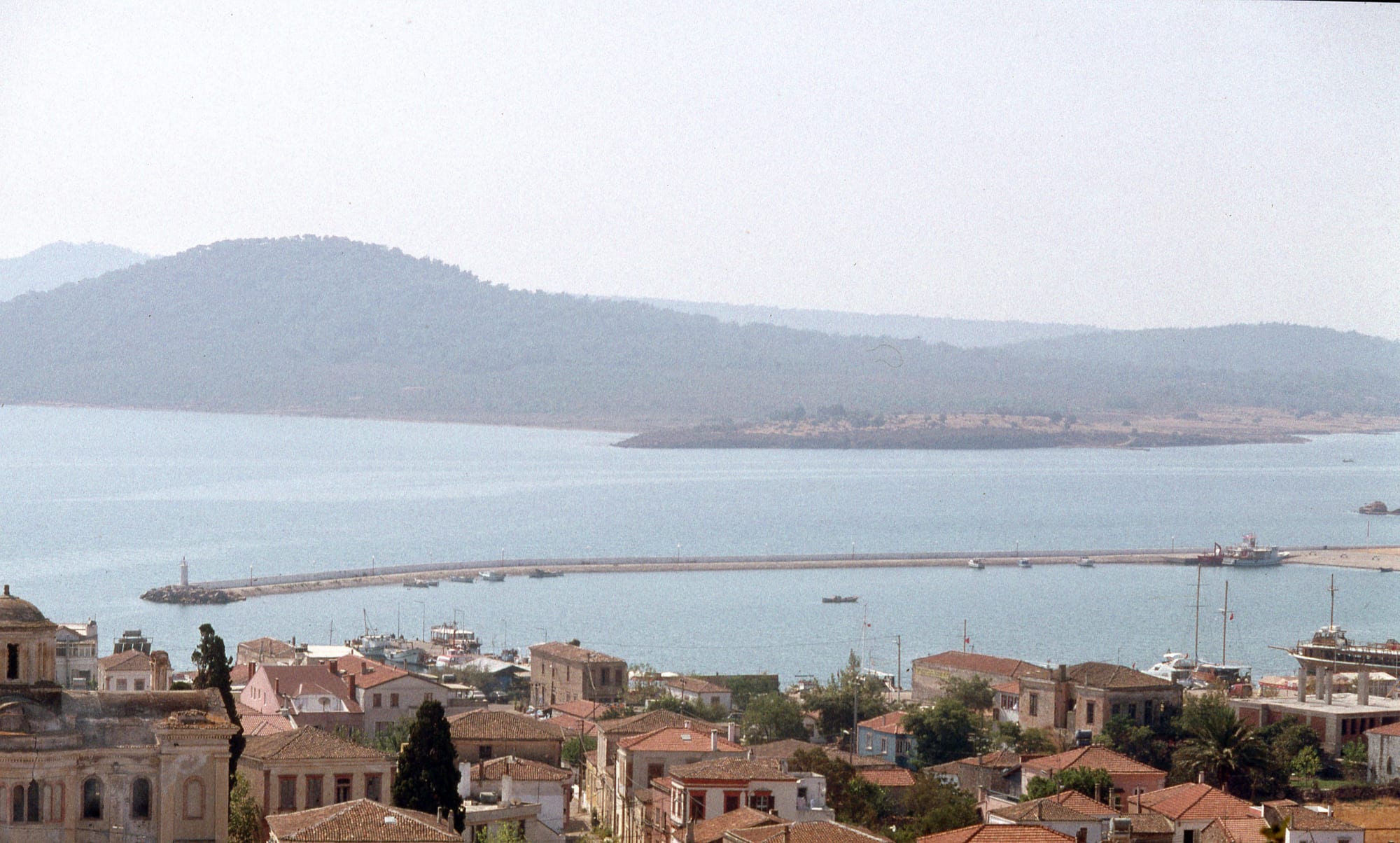
Ayvalık's tiled roofs below a hillside, with a long harbour breakwater, moored boats and wooded islands across a pale blue bay

Istanbul & the Marmara Region, Turkey

Ayvalık

Ayvalık, its harbour breakwater and the islands of the bay, seen from the hill above the town. (Dosseman / Wikimedia Commons · CC BY-SA 4.0)

A port town on Turkey's northern Aegean coast, in Balıkesir province, facing the Greek island of Lesbos across a narrow strait. Built up in the 18th and 19th centuries by a largely Greek Orthodox population that lived on olive oil and soap, it was resettled after the 1923 population exchange and is now a town of stone houses, olive mills, fish restaurants and the island quarter of Cunda.

Neighbourhoods

  • The old town
    • First-time visitors
    • Historic district
    • Best for food

    The grid of cobbled lanes climbing from the harbour, lined with tall stone and stucco houses built for 19th-century Greek merchants, many with carved doorways and shuttered bay windows. Former churches now serving as mosques stand among them, and the streets hold small hotels, antique shops, cafés and the weekly market.

    Open in Maps
  • The harbour and seafront
    • Close to public transport
    • Seafood
    • Evening walks

    The working quay and marina at the foot of the old town, where fishing boats unload, excursion boats tie up and the ferries for Lesbos leave in season. Fish restaurants and tea gardens line the water, and the bus and minibus stops for the rest of the district are close by.

    Open in Maps
  • Cunda (Alibey Island)
    • Seafood
    • Historic district
    • Day trips

    The island across the bay, reached by a causeway and bridge or by small boat, with its own quayside of fish restaurants and a hillside of Greek stone houses around the Taxiarchis Church, a large former Greek Orthodox church now restored as a museum. Quieter than the mainland town out of season and busy on summer evenings.

    Open in Maps
  • Sarımsaklı
    • Beaches
    • Families
    • Summer nightlife

    The long sandy beach strip south of the town, backed by holiday flats, hotels and summer restaurants. It fills with Turkish holidaymakers from June to September and is largely shut in winter; minibuses connect it with the centre through the season.

    Open in Maps

Things to do

The old town and the bay

  • Cunda Islandneighborhood

    The largest island of the bay, linked to the mainland by a causeway, with a waterfront of fish restaurants and lanes of old Greek stone houses below the Taxiarchis Church, a former Greek Orthodox cathedral restored as a museum.

    Open in Maps
  • Ayvalık Islands Nature Parkpark

    A protected area of more than twenty pine-covered islands and islets in the bay, visited by boat and looked down on from the hills above the town.

    Open in Maps
  • Sarımsaklı beachbeach

    The long sandy strip a few kilometres south of the centre, backed by holiday flats and summer restaurants and busy from June to September.

    Open in Maps

Short trips from the town

  • Pergamonlandmark

    The Hellenistic acropolis above the town of Bergama to the south, with a steep theatre, temples and the Asklepion healing sanctuary below.

    Open in Maps
  • Assoslandmark

    An ancient city on a headland to the north, its Temple of Athena standing above a small harbour on the Gulf of Edremit.

    Open in Maps
  • Mount Idaviewpoint

    The forested range inland known in Turkish as Kaz Dağları, with walking routes, waterfalls and villages on its lower slopes.

    Open in Maps
  • Lesbosattraction

    The Greek island across the strait, reached by passenger ferry from the harbour in season, with the port town of Mytilene on its eastern side.

    Open in Maps

Eat and drink

Long-standing places and food districts in Ayvalık. Hours, ratings and directions come from your maps app, always current.

Ayvalık classics

  • Ayvalık tosturestaurant

    The town's contribution to Turkish fast food — a pressed toasted sandwich stuffed with sausage, cheese, pickles and sauces, sold from small counters around the centre and copied across the country.

    Open in Maps
  • Papalina and Aegean fishrestaurant

    Papalina, the small whitebait of these waters, is fried whole and eaten with rakı in the fish restaurants along the harbour and on Cunda.

    Open in Maps

Markets and food shops

  • Ayvalık weekly marketmarket

    The town's street market, with vegetables, cheeses, olives and herbs from the surrounding villages.

    Open in Maps
  • Olive oil and soap shopsmarket

    Shops and old mills in and around the centre sell the district's olive oil, table olives and the hard olive-oil soap the town has made for generations.

    Open in Maps
  • Cunda waterfrontneighborhood

    The island's quay is lined with meze and fish places, and the lanes behind it hold cafés and bakeries in restored stone houses.

    Open in Maps

Experience Ayvalık

History

Ayvalık as a town dates from the 18th century, when a settlement of Greek Orthodox families on this stretch of coast grew into a prosperous port known in Greek as Kydonies. Under Ottoman rule the Greeks of the town were granted virtual autonomy in 1773, and by the end of the century it had its own printing press and a fleet trading olive oil and soap across the Aegean. The wealth of those decades built the tall stone houses, the churches and the warehouses that still define the centre.

The town was largely emptied during the Greek uprising of 1821 and its population scattered, but people returned and the olive trade grew again through the 19th century. Olive mills and soap works multiplied along the shore, and Ayvalık remained overwhelmingly Greek-speaking until the end of the Ottoman period. Greek forces occupied the district from 1919, and after the Turkish victory of 1922 the town changed hands again.

The population exchange agreed between Turkey and Greece in 1923 remade it completely. The Greek Orthodox inhabitants left for Lesbos and mainland Greece, and Muslim families from Lesbos, Crete and other parts of the Aegean were settled in their houses — many of them Greek-speaking themselves. The churches became mosques, the mills kept working, and the town lived on olive oil and fishing through the 20th century. In recent decades the old houses have been restored as hotels and second homes, and tourism, olive oil and the daily catch now carry the town together.

Culture & Customs

Ayvalık's identity rests on two things that outsiders notice at once: the olive and the sea. The harvest in late autumn organises the year in the surrounding villages, presses run through the winter, and olive oil is discussed here with the seriousness given to wine elsewhere. The evening ritual of meze, grilled fish and rakı on the water belongs to the same culture, and it is treated as a long, unhurried meal rather than a course before something else.

The town is also shaped by the Cretan and Aegean island families who arrived in 1923. Their cooking, their use of wild greens and herbs, and in some households their Greek dialect persisted for generations, and the shared past with Lesbos, visible across the strait, is a matter of open interest rather than distance. Restored churches, bilingual gravestones and museum displays on the exchange are part of the town's everyday landscape.

Ayvalık has drawn artists, musicians and writers from Istanbul, many of whom keep houses in the old quarter or on Cunda; an international music academy was founded in the town in 1998, and summer brings concerts, exhibitions and readings to courtyards and converted mills. Manners are those of the secular Aegean coast: dress is informal, alcohol is unremarkable, and conversation with shopkeepers over tea is expected rather than optional.

Daily Life

About 75,000 people live in the district of Ayvalık, a figure that multiplies in July and August as holiday flats fill and second-home owners arrive from Istanbul, İzmir and Bursa. The permanent population is concentrated in the town itself, with smaller communities on Cunda and in the villages inland, and the proportion of retired residents is high — the mild climate has made the district a popular place to settle.

The economy runs on olives, fishing and tourism. Groves cover the hills behind the town, mills and soap works process the crop, and olive oil is sold both locally and far beyond. Fishing boats work the bay and the strait, supplying the restaurants and the market. Tourism is strongly seasonal: hotels, boat crews and beach businesses work flat out from late spring to October, and much of Sarımsaklı closes for the winter.

The rhythm of the day follows the heat. Shops open early, the middle of a summer afternoon is slow, and the town comes back to life in the evening along the waterfront. Local concerns are familiar along this coast: the price of property and rents pushed up by outside buyers, pressure on water in dry summers, the condition of the older stone houses, and the risk of fire in the pine hills.

Food

Ayvalık cooks in olive oil. The zeytinyağlı dishes of the Aegean — artichokes, broad beans, green beans, stuffed vine leaves and wild greens, cooked slowly and eaten cool — are the backbone of the meze table, along with samphire and local cheeses. The oil itself, pressed within a few kilometres of the town, appears on almost everything, and jars of table olives and cakes of olive-oil soap are the standard thing to take away.

Fish follows. Papalina, the small whitebait caught in these waters, is floured and fried whole and is the dish most associated with the town; sea bass, bream, octopus and the seasonal catch of the strait fill the rest of the menu in the restaurants along the harbour and on Cunda's quay. The customary accompaniment is rakı, the aniseed spirit, clouded with water.

The town's best-known export is quicker. Ayvalık tostu is a toasted sandwich pressed flat and filled with sausage, cheese, pickles, tomato and sauces, sold from small counters in the centre and imitated in shops all over Turkey. For something sweet there is höşmerim, a warm pudding made from fresh unsalted cheese and semolina that is eaten across the Aegean and Marmara regions. Breakfast, as everywhere on this coast, is a spread of cheeses, olives, tomatoes, eggs and bread with endless glasses of tea.

Planning tools

Budget

Ayvalık is cheaper than Istanbul and than the big southern Aegean resorts, but prices swing with the season. Rooms in the restored old houses and on Cunda rise sharply in July and August and at weekends, when Istanbul and İzmir families arrive, and fall a long way in spring and autumn. Fish dinners on the water are the main daily expense.

Daily Budget Midrange
USD 90–180 (boutique hotel in an old stone house, fish dinners, boat trips, a hire car)
Daily Budget Shoestring
USD 35–60 (pension or simple hotel, lokanta meals and tostu, dolmuş minibuses)

Visit outside July and August for lower room rates, and expect a premium for a sea view on Cunda.

Best Time to Visit

May, June, September and October are the best months: warm, bright and quiet enough to walk the old town comfortably. July and August are hot and full, with the beaches and Cunda's restaurants at their busiest. Autumn brings the olive harvest and clear light over the bay. Winter is mild but wet, many seasonal places close, and the seafront can be windy.

Suggested Number of Days

Two days are enough for the town and the bay. Allow three or four to add the beaches, a boat trip and the ancient sites along the coast. A crossing to the Greek island opposite adds at least another day.

First Visit
2 days
With Surroundings
3–4 days

Transportation

The centre is small enough to cross on foot. Dolmuş minibuses run from the town to Cunda, to Sarımsaklı and to the villages of the district, more often in summer than in winter, and small boats cross the bay to Cunda in season. Intercity buses use a terminal on the edge of town. A car is useful for the ancient sites and the Gulf of Edremit, though parking in the old town is difficult.

Dolmuş minibuses leave when full rather than to a timetable, and taxi fares should be agreed or metered before setting off.

Airport & Station Connections

Most visitors arrive by road. Intercity buses run from Istanbul in about seven to eight hours and from İzmir in two to three. The nearest airport is at Edremit, roughly 50 kilometres north, with domestic flights; İzmir's Adnan Menderes Airport, about 170 kilometres south, has far more connections. A passenger ferry crosses to Mytilene on Lesbos, mainly in the warmer months.

Walkability

The old town and harbour are easy and rewarding on foot, though the lanes are steep, cobbled and uneven, and awkward for wheeled luggage or wheelchairs. Cunda's centre is equally walkable once reached, but the causeway is a long, exposed walk, and Sarımsaklı is several kilometres from the centre. Sturdy shoes matter more here than distance.

Safety

Ayvalık is a quiet town with little crime beyond occasional petty theft in summer crowds. The practical risks are traffic on the coast road, slippery cobbles, strong sun at midday and currents on open beaches. The region is seismically active, and forest fires can affect the pine hills in high summer.

Carry water and a hat for the islands and viewpoints, swim where others do, and follow local instructions during a wildfire. Check current official travel advice before travelling.

Climate

A Mediterranean climate: long hot dry summers, mild wet winters, and sea breezes that make the coast more comfortable than the interior. Rain falls mostly between November and March.

Summer
hot and dry, typically 28–33°C by day, with warm evenings and little rain
Winter
mild and wet, typically 8–14°C by day, with rain and wind off the sea

Local Customs

Manners are Aegean and relaxed: alcohol is served openly, dress is casual, and the evening rakı table with meze is a social institution. Shoes come off in homes and in mosques, and modest clothing and a head covering for women are expected inside a mosque. Greetings are warm, tea is offered constantly in shops, and refusing it outright is unusual.

Tipping of around ten per cent is normal in restaurants; ask before photographing people, and dress modestly away from the beach strip.

Common Payment Methods

The currency is the Turkish lira. Cards and contactless payment are taken in hotels, restaurants and shops, and ATMs are easy to find in the centre. Cash is useful for market stalls, dolmuş minibuses and small village places. Euros are sometimes accepted near the ferry but at poor rates.