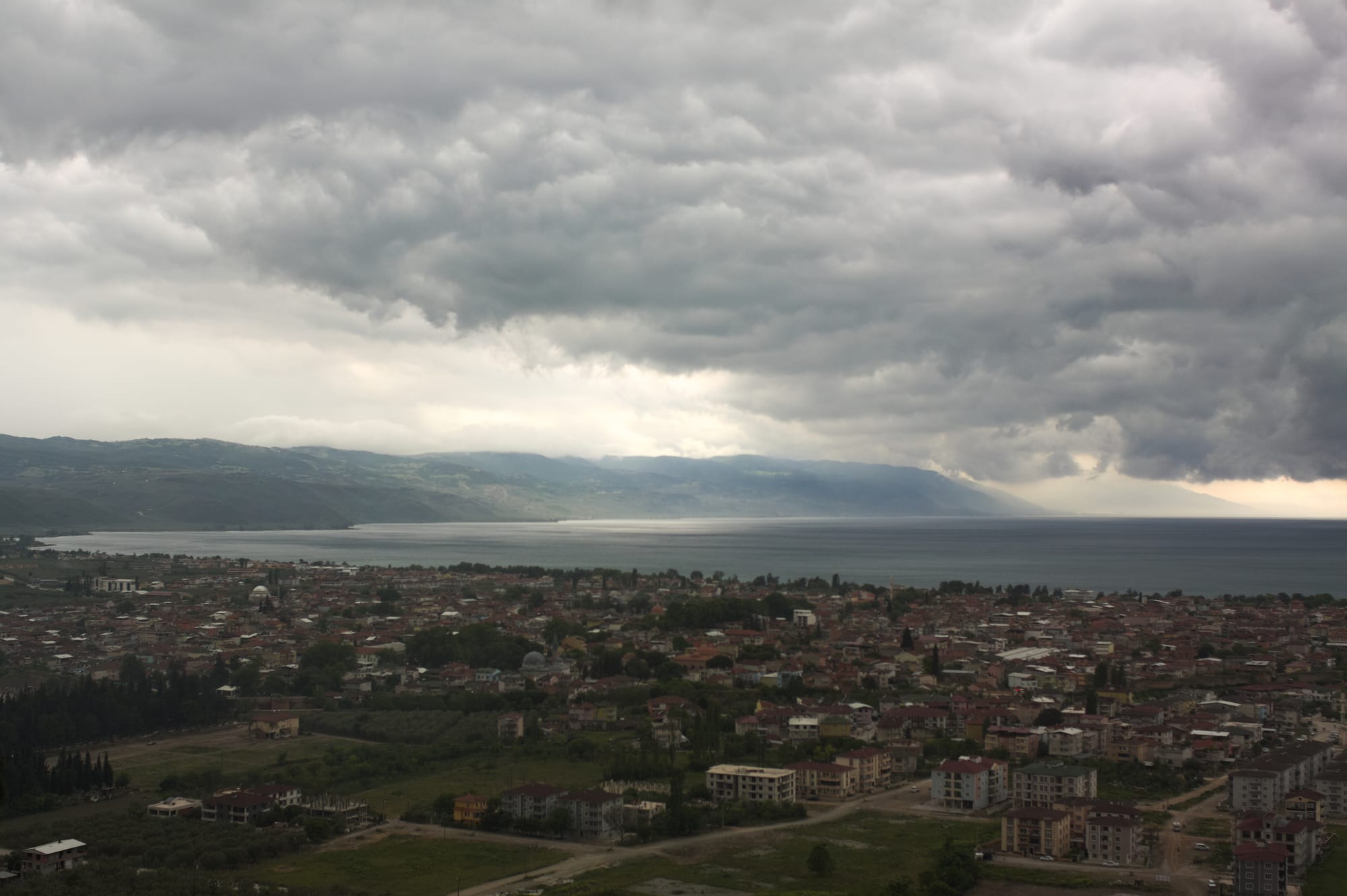
The low red-roofed town of İznik spread along the shore of a wide grey-blue lake, with wooded hills on the far side under heavy cloud

Istanbul & the Marmara Region, Turkey

İznik

İznik and its lake seen from the hills above the town. (Anatolian Citizen / Wikimedia Commons · CC BY-SA 4.0)

A small walled town on the eastern shore of a lake in north-western Turkey, the ancient Nicaea where the first Christian ecumenical council met in 325. Roman and Byzantine walls still enclose a grid of low streets, churches and early Ottoman mosques, and the blue-and-white tiles that took the town's name are made here again after centuries.

Neighbourhoods

  • Inside the walls
    • First-time visitors
    • Historic district
    • Close to public transport

    The old town is a Roman grid within a ring of walls, crossed by two straight streets that meet near the former church of Hagia Sophia. Mosques, excavated ruins, tile shops, small hotels and the market all sit within a few hundred metres.

    Open in Maps
  • The lakeshore
    • Waterfront
    • Best for food
    • Sunsets

    A strip of cafés, fish restaurants and tea gardens along the water at the town's western edge, with swimming spots and reed beds. The sunset over the lake is the evening event.

    Open in Maps
  • Beyond the gates
    • Quiet and residential
    • Local life

    Newer housing, workshops and the bus stop lie outside the Istanbul and Lefke gates, with olive groves and orchards starting almost at once on the slopes behind the town.

    Open in Maps

Things to do

The ancient and Byzantine town

  • Hagia Sophia of Nicaealandmark

    The church at the crossroads of the old town where the seventh ecumenical council met in 787; converted to a mosque after the Ottoman conquest, used as a museum from 1935 and in service as a mosque again since 2011.

    Open in Maps
  • Roman theatre of Nicaealandmark

    The excavated Roman theatre inside the walled town, which sits within a ring of Roman and Byzantine walls about three kilometres round, still pierced by four large gates.

    Open in Maps
  • Lake İznikattraction

    The long freshwater lake at the town's edge, used for swimming and fishing, with a submerged early church visible from the air near the shore.

    Open in Maps

Ottoman İznik and its tiles

  • Green Mosquelandmark

    A mosque built between the 1370s and the 1390s, named for the green, yellow and turquoise glazed tiles of its minaret, among the earliest Ottoman buildings in the town.

    Open in Maps
  • İznik tile workshopsattraction

    The blue, turquoise and red ceramics made here for the Ottoman court from the 15th century, revived in modern workshops in and around the town that sell and demonstrate the craft.

    Open in Maps

Short trips from the town

  • Bursaattraction

    The first Ottoman capital, with its Green Mosque, silk market and the mountain above it, about an hour and a half away by road.

    Open in Maps
  • Orhangaziattraction

    The market town at the western end of the lake, surrounded by olive groves and the main road junction for Yalova and the ferries to Istanbul.

    Open in Maps

Seasonal events

  • Olive harvestautumn

    The groves around the lake are picked from October, and pressing, salting and roadside sales of table olives and oil dominate the town for weeks.

  • Lakeside summerJune to September

    Swimming platforms, tea gardens and fish restaurants along the shore fill with families from Bursa and Istanbul at weekends.

  • Ramadan in the old townthe lunar month of Ramadan

    Iftar tables are set out near the mosques after sunset, and the market stays open late for bread and sweets.

Eat and drink

Long-standing places and food districts in İznik. Hours, ratings and directions come from your maps app, always current.

İznik classics

  • Lakeshore fish restaurantsneighborhood

    Freshwater fish from the lake, grilled or fried, served with meze at tables set out along the water.

    Open in Maps
  • Olives and olive oilmarket

    Table olives and cold-pressed oil from the groves around the lake, sold in shops in the town and at roadside stalls in the harvest season.

    Open in Maps

Market and street food

  • The town marketmarket

    The weekly market brings in fruit, vegetables, cheese and preserves from the lakeside villages, along with stalls selling gözleme and pide.

    Open in Maps
  • Tile-shop cafés inside the wallscafe

    Small courtyards and tea gardens among the ceramic workshops on the old town's two main streets, serving tea, Turkish coffee and pastries.

    Open in Maps

Experience İznik

History

The town was founded in the 4th century BC by one of Alexander's successors and renamed Nicaea after the wife of Lysimachus. Its regular grid and the ring of walls, rebuilt under Rome and repeatedly strengthened afterwards, still define the shape of the place. As a Roman and then Byzantine city it was prosperous and strategically placed on the road east from Constantinople, and in 325 the emperor Constantine summoned the bishops of the empire here for the first ecumenical council of the Christian Church, which produced the Nicene Creed. A second council met in the church of Hagia Sophia in 787 to settle the dispute over religious images.

After the Fourth Crusade took Constantinople in 1204, Nicaea became the capital of an exiled Byzantine state that recovered the imperial city in 1261. Seventy years later the town fell to the young Ottoman principality, and its churches were converted and new mosques, baths and soup kitchens built beside them.

Its lasting fame came in the 15th and 16th centuries, when İznik's potters supplied the Ottoman court with tiles and vessels in cobalt blue, turquoise and a distinctive sealing-wax red, glazed to a brilliance that later makers could not match. The workshops declined in the 17th century and eventually stopped. Earthquakes, the wars of 1919–22 and a long quiet period left a small agricultural town inside its ancient walls; tile making was deliberately revived in the late 20th century, and excavation of the Roman theatre and other sites continues.

Culture & Customs

Two identities sit side by side here. For Christian visitors İznik is Nicaea, the place of the creed recited in churches around the world, and pilgrims and church delegations come to the rebuilt Hagia Sophia, now a working mosque, and the lakeside where a sunken basilica was identified in 2014. For Turkey it is a quiet Ottoman market town and the home of the country's most admired ceramic tradition.

Tiles set the tone of daily life in the centre. Workshops line the two main streets, and painters can be seen filling in patterns of carnations, tulips and saz leaves copied from Ottoman originals; the craft supports a local guild of makers, sellers and teachers, and pieces made here go to restoration projects in mosques around the country. Hand-painted work is expensive and clearly distinguished from the cheaper transfer-printed ceramics sold to passing coaches.

Otherwise the customs are those of rural Bursa province: conservative dress, mosque attendance, coffee houses full of men at midday, and a farming calendar built around olives and fruit. The lake is the town's shared space, used for picnics, swimming and fishing, and weekend arrivals from the cities are a large part of the local economy without having changed the town's character much.

Daily Life

About 44,000 people live in the district of İznik, part of the province of Bursa, a good many of them in the town itself and the rest in the villages around the lake. It is small enough that most people know each other, and the working day begins early and ends with tea in the gardens by the water.

Agriculture is the mainstay. Olive groves cover the slopes around the lake, and olive growing is a mainstay of the lakeside districts; fruit, vegetables and grapes fill the plain, and fishing on the lake adds a little. The tile workshops employ a modest number of people between them, and tourism is seasonal: day visitors from Bursa and Istanbul, church groups, and Turkish families at the lakeside in summer.

The town's issues are those of a small place with an ancient site underneath it. Building is constrained by archaeology and by the walls, young people leave for Bursa and Istanbul for work and study, and the health of the lake — water levels, pollution from farming and the pressure of shoreline development — is a recurring local subject. Excavations continue in the theatre and around the gates, and restoration work on the walls goes on in stages.

Food

Olives are the first thing the town is known for. The groves around the lake produce table olives cured in brine and salt, sold in every grocer's in the centre, alongside local olive oil pressed after the autumn harvest. Breakfast in İznik means those olives with white cheese, tomatoes, bread and honey, taken slowly and at length.

Fish from the lake appears on the shoreline tables: carp and other freshwater species grilled or fried and served with rocket, lemon and meze of yoghurt and vegetables in oil. Inland the cooking is that of Bursa province — köfte grilled over charcoal, pide baked in long ovens, stews of beans and lamb in the lokantas — with gözleme, thin pancakes filled with cheese, potato or spinach, cooked on griddles at the market and at roadside stops.

Fruit is the other speciality. The plain around the town grows peaches, grapes, quinces and mulberries, and much of the crop is dried, bottled or turned into jam and sold from the same shops as the olives. Kestane şekeri, the candied chestnuts of the Uludağ slopes, and Bursa's İskender kebap are close enough to count as local, and tea in a lakeside garden at sunset is the town's own small ritual.

Planning tools

Budget

İznik is inexpensive. Guesthouses and small hotels inside the walls and along the lake cost little outside high summer, meals are modest, and the main sites charge small entry fees or none at all. Tiles are the one expensive purchase: hand-painted work from the local workshops is priced well above factory ceramics.

Daily Budget Midrange
USD 45–90 (lakeside hotel, fish dinners, museum entry, a taxi or hire car)
Daily Budget Shoestring
USD 20–35 (guesthouse or pension, lokanta meals and market food, minibuses)

Weekend rooms by the lake in July and August are the only real pressure point; midweek the town is quiet and cheap.

Best Time to Visit

April to June and September to October, when the lake is calm, the olive country is green or being harvested and the walls can be walked without heat. July and August are hot and busy with weekend visitors from Bursa and Istanbul. Winter is cold, wet and very quiet, with some lakeside restaurants closed.

Suggested Number of Days

The walled town is small and most visitors see it in a few hours, often as a stop on a longer drive. Staying a night allows the lake, the workshops and the villages around the shore at a slower pace.

First Visit
half a day to 1 day
With Surroundings
2 days

Transportation

The town is small enough to cover entirely on foot, and bicycles are a good way to reach the shore and the gates. Minibuses run to Bursa, Orhangazi and Yalova from the stop outside the walls, and a car is useful for the lakeside villages and the olive country.

Minibus services thin out in the evening, so check the last departure before planning a late return to Bursa or Yalova.

Airport & Station Connections

From Istanbul most people take a ferry across the Sea of Marmara to Yalova and then a bus or minibus, about three hours in all, or drive over the İzmit Bay bridge. From Bursa it is about an hour and a half by road through the hills, with regular minibuses. There is no railway or airport in the town itself.

Walkability

Very walkable: the Roman grid inside the walls is flat, the two main streets cross at the centre, and it takes about twenty minutes to walk from the Istanbul Gate to the lake. Pavements are uneven in places and the circuit of the walls involves rough ground.

Safety

A quiet town with very little crime. The practical hazards are traffic on the main through streets, uneven footing among the ruins and along the walls, and the lake itself, which is deep and cold away from the shallow margins. The region is seismically active.

Take care on unfenced sections of the walls and excavations, swim only from the recognised shore areas, and note the hotel's earthquake assembly point. Check current official travel advice before travelling.

Climate

A transitional climate between the Marmara coast and the interior, tempered by the lake. Summers are hot and dry, winters cool and wet, and mist forms over the water on autumn and winter mornings.

Summer
hot and dry, typically 29–33°C by day, with warm evenings by the lake
Winter
cool and wet, typically 3–10°C, with occasional snow and lake mist

Local Customs

İznik is a conservative country town, and visitors are expected to dress modestly in the streets as well as in the mosques, where shoes come off and women cover their hair. Several monuments are working mosques rather than museums, so visits are arranged around prayer times. Tile workshops welcome visitors, and looking without buying is normal.

Ask before photographing people, particularly women and workers in the groves, and avoid entering mosques during prayers.

Common Payment Methods

The currency is the Turkish lira. Cards are accepted in hotels, restaurants and the larger tile shops, and there are ATMs in the centre, but cash is needed for the market, minibuses, roadside olive stalls and small cafés.