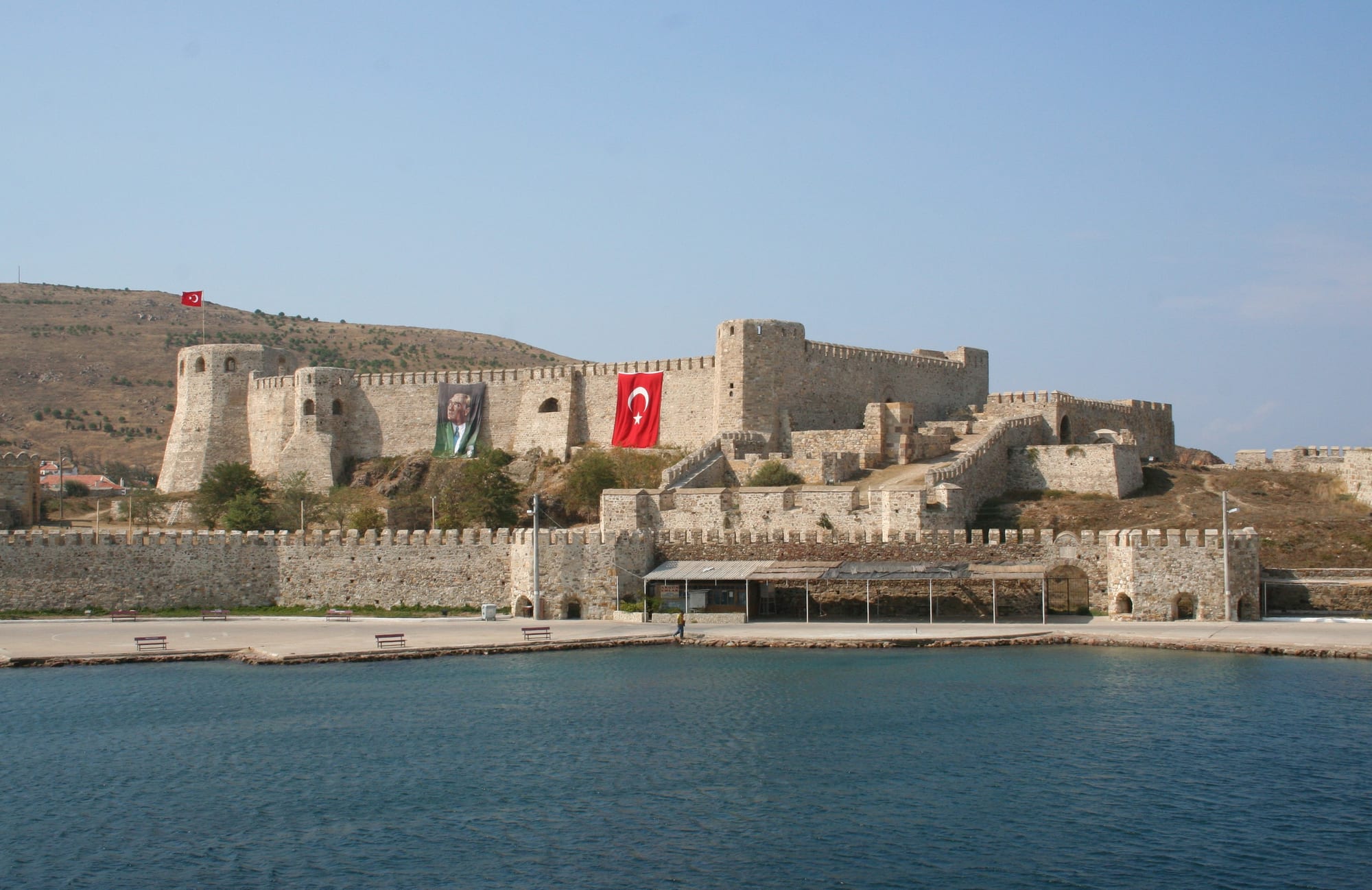
A long stone fortress with round towers and battlements rising above a quay and calm blue harbour water on a clear day

Istanbul & the Marmara Region, Turkey

Bozcaada

The fortress above the harbour of Bozcaada, seen from the water. (Filanca / Wikimedia Commons · CC BY-SA 3.0)

A small Turkish island in the northern Aegean, off the mouth of the Dardanelles in Çanakkale province, known in antiquity as Tenedos. A large fortress guards its single harbour town of cobbled lanes and shuttered houses, vineyards cover the low interior, and sandy beaches line the southern shore. Wine, fishing and a short summer season carry the island.

Neighbourhoods

  • The harbour and the castle quarter
    • First-time visitors
    • Close to the ferry
    • Cafés and bars

    The arrival point and the centre of island life, where the ferry ties up beneath the fortress walls. Cafés, wine shops, fish restaurants and most of the small hotels stand within a few minutes' walk, and the streets stay busy late on summer evenings.

    Open in Maps
  • The Greek quarter
    • Historic district
    • Photography
    • Quiet streets

    The older half of the town, laid out in narrow cobbled lanes of stone houses with wooden shutters and small courtyards, built when the island's population was largely Greek Orthodox. A church, a school building and several restored guest houses survive among them, and the streets are quieter than the waterfront.

    Open in Maps
  • The Turkish quarter
    • Local life
    • Quiet and residential

    The part of town around the mosque and the market street, with plainer houses, everyday shops, bakeries and the offices of island life. It shades into the Greek quarter without a clear border and holds much of the permanent population.

    Open in Maps
  • The south coast and the vineyards
    • Beaches
    • Wine
    • Cycling

    Beyond the town the island opens into low vine-covered country crossed by a few roads, ending in the sandy bays of the southern shore. Beach clubs and a scatter of holiday houses operate here in summer; in winter it is empty apart from the vineyards.

    Open in Maps

Things to do

The town

  • Bozcaada Castlelandmark

    The fortress on the harbour, standing on the site of an older castle of undocumented date and rebuilt by Mehmed II after the Ottoman conquest of 1455, with walls and towers looking over the town and the strait.

    Open in Maps
  • The old town lanesneighborhood

    Cobbled streets of stone houses, wooden shutters and bougainvillaea between the harbour and the windmills, walkable end to end in an afternoon.

    Open in Maps

Beaches and the shore

  • Ayazma beachbeach

    The island's best-known beach, a broad sandy bay on the southern shore with shallow water, pine trees behind it and cafés and restaurants at its edge.

    Open in Maps
  • Polente lighthouseviewpoint

    A lighthouse of 1861 on the low rocky cape at the western end of the island, reached by road past wind turbines, with open sea beyond.

    Open in Maps

Short trips from the island

  • Troylandmark

    The excavated mound of Hisarlık on the mainland, a UNESCO World Heritage Site with layers of settlement from the Bronze Age to Roman times, and a modern museum beside it.

    Open in Maps
  • Alexandria Troaslandmark

    The extensive and little-visited ruins of a Hellenistic and Roman port city on the mainland coast opposite the island.

    Open in Maps
  • Assoslandmark

    An ancient city on a headland down the coast, its Temple of Athena standing above a small stone harbour.

    Open in Maps
  • Gökçeadaattraction

    Turkey's largest island, to the north-west, with old Greek villages, beaches and a long history parallel to Bozcaada's.

    Open in Maps

Seasonal events

  • Grape harvest festivalearly September

    The island's vintage is marked with tastings, music and a procession in the town, and the wineries open their doors as the picking ends.

  • Summer seasonJune to September

    The months when the ferries run most often, the beach clubs and restaurants open and the population multiplies with holidaymakers from Istanbul and İzmir.

Eat and drink

Long-standing places and food districts in Bozcaada. Hours, ratings and directions come from your maps app, always current.

Bozcaada classics

  • Island winemarket

    Vines have been grown here since antiquity, and several wineries in the town and among the fields sell and pour their own bottles, including wines from local grape varieties.

    Open in Maps
  • Fish restaurants on the harbourrestaurant

    The quayside places serve the day's catch from the strait with Aegean meze cooked in olive oil, and stay open late through the summer.

    Open in Maps

Shops and market stalls

  • Tomato jam and island preservesmarket

    Small shops in the lanes sell the island's tomato jam, grape molasses, dried fruit and olive oil, sold as much to visitors as to residents.

    Open in Maps
  • Cafés in the old quarterscafe

    Courtyard cafés in restored stone houses serve Turkish coffee, tea and long breakfasts of cheeses, olives and preserves.

    Open in Maps

Experience Bozcaada

History

The island was Tenedos in antiquity, a name that appears in Homer and, in Virgil's Aeneid, as the place where the Greek fleet hid while the wooden horse stood before Troy, whose mound lies a short distance across the water. Its position at the mouth of the Dardanelles, with the only good harbour for ships waiting for a wind to enter the strait, made it valuable out of all proportion to its size. It was settled by Aeolian Greeks, taken by the Persians, joined the Athenian empire, and passed in turn to Alexander's successors, Rome and Byzantium.

That same position made it a prize in the late Middle Ages. Venice and Genoa fought over the island in the 14th century, and the Treaty of Turin of 1381 ordered its fortifications destroyed and its inhabitants removed. The Ottomans took it under Mehmed II in the 1450s and rebuilt the castle; a Venetian fleet seized it briefly in the 17th century during the long war for Crete before the Ottomans recovered it. The fortress on the harbour carries the marks of all of these hands.

Modern history came with the end of the empire. Greek forces occupied the island during the Balkan Wars, and during the Gallipoli campaign of 1915 the British used it as a supply base and built airstrips on it. The Treaty of Lausanne of 1923 confirmed it as Turkish and, unlike the Aegean coast, exempted it from the population exchange, so its Greek Orthodox community remained. That community nevertheless declined through the 20th century until only a handful of families were left. Vineyards and fishing kept the island going, and from the 1990s tourism from Istanbul turned the old houses into hotels and the wine into a reason to come.

Culture & Customs

Wine is the island's defining trade and its cultural signature. Vines have been grown here for thousands of years — ancient coins of Tenedos carried a bunch of grapes — and the vintage in early September still organises the calendar, with tastings, music and open cellars in the town. Several wineries work local grape varieties alongside international ones, and a bottle from the island is the standard gift to take home.

The island's double heritage is visible in its streets. A Greek Orthodox church and the lanes of the old Greek quarter stand beside the mosque and the Turkish quarter, and descendants of the island's Greek families return in summer, some for the church's feast days. Islanders talk about that history matter-of-factly as part of what the place is, and restoration work on the old houses has made it more legible rather than less.

Summer brings a different culture again: writers, musicians and film-makers from Istanbul with houses in the old town, small festivals and concerts in courtyards, and late evenings at the harbour. Out of season the island returns to a few thousand residents who know each other, when shops keep short hours and life follows the ferry timetable and the wind. Manners are informal and Aegean, with tea and conversation expected before business.

Daily Life

Bozcaada is a district of Çanakkale province with roughly 3,000 permanent residents, almost all of them in the single town; in July and August the number on the island multiplies several times over. It is small enough that everything official — the district administration, the school, the health centre, the police — sits within a few streets of the harbour.

The economy stands on three things: viticulture and wine-making, fishing in the strait, and a tourist season of about five months. A wind farm of seventeen turbines, put up at the western cape in 2000, adds another income. Nearly everything else arrives by ferry, which makes supply and prices sensitive to the weather; a few days of northerly gales in winter can empty the shelves and cut the island off.

Daily rhythms follow that dependence. Deliveries, commuting students and workers all move on the boat, and the summer day runs early to the beaches, slow in the afternoon heat and late in the harbour restaurants. Local issues are those of a small island under pressure: the price of houses bought as second homes, water in dry summers, the balance between vineyards and building, and the strain a crowded August puts on a place built for a few thousand people.

Food

The kitchen here is Aegean and light. Vegetables cooked slowly in olive oil and eaten cool, wild greens dressed with lemon, tomatoes, peppers and cheese make up the meze table, and fish from the strait — sea bass, bream, bonito and the small fry fried whole — is the centre of an evening meal, usually with rakı or a local wine.

The island's own products are sold in every second shop in the lanes. Tomato jam is the best known, made from the small, intensely flavoured tomatoes grown in the island's dry fields; grape molasses, dried figs and grapes, olive oil, herbs and soap sit beside it. Breakfast follows the regional pattern — cheeses, olives, tomatoes, eggs, bread and preserves, with tea refilled until the table is cleared.

Wine is the reason many people come. The vineyards work Turkish varieties alongside international ones, and tasting rooms in the town and among the fields pour both. Coffee is the other fixture: Turkish coffee in the shaded courtyards of the old quarters, drunk slowly, and tea glasses on every shop counter through the day.

Planning tools

Budget

Prices on Bozcaada are set by the season rather than by the island's size. Rooms in the restored stone houses are expensive in July and August and at summer weekends, when demand from Istanbul far exceeds the number of beds, and much cheaper in spring and autumn. Everything arrives by ferry, which lifts the cost of food and drink above mainland levels.

Daily Budget Midrange
USD 110–220 (room in a restored stone house, fish dinners, wine tastings, scooter or bicycle hire)
Daily Budget Shoestring
USD 45–75 (simple pension or camping, lokanta meals, walking and the island minibus)

Book accommodation and the car ferry well ahead for summer weekends, and expect lower rates midweek and outside the season.

Best Time to Visit

Late May to June and September are the best months, with warm sea, open restaurants and space in the town; September also brings the grape harvest. July and August are hot and crowded, and the island can sell out. Spring is green and windy, and winter is wet and largely closed, with ferries cancelled in bad weather.

Suggested Number of Days

Two days are enough to see the town, reach a beach and taste the island's wine. Three or four suit a slower stay or a trip to the mainland ruins. Ferry timetables and weather, rather than distance, decide how long a visit really takes.

First Visit
2 days
With Surroundings
3–4 days

Transportation

The island is small, and the town is walked from end to end. A minibus runs to the southern beaches through the summer, and bicycles, scooters and small cars are hired in the town for the handful of island roads. Cars can be brought over on the ferry, though the town's lanes are closed to them and parking is limited in season. Taxis are few.

Roads are narrow and shadeless, so carry water for cycling and allow for the wind, which blows hard for days at a time.

Airport & Station Connections

Ferries from Geyikli on the mainland, west of Çanakkale, take roughly half an hour and run several times a day, more often in summer; additional seasonal services operate from Çanakkale. Buses from Istanbul and İzmir reach Çanakkale in about five to seven hours, with connections onward to the ferry pier. Sailings can be cancelled in strong winds at any time of year.

Walkability

The town is entirely walkable and largely free of traffic in its old lanes, although the cobbles are uneven and the slopes short but steep. The beaches are several kilometres away over open country with little shade, which is a long walk in summer heat; most people use the minibus, a bicycle or a scooter for them.

Safety

Bozcaada is a quiet place with very little crime. The practical concerns are strong sun and dehydration, the north wind, which raises a choppy sea and can strand visitors when ferries stop running, and currents off the more exposed beaches. Medical facilities on the island are basic, and serious cases go to the mainland.

Watch the ferry forecast if a flight is booked on the mainland, swim from the sheltered southern bays, and bring any prescription medicines from the mainland. Check current official travel advice before travelling.

Climate

A Mediterranean island climate, drier and windier than the mainland opposite. Summers are hot with almost no rain, winters mild and wet, and the north wind blows across the island in every season — which is why wind turbines stand on its ridges.

Summer
hot and dry, typically 27–32°C by day, tempered by the constant breeze
Winter
mild and wet, typically 8–14°C by day, with gales and rough seas

Local Customs

The island is relaxed and secular in manner: wine is central to its economy and openly enjoyed, beach dress is normal on the shore but not in the town, and evenings are long and sociable. Shoes are removed in homes, modest clothing and a head covering for women are expected in the mosque, and the same courtesy applies at the church.

Tipping of around ten per cent is usual in restaurants; ask before photographing residents or the interiors of houses in the old quarters.

Common Payment Methods

The currency is the Turkish lira. Cards are accepted in hotels, wineries and most restaurants, and there are ATMs in the town, though they can run short at busy summer weekends. Carry some cash for the minibus, small stalls and beach clubs.