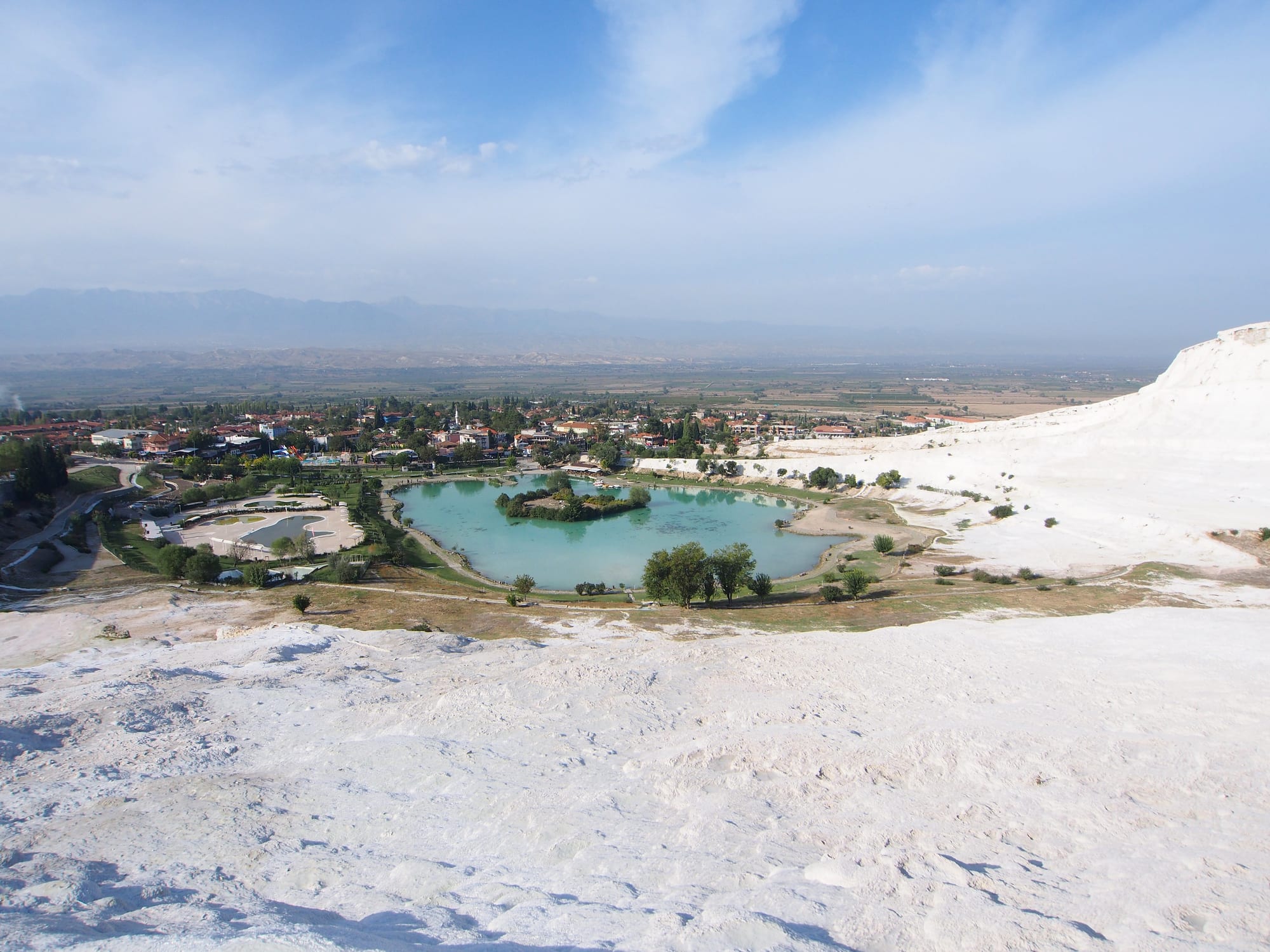
A village of low red-roofed houses and a turquoise lake seen from a slope of brilliant white travertine rock, with a wide plain and hazy mountains behind

The Aegean, Turkey

Pamukkale

Pamukkale village and its lake seen from the white travertine slope above it. (rheins / Wikimedia Commons · CC BY 3.0)

A small village in Denizli province, western Turkey, below the white travertine terraces that give it its name — 'cotton castle' in Turkish. Calcium-rich hot springs have built the shelves of white rock over millennia, and the Greco-Roman spa city of Hierapolis stands on the ridge above them. Together they form a UNESCO World Heritage Site, and the village lives almost entirely from visitors to it.

Neighbourhoods

  • Pamukkale village
    • First-time visitors
    • Close to the terraces
    • Budget pensions

    The grid of low streets directly below the white slope, built up since the 1980s with family-run pensions, small hotels and restaurants. Almost everything is within a few minutes' walk of the lower entrance to the terraces, and the village park and its lake sit at the foot of the rock.

    Open in Maps
  • The ridge and Hierapolis
    • Ancient ruins
    • Walks and viewpoints
    • Thermal pools

    The plateau above the terraces holds the ruined city of Hierapolis, spread over a wide site with a theatre, colonnaded street, baths and one of the best-preserved ancient cemeteries in Turkey. Two gates, north and south, serve drivers, while the barefoot path up the travertine climbs from the village.

    Open in Maps
  • Karahayıt
    • Thermal spa hotels
    • Quiet and residential

    A separate village about five kilometres north, where mineral springs have stained the rock red and orange. Most of the area's larger thermal hotels are here rather than in Pamukkale itself, which suits visitors who have come for the water rather than the ruins.

    Open in Maps
  • Denizli
    • Transport connections
    • City life
    • Shopping

    The provincial capital on the plain below, a textile city of nearly 700,000 people about twenty kilometres away. It has the bus terminal, the train station, the airport road and ordinary Turkish city life, and minibuses run to Pamukkale through the day.

    Open in Maps

Things to do

The terraces and the ancient city

  • The travertine terraceslandmark

    Shelves and basins of white calcium carbonate deposited by hot springs down a slope some 2.7 kilometres long, crossed on foot without shoes along a marked channel of shallow warm water.

    Open in Maps
  • Hierapolislandmark

    The Greco-Roman spa city founded in the 3rd century BC on the ridge above the springs, with a colonnaded street, monumental gates, baths, a nymphaeum and a vast necropolis of tombs.

    Open in Maps
  • Ploutonion at Hierapolislandmark

    A grotto beside the sanctuary of Apollo from which carbon dioxide still seeps, treated in antiquity as an entrance to the underworld and described by ancient writers.

    Open in Maps

Ancient cities of the Lycus valley

  • Laodicea on the Lycuslandmark

    A large Roman city on the plain south of Pamukkale, one of the seven churches of Asia named in the Book of Revelation, with two theatres, a stadium and excavated streets.

    Open in Maps
  • Colossaelandmark

    The mound of the city addressed in Paul's Epistle to the Colossians, in farmland a few kilometres north of Honaz, south-east of the valley, where excavation began in 2021.

    Open in Maps
  • Tripolis on the Meanderlandmark

    A Roman and Byzantine city near Yenicekent in the Buldan district, north-west of Pamukkale, with a theatre, baths, city walls and a necropolis.

    Open in Maps

Short trips

  • Aphrodisiaslandmark

    A marble city in the hills of Aydın province, a UNESCO World Heritage Site known for its sculpture school, tetrapylon gateway and long stadium.

    Open in Maps
  • Buldanneighborhood

    A hill town north-west of the valley, long a centre of hand-weaving and known for the fine cotton cloth called Buldan bezi.

    Open in Maps
  • Denizlineighborhood

    The provincial capital, a centre of Turkish textile manufacturing, with a bazaar quarter, city parks and the region's transport links.

    Open in Maps

Eat and drink

Long-standing places and food districts in Pamukkale. Hours, ratings and directions come from your maps app, always current.

Eating in the village

  • Pamukkale village restaurantsneighborhood

    A short run of family-run places along the main streets below the terraces, serving grills, pide, mezes and the slow-cooked vegetable dishes in olive oil that the Aegean is known for. Many pensions cook for their own guests as well.

    Open in Maps
  • Karahayıtneighborhood

    The thermal village north of Pamukkale, where hotel restaurants and a small market street serve much the same Turkish menu to spa visitors, many of them domestic.

    Open in Maps

Denizli food

  • Denizli city centreneighborhood

    The provincial capital, where charcoal-grilled çöp şiş eaten with the local strained süzme yoghurt is the favourite, served in the kebab houses and market streets of the centre.

    Open in Maps
  • Denizli's leblebi and fig stallsmarket

    Roasted chickpeas, dried figs from the Menderes valley, walnuts and pekmez grape molasses are sold in the market streets and at roadside stalls along the valley.

    Open in Maps

Experience Pamukkale

History

The springs made the place long before the village did. Hot water saturated with calcium carbonate has risen here for thousands of years, and as it cools and gives off carbon dioxide it leaves a white deposit that has built the terraces into a slope of travertine more than two kilometres long. The Greeks connected the springs with the god Apollo and with a Phrygian mother goddess, and a shrine stood above them before any city did.

Hierapolis was founded on the ridge in the 3rd century BC by the Seleucids, on the site of a Phrygian cult centre, was raised to city status by the Attalid kings of Pergamon, and passed to Rome in 133 BC with the rest of their kingdom. It grew wealthy as a spa and a wool-dyeing town, drawing the sick and the curious to its waters; earthquakes levelled it more than once, and the city visible today is largely the rebuilding that followed the disaster of 60 AD. A large Jewish community lived there, and a Christian one followed: tradition holds that the apostle Philip died at Hierapolis, and a martyrium was built on the hill in his honour. The city continued under Byzantine rule as a bishopric, came under Seljuk control in the 12th century, and the settlement that followed it was abandoned in the late 14th.

The modern village grew up below the slope only in recent generations, and its fortunes changed entirely with mass tourism. By the 1980s hotels had been built on top of the travertine itself, damaging both the ancient city and the formations. Hierapolis-Pamukkale was inscribed as a UNESCO World Heritage Site in 1988, those buildings have since been removed, and the water is now managed by closing sections in turn so that the white deposit keeps forming. The village below has taken their place.

Culture & Customs

Pamukkale is a working village that has become a resort, and both halves are visible. Farming continues on the plain — cotton, vines, fruit and vegetables — while the streets nearest the terraces are given over to pensions, carpet and souvenir shops and restaurants with picture menus. Many families run the guesthouses themselves, and the hospitality is of the kind where the owner brings tea and sits down with it.

The wider culture is that of the Denizli countryside rather than the coast: a conservative Aegean province, more religious than İzmir and less used to foreign visitors than Bodrum, though decades of tourism have made English, German and Russian common in the village. Denizli is known nationally for the Denizli chicken, a breed of long-crowing rooster, and for textiles, which have employed the valley for centuries and were already the basis of Hierapolis's wealth when the city dyed wool in the mineral water.

Bathing has been the point of the place for two thousand years, and the etiquette of it is still local: the thermal pool among the fallen columns at Hierapolis, the red-tinged water at Karahayıt and the domestic spa hotels are visited by Turkish families for health as much as for pleasure, often for a course of several days. Foreign visitors, who mostly come for a few hours, see a different Pamukkale from the one its regulars know.

Daily Life

Only a few thousand people live in the village itself, in a district of the same name that reaches into the city of Denizli, where several hundred thousand people live on the plain below. The village population rises and falls with the season: almost every household is connected to tourism, and many take other work in Denizli's factories in winter, when hotels run at a fraction of capacity.

The valley economy is agricultural and industrial in equal measure. Denizli is one of Turkey's textile centres, exporting towels, bathrobes and home linen, and the plain grows cotton, grapes, figs and olives. Travertine and marble are quarried in the province and exported as stone, an industry that shares its name with the formations above the village. Thermal water supports a spa sector centred on Karahayıt that is largely domestic.

The day starts early for both farming and tour groups. Coaches arrive from the coast in the middle of the morning and again in the afternoon, and the village is at its quietest at dawn and after sunset, when the terraces hold the light. Water is the recurring local issue: the springs must be shared between the formations, the spa hotels and agriculture, and the terraces are managed by rotating the flow between sections so that the white deposit keeps forming. Traffic on the Denizli road and new building at the edge of the village are the other subjects of local argument.

Food

The food is that of the inland Aegean: lighter and more vegetable-heavy than central Anatolia, built on olive oil, yoghurt and bread. Village restaurants serve mezes of aubergine, beans and wild greens dressed with lemon, gözleme — thin flatbread folded over cheese, potato or spinach and cooked on a griddle — and the standard grills of köfte and chicken. Pide, the boat-shaped flatbread baked with cheese, egg or minced meat, is the everyday hot meal.

In Denizli the kebab people go for is çöp şiş, thin skewers of charcoal-grilled lamb eaten with the local strained süzme yoghurt and often a glass of rakı. The province is also known for leblebi, dried chickpeas roasted until crisp and sold plain, salted or coated, and for its dried figs and sultanas from the Büyük Menderes valley below. Pekmez, a thick molasses boiled down from grape juice, is eaten with tahini for breakfast, and tarhana — dried fermented yoghurt, grain and vegetables — is made in summer to become winter soup.

Breakfast is the meal visitors remember: a spread of white cheese, olives, tomatoes, cucumber, honey with clotted kaymak, jams, eggs and endless small glasses of tea. Ayran, salted diluted yoghurt, accompanies grilled meat. The Çal district of Denizli gives its name to Çal Karası, an indigenous red grape of the inland Aegean, while grape juice, mulberry juice and Turkish coffee are the usual non-alcoholic choices.

Planning tools

Budget

One of the cheaper places to stay in the Aegean region. Pensions in the village cost a fraction of coastal hotel prices, meals are inexpensive, and the main expense for foreign visitors is the entry ticket to Hierapolis-Pamukkale, with a separate charge for the warm antique pool. Thermal hotels at Karahayıt cost more and usually include meals.

Daily Budget Midrange
USD 100–220 (thermal or boutique hotel, restaurant dinners, site tickets, a hire car or day tour)
Daily Budget Shoestring
USD 30–55 (village pension, lokanta meals, dolmuş from Denizli, site ticket)

Staying in the village rather than in Denizli puts the terraces within walking distance and allows an early or late visit when the site is quietest and the light best.

Best Time to Visit

April to June and September to October, when the plain is warm rather than scorching and the ruins can be walked at midday. July and August bring hard heat and the largest tour groups, although the shallow water on the terraces is a relief. Winter is cold and can be wet, but the springs stay warm, prices fall and the site is close to empty.

Suggested Number of Days

Most of what draws people here can be seen in a single long visit, and many arrive and leave the same day. An overnight stay allows an early or late start when the crowds are thinnest, and two to three days suits anyone who wants the other ancient cities of the valley as well.

First Visit
1 day
With Surroundings
2–3 days

Transportation

The village is small enough to cross on foot. Minibuses run frequently between Denizli's bus terminal and Pamukkale, taking around half an hour, and continue to Karahayıt. Taxis wait in the village, and a hire car is the simplest way to reach Laodicea, Tripolis and Aphrodisias, which have little public transport. Buses between the Hierapolis gates save the climb for those who cannot manage the travertine path.

Shoes must be carried rather than worn on the travertine, so pack a bag for them; the surface is hard and in places sharp underfoot.

Airport & Station Connections

Denizli Çardak Airport lies east of the village, about an hour away by road, and handles domestic flights. Denizli is a major intercity bus hub, with long-distance services from Istanbul, İzmir, Antalya and the coastal resorts, and trains run from İzmir through Selçuk and Aydın to Denizli station. From Denizli it is a short minibus ride to the village.

Walkability

Pamukkale village can be walked end to end in about ten minutes, and the lower entrance to the terraces is at its edge. The site above is large and exposed: walking barefoot up the travertine and then across Hierapolis to the theatre and the necropolis covers several kilometres with almost no shade. The travertine is slippery in places and uneven, and the ancient site has rough stone footing throughout.

Safety

A quiet village with very little crime. The real risks are heat and sun on an open white surface that reflects strongly, slips on wet travertine, and uneven ground among the ruins. The thermal water is hot at source, and the region is seismically active.

Carry water, a hat and sun cream, use sunglasses against the glare off the white rock, step carefully on wet travertine, and keep to the marked route rather than walking on protected formations. Check current official travel advice before travelling.

Climate

A Mediterranean climate with a continental edge, on a plain enclosed by mountains. Summers are long, hot and dry; winters are cool and are the wet season, with rain rather than snow at village level and snow on the surrounding heights.

Summer
hot and dry — July and August days are commonly 33–37°C, with cooler evenings
Winter
cool and wet — January days are typically 8–12°C, with frosty nights

Local Customs

Shoes are removed before walking on the travertine, a rule that is enforced, and bathing is allowed only in the pools set aside for it. Tipping of around ten per cent is usual in restaurants. Modest dress is expected in the village mosque and appreciated in the streets, even though swimwear is normal at the pools. Turkish tea is offered constantly and refusing it outright can seem brusque.

Removing travertine, coins or stone from the site is illegal, as is taking antiquities out of Turkey; ask before photographing villagers or stallholders.

Common Payment Methods

The currency is the Turkish lira. Cards and contactless payment are taken by hotels, the site ticket office and most restaurants, but small pensions, minibuses, market stalls and village cafés often want cash. ATMs are in the village and plentiful in Denizli, and changing money is easier in the city.