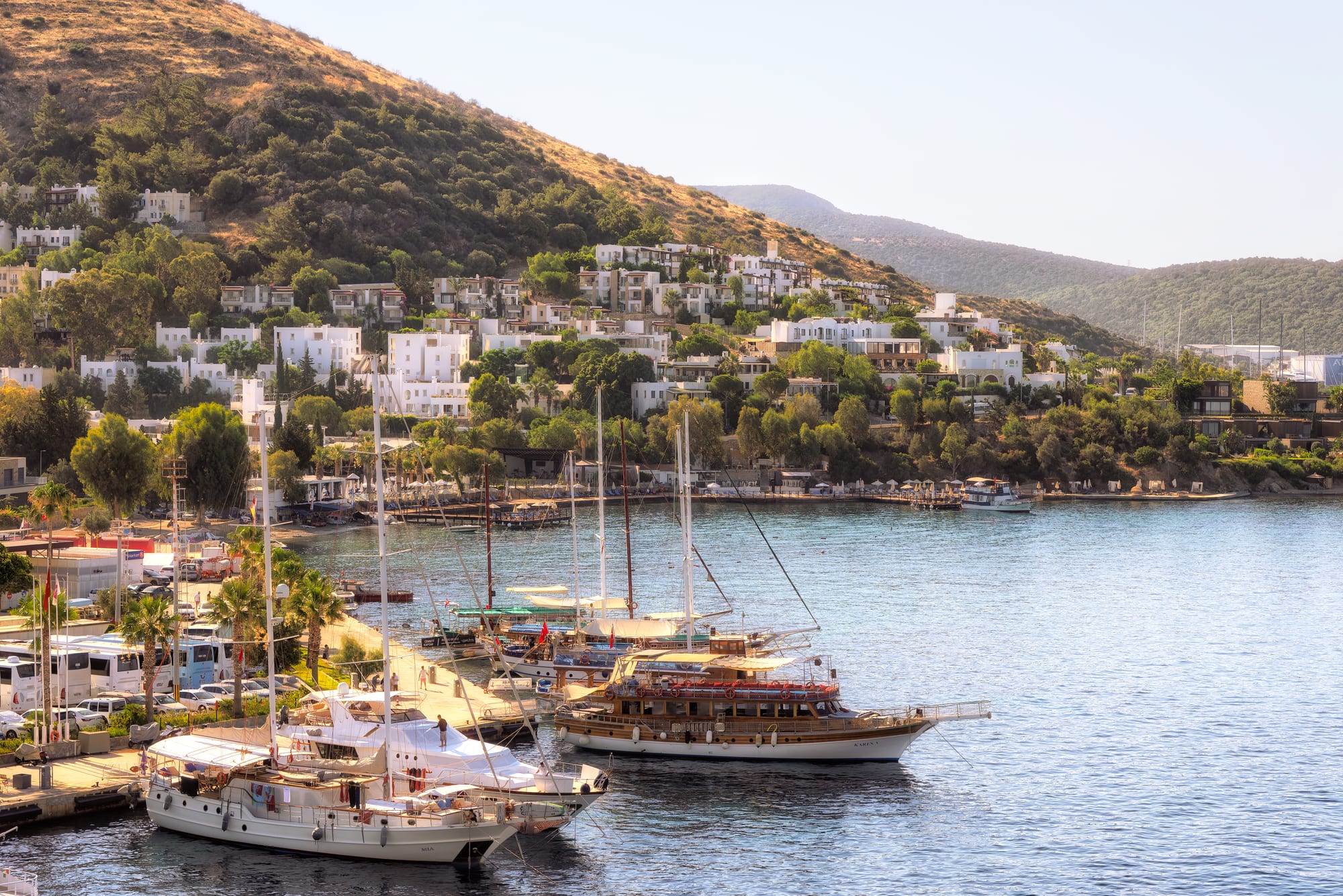
Wooden gulet yachts moored along a quay in a calm blue bay, with white cube houses climbing a green hillside behind

The Aegean, Turkey

Bodrum

Wooden gulets moored in Bodrum harbour below the white houses of the hillside. (Mustang Joe / Wikimedia Commons · CC0)

A resort town on the Aegean coast of Muğla province, built around a crusader castle on a headland between two bays. It stands on ancient Halicarnassus, capital of the Carian king Mausolus and birthplace of Herodotus. Sponge diving and boat building gave way to tourism from the 1970s, and whitewashed houses now spread across the peninsula around it.

Neighbourhoods

  • The town centre and the castle
    • First-time visitors
    • Historic district
    • Nightlife

    The old core between the two bays, with the castle on the headland, the marina on one side and a long bar street on the other. Whitewashed lanes of shops and restaurants run back from the water, and the bus station, ferry pier and most small hotels are within walking distance.

    Open in Maps
  • Gümbet
    • Beaches
    • Budget stays
    • Nightlife

    A bay just west of the town over a low hill, lined with hotels, apartment blocks and a sandy beach with water sports. It is the cheapest and busiest part of the peninsula in summer, with a concentration of bars and package accommodation.

    Open in Maps
  • Bitez
    • Families
    • Quiet and residential
    • Beaches

    A shallow bay of citrus groves and low hotels a short drive west, with a beachfront of cafés and a calm blue-flag beach that suits families. Quieter than Gümbet and easy to reach by minibus.

    Open in Maps
  • Yalıkavak
    • Marinas
    • Restaurants
    • Sunsets

    A former sponge-diving village on the north-western side of the peninsula, now built around a large yacht marina with expensive restaurants and shops. The bays nearby face the sunset.

    Open in Maps
  • Turgutreis
    • Beaches
    • Local life
    • Sunsets

    A town at the western tip of the peninsula, named after the Ottoman admiral Turgut Reis, who was born there in 1485. It has a long beach, a marina, a weekly market and ferries to the Greek island of Kos in season.

    Open in Maps
  • Göltürkbükü
    • Quiet and residential
    • Waterfront dining

    Two villages on the northern shore, Gölköy and Türkbükü, joined into one municipality and long favoured by Istanbul holidaymakers, with restaurants and hotels along the water. Expensive in season and sleepy outside it.

    Open in Maps

Things to do

Landmarks and ancient sites

  • Bodrum Castlelandmark

    The Castle of St Peter, begun by the Knights Hospitaller in the early 15th century on the headland between the bays and built partly from the stones of the ruined Mausoleum.

    Open in Maps
  • Mausoleum at Halicarnassuslandmark

    The site of the monumental tomb of the Carian ruler Mausolus, one of the Seven Wonders of the ancient world, now an excavated enclosure of foundations and fallen blocks in the town.

    Open in Maps
  • Theatre of Halicarnassuslandmark

    A theatre of the 4th century BC cut into the hillside above the town, restored and used for concerts and festivals, with a view over the bay and the castle.

    Open in Maps
  • Myndos Gatelandmark

    The towered western gate of the city walls of Halicarnassus, on the western edge of the town, named for the road towards ancient Myndos at the tip of the peninsula; one of its two towers still stands to nearly its full height.

    Open in Maps

Museums

  • Bodrum Museum of Underwater Archaeologymuseum

    Housed inside the castle, one of the major collections of shipwreck archaeology in the world, including finds from the Bronze Age Uluburun wreck.

    Open in Maps
  • Zeki Müren Art Museummuseum

    The house of the singer Zeki Müren, who spent his later years in the town, opened to the public in 2000 as a museum of his costumes, instruments and rooms.

    Open in Maps

Beaches and the peninsula

  • Gümbetbeach

    The closest large beach to the town, a sandy bay of hotels, loungers and water sports over the hill to the west.

    Open in Maps
  • Bitezbeach

    A sheltered bay backed by citrus groves, with shallow water and beachfront cafés.

    Open in Maps
  • Yalıkavakattraction

    A marina village on the north-west coast, once the area's main sponge-diving port, with small bays along the shore nearby.

    Open in Maps
  • Gulet cruises from the harbourattraction

    Wooden gulets, the broad-beamed boats built in the town for generations, run day trips and longer charters around the bays and islands of the coast.

    Open in Maps

Short trips from the town

  • Kosattraction

    The Greek island opposite, visible across the strait and reached by passenger ferry in under an hour, with its own castle and ancient sites.

    Open in Maps
  • Euromoslandmark

    An ancient Carian city inland, north-west of Milas, whose temple of Zeus Lepsynos, built under Hadrian, is one of the best-preserved classical temples in Turkey.

    Open in Maps
  • Milasattraction

    The old town of the Carian interior, with Roman and Ottoman monuments, a carpet-weaving tradition and the fortress hill of Beçin nearby.

    Open in Maps

Seasonal events

  • The Bodrum Cupautumn

    A regatta of wooden gulets and sailing yachts around the peninsula and the neighbouring bays, held annually in autumn.

  • Bodrum International Ballet Festivalsummer

    Open-air performances of ballet, opera and dance staged in the ancient theatre above the town, held every summer since 2002.

  • Summer seasonJune to September

    The months when the peninsula fills, boats run daily from the harbour and the bar streets and marinas stay open into the early hours.

Eat and drink

Long-standing places and food districts in Bodrum. Hours, ratings and directions come from your maps app, always current.

Bodrum classics

  • Çökertme kebabırestaurant

    The dish of the Bodrum area — strips of marinated veal over fried potato with garlic yoghurt and tomato sauce, named after Çökertme, a village in the neighbouring Milas district.

    Open in Maps
  • Fish and Aegean mezerestaurant

    Sea bass, bream, octopus and samphire with olive oil, lemon and rakı are the standard evening meal along the harbour and in the peninsula villages.

    Open in Maps

Markets and food streets

  • Bodrum weekly marketmarket

    The covered market days bring vegetables, herbs, cheeses, olives and the peninsula's tangerines, with separate days for textiles and household goods.

    Open in Maps
  • Turgutreis marketmarket

    A weekly market in the western town of the peninsula, busy with both residents and visitors.

    Open in Maps
  • Bar Street and the marinaneighborhood

    The eastern bay's long strip of bars and clubs and the quieter marina side opposite hold most of the town's nightlife and its more expensive restaurants.

    Open in Maps

Experience Bodrum

History

The town stands on Halicarnassus, a Dorian Greek foundation that became the seat of the Carian dynasty of the Hecatomnids in the 4th century BC. Mausolus moved his capital here and rebuilt the city on a grand scale; after his death his sister and widow Artemisia completed the monumental tomb that took his name, the Mausoleum, counted among the Seven Wonders of the ancient world. Herodotus, the first Greek historian, was born in the city in the 5th century BC. Alexander the Great besieged and largely destroyed it in 334 BC, and it never recovered its importance.

The Mausoleum stood for centuries before earthquakes brought it down. In the early 15th century the Knights Hospitaller of Rhodes built the Castle of St Peter on the headland, quarrying the ruins for stone, and the fortress gave the town its later name — Petronium became Bodrum. Suleiman the Magnificent took the castle in 1523 after the fall of Rhodes, and under the Ottomans it settled into a small harbour town of fishermen, boat builders and sponge divers.

That quiet lasted into the 20th century, when Bodrum was remote enough to serve as a place of internal exile. The writer Cevat Şakir Kabaağaçlı, exiled here in 1925 and known as the Fisherman of Halicarnassus, served his sentence in the town and made its coast famous in Turkish literature. The castle became a museum of underwater archaeology from the 1960s, an airport opened in the 1990s, and package holidays, marinas and second homes transformed the peninsula from the 1970s onward into one of the best-known resort areas in the country.

Culture & Customs

Bodrum has a reputation in Turkey for being liberal, artistic and expensive, in roughly equal measure. Since the mid-20th century it has drawn writers, painters and musicians as well as holidaymakers, an association that began with the Fisherman of Halicarnassus and his circle, and its identity as a place apart from mainstream Turkish conservatism is carefully maintained. The singer Zeki Müren, one of the great figures of Turkish classical song, lived his last years here, and his house is now a museum.

The sea shapes local culture more than anything else. Sponge diving supported the peninsula's villages for generations and is still remembered in Yalıkavak, once the area's main sponge-diving port, and the broad wooden gulet, built in the town's yards, is both a working boat and an emblem — the autumn regatta around the peninsula is the year's sailing event. The white cube houses with blue doors and windows, their walls traditionally limewashed for the insect-repellent properties of lime, give the town its recognisable look.

Summer nights are central to the town's character, with a long bar street, clubs and marina restaurants busy until dawn, while the inland villages of the peninsula keep to a slower, more traditional life of olive and tangerine farming. Visitors move between the two without difficulty, but dress and noise that pass on the seafront are noticed a few kilometres inland.

Daily Life

The district of Bodrum covers the whole peninsula, 689 square kilometres with 215 kilometres of coastline, and its permanent residents are spread across the town and the villages, a number that multiplies several times over in July and August. The town itself is modest in size; growth over the past fifty years has gone into the surrounding villages, which have merged into a near-continuous band of low white housing along the coast roads.

Tourism dominates the economy — hotels, restaurants, marinas, boat charters, property and construction — supported by yacht building and maintenance, fishing, and the farming that survives inland: olives, tangerines and market vegetables. Work is intensely seasonal, with many businesses trading for five or six months and staff arriving from elsewhere in Turkey for the summer.

The seasonal swing sets the rhythm of the year. Roads, water supply and rubbish collection strain in August and the peninsula empties in November, when many places shut and the resident population returns to its own routines. Long-running local concerns include the cost of housing, water shortages in dry summers, pressure from new building on the coastline, and wildfire risk in the pine hills behind the bays.

Food

The Aegean style of cooking is at its clearest here: vegetables and wild greens simmered in olive oil and served cool, samphire dressed with lemon and garlic, stuffed courgette flowers, and cheese and herb pastries. Meze are the point of an evening meal, laid out in numbers and eaten slowly with rakı while the fish grills.

Fish and seafood follow the season — sea bass, bream, red mullet, octopus and calamari — and are usually cooked simply over charcoal. The dish most closely identified with the area is çökertme kebabı, strips of marinated veal laid over fried potato with garlic yoghurt and tomato sauce, named for a village in the neighbouring Milas district. Tarhana soup, made from dried fermented yoghurt and grain, is the regional winter staple.

The peninsula grows its own produce in the gaps between hotels: citrus from the groves behind Bitez, olives and olive oil, almonds and figs, and herbs gathered in spring. Markets rotate through the villages by day of the week and sell all of it alongside cheeses from the Muğla hills. The town's cafés serve Turkish coffee and tea from early morning to very late.

Planning tools

Budget

Bodrum spans the whole price range. Gümbet and the inland streets of the town are inexpensive, while the marinas at Yalıkavak and the waterfront restaurants of Göltürkbükü are among the costliest places in Turkey in high summer. Prices roughly halve outside July and August, when many hotels and restaurants close altogether.

Daily Budget Midrange
USD 110–220 (hotel near the centre, fish dinners, a boat day trip, taxis or a hire car)
Daily Budget Shoestring
USD 40–70 (pension or budget hotel in Gümbet, lokanta meals, dolmuş minibuses)

Visit in June or September for lower rates and open restaurants, and agree the price of a boat trip and what it includes before boarding.

Best Time to Visit

May, June, September and early October are the most comfortable months, with warm sea, open businesses and manageable crowds. July and August are hot, expensive and crowded, and the peninsula's roads jam at weekends. Winter is mild but wet, and much of the coast closes down, though the town centre and castle stay open.

Suggested Number of Days

Two or three days cover the town, the castle and a boat trip. Four to six allow for the rest of the peninsula, a beach base and the ancient sites inland. Anyone chartering a boat usually plans a week.

First Visit
2–3 days
With Surroundings
4–6 days

Transportation

Dolmuş minibuses are the backbone of the peninsula, running frequently between the town's bus station and every village, with fewer services in winter. Taxis are plentiful and expensive, and a hire car or scooter gives the most freedom, although the roads are narrow, steep and busy in summer. Sea taxis and ferries cross between the bays and to the Greek islands, and the centre itself is best covered on foot.

Parking in the centre is difficult in season, so many visitors leave a car at the hotel and use minibuses or the water.

Airport & Station Connections

Milas–Bodrum Airport lies about 35 kilometres north-east, roughly 45 minutes by road, and handles domestic flights year round with many international charters in summer. Intercity buses run from İzmir in about three and a half hours and from Istanbul overnight. Passenger ferries link the town and Turgutreis with Kos and other Greek islands in season, and catamarans cross the gulf to Datça.

Walkability

The town centre is walkable and mostly flat along the two bays, with the castle, the Mausoleum site and the harbour all within twenty minutes of each other. Beyond it the peninsula is hilly, spread out and built for cars, and the beach villages are several kilometres apart. Pavements are narrow, and walking at night on the connecting roads is best avoided.

Safety

Bodrum is a safe, heavily policed resort. The usual problems are overcharging in bars and on boat trips, drink spiking in a small number of nightlife venues, petty theft on beaches, scooter and road accidents, and strong sun. Forest fires are a real summer risk in the pine-covered hills of Muğla, and the region is seismically active.

Agree prices for taxis and boats in advance, keep sight of drinks in clubs, wear a helmet on a scooter, and follow official instructions during a wildfire. Check current official travel advice before travelling.

Climate

A Mediterranean climate at its driest and sunniest on the peninsula: rainless summers cooled by a sea breeze, and mild, wet winters. The sea stays warm enough for swimming well into October.

Summer
hot and dry, typically 32–36°C by day, with long sunshine and little humidity by the water
Winter
mild and wet, typically 10–16°C by day, with most rain from November to March

Local Customs

Bodrum is the most relaxed corner of a relaxed coast: beachwear is normal on the shore, alcohol is served everywhere, and nightlife runs very late. Away from the resorts the peninsula's villages are more conservative, and the usual Turkish courtesies apply — shoes off in homes, modest dress and a head covering for women in mosques, and tea accepted when offered.

Cover up when leaving the beach for the town, tip around ten per cent in restaurants, and ask before photographing villagers or market traders.

Common Payment Methods

The currency is the Turkish lira. Cards and contactless payment are accepted almost everywhere on the peninsula, and ATMs are common. Cash is useful for minibuses, markets and small beach places. Some marina businesses quote in euros, and paying in lira is usually cheaper.