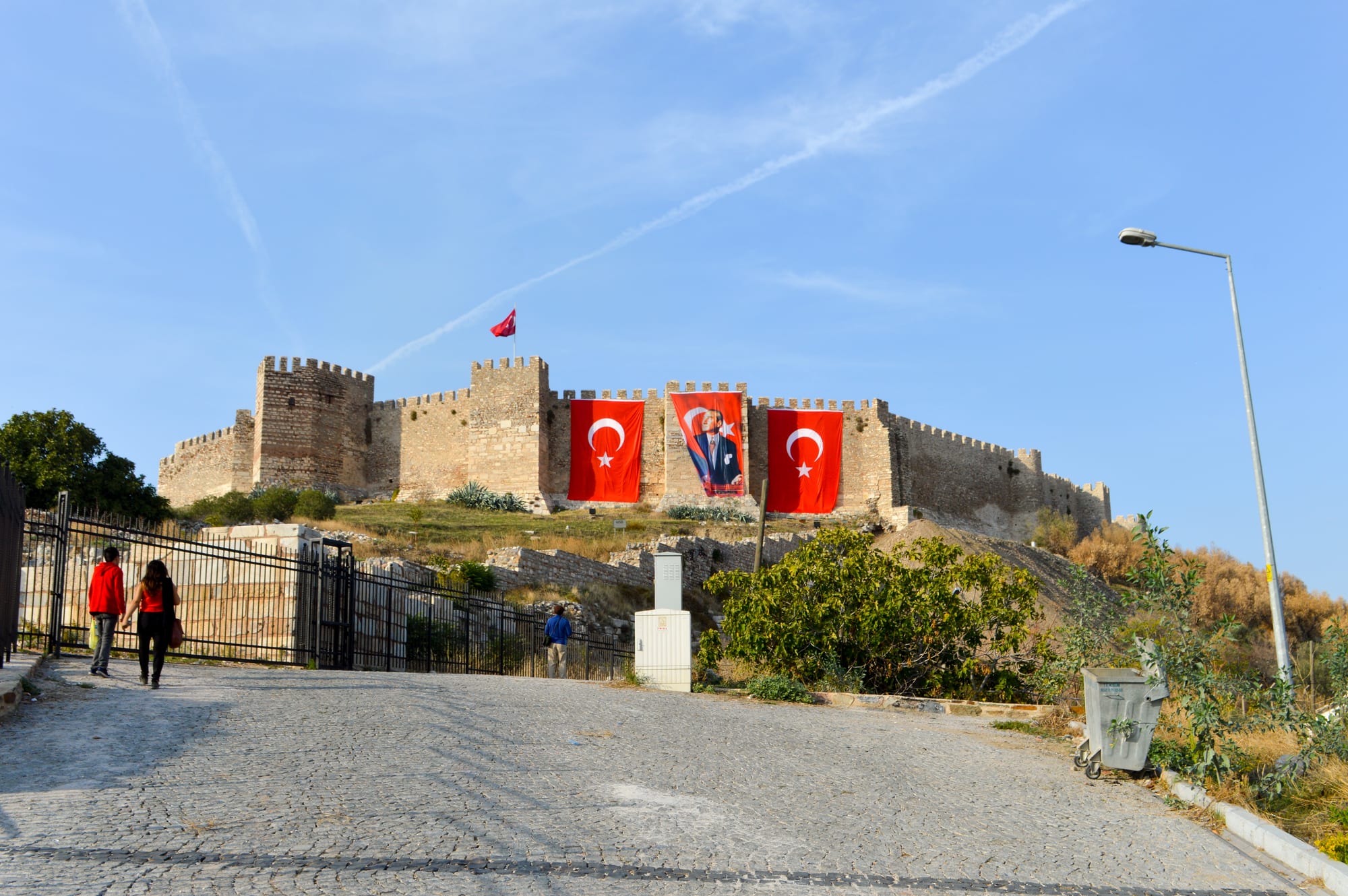
A long battlemented stone fortress on a low grassy hill above a cobbled road, with Turkish flags hung on its wall under a clear sky

The Aegean, Turkey

Selçuk

The fortress on Ayasuluk Hill above the town of Selçuk. (Francisco Anzola / Wikimedia Commons · CC BY 2.0)

A small town in İzmir province on Turkey's Aegean coast, standing beside the ruins of Ephesus. Its own hill, Ayasuluk, carries a Byzantine fortress and the Basilica of St John, and a 14th-century mosque and the last column of the Temple of Artemis lie below. Farming, olive groves and a steady flow of visitors to the ancient city support it.

Neighbourhoods

  • The town centre
    • First-time visitors
    • Close to public transport
    • Best for food

    A compact grid of low streets around the main square, the bus station and the railway line, with the arches of a Byzantine aqueduct running through it. Most of the pensions, restaurants and shops are within a few minutes' walk of each other.

    Open in Maps
  • Around Ayasuluk Hill
    • Historic district
    • Quiet streets
    • Viewpoints

    The northern edge of town beneath the fortress, where the Basilica of St John, the İsa Bey Mosque and the old Turkish quarter of stone and timber houses stand together. It is the quietest and oldest-feeling part of the town, and the hill gives a view over the plain towards the sea.

    Open in Maps
  • Şirince
    • Wine
    • Quiet and residential
    • Day trips

    A hill village about eight kilometres east, whose Greek Orthodox inhabitants left in the early 1920s, now restored as a place of guest houses, fruit wines and craft stalls. It is busy with day visitors in the middle of the day and very quiet in the evening.

    Open in Maps
  • Pamucak and the coast
    • Beaches
    • Quiet and residential

    The shore of the district, several kilometres west of the town, where a long sandy beach backed by farmland and a few hotels faces the Aegean. It is uncrowded compared with the resorts to the south and reached by road or seasonal minibus.

    Open in Maps

Things to do

Ancient sites

  • Ephesuslandmark

    The great Roman city of the province of Asia, a UNESCO World Heritage Site about three kilometres from the town, with the Library of Celsus, the Great Theatre, marble streets and the painted terrace houses.

    Open in Maps
  • Temple of Artemislandmark

    One of the Seven Wonders of the ancient world, of which a single reassembled column now stands in a marshy field on the edge of the town.

    Open in Maps
  • Basilica of St Johnlandmark

    The ruins of a domed 6th-century church built by Justinian on Ayasuluk Hill over the site traditionally held to be the tomb of John the Evangelist.

    Open in Maps
  • House of the Virgin Marylandmark

    A small stone chapel on the wooded slopes of Bülbül Dağı above Ephesus, venerated by Catholic and Muslim visitors as the place where Mary spent her last years.

    Open in Maps

The town

  • Ayasuluk Castlelandmark

    The walled citadel crowning the hill above the town, of Byzantine origin and rebuilt in the Turkish period, with a mosque and cisterns inside its curtain of towers.

    Open in Maps
  • İsa Bey Mosquelandmark

    A mosque of 1375 built for the Aydınid ruler İsa Bey below the hill, with a courtyard, reused ancient columns and carved stonework.

    Open in Maps
  • Ephesus Archaeological Museummuseum

    The town museum holding the finds from Ephesus, including the marble statue of Artemis covered in rows of bulbous ornaments.

    Open in Maps

Short trips from the town

  • Şirinceattraction

    A restored hill village of old Greek houses above the town, known for its fruit wines, olive oil and market stalls.

    Open in Maps
  • Kuşadasıattraction

    The cruise port and resort town on the coast to the south, with a long seafront, a fortified islet and beaches either side.

    Open in Maps
  • Prienelandmark

    A Hellenistic city on terraces below the escarpment of Mycale, north of the Büyük Menderes and about thirty kilometres south of the town, laid out on a strict grid and one of the best preserved of the Ionian sites.

    Open in Maps

Seasonal events

  • Selçuk–Efes camel wrestling festivalJanuary

    Bull camels in decorated harness are matched against each other at Pamucak on the coast west of the town, on the third Sunday of January, in one of the best-regarded events of the Aegean camel-wrestling season, which runs from November to March.

  • Feast of the Assumption at the House of the Virgin Marymid-August

    The shrine above Ephesus draws pilgrims around the Feast of the Assumption in mid-August, and Christian and Muslim visitors come to it through the year.

  • Spring at the ancient sitesMarch to May

    Wild flowers cover the ruins and the plain around the town is at its greenest before the summer heat sets in.

Eat and drink

Long-standing places and food districts in Selçuk. Hours, ratings and directions come from your maps app, always current.

Selçuk classics

  • Çöp şişrestaurant

    Lamb marinated with garlic, tomato and herbs and grilled on thin wooden skewers, served with grilled peppers, onion and bread; a kebab eaten across Anatolia and a staple of the grill houses here.

    Open in Maps
  • Gözleme and village breakfastrestaurant

    Thin pastries filled with cheese, potato or wild greens, cooked on a griddle and eaten with tea, alongside breakfast spreads of local olives, cheese and preserves.

    Open in Maps

Markets and food streets

  • Selçuk weekly marketmarket

    The weekly street market fills several blocks with fruit, vegetables, cheese, olives and household goods from the surrounding villages.

    Open in Maps
  • Restaurants around the centreneighborhood

    The streets between the main square and the museum hold most of the town's kebab houses, meze restaurants and courtyard cafés.

    Open in Maps
  • Şirince wine stallsmarket

    The village above the town sells homemade fruit wines, olive oil and dried fruit from stalls along its lanes.

    Open in Maps

Experience Selçuk

History

The hill of Ayasuluk on which the town stands was inhabited long before the Roman city beside it: Bronze Age settlement here is linked with Apasa, a capital mentioned in Hittite records. Ephesus itself grew up on the plain below around the sanctuary of Artemis, whose temple, rebuilt in the 4th century BC, was counted among the Seven Wonders of the ancient world. Under Rome the city became the capital of the province of Asia, a centre of early Christianity where Paul preached and to which one of the letters of Revelation was addressed.

The harbour was the city's making and its undoing. Silt carried down by the Küçük Menderes gradually closed it, trade fell away, and from late antiquity the population drifted up to the defensible hill. Justinian built a great domed basilica there in the 6th century over what was held to be the grave of John the Evangelist, and walls and a citadel followed as Arab raids struck the coast. The settlement became known as Ayasuluk, from the Greek for the holy theologian.

Turkish principalities took the region in the 13th and 14th centuries, and under the Aydınids the town flourished again as a port on a new outlet to the sea, with the İsa Bey Mosque built in 1375 as the high point of that period. The Ottomans absorbed the beylik in the 15th century, after which the town declined into a malarial village on a marshy plain. Systematic excavation of Ephesus began in the 19th century and continues today; the settlement was renamed Selçuk in 1914, malaria was cleared in the republican period, and from the 1970s tourism turned a farming town into one of the best-known small towns in Turkey.

Culture & Customs

Selçuk lives between two identities: an Aegean farming town of about the size where everyone knows everyone, and a place visited by millions over the decades because of what lies three kilometres away. The result is a town used to foreigners and largely relaxed about them, with pension owners who have hosted guests for two generations, and a main square where farmers, students and travellers share the same tea gardens.

The most distinctive local tradition is camel wrestling. Through the winter, decorated bull camels are brought to arenas across the Aegean countryside, and the January festival outside Selçuk is the biggest of them; it is as much a family picnic, with grilled sausage and music, as a contest. The region's other folk emblem is the zeybek, the slow, weighted dance of the Aegean hills, performed at weddings and public ceremonies.

Religion here is visible in several forms at once. The Basilica of St John and the House of the Virgin Mary draw Christian pilgrims, and the house is also visited by Muslim Turks, for whom Mary is a revered figure. The İsa Bey Mosque continues in use below the hill. The nearby village of Şirince, whose Greek Orthodox inhabitants left in the early 1920s, keeps that history in its stone houses and its Ottoman-era Christian architecture.

Daily Life

The district of Selçuk has about 38,000 residents, most of them in the town itself and the rest in villages spread across the plain and the hills. It is small enough to walk across in twenty minutes, and the bus station, the railway halt, the market place and the mosque are all within a few streets of each other.

Agriculture is still the base of the economy. The alluvial plain of the Küçük Menderes produces peaches, citrus, cotton and vegetables, olive groves cover the slopes, and livestock is kept in the villages; the weekly market is where much of it is sold. Tourism supplies the rest, through pensions, restaurants, guides, carpet and souvenir shops and the coach traffic from the cruise port at Kuşadası, and the work is strongly seasonal.

Daily rhythms are those of a hot-country town: early starts, a slow middle of the day in summer, and evenings in the tea gardens and on the square. The arches of the Byzantine aqueduct running through the centre are a fixture of the street scene. Concerns include the seasonality of work, water for irrigation in dry years, the balance between farmland and building, and the wish for visitors to stay a night rather than pass through on a coach.

Food

The cooking is Aegean and rural. Vegetables and wild greens stewed in olive oil, courgette flowers, artichokes and broad beans in spring, and salads of tomato, cucumber and herbs accompany almost every meal. Cheeses from the surrounding villages, home-cured olives, and bread from wood-fired ovens are the everyday staples, and breakfast is a long table of small dishes with tea.

A grill-house staple is çöp şiş: lamb marinated with garlic, tomato and herbs and grilled on thin wooden skewers rather than iron ones, served with grilled peppers, onion and bread; it is eaten across Anatolia and is common in the villages around the town. Kebab houses in the centre also do the standard Turkish grills, and gözleme — thin dough folded around cheese, potato or greens and cooked on a griddle — is sold at the market and by village women at the sites.

Fruit defines the sweet side. The plain grows peaches, figs and citrus, and dried figs from the Menderes valleys are a regional export. Şirince, in the hills above the town, is known for homemade fruit wines pressed from berries, apples and pomegranates, sold from stalls along its lanes, and for its olive oil. Turkish coffee and endless glasses of black tea punctuate the day, as everywhere in the region.

Planning tools

Budget

Selçuk is one of the cheaper bases on the Aegean coast, which is why many visitors stay here rather than in the nearby resorts. Family-run pensions cost far less than hotels in Kuşadası, and meals in the town centre are inexpensive. The largest single expense is the entry ticket to Ephesus, with a separate charge for the terrace houses.

Daily Budget Midrange
USD 80–160 (small hotel or boutique pension, restaurant dinners, site tickets, a hire car for a day)
Daily Budget Shoestring
USD 30–55 (pension or hostel, lokanta meals, trains and dolmuş minibuses)

Staying in Selçuk rather than Kuşadası cuts costs and puts Ephesus within walking distance; check whether a museum pass covers the sites planned.

Best Time to Visit

April to early June and September to October are the best months, when the ruins are warm rather than scorching and the fields around are green or freshly harvested. July and August bring heat above 35°C and large cruise groups at Ephesus. Winter is mild, wet and very quiet, with the camel wrestling season in January.

Suggested Number of Days

One full day covers the town and the main ancient site; two are more comfortable. Three suit a base for the wider area, including the hill village, the coast and the other Ionian ruins to the south.

First Visit
1–2 days
With Surroundings
3 days

Transportation

The town itself is walked. Dolmuş minibuses run to Ephesus, to Şirince, to Pamucak beach and to Kuşadası through the day, leaving from near the centre, and regional trains on the İzmir–Denizli line stop at the station in town. A hire car helps for the more distant ruins, and taxis wait at the square.

Minibuses are frequent in summer and thinner in winter, and the walk from the town to the main gate of Ephesus takes roughly forty minutes with little shade.

Airport & Station Connections

İzmir's Adnan Menderes Airport is about 55 kilometres north, roughly an hour by road, with trains from the airport station to Selçuk taking a little longer. Regional trains and intercity buses connect İzmir with the town, and buses run from Bodrum, Denizli and further afield. Cruise ships dock at Kuşadası, about 20 kilometres away, and passengers come by coach.

Walkability

The centre is flat, small and easily walked, and the museum, the mosque and the Temple of Artemis are all a few minutes apart. Ayasuluk Hill is a short climb. Ephesus is roughly three kilometres out along a road with a footpath for part of the way, walkable in cool weather but hot in summer, and the site itself involves a long walk over uneven marble.

Safety

Selçuk is a quiet town with little crime beyond occasional petty theft in crowds at the ancient sites. The real risks are heat and dehydration at Ephesus, where shade is scarce, slippery polished marble underfoot, and traffic on the road out to the site. The region is seismically active.

Visit the ruins early with water, a hat and shoes with grip, and agree taxi fares in advance. Check current official travel advice before travelling.

Climate

A Mediterranean climate on a low inland plain a few kilometres from the sea, which makes summers hotter and stiller than on the coast itself. Rain falls almost entirely between November and March.

Summer
hot and dry, typically 32–36°C by day, with very little rain and strong midday sun
Winter
mild and wet, typically 9–15°C by day, with rain and occasional frost at night

Local Customs

Manners are those of a small Aegean town: greetings matter, tea is offered in shops and refusing it flatly seems unfriendly, and bargaining is normal in souvenir shops but not in restaurants or food markets. Modest clothing and a head covering for women are expected in the mosque, and the chapel above Ephesus is a place of pilgrimage where quiet is asked for.

Cover shoulders and knees at religious sites, tip around ten per cent in restaurants, and ask before photographing people, particularly at the market.

Common Payment Methods

The currency is the Turkish lira. Cards are accepted in hotels, restaurants and at the site ticket offices, and there are ATMs in the centre. Cash is useful for minibuses, market stalls and village guest houses. Exchange rates in the town are usually better than at the airport.