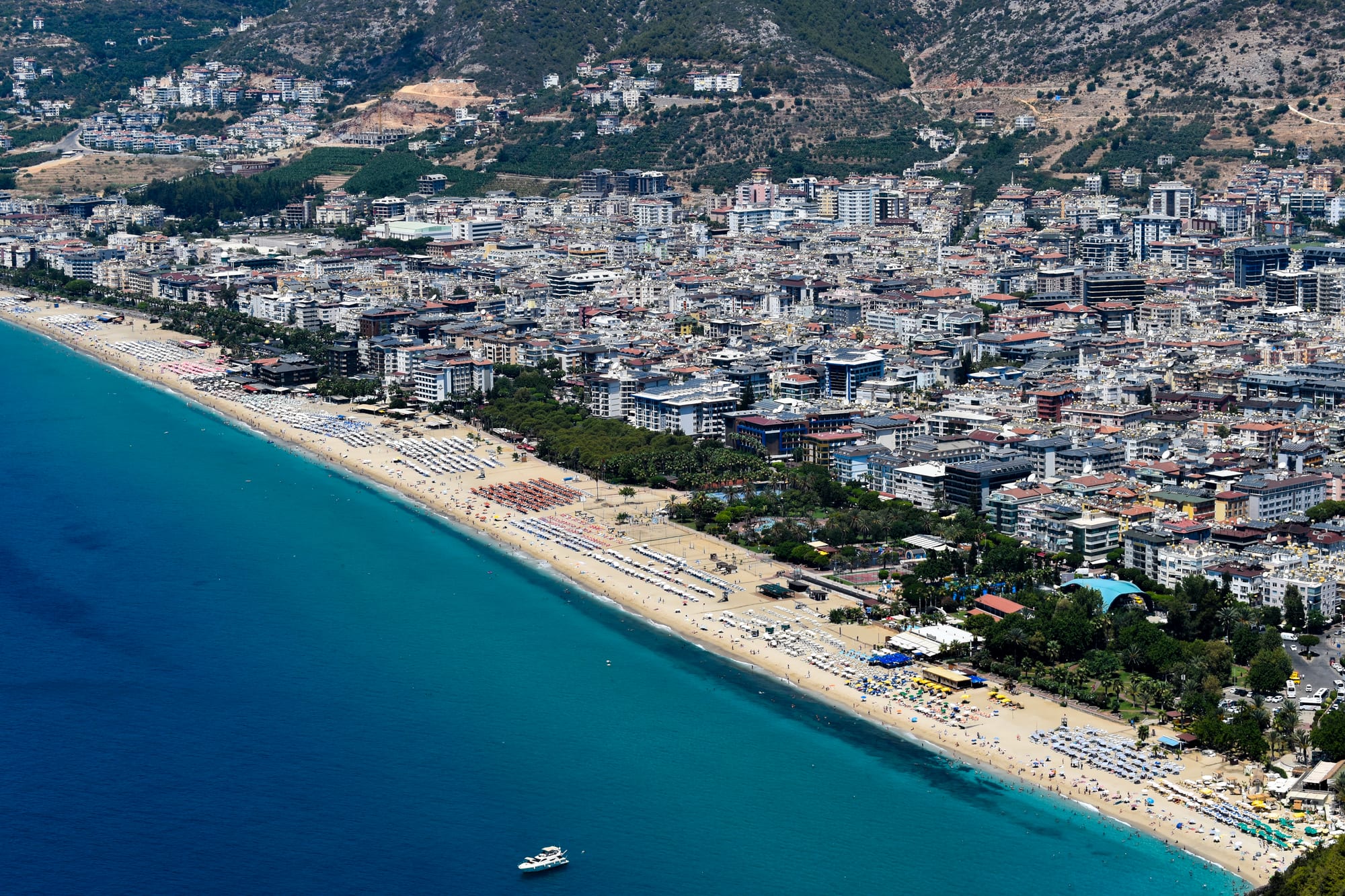
A long sand beach lined with parasols curving beside a dense town of white apartment blocks, with wooded mountains rising behind

Antalya & the Mediterranean, Turkey

Alanya

Cleopatra Beach and the town of Alanya seen from the castle hill. (Julian Lupyan / Wikimedia Commons · CC0)

A resort town on Turkey's Mediterranean coast, about 130 kilometres east of Antalya, built around a rocky headland crowned by Seljuk walls. Known in antiquity as Coracesium and a pirate stronghold before Rome took it, it became the winter capital of the Seljuk sultan Alaeddin Keykubad in 1221. Long beaches on either side of the castle rock have made it one of the busiest holiday towns in the country.

Neighbourhoods

  • The castle hill and Tophane
    • Historic district
    • Walks and viewpoints
    • Quiet and residential

    The headland above the town, ringed by Seljuk walls and reached by road, footpath or cable car. Inside them are gardens, old houses, a small Ottoman quarter of wooden-fronted buildings called Tophane, a mosque and a ruined Byzantine church, with the sea on three sides.

    Open in Maps
  • The harbour and the centre
    • First-time visitors
    • Best for food
    • Nightlife

    The old port below the castle, with the Red Tower at its head, a marina, excursion boats and a promenade. Behind it the commercial centre runs inland through shopping streets, the bazaar and the bar district that gives Alanya much of its reputation.

    Open in Maps
  • Damlataş and Cleopatra Beach
    • Beaches
    • Families
    • Close to the centre

    The western side of the headland, where a long sand beach runs for kilometres beneath the castle rock. The cave of Damlataş, the museum and the beach park are at its eastern end, and hotels, cafés and apartment blocks line the road behind.

    Open in Maps
  • Oba and Tosmur
    • Quiet and residential
    • Long-stay visitors
    • Local life

    Residential districts just east of the centre, where much of the town's foreign population lives in apartment blocks among supermarkets, schools and ordinary Turkish streets, a short bus ride from the beaches and the Dim river valley.

    Open in Maps
  • Mahmutlar
    • Budget apartments
    • Long-stay visitors
    • Beaches

    A large suburb about ten kilometres east along the coast, with more than fifty thousand residents, built up with apartment towers and popular with foreign residents and long-stay visitors. It has its own beach, weekly market and shopping streets, and dolmuş minibuses run constantly into Alanya.

    Open in Maps

Things to do

The castle and the old port

  • Alanya Castlelandmark

    A Seljuk fortress of the 13th century on a headland some 250 metres above the sea, with kilometres of wall and towers enclosing gardens, cisterns and the remains of earlier Byzantine work, and a vaulted Seljuk dockyard cut into the rock at the water's edge below.

    Open in Maps
  • Red Towerlandmark

    An octagonal tower of red brick and stone completed in 1226 to guard the harbour and the Seljuk shipyard beside it, holding the city's ethnographic museum since 1979, with ramparts at the top.

    Open in Maps
  • Alanya Archaeological Museummuseum

    Finds from the town and the surrounding coast, including a bronze statue of Heracles, displayed near Damlataş Cave.

    Open in Maps

Beaches and caves

  • Damlataş Caveattraction

    A stalactite cave in the rock beside the western beach, opened in the 1940s, whose warm humid air has long been considered helpful for asthma.

    Open in Maps

Short trips along the coast and inland

  • Syedralandmark

    An ancient hill town east of Alanya, settled from the 7th century BC and abandoned in the 13th century AD, with an excavated main street and long views over the sea.

    Open in Maps
  • Alara Castlelandmark

    A castle on a crag above the Alara river north-west of the town, Byzantine in origin and given up to the Seljuks in 1231, reached by a stairway of about 180 steps tunnelled through the rock.

    Open in Maps
  • Manavgat Waterfallattraction

    A broad, low fall on the Manavgat river west of Alanya, set in a park of tea gardens and restaurants.

    Open in Maps
  • Sidelandmark

    A resort town on a promontory built among the ruins of an ancient port, with a large theatre and the Temple of Apollo on the shore.

    Open in Maps

Eat and drink

Long-standing places and food districts in Alanya. Hours, ratings and directions come from your maps app, always current.

Eating in Alanya

  • The harbour and the old quarterneighborhood

    Fish restaurants and meyhanes around the marina and in the lanes below the castle, serving meze tables, grilled fish and rakı with the tower lit above them.

    Open in Maps
  • The bazaar streetsneighborhood

    Inland from the seafront, lokantas serve trays of ready-cooked stews, pide and kebabs to people who live and work in the town rather than to holidaymakers, alongside bakeries and tripe soup shops.

    Open in Maps

Markets and local produce

  • Alanya's weekly marketsmarket

    Open-air markets move between the districts on set days, selling bananas, avocados and citrus grown on this warm coast, along with cheeses, olives, dried fruit and spices.

    Open in Maps
  • Dim Çayı riverside restaurantsrestaurant

    Platforms built over the cold river in the valley east of the town, where trout, gözleme and long breakfasts are eaten at low tables with feet in the water.

    Open in Maps

Experience Alanya

History

The headland has been fortified for more than two thousand years. As Coracesium it stayed loyal in the 140s BC to Diodotus Tryphon, who had seized the Seleucid crown, and the rock was long a base for the pirates who preyed on Roman shipping until Pompey defeated them off this coast in 67 BC. Under Rome and Byzantium it remained a minor port, changing hands as the empire's frontier with Arab fleets moved up and down the shore.

The town's defining moment came in 1221, when the Seljuk sultan Alaeddin Keykubad I took the castle and made the place a winter residence and naval base, renaming it Alaiye. Within a few years he had built the octagonal Red Tower over the harbour, the vaulted shipyard beside it and much of the circuit of walls that still rings the hill, using it to build the galleys that gave the Seljuks a Mediterranean fleet. After the Mongol defeat of the Seljuks the coast passed to the Karamanids, who sold the town to the Mamluks of Egypt in 1427, and it was taken into the Ottoman Empire in 1471, after which Alaiye declined into a small port trading in timber and citrus.

The modern name dates from 1935, when Atatürk's visit was followed by the change from Alaiye to Alanya. The town was still small and awkward to reach in the 1960s, when Turkish visitors began coming for the air in Damlataş Cave; the coastal highway, charter flights into Antalya and the opening of Gazipaşa airport in 2010 transformed it. From the 1980s the beaches on either side of the rock filled with hotels and apartment blocks, German and Scandinavian visitors arrived in large numbers, and Alanya became both a mass resort and a place where foreigners bought property and settled. The castle and the shipyard were put on Turkey's tentative list for UNESCO World Heritage status in 2009.

Culture & Customs

Alanya is the most internationally settled town on this coast. Germans, Scandinavians, Dutch, Russians and, in recent years, Iranians and Central Asians own flats and spend part or all of the year here, and whole suburbs — Oba, Tosmur, Mahmutlar — have shops, estate agents, doctors and restaurants working in several languages. The result is a town where Turkish provincial life, mass package tourism and a large resident foreign community overlap in the same streets.

The Turkish side of that culture is unmistakable once away from the seafront: the bazaar, tea gardens where men play okey and backgammon, mosques filling on Friday, families walking the promenade after dark, and weddings that take over whole restaurants in summer. In the mountains immediately behind the town, Yörük families keep flocks on summer pastures and weave rugs from goat hair, and the district's old trade in silk, cotton and timber is remembered in the Seljuk caravanserai at Alarahan on the inland road.

The castle rock defines the town's image of itself, appearing on everything from municipal signs to fridge magnets, and its illuminated walls are the view from almost every hotel. Boat trips around the headland to the sea caves, the cable car up the hill and the nightlife strip behind the harbour are the three things almost every visitor does, and the town has grown practised at accommodating very large numbers of people without much friction.

Daily Life

The district has roughly 365,000 residents, and the population rises sharply in summer. Alanya has one of the largest foreign resident populations of any Turkish district, with thousands of European residents and property owners, many of them retired, alongside Turkish families who have moved from inland Anatolia for work in tourism and construction.

Tourism and property are the economy. Hotels, restaurants, excursion operators, estate agencies and building firms employ most of the workforce, and construction of apartment blocks along the coast has been continuous for decades. Agriculture remains important in the valleys: this is one of the few places in Turkey warm enough for bananas, grown under plastic and in the open along the coast, together with avocados, citrus, pomegranates and greenhouse vegetables. Fishing continues from the harbour on a small scale.

The year divides sharply. From May to October the coast road is jammed, the promenade is busy past midnight and every business runs seven days a week; in winter a good share of the hotels close and the town settles into the pace of a provincial centre, kept going by its residents. Rents and property prices driven by foreign demand, water supply, the density of building along the shore and the risk of wildfire and earthquake are the constant local subjects.

Food

The cooking is Mediterranean Turkish, with the produce of an unusually warm coast behind it. Fish from the harbour — sea bass, bream, calamari and octopus — is grilled plainly with lemon and rocket, and meze tables carry aubergine salads, stuffed vine leaves, samphire in olive oil, garlic yoghurt and hibeş, a tahini and cumin dip common along this part of the coast. Rakı, the aniseed spirit, is the drink that goes with them.

Inland the food is heartier: lamb tandır cooked slowly until it falls off the bone, testi kebab sealed in a clay pot, trout from the cold rivers of the mountain valleys, and gözleme made on a griddle at roadside places and market stalls. Antalya province's piyaz, a white-bean salad bound with tahini and eaten with köfte, is on most local menus, and the ready-cooked stews and vegetable dishes of the lokanta are the everyday lunch.

The district's fruit is its speciality. Bananas grown on this coast are small, fragrant and sold everywhere, fresh and as juice or ice cream; avocados, pomegranates, citrus, carob and loquats grow in the same warm strip. Sweet things include Turkish delight flavoured with local fruit, künefe made with shredded pastry and cheese, and tahini halva. Breakfast is the long Turkish spread of cheeses, olives, eggs, tomatoes, honey and clotted kaymak, and tea in tulip glasses runs through the day.

Planning tools

Budget

One of the cheapest resort towns on the Turkish coast, built largely on all-inclusive packages and long-stay apartments. Hotels, meals and transport all cost less than in Antalya or Kaş, and prices fall dramatically outside high summer. Boat trips, the cable car, the castle and cave tickets and hire cars are the usual extras.

Daily Budget Midrange
USD 90–200 (resort or boutique hotel, restaurants, site tickets, a boat trip or a hire car day)
Daily Budget Shoestring
USD 25–50 (guesthouse or apartment, lokanta meals, dolmuş minibuses)

Rates in May, October and November are a fraction of the July and August prices while the sea stays warm; the beaches, the castle walls' outer paths and the promenade cost nothing.

Best Time to Visit

April to June and September to November. The sea here is among the warmest in Turkey and stays swimmable into late autumn, and the castle and inland valleys are pleasant in spring. July and August are very hot and the town is full. Winter is mild and sunny between rain spells, with citrus ripening and many hotels closed. The seasons themselves are unchanged by the war that began in February 2026, although aviation and tourism across the wider region have been disrupted.

Suggested Number of Days

Two or three days is enough for the town itself. Four to six suits anyone adding the coast and the mountain valleys inland, and long-stay visitors often base themselves here for weeks. The scale of the resort strip means journeys within it take longer than expected.

First Visit
2–3 days
With Surroundings
4–6 days

Transportation

Dolmuş minibuses run constantly along the coast road through Oba, Tosmur and Mahmutlar, and a cable car climbs from the western beach to the castle hill. Intercity buses leave from the otogar on the edge of town for Antalya, Konya and beyond, and boats run from the harbour along the coast. A hire car is useful for the caves, the river valleys and the ancient sites inland. The town is spread thinly along the shore, so some form of transport is needed most days.

The coastal road east of Alanya towards Silifke is slow and winding, and the road west to Antalya is heavily used in summer; allow more time than the distance suggests.

Airport & Station Connections

Gazipaşa–Alanya Airport is about 40 kilometres east, roughly half an hour away, with seasonal flights from Europe and domestic services; Antalya Airport, about 120 kilometres west, has far more flights and is reached in around two hours by bus or transfer. Intercity coaches connect Alanya with Antalya, Konya, Ankara and Istanbul. Air travel across the Middle East has been disrupted since the war that began in February 2026, and schedules at the region's airports can change at short notice.

Walkability

The centre, the harbour and the western beach are easily walked, and the promenade runs for kilometres along the shore. The castle is a different matter: the road up climbs several hundred metres in a series of bends, and walking it in summer heat is hard work, so most people take the cable car, a bus or a taxi. Oba, Tosmur and Mahmutlar are too far out to reach on foot.

Safety

A safe town where the usual problems are overcharging in bars aimed at visitors, pickpocketing in crowded markets and the nightlife district, road traffic and strong sun. Sea conditions at the open beaches change with the wind, the castle walls have unfenced drops, wildfires are a summer risk in the forests inland, and the region is seismically active.

Agree prices before boat trips and taxis, swim where beaches are supervised, take care near the unprotected edges on the castle hill, and follow local instructions during wildfires. Check current official travel advice before travelling.

Climate

A Mediterranean climate that is among the mildest in Turkey, sheltered by the Taurus Mountains immediately behind the town. Summers are long, hot and humid; winters are mild and wet, warm enough for bananas and citrus to grow along the coast, while snow lies on the mountains a short drive inland.

Summer
hot and humid — July and August days are commonly 33–37°C, with warm nights and sea temperatures near 28°C
Winter
mild and rainy — January days are typically 15–17°C, and frost is very rare on the coast

Local Customs

A holiday town used to foreign visitors, where beachwear is normal on the shore and out of place in the bazaar and the old quarter. Shoes are removed at mosques and shoulders, knees and hair covered inside. Tipping of around ten per cent is usual in restaurants. Bargaining is expected in the market and carpet shops, not in supermarkets. Alcohol is sold freely in the resort areas, and tea offered in a shop is hospitality rather than a sale.

Ask before photographing people in markets or at prayer; taking antiquities or fragments of stone from ancient sites out of Turkey is a serious criminal offence.

Common Payment Methods

The currency is the Turkish lira. Cards and contactless payment are widely accepted in hotels, restaurants and shops, while cash is needed for dolmuş minibuses, market stalls and smaller cafés. ATMs are everywhere along the coast strip, exchange offices are plentiful, and some businesses quote prices in euros, usually at a poor rate.