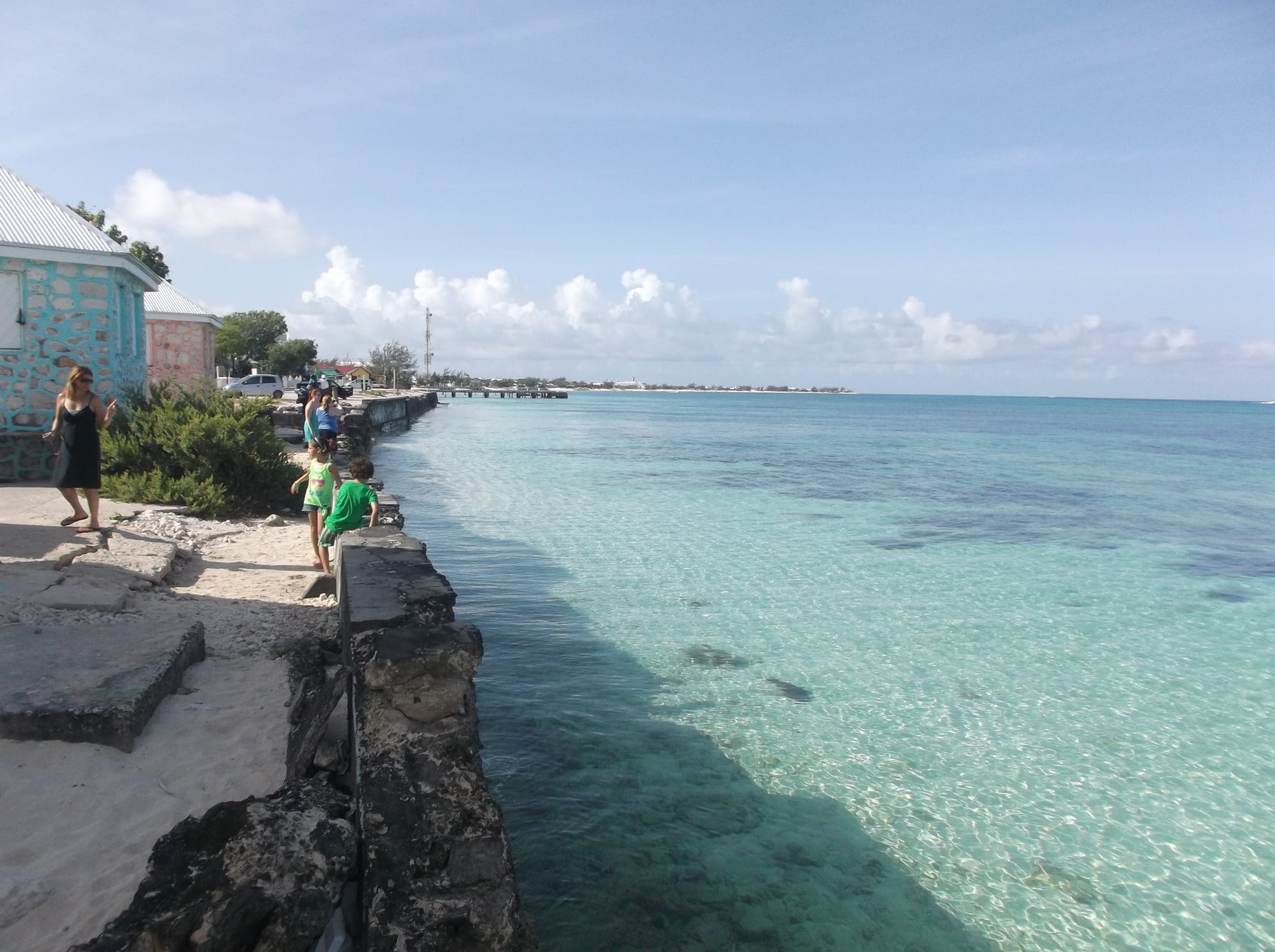
A low stone sea wall beside clear turquoise shallows, with pastel stone cottages and a long pier along the shore

Turks and Caicos Islands

Grand Turk

The waterfront of Cockburn Town on Grand Turk. (socaltraveler / Wikimedia Commons · CC BY-SA 3.0)

Grand Turk is the largest of the Turks Islands and home to Cockburn Town, the territory's capital since 1766. Bermudian salt rakers settled it in 1681, and 18th- and 19th-century Bermudian houses still line Duke and Front Streets. Today it is the seat of government and a cruise stop, with a coral wall a short boat ride offshore.

Neighbourhoods

  • Cockburn Town
    • First-time visitors
    • Historic district

    The capital, spreading across most of the island. Its historic core of 18th- and 19th-century Bermudian houses lines Duke Street and Front Street, with long, narrow streets and old street lamps; the national museum and the old prison are here.

    Open in Maps
  • The south end and the cruise centre
    • Beaches
    • Cruise visitors

    The southern part of the island, where the cruise terminal stands with its shops, restaurants, large pool and beach.

    Open in Maps
  • North Creek and the lighthouse
    • Viewpoints
    • Quiet

    The northern end of the island, around the inlet of North Creek and the bluff where the 1852 lighthouse stands. Donkey trails lead from the lighthouse down to the beach, and the views take in much of the island.

    Open in Maps

Things to do

History and landmarks

  • Turks and Caicos National Museummuseum

    The national museum in Guinep House on Front Street, opened in 1991, with the Molasses Reef Wreck of about 1505, Lucayan finds and displays on salt, slavery and the space age.

    Open in Maps
  • Grand Turk Lighthouselandmark

    A 60-foot lighthouse built in England, shipped in pieces and completed in 1852 to warn ships off the shallow reef at the island's northern end, with the keeper's house beside it.

    Open in Maps
  • Her Majesty's Prisonlandmark

    A prison on Pond Street in Cockburn Town, built in the 1830s and in use until 1994, with its cell block, bell tower and a small museum.

    Open in Maps
  • Front Street and Duke Streetneighborhood

    The two shore streets of Cockburn Town, lined with old Bermudian-style houses, some more than a century old — easy to explore on foot or by bicycle.

    Open in Maps
  • Friendship 7 replicaattraction

    A replica of the Mercury capsule that splashed down off the island's south-east shore in 1962 after the first American orbital flight, displayed at the entrance to the airport.

    Open in Maps

Beaches and diving

  • Governor's Beachbeach

    One of the island's nicest beaches and one of the better snorkelling spots on Grand Turk.

    Open in Maps
  • The Grand Turk wallattraction

    A coral wall a short boat ride from the beach, known for healthy corals, diverse marine life and clear water, which draws divers from around the world.

    Open in Maps
  • Grand Turk cruise centreattraction

    The cruise terminal toward the south end of the island, with a tourist village of shops and restaurants, a very large pool and an 800-foot stretch of beach; it can be crowded when two ships are in.

    Open in Maps

Short trips from the island

  • Gibbs Cayattraction

    A small uninhabited cay off the island, visited on boat excursions where stingrays come close to swimmers.

    Open in Maps
  • Salt Cayattraction

    The small island to the south, reached on day trips for diving and snorkelling, with old salt ponds and a quiet village.

    Open in Maps

Eat and drink

Long-standing places and food districts in Grand Turk. Hours, ratings and directions come from your maps app, always current.

Food districts

  • Front Street, Cockburn Townneighborhood

    The historic street of the capital, lined with old Bermudian-style buildings, where some of the town's small restaurants and bars are found.

    Open in Maps
  • The cruise centreneighborhood

    The restaurants and bars of the cruise terminal's tourist village, busiest on days when ships are in port.

    Open in Maps

Experience Grand Turk

History

The Lucayan people, the island's first inhabitants, called it Abawana, "the first small land"; the Spanish later knew it as Amuana. Some historians have argued that Grand Turk, not an island in the Bahamas, was where Columbus first landed in 1492, a claim others reject. The island's English name is usually traced to the Turk's cap cactus, whose red top recalls a fez. Bermudians colonised it in 1681 and set up the salt industry, and Cockburn Town, the first permanent settlement in the islands, became the seat of government in 1766.

Salt shaped everything that followed. In 1754 British warships cut down French marks of possession on the island. A hurricane in September 1813 destroyed more than 120 houses, and the reefs around the island claimed ship after ship. In 1836 Grand Turk was declared a free port, and in 1852 a lighthouse, prefabricated in England, went up on the northern bluff to make the passage safer and save the declining salt trade. The prison on Pond Street, built in the 1830s, stayed in use until 1994.

In the Cold War the island became a station for the United States. A naval facility of the undersea surveillance network opened near the lighthouse in 1954 and ran until 1980, and the island became the first down-range station of the US Air Force's Eastern Range with a missile impact location array. In 1962 John Glenn's Friendship 7 capsule came down off the south-east shore after the first American orbital flight. Tourism was courted from the 1950s, and in 2004 plans were announced for a cruise port, which has since made the island a regular cruise stop.

Culture & Customs

Grand Turk is the administrative, historic and cultural centre of the territory. Its townscape is the clearest survival of the salt era: Duke Street and Front Street are lined with 18th- and 19th-century houses in the Bermudian style, with long, narrow streets and old street lamps. The town is named after Francis Cockburn, a former Governor of the Bahamas.

The Turks and Caicos National Museum keeps the islands' memory. Housed in Guinep House, a building more than 180 years old that was partly built from shipwreck timber, including a ship's mast, it shows the Molasses Reef Wreck, considered the oldest known European shipwreck in the Americas, alongside exhibits on the Lucayans, slavery and the slave trade, the salt and sisal industries, postage stamps and the space race. Its Message in a Bottle project has recorded nearly 40 years of messages washed up on the island's shores.

Music is part of island evenings: the island's best-known party band plays soca and island music, with a saw player in its line-up. The Grand Turk Parade Ground in Cockburn Town hosts athletics, cricket, rugby and football, and has also been the setting for state occasions such as the funeral of the territory's first Chief Minister. Watching the sunset, and the green flash that locals insist is not so elusive, is an island habit.

Daily Life

About 4,800 people lived on Grand Turk in 2012, the second-largest population of any island in the territory. As home to the capital it holds the government offices, courts and the territory's administration, and it is also a financial centre. Cockburn Town spreads across most of the island, and its sole high school is HJ Robinson High School.

Tourism is the other pillar. The cruise terminal at the south end draws ships travelling between Florida and the Caribbean, and on busy days passengers fill the beaches, tours and the tourist village, then leave by evening. Diving brings a smaller, steadier stream of visitors, drawn by the coral wall a short boat ride from shore.

Life away from the cruise centre is slow and small-scale. Most food and goods are imported, and the airport, about a mile south of town, links residents with Providenciales and the other islands by short domestic flights. Like the rest of the territory, Grand Turk lies in the hurricane belt.

Food

The food is that of the islands as a whole, built on the sea. Conch is the staple — cracked (pounded and fried), as fritters, in chowder, or raw as conch salad with lime — and grouper, snapper and spiny lobster round out the seafood. Johnnycake is the traditional side.

In Cockburn Town, meals are eaten at a small number of local restaurants and bars, some of them along historic Front Street. On cruise days the restaurants and bars of the terminal's tourist village feed most of the visitors. Rum is the usual drink, and nearly everything in the shops is imported, so fresh fish and conch are the most local things on any menu.

Salt, the island's old staple, survives as a product rather than an industry: sea salt and bath salts from neighbouring Salt Cay are sold in the national museum's shop, alongside straw hats and baskets from Middle Caicos and sea-glass jewellery made from glass found on the beaches. For centuries salt, along with small exports of sponge and hemp, sustained the islands.

Planning tools

Budget

Grand Turk has far fewer places to stay than Providenciales, and like all the islands it relies on imported food, so meals and groceries are expensive. An accommodation tax is added to room bills. Many visitors come for a single day from a cruise ship and spend money mainly on tours and at the cruise centre.

Daily Budget Midrange
USD 350–700 (small hotel by the sea, restaurant meals, a dive or snorkelling trip, car or scooter hire)
Daily Budget Shoestring
USD 150–250 (guesthouse room, self-catering and simple seafood meals, a bicycle or shared car)

Pick a stay away from days when two cruise ships are in port if quiet beaches matter, and book dives with a shop that collects from the beach.

Best Time to Visit

December to April is the dry, breezy high season, and also when humpback whales pass Grand Turk and Salt Cay on their migration. The rainier season runs from September to December, when the north-east trade winds are strongest and hurricanes are common.

Suggested Number of Days

The island is small, and two or three days are enough for a first stay. Four or five allow time for boat trips to the neighbouring cays and islands, and divers often stay longer.

First Visit
2–3 days
With Surroundings
4–5 days

Transportation

The island is small and flat. Hire cars, scooters and bicycles are the usual ways to get around independently, and guided tours by 4x4, dune buggy, bicycle or on horseback are offered, many aimed at cruise passengers. Driving is on the left.

Hire a car or scooter for a day to reach North Creek, the lighthouse and the beaches at the south end.

Airport & Station Connections

JAGS McCartney International Airport, also known as Grand Turk International Airport, is about 1 mile south of Cockburn Town. Although classed as international, it mainly serves domestic flights, and most visitors fly in via Providenciales and take a short local flight. Cruise ships call at the terminal toward the south end of the island, no more than two at a time.

Walkability

Cockburn Town's historic streets along Front Street and Duke Street are pleasant on foot, and the airport is close to town. The lighthouse, North Creek and the southern beaches are further away, and a car, scooter or bicycle makes reaching them easier.

Safety

Generally safe for visitors. The gang-related gun violence reported in the territory is concentrated among residents in parts of Providenciales, not on Grand Turk. Strong currents occur at some beaches and on the wall dives, and the island is in the hurricane belt.

Check every bag for stray ammunition before travelling, as possession is a serious criminal offence; dive with a guide who knows the currents, and check the forecast in hurricane season. Check current official travel advice before travelling.

Climate

Hot and semi-arid, with summer-like weather all year round. Across the islands temperatures are typically around 27–32°C. A rainier season runs from September to December, when the north-east trade winds are strongest and hurricanes are common.

Summer
hot and sunny — across the islands temperatures rarely exceed 33°C, with the hurricane risk at its peak late in the season
Winter
warm, breezy and drier — night-time temperatures across the islands rarely fall below 18°C

Local Customs

Grand Turk is the territory's administrative and historic centre, and its society is conservative and church-centred. English is the everyday language. Sunsets are a local ritual, and many people watch for the green flash as the sun drops into the sea.

Firearms law is enforced strictly, ammunition included. Ask before photographing people, and expect duty-free purchases at the cruise centre to require photo identification.

Common Payment Methods

The currency is the US dollar. Cards are widely accepted, especially at the cruise centre; some cash is useful for small shops, taxis and tours.