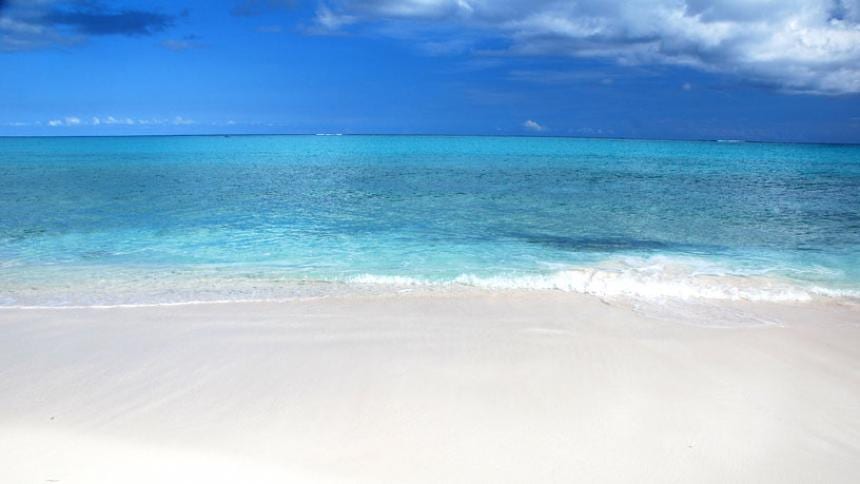
A wide beach of fine white sand meeting clear turquoise water that deepens to blue, under a bright sky with white clouds

Turks and Caicos Islands

North Caicos

A beach on North Caicos. (Dirk2112 / Wikimedia Commons · CC BY-SA 3.0)

North Caicos is the second-largest of the Turks and Caicos Islands, 12 miles east of Providenciales and joined to Middle Caicos by a causeway. Loyalist cotton planters settled it after the American Revolution; at the 2012 census 1,312 people lived in its villages, among ponds, farms, plantation ruins and quiet beaches.

Neighbourhoods

  • Bottle Creek
    • Local life
    • Services

    The island's main village and the district capital, home to the government offices, the utility companies and the high school. Old plantation lands lie along the King's Road between the village and the causeway to Middle Caicos.

    Open in Maps
  • Kew
    • Historic district
    • Farming country

    One of the oldest settlements in the territory, inland among heavy vegetation that has earned it the nickname 'garden of the Turks and Caicos'. Small houses, churches, shops, a library and a police station make up the village, and Wade's Green Plantation is nearby.

    Open in Maps
  • Whitby
    • Beaches
    • Snorkelling

    A small seaside village on the north shore, between the protected snorkelling area of Three Mary Cays and Horsestable Beach.

    Open in Maps
  • Sandy Point
    • Boat trips
    • Arrivals by sea

    A tiny settlement at the north-western tip of the island facing Parrot Cay, with the marina where ferries from Providenciales arrive and a yacht club.

    Open in Maps

Things to do

History and nature

  • Wade's Green Plantationlandmark

    The ruined plantation house and outbuildings of the Loyalist Wade Stubbs, who was granted land at Kew in 1789 and worked it with enslaved people until his death in 1822; abandoned for generations, it has been presented as a historic site since the 2010s.

    Open in Maps
  • Flamingo Pond Overlookviewpoint

    A viewing point above Flamingo Pond, one of the island's sights.

    Open in Maps
  • Cottage Pondpark

    A pond and one of the island's natural sights.

    Open in Maps

Beaches and snorkelling

  • Horsestable Beachbeach

    A beach on the north shore near Whitby, part of a protected snorkelling area.

    Open in Maps
  • Three Mary Caysbeach

    Tiny cays about 20 metres off the north-western shore, in a protected area popular for snorkelling.

    Open in Maps

Short trips from the island

  • Middle Caicosattraction

    The largest island in the territory, reached across the causeway, with an estimated 118 residents in 2022 in three small villages and at least 38 Lucayan archaeological sites.

    Open in Maps
  • Conch Bar Cavesattraction

    On Middle Caicos, the largest above-ground cave system in the Bahamas and Turks and Caicos archipelago, mined for guano in the 1880s, when Lucayan artefacts were found inside.

    Open in Maps
  • Mudjin Harbourviewpoint

    A scenic harbour on the northern shore of Middle Caicos, one of that island's best-known natural areas.

    Open in Maps

Eat and drink

Long-standing places and food districts in North Caicos. Hours, ratings and directions come from your maps app, always current.

Food districts

  • Bottle Creekneighborhood

    The island's main village and district capital, the centre of local life and services.

    Open in Maps
  • Whitbyneighborhood

    The north-shore village near Horsestable Beach, a village of a few houses, shops and restaurants.

    Open in Maps

Experience North Caicos

History

North Caicos was home to the Lucayan people before Spanish raids and disease emptied the islands in the early 16th century. Its modern history begins after the American Revolution, when Loyalists were granted land here by the British crown and arrived with enslaved Africans. Large cotton plantations were laid out around Kew and operated into the 19th century; the ruins of Teron Hill, St James Hill and Wade's Green survive.

Wade's Green is the main attraction among them. The Loyalist Wade Stubbs, who had lost his land in British Florida, was granted land at Kew in 1789 by George III as compensation, and worked his plantation with a large number of enslaved people until his death in 1822. After the abolition of slavery in the 1830s, soil exhaustion, plant diseases and economic change ended Kew's role as a major farming area, and the plantation lay abandoned until its ruins were opened to visitors in the 2010s. Old plantation lands also line the King's Road between Bottle Creek and the causeway.

The island has remained small and rural while tourism has transformed Providenciales next door. Bottle Creek became the district capital and the birthplace of Michael Misick, chief minister from 2003 and the territory's first premier from 2006 to 2009. A causeway of about a mile now links North Caicos with Middle Caicos, and daily ferries tie it to Providenciales.

Culture & Customs

North Caicos belongs to the 'family islands', the small and quiet islands of the territory where life is slower and older ways persist. Islanders with roots in the territory, known as Belongers, are descended from enslaved Africans and the salt-raking communities, and village life revolves around family, church and farming. Kew, set among heavy vegetation, is known as the 'garden of the Turks and Caicos' and the centre of the territory's farming community.

The islands are best known musically for ripsaw, a rhythm scraped on a carpenter's handsaw alongside drums, box guitar and accordion, which began in North and Middle Caicos. It remains the music the islands are best known for.

The landscape is part of the island's identity: the heavy vegetation around Kew, and ponds such as Flamingo Pond and Cottage Pond, are among its best-known sights. Three Mary Cays and Horsestable Beach are protected snorkelling areas. Islanders with roots in the territory share the conservative, church-centred outlook of the islands as a whole.

Daily Life

North Caicos had 1,312 residents at the 2012 census, on an island of about 45 square miles. Bottle Creek is the main village and the district capital, with the island's government offices, utility companies and Raymond Gardiner High School. Kew is the farming village, Whitby the north-shore beach village, and Sandy Point, where the ferries land, is home to only a few people.

The island is far quieter than Providenciales, where most of the territory's people live, and like the other 'family islands' it remains small and has been slowly emptying while the tourism island next door has grown. Daily ferries to Sandy Point and short flights to North Caicos Airport keep it linked to Providenciales, 12 miles away.

Together with Parrot Cay, Bay Cay and a few uninhabited offshore cays, the island forms the North Caicos District. Middle Caicos, across the causeway, had an estimated 118 residents in 2022.

Food

Food on North Caicos follows the islands' seafood tradition. Conch is the staple — cracked (pounded and fried), as fritters, in chowder, or raw as conch salad with lime — and grouper, snapper and spiny lobster are caught in the surrounding waters. Johnnycake is the traditional side.

The island's greener soil sets it apart. Kew has long been the centre of the territory's farming community, and small farms and village gardens grow produce in a country that otherwise imports nearly everything it eats.

Places to eat are few and small, among them the restaurants of Whitby, the north-shore village. Many visitors on longer stays self-cater, bringing supplies from Providenciales, where the supermarkets are larger. Rum is the usual drink across the islands.

Conch salad, raw conch marinated in lime and made to order, is a standard local dish, sold at the shacks on Providenciales. Fresh fish and lobster from the surrounding waters, and produce from the farms around Kew, are the most local things on any plate.

Planning tools

Budget

North Caicos has only a small number of places to stay and few restaurants. Groceries are imported and expensive, as everywhere in the islands, and an accommodation tax is added to room bills. A hire car is needed to get around and adds to the cost.

Daily Budget Midrange
USD 350–700 (beach villa, meals out, car hire, a snorkelling or boat trip)
Daily Budget Shoestring
USD 150–250 (guesthouse or simple villa, self-catering, a shared hire car)

Bring some supplies from the larger supermarkets on Providenciales, and hire a car for the whole stay.

Best Time to Visit

December to April is the dry, breezy high season across the islands. May, June and November are quieter shoulder months, and August to October carries the main hurricane risk.

Suggested Number of Days

A day or two is enough for a first look at the island, and many visitors come for a single day from Providenciales. Three or four days suit a slower stay that takes in the neighbouring island as well.

First Visit
1–2 days
With Surroundings
3–4 days

Transportation

The villages, ponds, beaches and the causeway are spread across the island, so a hire car is the practical way to get around. Driving is on the left.

Arrange a car before arriving by ferry, and carry water and some cash when driving to the far end of the island.

Airport & Station Connections

North Caicos lies 12 miles from Providenciales, and daily ferries run from Providenciales to the marina at Sandy Point. North Caicos Airport has short domestic flights from Providenciales. A causeway of about a mile links the island to Middle Caicos.

Walkability

The villages are small enough to walk around, but they are miles apart, and the ponds, beaches and plantation ruins are spread across the island. Walking between them is not practical in the heat; a car or bicycle is needed.

Safety

Generally safe for visitors. The rise in gang-related gun violence reported in the territory is among residents in parts of Providenciales. Some beaches have strong currents, services are spread thin, and the island is in the hurricane belt.

Check every bag for stray ammunition before travelling, as possession is a serious criminal offence; carry water and a charged phone when driving to remote beaches, and check the forecast in hurricane season. Check current official travel advice before travelling.

Climate

Tropical, dry and sunny for most of the year. Across the islands temperatures are typically around 27–32°C, and the hurricane season runs from June to November. December to April is slightly cooler and breezier.

Summer
hot — temperatures across the islands rarely exceed 33°C, with the main hurricane risk from August to October
Winter
warm and breezy — night-time temperatures across the islands rarely fall below 18°C

Local Customs

North Caicos is one of the quiet 'family islands', and its villages are close-knit, conservative and church-centred. English is the everyday language. Ripsaw music, scraped on a carpenter's handsaw, began in North and Middle Caicos.

Firearms law is enforced strictly, ammunition included. Greet people in the villages, and ask before photographing them or their homes.

Common Payment Methods

The currency is the US dollar. Cards are widely accepted across the islands, but the island has few shops and services, so carrying enough cash for small shops, meals and fuel is sensible.