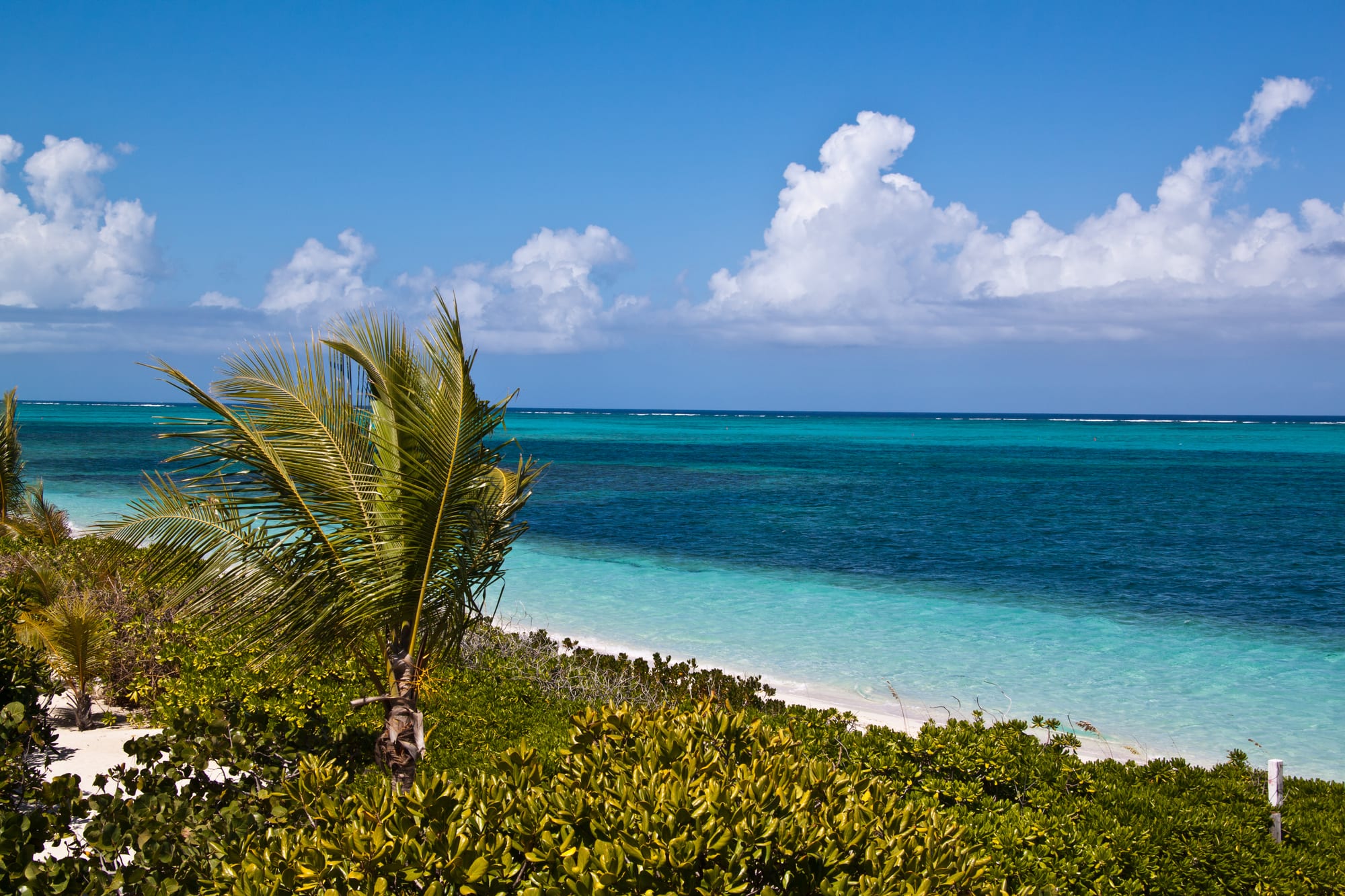
A wind-bent palm and low green shrubs above a strip of white sand and clear turquoise water under puffy clouds

Turks and Caicos Islands

Providenciales

The shore at Turtle Cove on the north coast of Providenciales. (Tim Sackton / Wikimedia Commons · CC BY-SA 2.0)

Providenciales, known as Provo, is a low island of scrub-covered hills in the north-west Caicos Islands. Settlers once scraped a living from salt and cotton; since the 1980s an airport and beach resorts along Grace Bay have made it the territory's tourism and business centre and home to most of its people, with working settlements inland.

Neighbourhoods

  • Grace Bay
    • First-time visitors
    • Beaches

    The resort strip along the north shore, built around a beach about five miles long. Most of the island's hotels and condos stand here, with shops and restaurants in the plazas along Grace Bay Road within walking distance of much of the beach.

    Open in Maps
  • Turtle Cove
    • Boat trips
    • Best for food

    A marina about ten minutes from the heart of Grace Bay, the base for many dive operators, fishing charters and cruise boats. Casual grills and restaurants sit around the harbour.

    Open in Maps
  • Downtown, Kew Town and the Leeward Highway
    • Local life
    • Shopping

    The working centre of the island near the airport. The Leeward Highway runs east to west through it, lined with shopping plazas, supermarkets and services, and many islanders live in the settlements around it.

    Open in Maps
  • Blue Hills
    • Local life
    • Best for food

    One of the three small settlements that existed before tourism. Beach bars and conch shacks line the road by the sea, and the annual Conch Festival is held here.

    Open in Maps
  • Long Bay and Chalk Sound
    • Quiet and residential
    • Kiteboarding

    The south and west of the island, where newer houses and villas have spread along Long Bay, a largely undeveloped windward beach, and around the turquoise lagoon of Chalk Sound. Quieter than Grace Bay, and a car is essential.

    Open in Maps

Things to do

Beaches

  • Grace Bay Beachbeach

    The island's main attraction — about five miles of soft white sand on the north shore, with gentle water for swimming and snorkelling and most of the resorts behind it.

    Open in Maps
  • Long Bay Beachbeach

    A long white beach on the southern, windward side, still largely undeveloped. Steady wind has made it a kiteboarding spot, and sharp shells below the waterline make it better for walking than swimming.

    Open in Maps
  • Sapodilla Bay Beachbeach

    A beach with holiday villas along it, used as a base for water-sports rentals.

    Open in Maps

Parks and history

  • Chalk Sound National Parkpark

    A bay about three miles long south-west of Downtown, its water a uniform turquoise studded with countless small mushroom-shaped islets — the island's best natural sight.

    Open in Maps
  • Northwest Point Marine National Parkpark

    A protected area on the wild western half of the island, extending to nearby reefs and to several saline lakes that attract breeding and migrant waterfowl.

    Open in Maps
  • Cheshire Hall Plantationlandmark

    The ruins of a 5,000-acre sisal and cotton plantation owned by the Loyalist Thomas Stubbs from the late 1700s until 1810; part of it is kept as a historic site by the Turks and Caicos National Trust.

    Open in Maps
  • Sapodilla Hillviewpoint

    A hill where remnants of the era of Caribbean piracy survive, one of two such sites on the island along with Osprey Rock.

    Open in Maps

Short trips from the island

  • West Caicosattraction

    An island of about 11 square miles south-west of Providenciales, uninhabited for more than a century, where the sea off the west coast drops quickly to great depths, home to sea turtles, spotted eagle rays, reef sharks and humpback whales.

    Open in Maps

Seasonal events

  • Turks and Caicos Music and Cultural Festivallate summer

    A series of concerts with local performers and artists from around the Caribbean and the United States, organised by the tourist board since 2003 to draw visitors in the low season.

  • Conch FestivalNovember

    A beach-side day in Blue Hills celebrating conch, the islands' best-known food and export, with cooking and music for locals and visitors alike.

  • MaskanooBoxing Day, 26 December

    A street festival in the Grace Bay area with parades, costumes, music, dancing and stalls of traditional food and crafts.

Eat and drink

Long-standing places and food districts in Providenciales. Hours, ratings and directions come from your maps app, always current.

Providenciales classics

  • Da Conch Shackrestaurant

    A beach restaurant on Blue Hills Road known for conch salad made fresh, conch fritters and cracked conch.

    Open in Maps
  • Bugaloo's Conch Crawlrestaurant

    A beach restaurant at Five Cays, known for lobster and local fish from the fishermen's dock nearby.

    Open in Maps

Food districts

  • Blue Hills conch shacksneighborhood

    The seafront road through Blue Hills, with beach bars and shacks serving conch, fish and local dishes.

    Open in Maps
  • Turtle Cove Marinaneighborhood

    Casual waterside grills and bars around the boat harbour, where fresh fish is the usual order.

    Open in Maps

Experience Providenciales

History

Before tourism, Providenciales was sparsely populated, and its hardy settlers tried to make a living from sea salt and cotton. After the American Revolution Loyalist planters arrived with enslaved Africans, and the ruins of Cheshire Hall, a sisal and cotton plantation owned by Thomas Stubbs from the late 1700s until 1810, still stand on a hilltop near Downtown. Remnants of Caribbean piracy survive at Osprey Rock and Sapodilla Hill.

The island changed late and fast. As recently as 1964 it had no wheeled vehicle, no roads, no piped water, no telephones and no electricity. In 1967 a developer, Provident Limited, won permission to build an airstrip, a port and a hotel, and flew in prospective land buyers from Florida in a Second World War DC-3. The first beachfront resort opened on Grace Bay in 1984, and its owner funded an upgrade of the airstrip for larger aircraft in the 1980s; in 1984 the port at South Dock was upgraded for container shipping.

From the 1990s Grace Bay became a luxury destination, and more than 20 resorts opened between 1995 and 2005. Most of the island's buildings date from after 1980, and there is no traditional downtown — only open-air shopping centres and mixed-use developments. A runway extension and renovation of the airport were completed by the end of 2014, and in 2023 the airport was officially renamed Howard Hamilton International Airport. Retirees from around the world have fuelled a boom in house building, and in 2024 the territory as a whole recorded more than two million visitors.

Culture & Customs

Providenciales is the most developed and most mixed of the islands. Belongers, the descendants of enslaved Africans and the old salt-raking and planting communities, share it with workers from Haiti, the Dominican Republic and elsewhere, with retirees from abroad and with visitors. Haitian Creole and Spanish are widely spoken alongside the local English, and church remains at the centre of island life.

The islands are best known musically for ripsaw, a rhythm scraped on a carpenter's handsaw with drums, box guitar and accordion, which began in North and Middle Caicos. Since 2003 the tourist board has held a series of concerts each late summer, the Turks and Caicos Music and Cultural Festival, with local performers and artists from around the Caribbean and the United States.

Conch is a cultural emblem as well as a food. Blue Hills, one of the island's original settlements, hosts the annual Conch Festival in November, and on Boxing Day the Maskanoo street festival brings parades, costumes, music and dancing to the Grace Bay area. Sport on the island ranges from kiteboarding on Long Bay to an 18-hole golf course that has twice hosted the Caribbean Amateur Open.

Daily Life

Providenciales had 23,769 residents at the 2012 census, the latest island-by-island count published, and is home to a majority of the territory's people. It is the most developed and tourism-oriented of the islands: resorts, condos, restaurants, dive shops and boat charters provide most of the work, alongside building, retail and offices, and a growing number of retirees have settled on the island.

Before tourism there were three small centres of population — Blue Hills, The Bight on Grace Bay, and Five Cays. All three have grown, and many new houses have been built in the east and south, with larger communities at Leeward, Long Bay and Chalk Sound. Downtown and Kew Town lie near the airport, and Wheeland is in the north-west corner. Luxury homes stand close to pockets of makeshift shacks, a sign of how unevenly the island has grown.

Life runs along the Leeward Highway, where most shops, plazas and services are found. With no public transport, almost everyone depends on a car. Nearly all food is imported and expensive, and none of the major fast-food chains operate on the island, so supermarkets, local restaurants and roadside conch shacks fill the gap. Public secondary education is provided by Clement Howell High School and Long Bay High School.

Food

Conch is the staple: cracked (pounded and fried), as fritters, in chowder, or raw as conch salad, chopped with lime and vegetables and mixed to order. The beach shacks of Blue Hills are the best-known place to eat it, and the territory also has the world's only conch farm. Grouper, snapper and spiny lobster round out the seafood, some of it landed at the fishermen's dock at Five Cays and served at the grills nearby.

Johnnycake is the traditional side, and the Haitian community has made griot, fried pork served with rice, widely available. Rum is the usual drink, often as rum punch, and Turks Head beer is served at the marina grills.

Because almost everything else is imported, the island's supermarkets stock mostly American brands, and the restaurants of Grace Bay serve a broad international range, from Italian and Mediterranean to Japanese, at prices well above the mainland's. The cheapest and most local meals remain those from the conch shacks and the casual grills around Turtle Cove and Five Cays.

Planning tools

Budget

Providenciales is one of the most expensive islands in the Caribbean. Nearly all food and drink is imported, so supermarket prices are far above those on the North American mainland, and rooms along Grace Bay are costly. An accommodation tax is added to room bills. Self-catering and eating at the conch shacks keep costs down, and all beaches are public and free.

Daily Budget Midrange
USD 400–900 (Grace Bay condo or hotel, restaurants, a boat or dive trip, car hire)
Daily Budget Shoestring
USD 150–280 (guesthouse or budget condo, self-catering and conch shacks, shared hire car)

Choose a condo with a kitchen, shop at the supermarkets on the Leeward Highway or near Grace Bay, and pick one boat trip rather than several.

Best Time to Visit

December to April is the dry, calm high season, which is also the humpback whale migration season off the islands. May, June and November are good-value shoulder months. August to October carries the main hurricane risk, but the late-summer low season brings the islands' music and cultural festival.

Suggested Number of Days

Most visitors come for a beach stay of four or five days. A week or more leaves time for boat trips to the outer cays and a flight or ferry to the quieter islands. Without a hire car, a stay is more restricted to the Grace Bay area.

First Visit
4–5 days
With Surroundings
7–8 days

Transportation

There is no public transport on the island. The Leeward Highway runs east to west from Downtown to Leeward, with most services along it, and a hire car is the usual way to get around; driving is on the left. Taxis are expensive. Many Grace Bay resorts run shuttles to nearby shops and restaurants, and boats to the uninhabited cays leave from the marinas.

Hire a car for anything beyond Grace Bay, and arrange a taxi or shuttle before landing rather than looking for one at the airport.

Airport & Station Connections

Providenciales International Airport, officially renamed Howard Hamilton International Airport in 2023, is the territory's main gateway, near the communities of Downtown and Kew Town. It has non-stop flights from several cities in the United States and Canada, services from London via Nassau, and regional and inter-island flights. The terminal is small and crowded at peak times, Saturdays above all, so departing passengers allow plenty of time.

Walkability

Only the Grace Bay strip works on foot, where the beach itself is the easiest path and many shops and restaurants are close together. The rest of the island is spread out along a highway with little shade, and settlements, beaches and parks are far apart.

Safety

Generally safe for visitors. The main issues are petty theft from cars and villas and a rise in gang-related gun violence among residents in parts of the island away from the resorts, with occasional armed robberies. Reckless boat operators have killed travellers, so it pays to keep clear of boat channels, and some beaches have strong currents.

Check every bag for stray ammunition before flying in, as possession is a serious criminal offence; lock valuables away, take normal night-time precautions away from Grace Bay, and check the forecast in hurricane season. Check current official travel advice before travelling.

Climate

Tropical, dry and sunny for most of the year. Across the islands temperatures are typically around 27–32°C, and the hurricane season runs from June to November. December to April is slightly cooler and breezier.

Summer
hot and sunny — temperatures across the islands rarely exceed 33°C, with the hurricane risk highest from August to October
Winter
warm, breezy and dry — night-time temperatures across the islands rarely fall below 18°C

Local Customs

Islanders with roots in the territory are known as Belongers, and society is conservative and church-centred alongside a large Haitian and Dominican workforce; Haitian Creole and Spanish are heard widely. English is the everyday language. Driving is on the left.

Firearms law is enforced strictly, ammunition included. Ask before photographing people.

Common Payment Methods

The currency is the US dollar. Cards are accepted everywhere in the resort area; some cash is useful for conch shacks, taxis and small shops.