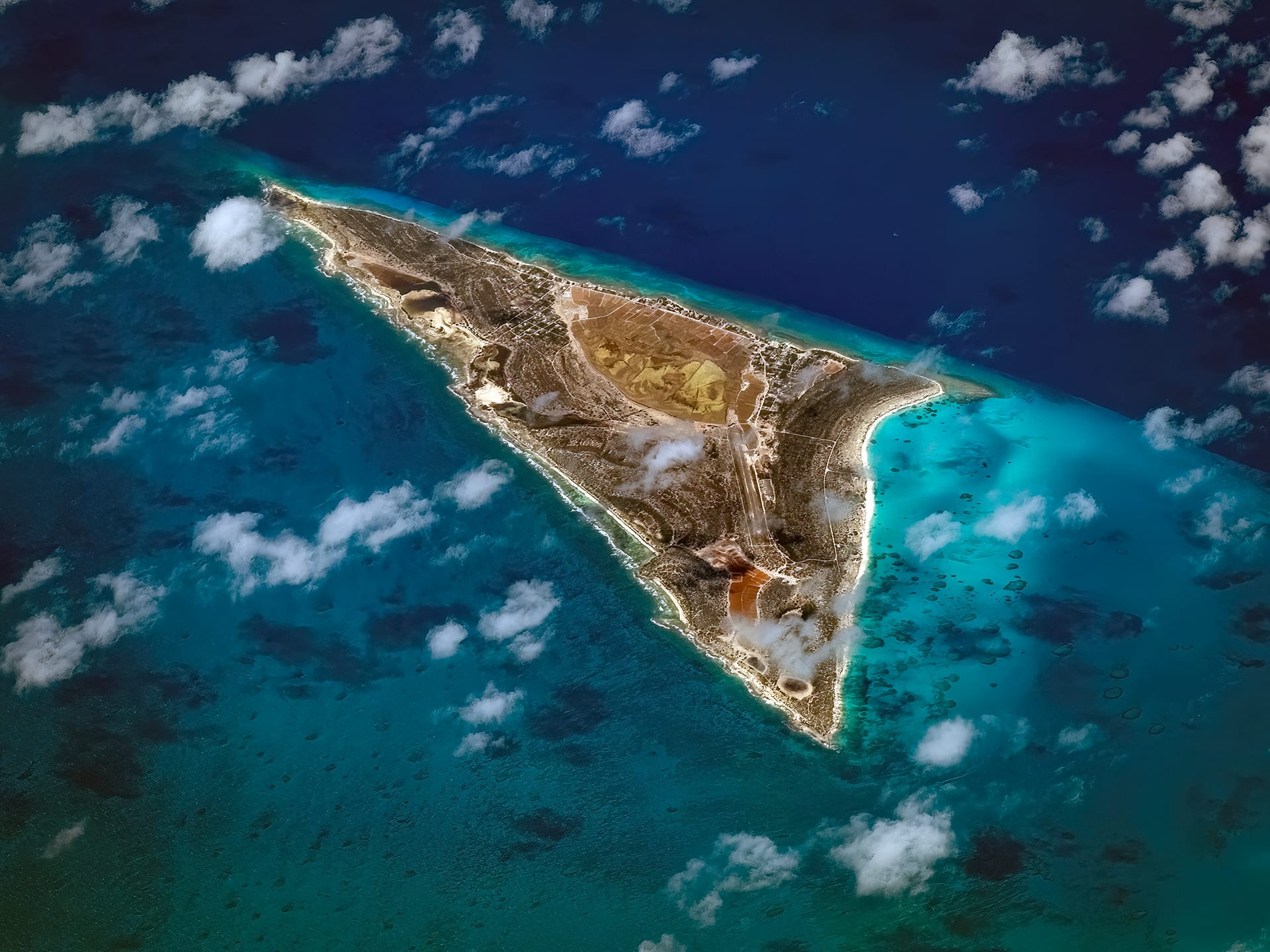
Aerial view of a flat triangular island with brown salt ponds and an airstrip, ringed by turquoise shallows and deep blue sea

Turks and Caicos Islands

Salt Cay

Salt Cay seen from the air, with its salt ponds filling much of the island. (Thudfinger / Wikimedia Commons · CC BY-SA 4.0)

Salt Cay is a tiny, flat, triangular island in the Turks Islands, about 8 miles from Grand Turk and given over mostly to salt pans. For three centuries salt raked from its ponds supported several hundred people; today about a hundred live in Balfour Town, and visitors come for empty beaches, diving and winter humpback whales.

Neighbourhoods

  • Balfour Town
    • First-time visitors
    • Historic district
    • Beaches

    The island's only settlement, established in 1673 on the west coast and home to everyone who lives on Salt Cay. Its few restaurants, shops and rented houses sit along hard-rolled limestone roads, with a beach in front of the town.

    Open in Maps
  • The salt ponds and the interior
    • History
    • Walks

    Most of the island's interior is taken up by the old salt pans, with ruins of the salt works among them. Paths and trails cross it, and donkeys and cattle descended from the animals of the salt days roam freely.

    Open in Maps
  • North Bay
    • Beaches
    • Quiet

    The north shore and North Bay Beach, one of the island's two main beaches, reached on foot, by bicycle or by golf cart from town.

    Open in Maps

Things to do

Salt, history and the island

  • The salt pondslandmark

    The shallow pans that cover much of the island, where brine was evaporated and salt raked for some three centuries until the industry ended; ruins of the salt operations remain.

    Open in Maps
  • Balfour Townneighborhood

    The small 17th-century settlement on the west coast, the only town on the island, where the life of a salt-raking community can still be imagined.

    Open in Maps

Beaches, whales and the sea

  • North Bay Beachbeach

    One of the island's two main beaches, on the north shore.

    Open in Maps
  • Balfour Town Beachbeach

    The beach in front of the town on the west coast; much of the rest of the coast, especially in the east, is rocky.

    Open in Maps
  • Whale watchingattraction

    Salt Cay lies in the middle of the humpback whales' migration route to the Silver Bank, and between December and mid-April the whales are spotted from boats and sometimes from the shore.

    Open in Maps

Short trips from the island

  • Great Sand Cayattraction

    A cay about 9 miles south of Salt Cay, long a calving place for humpback whales, whose newborn calves and mothers are often seen in the surrounding waters.

    Open in Maps
  • Grand Turkattraction

    The capital island, about 8 miles away by the community ferry or a short flight, with the national museum, the lighthouse and the shops and services Salt Cay lacks.

    Open in Maps

Eat and drink

Long-standing places and food districts in Salt Cay. Hours, ratings and directions come from your maps app, always current.

Salt Cay classics

  • Pat's Placerestaurant

    A small restaurant in Balfour Town serving traditional Turks and Caicos cooking.

    Open in Maps
  • Balfour Town seafood restaurantsneighborhood

    The handful of small restaurants in the only town, most of them specialising in fresh seafood.

    Open in Maps

Experience Salt Cay

History

Salt Cay was inhabited by the Lucayan people when Europeans reached the islands in the early 16th century; they disappeared soon afterwards through disease and forced labour. Bermudians arrived in 1673 and founded Balfour Town on the west coast, establishing what became the island's principal industry for the next 300 years: producing salt by evaporating brine in shallow pans. The island came under British colonial rule in 1766.

Salt Cay salt travelled far. Salt from the Turks and Caicos preserved food for George Washington's army in the American Revolutionary War, and Canadian and American fishing fleets used it to salt down their catches. As late as the 1920s and 1930s, up to half a dozen sailing ships at a time anchored off the island waiting for cargo, which had to be ferried out to them across the shallows. The island was once home to several hundred people, all supported by the salt industry, and the 1941 film Bahama Passage, shot largely on Salt Cay, recorded the industry in its final days.

Competition, costs, mismanagement and the lack of a deepwater harbour finally ended salt production, and the population shrank. An airstrip was built in the 1970s. On 7 September 2017 Hurricane Irma damaged every house on the island. The airport has been upgraded since the late 2010s and was renamed Leon Wilson Airport in 2020.

Culture & Customs

Salt Cay's identity is bound up with salt. The island is given over mostly to the old salt pans, and the ruins of the salt works, the town founded by Bermudian salt rakers and the animals left over from the salt days are what give it its character. Donkeys and cattle, descended from those that worked the salt industry, still roam freely across the island.

Life is that of a very small village. Everyone lives in Balfour Town, and the community of about a hundred people shares the conservative, church-centred outlook of the islands as a whole. Visitors arrive by community ferry or small plane, and the island has only a handful of restaurants and shops.

The sea gives the island its other identity. Salt Cay lies in the middle of the North Atlantic humpback whales' migration route to the Silver Bank, a mating and calving ground north of the Dominican Republic, and some of the same whales are seen off New England and further north. Each winter whale-watchers come to see them, and whales, including mothers and calves, are often spotted both from boats and from the shore.

Daily Life

Salt Cay had an estimated 108 residents in 2012, all of them living in Balfour Town. The island covers about 2.6 square miles, roughly 2 miles on each side, and much of it is salt pans. It is the second-largest of the Turks Islands and forms its own district with some uninhabited cays nearby.

The island is now popular with visitors looking for uncrowded beaches, whale-watching, diving and other water sports. There are no hotels or resorts; visitors rent houses and villas, and the island has a handful of restaurants specialising in fresh seafood and a few variety and gift shops. Supplies come by sea and air from Grand Turk and Providenciales, and residents rely on the community ferry and small planes for anything the island cannot provide.

Roads in town are hard-rolled limestone and the rest of the island is crossed by paths and trails, so people walk, cycle or drive golf carts. The population today is a fraction of the several hundred who lived here in the salt-raking years.

Food

Food on Salt Cay is simple and comes mostly from the sea. The island's few restaurants specialise in fresh seafood, at least one serves traditional Turks and Caicos cooking, and a couple offer international dishes. Conch is the staple of the islands — cracked (pounded and fried), as fritters, in chowder, or raw as conch salad with lime — and grouper, snapper and spiny lobster are the usual catch. Johnnycake is the traditional side.

Groceries are limited to a few small variety shops, so visitors who rent houses often bring supplies from Grand Turk or Providenciales and cook for themselves.

Salt itself is the island's best-known product. Sea salt and bath salts from Salt Cay are sold in the shop of the national museum on Grand Turk, a small reminder of the trade that once kept sailing ships anchored off the island. Rum is the usual drink across the islands.

Planning tools

Budget

There are no hotels or resorts on Salt Cay; visitors rent a house, villa or guest suite. The island has only a few restaurants and small shops, so many visitors self-cater, and groceries are imported and expensive. An accommodation tax is added to room bills.

Daily Budget Midrange
USD 350–700 (rented house or villa, restaurant meals, golf-cart hire, a whale-watching or dive trip)
Daily Budget Shoestring
USD 150–250 (rented room or cottage, self-catering, bicycle)

Bring some supplies from Grand Turk or Providenciales, as the island's shops are small.

Best Time to Visit

December to mid-April is the whale season, when humpbacks pass the island on the way to the Silver Bank, and also the dry, breezy high season. May, June and November are quieter, and August to October carries the main hurricane risk.

Suggested Number of Days

A day or two is enough for a first look at so small an island, and many visitors come for a single day. Three or four days suit divers and whale-watchers in season.

First Visit
1–2 days
With Surroundings
3–4 days

Transportation

The island is so small that walking, cycling and golf carts are the main ways of getting around. Roads in the settlement are hard-rolled limestone, and the rest of the island is crossed by unpaved paths and trails.

A bicycle or golf cart makes reaching North Bay and the far side of the salt ponds much easier in the heat.

Airport & Station Connections

Salt Cay Airport, renamed Leon Wilson Airport in 2020, has a short paved runway of about 2,700 feet for small aircraft, with flights from Providenciales and Grand Turk. A community ferry from Grand Turk runs three times a week and takes about an hour to cover the roughly 8 miles.

Walkability

The island measures about 2 miles on each side, so Balfour Town and its beach are easy to walk around. Reaching North Bay and the far side of the salt ponds on foot is possible but hot; a bicycle or golf cart helps.

Safety

Generally safe for visitors. The gang-related gun violence reported in the territory is concentrated among residents in parts of Providenciales, not on Salt Cay. Medical care on the island is limited, some beaches and much of the eastern coast are rocky, and the island is in the hurricane belt.

Check every bag for stray ammunition before travelling, as possession is a serious criminal offence; keep a respectful distance from whales, and check the forecast in hurricane season. Check current official travel advice before travelling.

Climate

Tropical, dry and sunny for most of the year. Across the islands temperatures are typically around 27–32°C, and the hurricane season runs from June to November. December to April is slightly cooler and breezier.

Summer
hot — temperatures across the islands rarely exceed 33°C, with the main hurricane risk from August to October
Winter
warm and breezy, the whale season — night-time temperatures across the islands rarely fall below 18°C

Local Customs

Salt Cay is a village of about a hundred people where everyone knows everyone, and the community is conservative and church-centred like the islands as a whole. English is the everyday language. Donkeys and cattle wander freely across the island.

Firearms law is enforced strictly, ammunition included. Greet people in town, and ask before photographing residents or their homes.

Common Payment Methods

The currency is the US dollar. With only a few small shops and restaurants, cash is important; bring enough from Grand Turk or Providenciales.