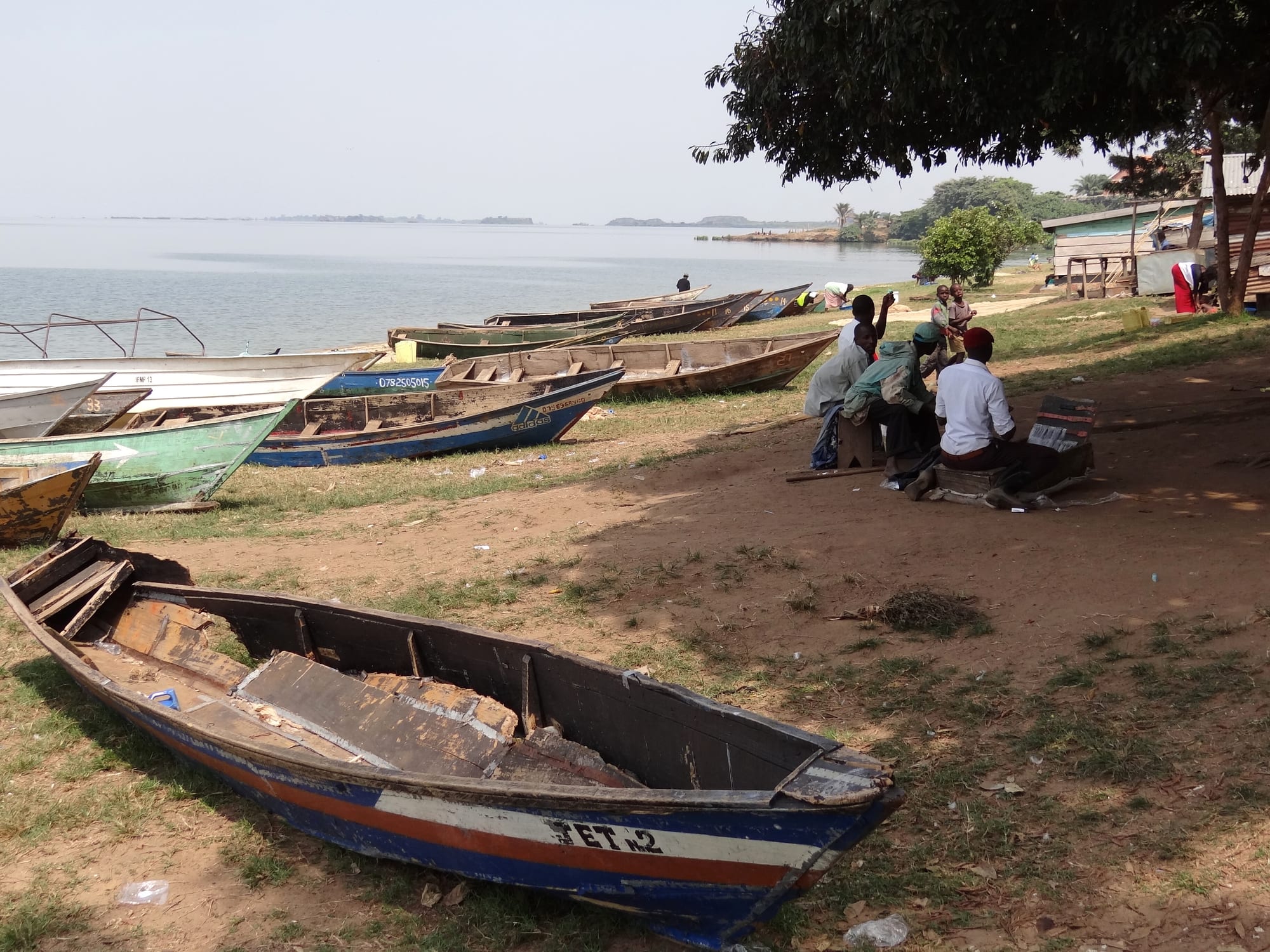
Wooden fishing boats drawn up on a grassy shore beside the flat water of Lake Victoria, with trees and low buildings behind

Kampala & Central Uganda, Uganda

Entebbe

Fishing boats on the Lake Victoria shore at Entebbe, with the lake stretching away beyond the landing. (Adam Jones, Ph.D. / Wikimedia Commons · CC BY-SA 3.0)

A quiet town on a peninsula reaching into Lake Victoria, about 35 km south of Kampala. It was the seat of the British protectorate government, which left it wide avenues, old bungalows and botanical gardens dating from 1898, and it now holds Uganda's international airport, a wildlife education centre and the lakeside piers for boats to the islands.

Neighbourhoods

  • Town centre and the old station
    • First-time visitors
    • Historic district
    • Quiet and residential

    The upper part of the peninsula, laid out by the protectorate administration with wide roads, mature trees, golf links and single-storey bungalows in large gardens. Government offices, the State House grounds and many of the older hotels are here, and it stays unusually quiet for a Ugandan town.

    Open in Maps
  • Kitoro
    • Local life
    • Best for food
    • Markets

    The busy commercial quarter near the airport road, with the main market, small shops, bars and boda-boda stages. This is where most of Entebbe's everyday trade happens and where cheap eating places are concentrated.

    Open in Maps
  • The lake shore and Lido area
    • Beaches
    • Sunsets
    • Relaxed evenings

    A strip of sandy beaches, gardens and open-air bars along the northern shore below the botanical gardens, busy with Kampala families at weekends. The water carries bilharzia, so most visitors come for the view, the food and the music rather than to swim.

    Open in Maps
  • Nakiwogo
    • Boats and ferries
    • Fishing life

    The landing site on the western side of the peninsula, where the ferry to the Ssese Islands loads and fishing boats come and go. The surroundings are workaday — nets, fish stalls and repair yards rather than hotels.

    Open in Maps
  • Kigungu
    • Fishing life
    • Quiet and residential

    A fishing village at the southern tip of the peninsula, beyond the airport, where the first Catholic missionaries landed in 1879 and a small monument marks the spot. Boats leave from here for the lake and its islands.

    Open in Maps

Things to do

Gardens and wildlife

  • Entebbe Botanical Gardenspark

    Gardens laid out in 1898 on the lake shore, with tall shade trees, a stretch of rainforest, monkeys and some of the easiest birdwatching in the country.

    Open in Maps
  • Uganda Wildlife Education Centreattraction

    Opened in 1952 as a reception centre for injured and confiscated wildlife and still known locally as the Entebbe zoo, on the shore beside the gardens, now a conservation and education centre with rescued animals in large enclosures.

    Open in Maps

The town

  • State House, Entebbelandmark

    The official residence of Uganda's president, set in guarded grounds on the peninsula and seen from the road; it is not open to visitors.

    Open in Maps
  • Entebbe International Airporttransit hub

    Uganda's only international airport, on the lake shore south of the town; the old terminal, since demolished apart from its control tower and hall, was the scene of the 1976 hostage rescue by Israeli soldiers.

    Open in Maps
  • Nakiwogo landing sitetransit hub

    The pier on the western shore where the ferry leaves for Bugala in the Ssese Islands, alongside a working fishing landing.

    Open in Maps
  • Lake Victoria beachesbeach

    Sandy public beaches along the northern shore with bars, grilled fish and music at weekends; still fresh water here carries bilharzia.

    Open in Maps

Short trips from the town

  • Ngamba Island Chimpanzee Sanctuaryattraction

    An island sanctuary about 25 km out in Lake Victoria, reached by boat, caring for orphaned and rescued chimpanzees in a forested enclosure.

    Open in Maps
  • Mabamba Bay Wetlandpark

    A Ramsar-listed papyrus swamp on the lake north-west of the peninsula, about 15 km away across the water and further by road, visited by canoe and known above all for its shoebills.

    Open in Maps
  • Kampalaattraction

    The capital, about 35 km north by expressway, with the Buganda royal sites, the Uganda Museum, the national mosque and the country's largest markets.

    Open in Maps

Seasonal events

  • Nsenene seasonaround April–May and November

    Grasshoppers swarm with the rains and are caught at night under bright lights, then fried and sold around the town.

  • Christmas and Easter weekends at the beachesDecember and April

    The lakeside beaches and gardens fill with families from Kampala, with live music and grilled fish along the shore.

Eat and drink

Long-standing places and food districts in Entebbe. Hours, ratings and directions come from your maps app, always current.

Lake fish

  • Beachside fish grillsrestaurant

    Whole tilapia, deep-fried or grilled and served with chips, cassava or matooke, is the town's standard meal, cooked at the bars and gardens along the northern shore.

    Open in Maps
  • Kigungu and Nakiwogo landing sitesmarket

    Fishing landings where the catch is sold and fried on the spot, along with mukene, the small silver fish dried in the sun.

    Open in Maps

Town eating

  • Kitoro market and food stallsmarket

    The main market for produce, with rolex stands, chapati and muchomo skewers on the surrounding streets.

    Open in Maps
  • Entebbe Road restaurantsneighborhood

    The main road through town carries most of the sit-down restaurants, from Ugandan buffets to Indian, Chinese and Italian kitchens serving airport and government traffic.

    Open in Maps

Experience Entebbe

History

Entebbe sits on a peninsula that was long used by Ganda fishing and canoe communities, and the name is usually explained as the Luganda word for a seat or chair, said to recall the place where a Ganda chief sat to hear cases. Catholic missionaries of the White Fathers landed nearby at Kigungu in 1879, one of the first European arrivals on this shore.

In 1893 the British chose the peninsula as an administrative base, preferring its lake access and breezes to the crowded hills at Kampala, and Entebbe became the capital of the Uganda Protectorate. Offices, a governor's residence, a golf course and quarters for officials were laid out along wide avenues, and the botanical gardens were laid out close to the shore in 1898. The lake was the main highway, with steamers linking the port to others around its shores.

At independence in 1962 government moved to Kampala, and Entebbe kept the airport, the State House and a reputation as a quiet official town. Its best-known moment came in 1976, when an airliner hijacked on a flight from Tel Aviv was flown here and the hostages were freed by Israeli commandos in a raid at the old terminal. Since the 1990s it has grown with the airport: new terminal and cargo facilities and runway works, hotels for transit passengers, and a steady spread of housing towards Kampala along the expressway opened in 2018.

Culture & Customs

Entebbe's character comes from three overlapping worlds. The first is official: the State House, ministries, research institutes and the airport give the town a population of civil servants, aviation staff, scientists and diplomats, and a formality that shows in how people dress and greet. The second is the fishing economy of the landings at Nakiwogo, Kigungu and the smaller beaches, working early and selling by the boat. The third is the weekend trade, when Kampala arrives for the beaches, the gardens and the music.

Like the rest of central Uganda this is Buganda, so Luganda is the everyday language, clan identities matter, and ceremonies such as the kwanjula introduction are the big family events of the year. Christianity is strong — Catholic and Anglican parishes, and a growing number of Pentecostal churches — with a Muslim minority and mosques in Kitoro.

The town has an unusual concentration of conservation and research work: the wildlife education centre, the botanical gardens, the Uganda Virus Research Institute, and the boat operators who take birdwatchers to the Mabamba swamp have made birding, and the shoebill in particular, part of local identity. Manners are courteous, unhurried and mildly formal; Entebbe prides itself on being calmer and greener than the capital.

Daily Life

About 70,000 people were counted in the municipality at the 2014 census, and the wider peninsula and the commuter belt towards Kampala have grown steadily since, as the expressway makes the capital reachable. The town divides in practice between the old administrative half on the upper peninsula and the denser commercial side around Kitoro.

Work here is unlike anywhere else in Uganda. The airport is the biggest employer, with airlines, ground handling, cargo, freight forwarders and security; around it are government offices, the State House, research institutes and the military airbase. Fishing remains important at the landings, and tourism supplies hotel, restaurant and boat jobs. Many residents commute to Kampala, and many Kampala residents own or rent a weekend place near the water.

The rhythm is set by flights and boats. Fishermen go out before dawn and sell in the morning; the market in Kitoro is busiest in the middle of the day; airport traffic peaks late at night when long-haul flights leave and arrive; and weekends belong to the beaches. Local concerns include the price of land as Kampala spreads south, declining fish catches and the regulation of the lake fishery, pollution of the shore, and the noise and expansion of the airport.

Food

Fish defines Entebbe's cooking. Tilapia is the standard — fried whole until crisp, or grilled, or stewed with tomato and onion — and Nile perch is cut into steaks and fillets. Both are eaten with chips, cassava, posho or matooke, and a simple salad of tomato, onion and cabbage called kachumbari. The lake also yields mukene, small silver fish dried on racks in the sun and cooked into a savoury groundnut sauce, and smoked fish sold at the landings.

Behind the fish is the standard Ganda kitchen: matooke steamed in banana leaves and served with groundnut sauce or beans, katogo for breakfast, luwombo for celebrations, and rice, sweet potato and greens on the lunchtime buffet. Street food is the same as Kampala's — the rolex, a chapati wrapped around fried egg with tomato and cabbage; muchomo skewers; roasted gonja plantain; samosas; and fried cassava. In the rainy months nsenene grasshoppers appear, fried with onion and sold by the cup.

To drink there is milky ginger tea, passion-fruit and mango juice, bottled lagers, waragi gin and, in the villages, tonto banana beer. Coffee is grown all around the lake shore, though tea remains the common hot drink at home, and a few cafés in the town roast and serve Ugandan beans for visitors waiting on flights.

Planning tools

Budget

Entebbe costs a little less than Kampala but more than most Ugandan towns, because hotels here serve airport traffic and can charge accordingly. Guesthouses in Kitoro and the back streets are cheap, local meals cost very little, and the main extras are boat trips to the islands and the wetland, which are priced in US dollars.

Daily Budget Midrange
USD 90–180 (mid-range lakeside hotel, restaurant meals, private car or a boat trip)
Daily Budget Shoestring
USD 30–55 (guesthouse room, fried fish and local food, boda-bodas and shared taxis)

Agree the price of a boat trip and check that life jackets are provided; carry small shilling notes for the market and boda-bodas.

Best Time to Visit

June to August and December to February are drier and easier for boat trips, with calmer water on the lake. The wet seasons of March to May and September to November bring heavy afternoon storms that can delay crossings, though the gardens and the wetland are at their greenest and birdlife is good all year.

Suggested Number of Days

A day is enough for the town itself, and many visitors see it on the way to or from the airport. Two or three days suits a stay that adds a boat trip or two on the lake. Weather on the water is what usually changes the plan.

First Visit
1 day
With Surroundings
2–3 days

Transportation

The town is small and strung along one main road, served by shared minibus taxis and by boda-boda motorbikes, which are the usual way to cover short distances. Minibuses and coaches run constantly to Kampala, and ride-hailing cars work here as well. Boats leave from Nakiwogo and Kigungu for the islands and the lakeside villages.

Fix the fare before getting on a boda-boda, and allow extra time for the Kampala road, which is slow at the city end.

Airport & Station Connections

Entebbe International Airport is in the town itself, a few kilometres from the centre, so most international visitors to Uganda begin here. Kampala is about 35 km north on a tolled expressway, roughly 45 minutes to an hour outside rush hour, and minibuses and coaches make the trip all day. The ferry to the Ssese Islands leaves from Nakiwogo and takes about three to four hours.

Walkability

The old upper town is pleasant to walk, with shade, wide verges and little traffic, and the botanical gardens and the wildlife centre sit next to each other on the shore. Distances between the centre, Kitoro and the ferry landing are longer than they look on a map, and there are stretches with no pavement, so most people take a boda-boda for anything over a kilometre.

Safety

Entebbe is calm by Ugandan standards, and the main risks are the everyday ones: petty theft in the market and at the landings, road accidents, especially on boda-bodas, and rough water on the lake, where sudden squalls are dangerous for small boats. Lake Victoria carries bilharzia, and crocodiles and hippos are present in places along the shore.

Avoid swimming in the lake, use boats that carry life jackets, keep valuables out of sight at the landings and markets, and stay away from demonstrations. Under the Anti-Homosexuality Act, 2023, same-sex acts carry life imprisonment and 'aggravated homosexuality' the death penalty; most of the law was upheld by the Constitutional Court in April 2024. Check current official travel advice before travelling.

Climate

Warm and humid all year, moderated by the lake and by an altitude of about 1,150 metres. Days are typically in the high 20s °C and nights in the high teens, with more rain than Kampala and frequent thunderstorms over the water. The two wetter seasons are roughly March to May and September to November.

Summer
June to August is slightly cooler and drier, about 17–26°C
Winter
December to February is drier and a little warmer, about 18–28°C

Local Customs

Greetings come first and are unhurried, and dress is neat; swimwear belongs on the beach and not in the town. Luganda is the everyday language alongside English. The town is used to travellers passing through, but its residential streets are ordinary neighbourhoods rather than a resort strip.

Do not photograph the airport, the State House, police or military installations. Ask before photographing people, especially at the fishing landings, and tip modestly in restaurants if service pleases.

Common Payment Methods

The currency is the Ugandan shilling (UGX). Hotels, the airport and larger restaurants take cards, but markets, boats, boda-bodas and small guesthouses are cash only. ATMs are available in the town centre and at the airport, and clean, recent US dollar notes are accepted for some tours and transfers.