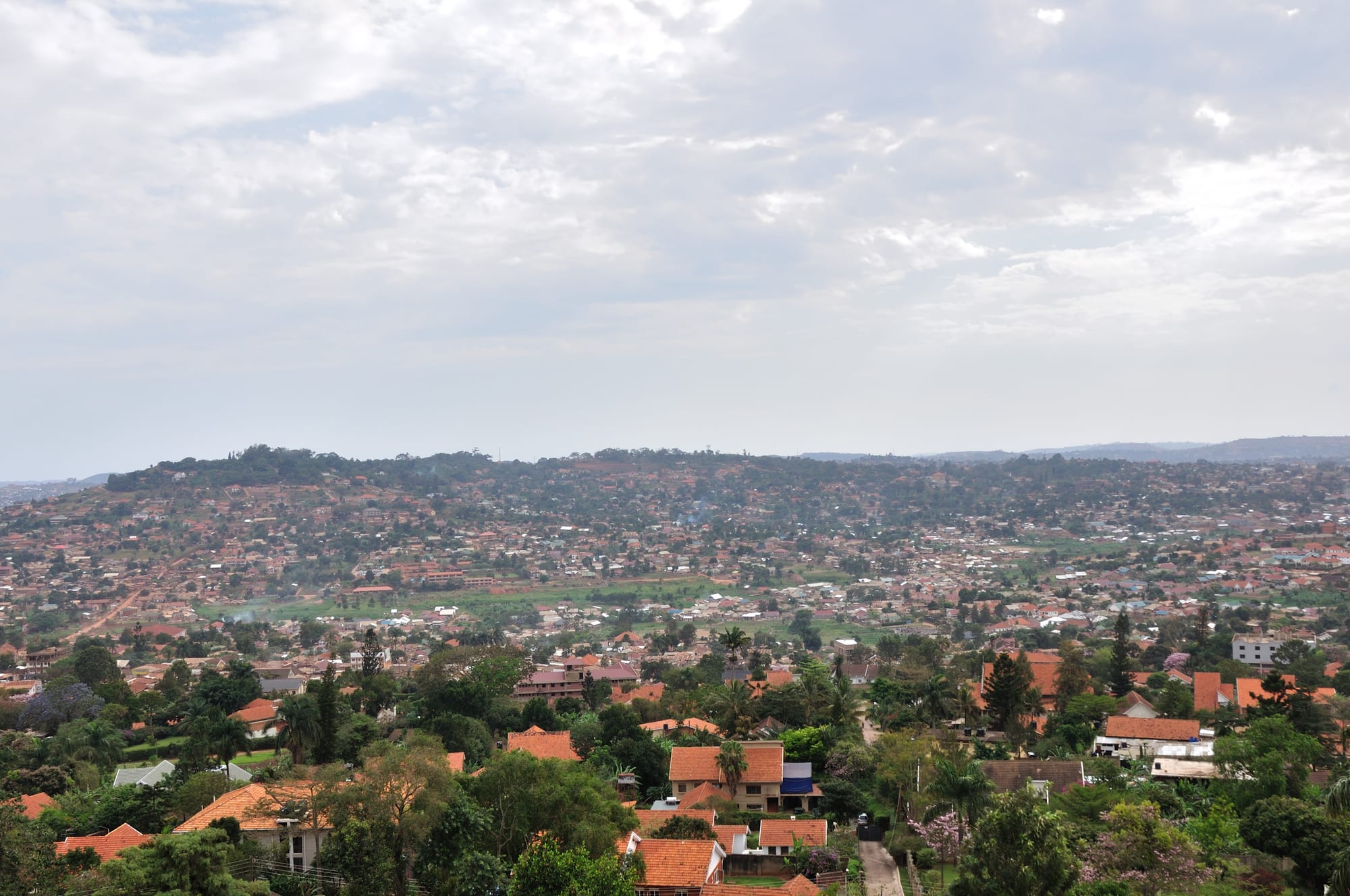
Kampala's red-roofed houses and trees spreading across low hills towards a hazy ridge under a pale sky

Kampala & Central Uganda, Uganda

Kampala

Kampala seen from one of its hills, the city's red-tiled roofs and trees running across the valleys beyond. (Simisa (talk · contribs) / Wikimedia Commons · CC BY-SA 3.0)

Uganda's capital and largest city, spread over a cluster of hills a few kilometres north of Lake Victoria. It grew around the Buganda royal court at Mengo and a British fort on Old Kampala hill, and is now the country's centre of government, trade and music — a crowded, fast-growing place of markets, arcades, boda-boda motorbikes and long traffic jams.

Neighbourhoods

  • Nakasero
    • First-time visitors
    • Business district
    • Markets

    The central hill, with government offices, banks, embassies and most of the city's larger hotels on its upper slopes, and the dense shopping streets, arcades and Nakasero market running down towards Kampala Road. The contrast between the quiet tree-lined top and the crowded lower town is the clearest thing about central Kampala.

    Open in Maps
  • Kololo
    • Quiet and residential
    • Restaurants
    • Embassies

    The highest hill in the city and its most expensive address, north-east of the centre, with walled houses, diplomatic residences and a spread of restaurants and cafés. The Independence Monument and the ceremonial grounds used for national celebrations lie on its lower edge.

    Open in Maps
  • Old Kampala
    • Historic district
    • Viewpoints

    The hill where the British fort stood in the 1890s, west of the centre, now crowned by the Uganda National Mosque, whose minaret gives the widest view over the city. The surrounding streets have long been a centre of Kampala's Asian and Muslim commercial life.

    Open in Maps
  • Mengo
    • Historic district
    • Local life

    The seat of the Buganda kingdom, south-west of the centre, where the Lubiri palace faces the Bulange parliament building along a straight royal avenue. Around it are old residential streets, the Kabaka's Lake and the approach to Rubaga hill.

    Open in Maps
  • Makerere
    • Students and nightlife
    • Budget stays

    The university hill north of the centre, its campus of red-brick and colonial-era buildings surrounded by hostels, cheap eating places, bookshops and bars. The student areas of Wandegeya and Kikoni below it stay busy late.

    Open in Maps
  • Kabalagala and Kansanga
    • Nightlife
    • Best for food

    A strip along Ggaba Road south-east of the centre known for its bars, nightclubs and late-night street food, with Ethiopian, Somali and Congolese restaurants among them. It is residential by day and one of the loudest parts of the city after dark.

    Open in Maps
  • Bugolobi and Nakawa
    • Quiet and residential
    • Close to public transport

    Leafy eastern suburbs on the road towards Jinja, with flats, supermarkets and a number of restaurants, close to the industrial area and the Nakawa markets. Many long-stay visitors and NGO staff live here.

    Open in Maps

Things to do

Buganda and the royal hills

  • Kasubi Tombslandmark

    The great thatched burial house of four kabakas of Buganda on Kasubi hill, a UNESCO World Heritage Site that burned in 2010 and was rebuilt with traditional materials, the restoration completed in 2023.

    Open in Maps
  • Lubiri (Mengo Palace)landmark

    The walled palace compound of the Buganda kabakas at Mengo, facing the Bulange along a straight royal avenue; the underground chambers built during Idi Amin's rule stand in the grounds.

    Open in Maps
  • Kabaka's Lakepark

    A hand-dug lake below the Mengo palace, ordered by Kabaka Mwanga II in the late nineteenth century as a water source and a defence for his palace, with a walking path around its edge and birdlife on the water.

    Open in Maps
  • Rubaga Cathedrallandmark

    The twin-towered Catholic cathedral on Rubaga hill, built on the site of an earlier Buganda royal capital and seat of the archbishop of Kampala.

    Open in Maps
  • Namirembe Cathedrallandmark

    The Anglican cathedral of red brick on Namirembe hill, completed in 1919, with a wide view east across the city from its terrace.

    Open in Maps

Landmarks and places of worship

  • Uganda National Mosquelandmark

    The large mosque on Old Kampala hill, completed in 2006, whose minaret is climbed for the broadest panorama of Kampala's hills.

    Open in Maps
  • Baháʼí House of Worshiplandmark

    A domed temple in gardens on Kikaaya hill north of the centre, dedicated in 1961 and known to Baháʼís as the mother temple of Africa.

    Open in Maps
  • Independence Monumentlandmark

    A concrete sculpture of a figure raising a child, marking the independence of 1962, standing in the King George V Jubilee gardens in the city centre.

    Open in Maps
  • Makerere Universitylandmark

    Founded in 1922 as a technical school and among the oldest universities in East Africa, its main building and wooded campus set on a hill above Wandegeya.

    Open in Maps

Museums and performance

  • Uganda Museummuseum

    The country's national museum, founded in 1908 and the oldest in East Africa, with ethnographic collections, archaeology and a notable display of traditional musical instruments.

    Open in Maps
  • Ndere Centreattraction

    A cultural centre whose resident troupe performs music and dance from across Uganda, and from Rwanda and Burundi, several nights a week in an open-air arena.

    Open in Maps

Markets and streets

  • St Balikuddembe Marketmarket

    Long known as Owino, a vast and tightly packed market near the old taxi park selling produce, second-hand clothing and household goods.

    Open in Maps
  • Nakasero Marketmarket

    The central produce market below Nakasero hill, with fruit, vegetables, fish and spices sold from stalls and along the surrounding streets.

    Open in Maps

Short trips from the city

  • Namugongo Martyrs' Shrinelandmark

    About 15 km north-east of the centre, the church and lake-side shrine marking where Christian converts were executed in 1886, and the destination of a very large pilgrimage each 3 June.

    Open in Maps
  • Entebbeattraction

    The lakeside town about 35 km south of Kampala, with botanical gardens laid out in 1898, a wildlife education centre and beaches on Lake Victoria.

    Open in Maps
  • Mabira Forestpark

    A large block of rainforest on the Jinja road, roughly 50 km east of the city, protected as a reserve since 1932, with walking trails, birds and a zip-line through the canopy.

    Open in Maps

Seasonal events

  • Martyrs' Day at Namugongo3 June

    One of Africa's largest pilgrimages brings enormous crowds, many walking for days, to the shrines on the eastern edge of the city.

  • Independence Day9 October

    Marked with parades and ceremonies, sometimes on the Kololo ceremonial grounds and sometimes in another part of the country.

  • Nsenene seasonaround April–May and November

    Grasshoppers swarm with the rains, and traders with lights and drums catch and fry them for sale across the city.

Eat and drink

Long-standing places and food districts in Kampala. Hours, ratings and directions come from your maps app, always current.

Kampala classics

  • Rolex stallsrestaurant

    The chapati rolled around a fried egg with tomato, onion and cabbage is Kampala's own street food, cooked to order at roadside stands; the student streets of Wandegeya are among the best-known places to find it.

    Open in Maps
  • Luwombo and matooke kitchensrestaurant

    Everyday canteens serve steamed matooke with groundnut sauce, beans and stew, and luwombo — meat or groundnut sauce steamed in a banana-leaf parcel — often at lunchtime buffets.

    Open in Maps

Markets and food districts

  • Nakasero Marketmarket

    The central fruit and vegetable market, good for jackfruit, passion fruit, mangoes and the small dried fish called mukene.

    Open in Maps
  • Ggaba landing siteneighborhood

    A fishing and market village on the Lake Victoria shore south of the city where tilapia is fried whole beside the water.

    Open in Maps
  • Kabalagala street foodneighborhood

    Grilled muchomo skewers, chips and rolex stands work late along Ggaba Road, alongside Ethiopian and Somali restaurants.

    Open in Maps
  • Kololo restaurantsneighborhood

    The city's widest choice of Indian, Italian, Japanese and modern Ugandan cooking is concentrated in the streets around Acacia Avenue.

    Open in Maps

Experience Kampala

History

Kampala began as royal ground rather than a town. The hills north-west of Lake Victoria were part of the Buganda kingdom's heartland, and the kabakas moved their capital from hill to hill — Kasubi, Mengo, Rubaga and Nakasero all served in turn — with a stockaded palace, chiefs' enclosures and reed houses that could be abandoned and rebuilt elsewhere. The hills were also hunting country: the name is usually traced to a Luganda phrase meaning the hill of the impala.

In 1890 Frederick Lugard of the Imperial British East Africa Company built a fort on the hill that is still called Old Kampala, a short distance from Kabaka Mwanga II's court at Mengo. Missionaries had arrived in the previous decade and took hills of their own: Namirembe for the Anglicans, Rubaga for the Catholics. Around the two centres of power grew a trading town, with Indian merchants settled along the roads below Nakasero. Entebbe was made the seat of the protectorate government, so Kampala developed as the commercial and educational capital instead, gaining Makerere College in 1922.

Kampala became the national capital at independence in 1962. The decades that followed were hard on it: Milton Obote's troops attacked the Mengo palace in 1966, Idi Amin's 1972 expulsion of the Asian community emptied much of the downtown commercial class, and the city was fought over at the end of the 1978–79 war with Tanzania and again in 1986, when the National Resistance Army took it. Since then it has grown enormously and rebuilt, with new towers on Nakasero, restored royal sites, and suburbs spreading across neighbouring districts far beyond the old seven hills.

Culture & Customs

Kampala is a Ganda city that has become a national one. Luganda is the language of the street and the market, and the institutions of Buganda — the kabaka, the Katikkiro and the Lukiiko assembly that meets in the Bulange at Mengo — carry real cultural weight, expressed in clan identities, in the kanzu and gomesi worn at ceremonies, and in the kwanjula introduction, often a larger affair than the wedding that follows; between 2017 and 2019 the kingdom's Kabaka birthday run raised funds for the fight against sickle cell disease. At the same time people from every region of Uganda live here, along with Kenyan, Congolese, Somali, Ethiopian, Indian and South Sudanese communities, and English is the common ground between them.

It is a strongly religious city, with Anglican Namirembe and Catholic Rubaga facing each other across the valleys, the national mosque on Old Kampala hill, large Pentecostal congregations, and a Baháʼí temple on its northern edge. The Namugongo pilgrimage each June is the single largest gathering of the year.

Music runs through everything. Kampala's studios turn out Afrobeat, dancehall and kadongo kamu, the Luganda guitar-and-storytelling style, and the best-known musician of the last generation, Bobi Wine, became a political figure. Nights out run late in Kabalagala, Kololo and the student bars around Makerere. Football is followed closely, and the Ndere troupe performs dances gathered from across the country. Manners are courteous and indirect; raised voices and public anger are badly received.

Daily Life

About 1.8 million people live within the city boundary, counted at the 2024 census, and several million more in the metropolitan area that has spread into Wakiso and Mukono districts — one of the fastest-growing urban regions in Africa. The city's five administrative divisions are Central, Kawempe, Makindye, Nakawa and Rubaga.

Kampala holds most of Uganda's formal employment: government ministries, banks, telecoms, universities and the head offices of almost everything. Around them works an enormous informal economy of market traders, arcade stalls, mechanics, food sellers and boda-boda riders, many of them young men who have come from the countryside. Incomes differ sharply between the gated houses of Kololo and the crowded low-lying settlements in the valleys.

The day starts early to beat the jams, with a rolex or a plate of katogo at a roadside stall and a long commute by minibus. Offices and markets fill by the middle of the morning; downtown is at its most congested in the afternoon; and the evening traffic dissolves slowly into bar and restaurant hours that go on late. Recurring local concerns are traffic and road safety, flooding in the valleys after heavy rain, waste and drainage, land disputes at the city's edges and unemployment among young graduates.

Food

The Ganda kitchen sets the tone. Matooke — green cooking bananas peeled, wrapped in banana leaves and steamed for hours, then mashed — is the centre of the plate, served with groundnut sauce (binyebwa), beans, greens or a meat stew. Luwombo, chicken, beef, fish or groundnut sauce slow-steamed in a banana-leaf parcel, is the dish of celebrations and of the kwanjula. Katogo, matooke cooked together with offal, beans or groundnuts, is the working breakfast, and posho, a stiff maize porridge, and rice, cassava and sweet potato fill out the buffet plates sold at lunchtime canteens.

Street food is Kampala's own contribution. The rolex — a chapati rolled around a fried egg with tomato, onion and cabbage — is made at stands on almost every busy corner, and is associated above all with the student streets. Alongside it are muchomo, grilled skewers of beef or goat; roasted gonja plantain; samosas and mandazi; and deep-fried cassava chips. In the rainy months, particularly around May and November, nsenene — grasshoppers — are caught at night under bright lights, then cleaned, de-winged and fried with onion, and sold by the cup.

Fish comes up from the lake: tilapia and Nile perch fried whole at Ggaba and other landing sites, and mukene, small silver fish dried in the sun. To drink there is milky ginger tea, sweet passion-fruit and mango juice, tonto, the traditional fermented banana beer, and waragi, the local gin, along with bottled lagers. Uganda's coffee is grown for export, but a small speciality café scene has grown up in the city.

Planning tools

Budget

Kampala is the most expensive place in Uganda, though cheap by international standards. Simple guesthouses, market food and shared minibuses cost very little; business hotels, restaurant meals in Kololo and a hired car with a driver raise the daily figure quickly. Traffic means many visitors pay for private transport to save hours.

Daily Budget Midrange
USD 90–180 (mid-range hotel, restaurant meals, private car and driver for day trips)
Daily Budget Shoestring
USD 30–60 (hostel or guesthouse bed, rolex and local canteen meals, minibus taxis and boda-bodas)

Carry small shilling notes for markets and boda-bodas, and agree a fare before setting off unless using a ride-hailing app.

Best Time to Visit

The drier spells of June to August and December to February are the easiest for getting around, as heavy rain floods low-lying roads and adds hours to journeys. Early June fills the eastern side of the city with Martyrs' Day pilgrims. The wet months are green and no colder, but afternoon storms are frequent.

Suggested Number of Days

Two days covers the city itself at an unhurried pace. Four or five suits a visit that adds the lake shore and the country nearby. Traffic, rather than distance, decides how much fits into a day.

First Visit
2 days
With Surroundings
4–5 days

Transportation

Shared minibuses, known as taxis or matatus, run from two crowded downtown parks along fixed routes; boda-boda motorbikes weave through the jams and are the fastest way across town, and the main risk to visitors. Ride-hailing apps cover cars and motorbikes, and agreed-price 'special hire' cars are widely used. Traffic on the main approach roads is heavy for much of the day.

Allow far more time than the distance suggests, and if using a boda-boda insist on a helmet or book one through an app.

Airport & Station Connections

Entebbe International Airport, on the Lake Victoria shore about 40 km south, is the country's only major airport; the expressway makes the journey roughly 45 minutes to an hour outside rush hour. Long-distance coaches leave the city centre for every region and for Nairobi, Kigali and Dar es Salaam. There is no useful passenger rail service.

Walkability

The downtown grid below Nakasero is walked easily enough, though the pavements are crowded and traders spill onto them. Beyond it the city is built over steep hills separated by valleys and busy dual carriageways, so walking between areas such as Mengo, Kololo and Makerere is hard work and not always pleasant. Crossing roads takes care, as traffic rarely stops.

Safety

Kampala is generally safe for visitors, with the ordinary risks of a large city: bag and phone snatching, sometimes from passing motorbikes, pickpocketing in crowded markets and taxi parks, and theft from vehicles. Road accidents, especially on boda-bodas, are the most serious danger. The city has suffered terrorist bombings, by al-Shabaab in 2010 and by attackers linked to the ADF and the Islamic State in 2021, and political protests can turn violent; the January 2026 general election was violent and disputed. Lake Victoria carries bilharzia.

Keep phones out of sight near the road, avoid walking alone at night, stay away from demonstrations, and avoid swimming in the lake. Under the Anti-Homosexuality Act, 2023, same-sex acts carry life imprisonment and 'aggravated homosexuality' the death penalty; most of the law was upheld by the Constitutional Court in April 2024. Check current official travel advice before travelling.

Climate

Warm and humid all year, tempered by an altitude of about 1,200 metres and by the lake. Days reach the high 20s °C and nights fall to the mid-to-high teens. Two rainy seasons, roughly March to May and September to November, bring heavy afternoon storms; thunder over the lake is common.

Summer
June to August is the cooler, drier spell, about 16–26°C
Winter
December to February is dry and a little warmer, about 17–29°C

Local Customs

Greetings come before business and are unhurried; a handshake and a few words about health and family are expected. Dress is neat and fairly modest, and smart clothes are worn for church, offices and formal visits. Luganda is the everyday language of the city alongside English. The kanzu and the gomesi are worn at ceremonies such as the kwanjula introduction.

Ask before photographing people, and avoid photographing government buildings, the police or military installations. Remove shoes and cover the head and shoulders at the national mosque, and dress modestly at the royal tombs and cathedrals. Tipping is not obligatory but small amounts are welcomed in restaurants.

Common Payment Methods

The currency is the Ugandan shilling (UGX). Cards work in hotels, supermarkets and larger restaurants but not in markets, canteens or on transport, so cash in small notes is essential. ATMs are common in the centre and the malls. Mobile money is used widely by residents, and clean, recent US dollar notes are accepted for some tours and lodges.