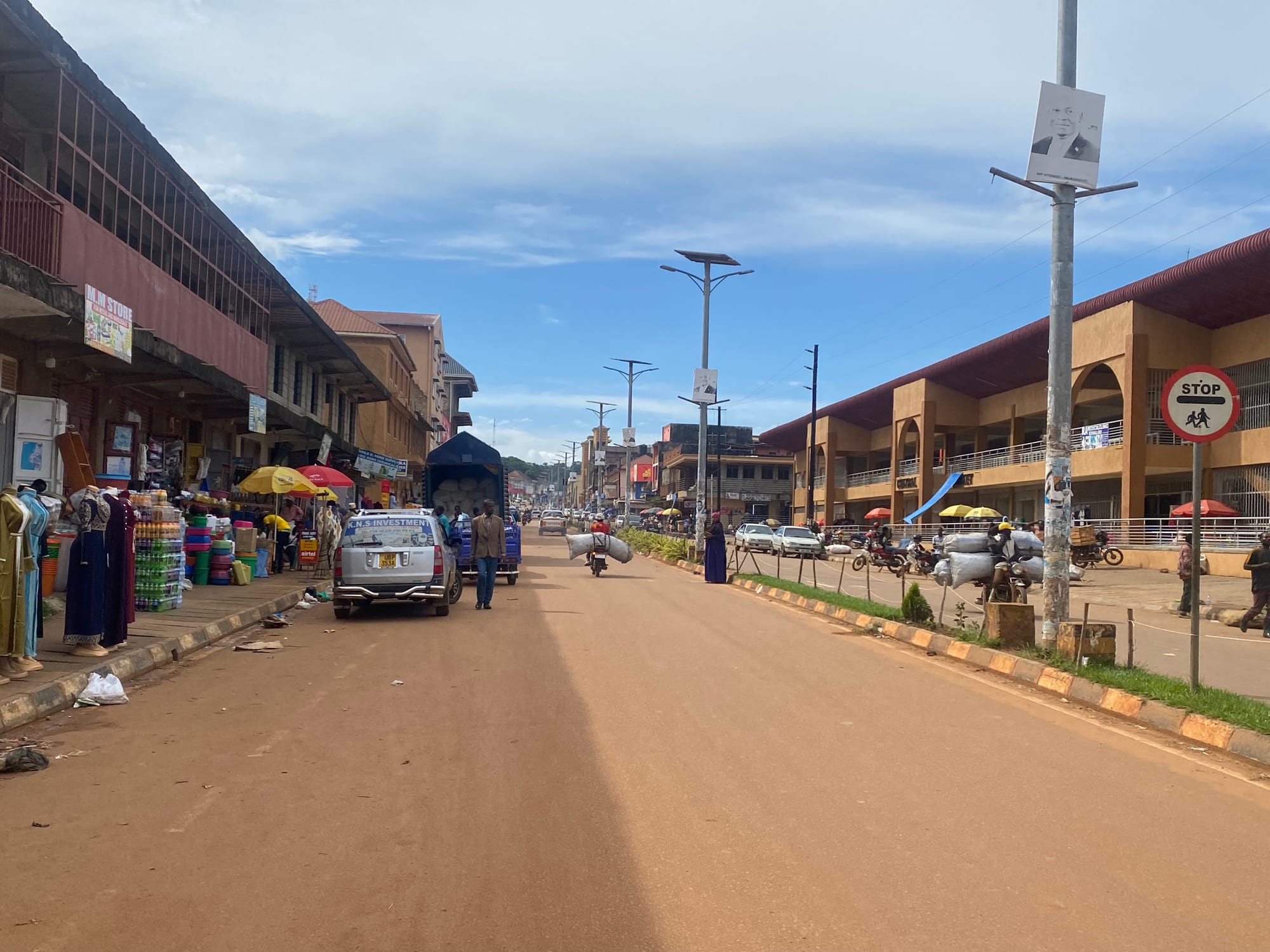
A wide main street in Masaka lined with shopfronts and arcades, with a pickup, motorbikes and traders under umbrellas

Kampala & Central Uganda, Uganda

Masaka

The main commercial street in central Masaka, lined with shops and arcades. (BalukuBrian / Wikimedia Commons · CC BY-SA 4.0)

A trading city about 130 km south-west of Kampala, on the main road towards Mbarara and the Tanzanian and Rwandan borders. It grew as a market and administrative centre for the south of Buganda, was badly damaged in the 1979 war, and now serves a farming region of bananas, coffee and cattle, with Lake Nabugabo and the Ssese ferry nearby.

Neighbourhoods

  • Town centre
    • First-time visitors
    • Markets
    • Close to transport

    A compact grid of arcades, shops, banks, bus and taxi stages around the main market, laid out along the broad streets that were rebuilt after the war of 1979. Almost all the city's hotels, restaurants and services are within a few blocks of each other here.

    Open in Maps
  • Nyendo
    • Local life
    • Best for food
    • Nightlife

    The busy trading area on the Kampala side of the city, strung along the highway, with a market, lorry stops, bars and street food. It is louder and cheaper than the centre and stays awake later.

    Open in Maps
  • Kitovu
    • Historic district
    • Quiet and residential

    The hill east of the centre that holds the headquarters of the Catholic diocese, the bishop's house and Kitovu Hospital, with mature trees and views over the town. The mission has been the focus of Catholic life in southern Buganda since the White Fathers reached the area in 1891.

    Open in Maps
  • Kimaanya and the outskirts
    • Quiet and residential
    • Countryside

    Residential areas spreading down the slopes towards the lake road, mixing houses, smallholdings and banana gardens. This is where much of the city's population lives and where the surrounding farmland begins.

    Open in Maps

Things to do

Markets and streets

  • Masaka central marketmarket

    The city's main produce market, piled with matooke, beans, coffee, fish and household goods, and busiest on the days when farmers come in from the surrounding villages.

    Open in Maps
  • Nyendo trading centreneighborhood

    The highway market and lorry stop on the Kampala side of town, good for street food, grilled meat and a sense of how the region's trade works.

    Open in Maps

Churches and hills

  • Kitovu missionlandmark

    The Catholic mission on Kitovu hill, seat of the Diocese of Masaka and of its bishop, with Kitovu Cathedral, where Monsignor Aloysius Ngobya is buried, the diocesan buildings and Kitovu Hospital around it.

    Open in Maps
  • Kitovu hill viewsviewpoint

    The mission hill east of the centre looks out over the rooftops of the city and the banana gardens on the slopes beyond.

    Open in Maps

Short trips from the city

  • Lake Nabugabopark

    A shallow freshwater lake about 20 km east, separated from Lake Victoria by a sand bar and lying only 4 km from its shore, with sandy shores, swamps and birdlife.

    Open in Maps
  • Bukakata ferrytransit hub

    The lake landing about 36 km east where the vehicle ferry crosses to Bugala in the Ssese Islands, through papyrus swamp and fishing villages.

    Open in Maps
  • The equator at Kayabwelandmark

    A monument, painted circles, craft stalls and restaurants mark the equator where the Kampala road crosses it at Kayabwe, about 51 km north-east of the city by road.

    Open in Maps
  • Lake Victoria landing sitesattraction

    Fishing landings on the lake shore east of the city, where tilapia and Nile perch are brought in, sold and smoked.

    Open in Maps

Seasonal events

  • Nsenene seasonaround April–May and November

    Masaka is known across Uganda for grasshoppers, caught at night in lit traps around the city and fried for sale by the cup.

  • Coffee harvestroughly September to December

    Robusta coffee comes in from the surrounding farms, filling stores and drying yards and setting the pace of trade in the city.

  • Martyrs' Day3 June

    Church services and processions mark the pilgrimage day across Catholic southern Buganda, with buses leaving for the shrines near Kampala.

Eat and drink

Long-standing places and food districts in Masaka. Hours, ratings and directions come from your maps app, always current.

Masaka eating

  • Central market food stallsmarket

    Produce and cooked-food stalls selling matooke with groundnut sauce, beans, rice and fried fish, with fruit from the surrounding farms.

    Open in Maps
  • Nyendo street foodneighborhood

    Rolex stands, chapati, muchomo skewers and grilled chicken along the highway strip, busy with drivers and traders into the night.

    Open in Maps
  • Town centre restaurantsneighborhood

    Simple Ugandan buffets around the main streets serving matooke, posho, rice, beans, stew and fried fish at lunchtime, with a few Indian and grill houses.

    Open in Maps
  • Nsenene sellersmarket

    In the rainy months grasshoppers are cleaned, de-winged and fried with onion, sold by the cup at roadside stalls and in the markets.

    Open in Maps

Experience Masaka

History

Masaka grew where two things met: the fertile banana country of southern Buganda and the road running south-west from the kabaka's capital towards Ankole and the lake shore. The area belonged to the county of Buddu, which Buganda took from Bunyoro in the eighteenth century and which became one of its wealthiest provinces. Catholic missionaries of the White Fathers reached the Masaka area in 1891, and the mission hill at Kitovu, where the diocese has its headquarters, has been a centre of Catholic Uganda ever since.

Under the protectorate Masaka became the administrative headquarters for Buddu and then for Masaka district, with a planned town of wide streets, shopfronts and warehouses. Indian and Ganda traders handled coffee, cotton and bananas, and the town's position on the main road made it the market for a wide farming region. Coffee in particular built the modern town.

The turning point was the war of 1979, when Tanzanian forces and Ugandan exiles advanced on Kampala along this road to remove Idi Amin. In the battle of 23 and 24 February 1979 the Tanzanian army fired nearly a thousand shells into the town and then razed much of what the bombardment had spared, in reprisal for the destruction Ugandan troops had caused in the Kagera salient; the town hall, the bank, the post office, the courts and the hospital were among the buildings lost. Rebuilding took years, and the town was again affected by the insecurity of the early 1980s. Since then it has grown steadily as a regional hub for trade, transport, schooling and health care; the Catholic mission hospital at Kitovu, founded in 1955, runs an HIV treatment centre among its community health programmes. Masaka was granted city status in 2020.

Culture & Customs

Masaka is thoroughly Ganda. Luganda is the language of the street, clan identities and the totems that go with them are taken seriously, and family ceremonies — above all the kwanjula, at which a bride's family receives the groom's — are the big social occasions of the year, with the kanzu for men and the gomesi for women. Respect for age, unhurried greetings and indirect speech are the local manners, and loudness in public is frowned upon.

Religion shapes much of the calendar. The Catholic church is unusually strong in this part of Buganda, with the cathedral and mission on Kitovu hill, large parishes in the surrounding countryside and a steady flow of pilgrims towards the martyrs' shrines near Kampala each June. Anglican and Pentecostal churches and a Muslim minority share the city with it.

The other strand of local identity is agricultural. Masaka thinks of itself as a coffee and matooke town, and the seasonal grasshopper catch — nsenene, trapped at night in lit drums when the rains come — is closely associated with the city and sends supplies across the country. Evenings revolve around bars, football on television and music along the Nyendo strip, and weddings, burials and church fundraisers draw people back from Kampala at weekends.

Daily Life

The 2014 census counted 103,829 people in the town; the 2024 census enumerated 285,509 in the enlarged Masaka City, which spreads along the highway and up the surrounding hills. It is the largest place between Kampala and Mbarara and serves a much larger rural population.

The economy is trade and services: produce markets, wholesalers, transport and lorry traffic on the highway, banks, schools, colleges and hospitals, including the mission hospital at Kitovu. The countryside around supplies matooke, coffee, beans, maize and dairy from the drier land to the west, and fishing communities work the Lake Victoria shore to the east. Many households also depend on money sent home from Kampala.

The day starts at first light with produce arriving for the market and boda-bodas gathering at the stages; by mid-morning the arcades and banks are busy, and the afternoon belongs to the highway traffic heading towards Mbarara or back to the capital. Recurring local issues are the state of the roads to the lake, water and drainage in the growing suburbs, the price farmers get for coffee and matooke, road safety on the highway, and youth unemployment that keeps sending people to Kampala.

Food

Masaka sits in the heart of matooke country, and the steamed, mashed green banana is the centre of almost every meal, served with binyebwa groundnut sauce, beans, greens or a beef or goat stew. Luwombo, meat or groundnut sauce steamed in a banana-leaf parcel, is the dish of celebrations, and katogo — matooke or cassava cooked together with beans, offal or groundnuts — is the working breakfast sold at stalls from early morning.

The city's best-known speciality is nsenene, the bush grasshoppers that swarm with the rains around April and May and again in November. They are caught at night in drums lit by bright lamps, then cleaned, de-winged and fried with onion and salt, and sold by the cup in the markets and along the roads; Masaka's traders supply much of the country.

Fish comes up from Lake Victoria and Lake Nabugabo: tilapia and Nile perch fried whole or stewed, and mukene, the small dried silver fish, cooked into groundnut sauce. Street food is the national repertoire — the rolex, a chapati rolled around fried egg and vegetables; muchomo skewers; roasted maize and gonja plantain; samosas and mandazi. Robusta coffee is the region's cash crop but tea with milk and ginger is the everyday drink, alongside passion-fruit juice, bottled lager, waragi gin and tonto banana beer in the villages.

Planning tools

Budget

Masaka is much cheaper than Kampala. Guesthouses and small hotels in the centre cost little, market meals less, and buses and shared taxis are inexpensive. Costs rise only for a lakeside lodge at Nabugabo or a hired car for trips out to the lake and the ferry.

Daily Budget Midrange
USD 60–120 (mid-range hotel or lakeside lodge, restaurant meals, a hired car for the day)
Daily Budget Shoestring
USD 20–40 (guesthouse room, market and street food, buses and boda-bodas)

Carry cash in small shilling notes; card acceptance outside a couple of hotels and supermarkets is limited.

Best Time to Visit

June to August and December to February are drier, which matters for the unpaved roads out to Lake Nabugabo and the ferry landing. The rains of March to May and September to November are heavy in the afternoons but green, and the grasshopper seasons in spring and late autumn are a local event in their own right.

Suggested Number of Days

A day covers the city itself, which most travellers see as a stop on the road south-west. Two or three days suits a stay that takes in the lakes and the country nearby. Road conditions decide how much fits into a day.

First Visit
1 day
With Surroundings
2–3 days

Transportation

The city is small enough to cross on foot in the centre, and boda-boda motorbikes and shared minibus taxis cover everything else. Coaches and minibuses run constantly along the Kampala–Mbarara highway from stages in the centre and at Nyendo, and matatus serve Nabugabo, Bukakata and the lakeside villages on a less predictable schedule.

Set the fare before getting on a boda-boda, and allow spare time for the lake roads, which are rough and slow after rain.

Airport & Station Connections

Masaka lies about 130 km south-west of Kampala on the main road to Mbarara, Kabale and the Rwandan border, a drive of roughly two and a half to three hours by coach or minibus. Entebbe International Airport, the nearest international airport, lies east along the Kampala road. The Bukakata ferry links the city to the Ssese Islands, and the road south continues towards the Tanzanian border at Mutukula.

Walkability

The centre is easy on foot: a grid of wide streets with shops, banks and the market within a few blocks, though pavements are crowded with traders and the traffic is loud. Kitovu and Nyendo are a long, hilly walk from the middle, and most residents use a boda-boda instead. There is little shade on the main streets in the middle of the day.

Safety

Masaka is generally safe and used to travellers passing through, with the ordinary risks of a Ugandan trading town: petty theft in the market and at the taxi stages, and road accidents, particularly on boda-bodas and on the busy highway. Lake Victoria and its landings carry bilharzia.

Keep valuables out of sight in crowded markets, avoid walking alone at night on unlit streets, travel the highway by day, and take malaria precautions. Under the Anti-Homosexuality Act, 2023, same-sex acts carry life imprisonment and 'aggravated homosexuality' the death penalty; most of the law was upheld by the Constitutional Court in April 2024. Check current official travel advice before travelling.

Climate

Warm and fairly even all year, moderated by an altitude of well over 1,000 metres. Days are typically in the high 20s °C and nights in the mid-to-high teens. The two rainy seasons run roughly March to May and September to November, with heavy afternoon storms; the area west of the city is drier cattle country.

Summer
June to August is the cooler, drier spell, about 16–27°C
Winter
December to February is drier and slightly warmer, about 17–29°C

Local Customs

This is Buganda, so Luganda is the everyday language alongside English, and greetings come before business and are not rushed. Dress is neat and modest, particularly around the churches and in the market. Catholic practice is strong here, and Sunday mornings are quiet until services end.

Ask before photographing people, traders or their stalls, dress modestly at the cathedral and mission buildings, and expect to greet shopkeepers before asking a price.

Common Payment Methods

The currency is the Ugandan shilling (UGX). Cash rules: markets, transport and small guesthouses take nothing else, while a few hotels and supermarkets accept cards. ATMs are available in the centre, and mobile money is used by most residents for everyday payments.