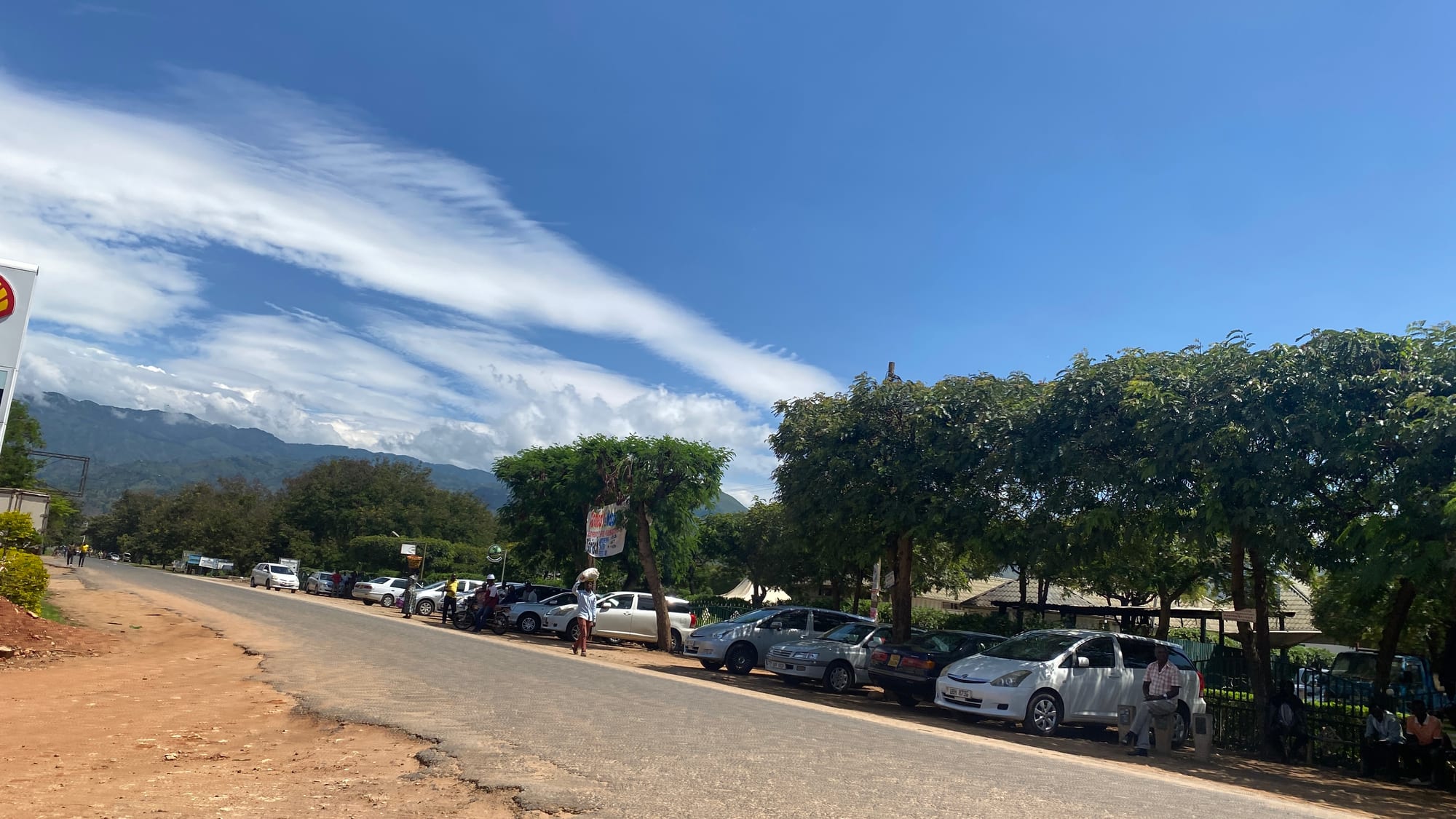
A wide street in Kasese with cars parked under trees along one side and the dark ridges of the Rwenzori foothills behind

Bwindi, the Rwenzoris & the West, Uganda

Kasese

A street in Kasese, with the foothills of the Rwenzori Mountains rising behind the town. (BalukuBrian / Wikimedia Commons · CC BY-SA 4.0)

A town on the rift floor of western Uganda, almost on the equator, with the glaciated Rwenzori Mountains rising steeply to the west and the savanna of Queen Elizabeth National Park beginning to the south. Built up around the copper mine at Kilembe and the railway that served it, it is now the main base for Rwenzori climbs and a gateway town for the park.

Neighbourhoods

  • The town centre
    • First-time visitors
    • Shops and banks
    • Transport

    A flat grid of wide streets around the main road, with the market, banks, bus stages and most guesthouses within a few blocks. Hot and dusty by day, busy with boda-bodas, and laid out on a generous colonial scale for a town of its size.

    Open in Maps
  • The Kilembe road
    • Mountain views
    • Quiet and residential
    • Close to the trailheads

    The road climbing west into the Rwenzori foothills towards the old copper-mining settlement of Kilembe, past the Nyamwamba river and small trading centres. Cooler and greener than the town, with lodges used by climbers.

    Open in Maps
  • The southern edge and the park road
    • Safari access
    • Quiet and residential

    Where the town gives out into open country on the road towards Queen Elizabeth National Park and Mbarara. Fuel stations, transport yards and lodges catering to safari traffic line the highway, and the plains begin within a couple of kilometres.

    Open in Maps

Things to do

Around the town

  • Kasese Airporttransit hub

    The airfield on the edge of town, used by light aircraft linking the western parks with Entebbe.

    Open in Maps
  • Kilembeattraction

    The old copper-mining settlement in a steep valley west of town, whose terraced housing and workshops remain among the foothills.

    Open in Maps

Short trips to the mountains

  • Rwenzori Mountains National Parkpark

    A UNESCO World Heritage Site since 1994, protecting glaciers, giant lobelias and groundsels on the range above the town, with the main trailhead at Nyakalengija.

    Open in Maps
  • Mount Stanleytrail

    The highest massif of the Rwenzori, topped by Margherita Peak at 5,109 metres, the highest point in both Uganda and the Democratic Republic of the Congo and a multi-day glacier climb.

    Open in Maps

Short trips to the rift and the parks

  • Queen Elizabeth National Parkpark

    Savanna, crater fields and lakes beginning a short drive south of the town, with elephant, buffalo, hippo and the tree-climbing lions of the Ishasha sector further on.

    Open in Maps
  • Kazinga Channelattraction

    The natural channel linking Lakes George and Edward, whose banks hold one of Africa's densest concentrations of hippos, seen from launch trips.

    Open in Maps
  • Lake Katweattraction

    A crater lake inside Queen Elizabeth National Park whose salt has been extracted by hand for centuries by evaporating the lake water in shallow pans.

    Open in Maps
  • Lake Georgeattraction

    A shallow equatorial lake east of the park, designated in 1988 as Uganda's first Ramsar wetland, fringed with papyrus and fishing villages.

    Open in Maps
  • Kyambura Gorgeattraction

    A forested gorge on the north-eastern side of the park, running 11 kilometres to the Kazinga Channel and noted for the primates, chimpanzees among them, that live in it.

    Open in Maps

Eat and drink

Long-standing places and food districts in Kasese. Hours, ratings and directions come from your maps app, always current.

Markets and eating houses

  • Kasese central marketmarket

    The town's produce market, selling matooke, cassava, beans, tomatoes and fish brought up from Lake George and the Kazinga Channel.

    Open in Maps
  • Eating houses in the town centreneighborhood

    Plain local restaurants along the main streets serving matooke, rice, posho, beans, greens and stewed goat, beef or tilapia at low prices.

    Open in Maps
  • Roadside grills and rolex standsneighborhood

    Charcoal grills turning out muchomo, skewered goat or beef, with chapati griddles beside them making the rolex, an egg omelette rolled in a chapati.

    Open in Maps

Experience Kasese

History

The Bakonzo have farmed the lower slopes of the Rwenzori for centuries, living in scattered homesteads up the ridges rather than in towns, under the nominal authority of the Tooro kingdom on the plateau above. The plain where Kasese now stands was grazing country, thinly settled and known for tsetse fly.

The town is a creation of mining. Copper had long been known in the Kilembe valley, and in 1950 two Canadian companies formed a venture to work the deposit on an industrial scale: a mine, a company town in the foothills, a smelter at Jinja and, in 1956, a railway extension from Kampala to carry the metal to the coast. Kasese grew at the railhead as the mine's service town and market, filling with workers from across Uganda.

Copper extraction ceased in 1982, leaving the town to trade, transport and farming. The tailings left behind are valued for their cobalt, and there have been repeated plans to reopen the mine itself.

Politics here has been shaped by the Rwenzururu movement, the Bakonzo campaign from the 1960s for separation from Tooro, which led to a long low-level rebellion in the mountains and, eventually, to government recognition of a Rwenzururu kingdom in 2008. Deadly clashes between the kingdom's royal guards and the security forces in Kasese in 2016 led to the king's arrest. Tourism based on the mountains and the parks has since become the town's main hope.

Culture & Customs

Kasese is the urban centre of Bakonzo culture. Lukonzo is the language of the streets and the hillside villages, and Bakonzo identity is tightly bound to the Rwenzori itself: the mountains carry names, stories and spirits, among them Kithasamba, the god of the Rwenzori, associated with the high snows, and older generations kept customs around what could be said or done on the heights. The Rwenzururu kingdom, its flag and its anniversaries are visible in the town, and the memory of the movement's long struggle remains strong.

It is also a mixed town, the legacy of the mine, which drew labour from all over the country, and of its position on the Congo road. Batooro, Bakiga, Basongora cattle keepers on the plains and Congolese traders all live here, and Swahili is widely used in the markets — more so than in most of Uganda — because of that cross-border traffic.

Christianity is dominant, Catholic and Anglican churches alongside a large number of Pentecostal congregations, with a Muslim minority around the mosque and the market. Football is followed intently, and Kasese has a reputation for producing mountain guides and porters whose work on the Rwenzori has become a family trade passed down through generations. Visitors are received easily, and greetings, handshakes and unhurried small talk precede any transaction.

Daily Life

About 100,000 people lived in the municipality at the 2014 census, in a district of several hundred thousand spread up the mountain slopes and across the plains. It is a young, growing, working town rather than a pretty one.

Since the mine closed, the economy has rested on three things: farming, trade and tourism. Cotton, maize, beans, cassava and bananas come off the plains, with coffee on the slopes; the plains also carry cattle, and fishing villages on Lake George and Lake Edward supply tilapia to the market. Trade with the Democratic Republic of the Congo through the Mpondwe crossing to the west moves goods and money through the town daily. Tourism supports guides, porters, drivers and lodges, and a small hydropower industry has grown on the fast mountain rivers.

Days start early and slow in the midday heat; the market is busiest in the morning, and the evening belongs to the grills, the bars and the boda-boda stages. The persistent problems are unemployment among the young, the long wait for the mine to reopen, and flooding: the Nyamwamba, swollen by storms on the mountains, has burst its banks and damaged homes, bridges and the Kilembe valley more than once in recent years, and the town has had to move households away from the riverbanks.

Food

Kasese eats plainly and cheaply. Matooke, steamed and mashed green banana, is the staple, served with beans, groundnut sauce, greens or a meat stew; posho, the stiff maize meal known elsewhere in East Africa as ugali, cassava and sweet potato fill out the plate, and rice is common in the town.

Fish is the local advantage. Tilapia from Lake George and Lake Edward and from the Kazinga Channel arrives daily, fried whole or cooked in a tomato sauce, and small dried silver fish are sold by the cupful in the market for stewing with groundnuts. Goat is the meat of choice at the roadside grills, sold as muchomo with a raw tomato and onion salad. Katwe's crater lake, worked for salt since long before the mine, supplied the region's kitchens for centuries.

The Bakonzo hill farms bring in beans, peas, Irish potatoes, millet and sorghum, and the cheap fruit of the plains — mangoes, papaya, jackfruit, avocado and small sweet bananas — is piled up around the market. The rolex, a chapati rolled around a fried egg, is the standard snack, sold at stands near the taxi stages. Drinks run from milky spiced tea and locally grown coffee to banana beer, sorghum brews and waragi in the bars, with bottled lagers and sodas everywhere.

Planning tools

Budget

The town is cheap — guesthouses, market meals and shared taxis cost very little, and it is one of the least expensive places to sleep in western Uganda. The money goes on what lies around it: park entry, a Rwenzori climb with guides, porters and equipment, or a vehicle and driver-guide for game drives and a launch trip.

Daily Budget Midrange
USD 180–470 on a trekking itinerary (lodge, park fees, 4x4 and driver-guide), plus permits
Daily Budget Shoestring
USD 25–50 without park fees (guesthouse, local food, buses and shared taxis)

Arrange a Rwenzori climb through an established operator well in advance, since porters, huts and equipment have to be booked as a package, and budget separately for park entry and a launch trip in Queen Elizabeth.

Best Time to Visit

June to August and December to February are the drier months, the best time for a Rwenzori climb, when the bogs are firmer and the summits clearer, and the easiest for park tracks. The mountains are wet in any season. Game viewing on the rift floor is good all year and best late in the dry spells, when animals gather at water.

Suggested Number of Days

The town itself needs little more than a night on the way through. Four to seven days suit a base here for the parks and mountains; a full Rwenzori circuit to the peaks takes around a week on its own, plus a day either side for preparation and rest.

First Visit
1–2 days
With Surroundings
4–7 days

Transportation

The centre is flat and walkable, and boda-boda motorbike taxis cover everything else. Shared minibuses run to Kilembe, Bwera and the trading centres, and buses to Fort Portal, Mbarara and Kampala leave from the stages in the centre. Park tracks and the mountain approach roads are rough, so game drives and trailhead transfers are made by hired 4x4 or through a lodge.

Fix the fare before boarding a boda-boda, and arrange park transport in advance rather than at the gate, as there is no public transport inside the national parks.

Airport & Station Connections

Kasese sits on the highway between Fort Portal, to the north, and Mbarara to the south-east, with buses from Kampala taking roughly seven to eight hours over some 380 kilometres. Light aircraft use the local airfield, which makes it a common fly-in point for the western parks. The railway line that once carried copper to the coast runs into the town from the east.

Walkability

The centre is easy to walk: flat, laid out in a grid, and small enough to cross in twenty minutes, with the market and transport stages close together. Pavements are uneven and there is little shade, so the middle of the day is hot at this low altitude. Distances stretch quickly beyond the centre and boda-bodas take over.

Safety

The town is calm and ordinary, with road accidents, boda-boda crashes and petty theft in crowds the everyday risks. The border country west of Kasese carries a real risk from the Allied Democratic Forces, an armed group based in eastern Congo; in 2023 ADF fighters killed dozens of pupils at a school at Mpondwe in Kasese district, and security has since been stepped up along the frontier. Altitude, cold and rockfall are the serious hazards on a Rwenzori climb, and the Nyamwamba river has flooded parts of the town and the Kilembe valley in heavy rains.

Uganda is generally safe for tourists on the main routes, with petty theft, road accidents, and boda-boda crashes the everyday risks. Stay informed about the border areas, travel in the parks with an established operator and follow ranger instructions, and acclimatise properly for a Rwenzori climb. Check current official travel advice before travelling.

Climate

Kasese lies low on the rift floor and is one of the warmer places in western Uganda, noticeably hotter than Fort Portal or Kabale. Rain falls in two main seasons, roughly March to May and September to November, and the mountains alongside are among the wettest in Africa even when the town is dry.

Summer
June to August is the main dry season — days often around 30–32°C, nights near 18°C, with dust on the plains
Winter
December to February is the second drier spell, similar heat by day, around 30°C, with cooler nights and storms building over the mountains

Local Customs

Most people here are Bakonzo, the mountain people of the Rwenzori, who speak Lukonzo alongside English and Swahili; Batooro, Basongora and Congolese communities live in the town as well. The Rwenzururu kingdom, recognised by the government in 2008, is an important part of Bakonzo identity, and local politics can be a sensitive subject. Greetings come before business and elders are addressed first.

Dress modestly, ask before photographing people, and never photograph soldiers, police or border installations. Tipping mountain guides and porters is customary and forms much of their income. Same-sex relations are criminalised under Ugandan law, and discretion is strongly advised.

Common Payment Methods

The currency is the Ugandan shilling. Banks and ATMs are in the centre and mobile money agents are everywhere, but machines can run dry at weekends. Park fees and organised climbs are usually quoted in US dollars and often paid in advance; markets, boda-bodas, guesthouses and porters' tips need cash in shillings.