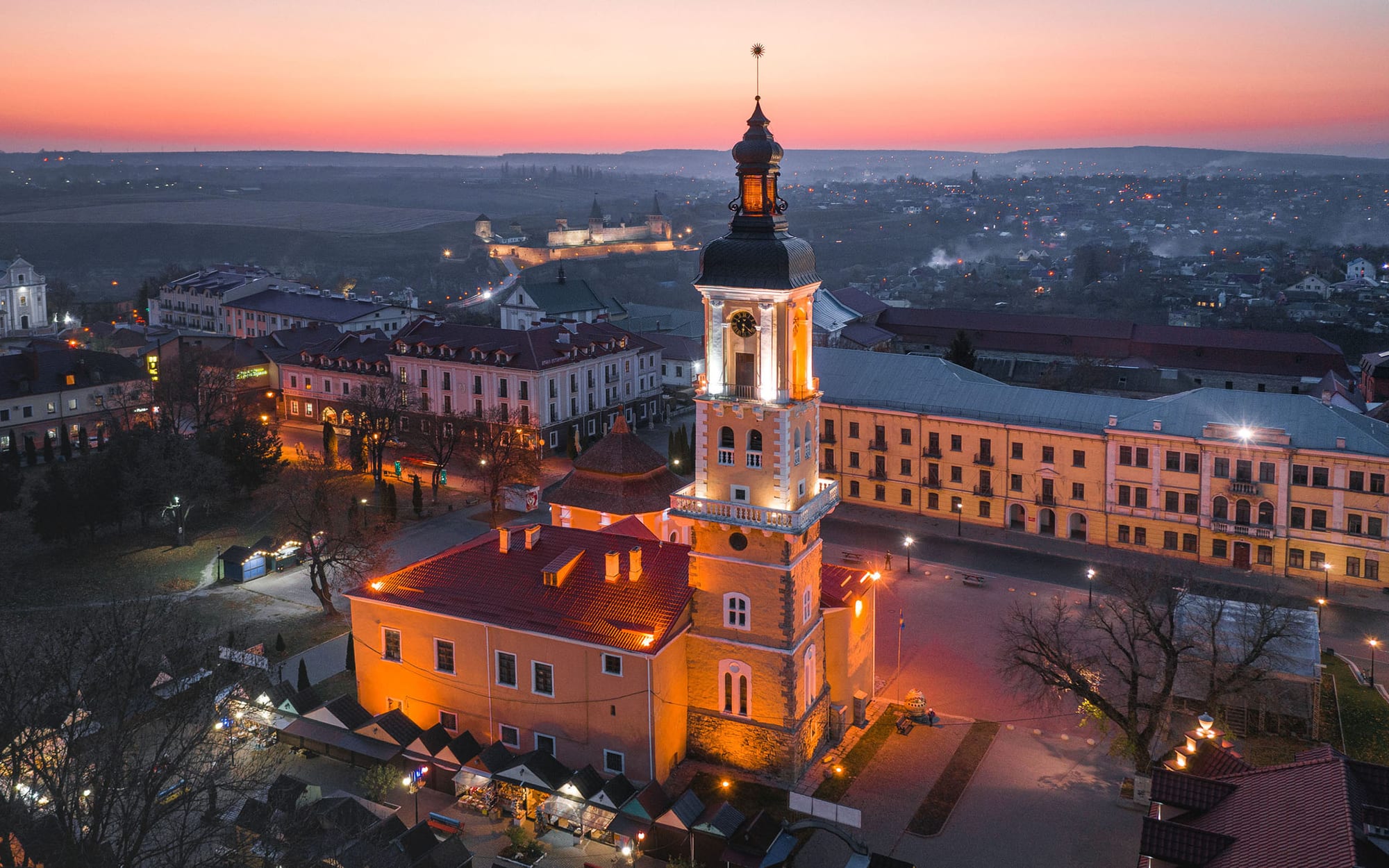
Aerial view of a town hall tower rising over an old market square

Western Ukraine & the Carpathians, Ukraine

Kamianets-Podilskyi

The Polish Town Hall on the Polish Market Square in the Old Town of Kamianets-Podilskyi. (Seencleyr / Wikimedia Commons · CC BY-SA 4.0)

A historic Podolian city on the Smotrych River in western Ukraine, whose Old Town stands on a rock plateau inside a loop of the river canyon, joined by a bridge to a fortress that held the Polish frontier against the Ottomans. Today it is a university and tourist town of about 97,000. This page is written to explain the city, not to encourage travel.

Neighbourhoods

  • Old Town
    • First-time visitors
    • Historic district

    The historic centre on a rock plateau almost encircled by the Smotrych canyon. Churches of several faiths, the Polish Town Hall, the old Armenian market square, Renaissance and Baroque houses and the city's medieval gates sit within a short walk of each other.

    Open in Maps
  • The castle and Karvasary
    • Historic sights
    • Views

    West of the Old Town, across the canyon, the fortress stands on its own spur of rock, reached by the castle bridge. Below it, at the bottom of the canyon, lies the old suburb of Karvasary.

    Open in Maps
  • New Plan
    • Local life
    • Close to public transport

    The newer part of the city, built to a regular street plan on the plateau east of the canyon. It holds most of the shops, offices and housing, and lies between the Old Town and the bus station.

    Open in Maps
  • Polski and Ruski Filvarky
    • Quiet and residential

    Former suburbs around the edge of the canyon that grew up outside the old walls and are now residential districts of the city.

    Open in Maps

Things to do

Famous landmarks

  • Kamianets-Podilskyi Castlelandmark

    The fortress on a peninsula carved by the Smotrych, first built to guard the bridge linking the town with the mainland and rebuilt by Polish kings; named one of the Seven Wonders of Ukraine in 2007 and a candidate World Heritage Site.

    Open in Maps
  • Polish Town Halllandmark

    The tower of the Polish City Hall rises over the Old Town's market square, a reminder of the separate Polish, Ruthenian and Armenian courts that once governed the town.

    Open in Maps
  • Turkish Bridgelandmark

    The so-called Turkish Bridge, dating from the 14th century, one of the historic sights of the Old Town.

    Open in Maps
  • Ruthenian Gatelandmark

    A 14th-century gate in the old fortifications at the edge of the Old Town, one of several surviving defensive works.

    Open in Maps

Churches

  • Cathedral of Saints Peter and Paullandmark

    The Roman Catholic cathedral of the Old Town, seat of the diocese that Pope John Paul II re-established in 1991 after its dissolution under Soviet rule.

    Open in Maps
  • Holy Trinity Churchlandmark

    A church on Trinity Square near the entrance to the Old Town.

    Open in Maps
  • Saint Nicholas Armenian Churchlandmark

    A 15th-century church of the Armenian community, which was one of the main Armenian communes in Poland until the Ottomans expelled it in 1674.

    Open in Maps

The canyon

  • Smotrych canyonviewpoint

    The deep canyon of the Smotrych that surrounds the Old Town, listed in 1989 on Ukraine's tentative list for World Heritage, and the setting for balloon flights over the city.

    Open in Maps

Short trips from the town

  • Khotyn Fortresslandmark

    A fortification complex on the right bank of the Dniester at Khotyn, in Chernivtsi Oblast.

    Open in Maps
  • Bakotaattraction

    A historic settlement now submerged beneath the Dniester, with a cave monastery holding old frescoes on the hillside above the water.

    Open in Maps
  • Podilski Tovtry National Nature Parkpark

    A national park covering the Tovtry ridges of the Podolian Upland in Khmelnytskyi and Kamianets-Podilskyi raions.

    Open in Maps

Seasonal events

  • Spring ballooning festivalMay

    Hot-air balloons fly over the Smotrych canyon and the Old Town during the city's spring ballooning festival.

  • Autumn ballooning festivalOctober

    A second ballooning festival over the canyon in autumn; the city has also hosted the open ballooning championship of Ukraine.

Eat and drink

Long-standing places and food districts in Kamianets-Podilskyi. Hours, ratings and directions come from your maps app, always current.

Kamianets-Podilskyi classics

  • Varenyky cafésrestaurant

    Cafés near the centre serve varenyky, dumplings of thin unleavened dough with sweet or savoury fillings; one offers about 35 kinds.

    Open in Maps
  • Old Town cafés and restaurantsneighborhood

    Cafés and restaurants around the Old Town squares serve borscht, holubtsi and other Ukrainian staples to visitors walking between the churches and the castle.

    Open in Maps

Everyday food

  • New Plan cafésneighborhood

    The everyday cafés, canteens and shops of the newer city between the Old Town and the bus station.

    Open in Maps

Experience Kamianets-Podilskyi

History

The city was first mentioned in 1062, when it belonged to the principality of Terebovlia and later to Halych and the Kingdom of Galicia–Volhynia. Around 1230 Armenians were invited to help defend the eastern border, beginning a community that would shape the town for centuries. Under Polish rule from 1352, Dominican and Franciscan monasteries were founded, separate Ruthenian and Armenian courts governed their own communities, and by the 15th century Kamianets was, with Lviv, the most important trading centre of the region and the largest fortress in eastern Poland — the 'gateway to Poland' against the Ottomans and Tatars.

The Ottomans took the city in 1672 and held it until 1699, expelling the Armenians and Jews. Back under the Commonwealth the fortress was enlarged into its strongest. Russian rule followed in 1793; without a railway until 1914, the town stagnated, and its fortifications became a prison. In 1897 it was still the largest city of Podolia, with nearly 36,000 people, and in 1910 more than 48 per cent of residents were Jews. During the Ukrainian–Soviet War it served as the temporary capital of the Ukrainian People's Republic in 1919–20.

Soviet rule brought persecution, deportations of Poles and uprisings against collectivisation in 1927. German troops occupied the city in July 1941, and on 27–28 August 1941 about 23,000 Jews were murdered in one of the first great massacres of the Holocaust. Since independence the city has grown into one of the chief tourist centres of western Ukraine; after the full-scale invasion of February 2022 it took in many displaced people, and dozens of streets were renamed in 2022 and 2023.

Culture & Customs

Kamianets-Podilskyi has always been a town of many communities. Poles, Jews and Ukrainians dominated the population for centuries, alongside a substantial Armenian minority, and the Old Town still reflects it: Catholic, Orthodox and Armenian churches, the Armenian market square and the Polish Town Hall stand within a few streets. Today a large share of residents are Catholic and many are Orthodox, and Pope John Paul II re-established the Catholic diocese in 1991.

The city is a centre of learning, home to the Ivan Ohiienko National University and the Podolia State Agrarian and Technical University, whose students marched through the streets in support of Euromaidan in December 2013. A Polish theatre was founded here as early as 1798.

Festivals give the city much of its modern identity. Balloon flights over the Smotrych canyon draw tourists, with ballooning festivals in May and October, and the annual Cossack Games combine the open ballooning championship of Ukraine with car racing, music, art and drama. The Respublica festival of music, literature and street art has left murals on many buildings.

Daily Life

About 97,000 people lived in the city in 2022, fewer than the 105,000 of 1991. Since the full-scale invasion, displaced people from other parts of Ukraine have added to that total — about 22,000 were officially registered in 2024 — and housing for them remains an open question.

The city is the administrative centre of its raion within Khmelnytskyi Oblast, having lost the role of oblast capital to Khmelnytskyi at the start of the Second World War. Tourism, education and services are central to the economy, with universities and colleges bringing a large student population. Most people live in the New Plan and the former suburbs around the canyon, while the Old Town on its plateau is given over largely to churches, museums, cafés and visitors.

Traffic is a daily complaint: the main flow of cars passes through the city centre, and a bypass road has been discussed for years. As elsewhere in Ukraine, life since 2022 has been shaped by air-raid alerts, martial law and the arrival of families from the east and south.

Food

The city eats the food of Podillia and of Ukraine as a whole. Red borscht, a soup of beets, cabbage, potatoes, tomatoes, carrots, onions, garlic and dill, is the national dish, but southern Podolia also has its own white borscht, cooked with fresh sugar beets, beans and vegetables. Varenyky, dumplings of thin, soft unleavened dough usually filled with potato, are the everyday favourite, and one café near the centre offers about 35 kinds.

Holubtsi, cabbage rolls, deruny, potato pancakes served with sour cream, and salo, cured pork fat, are on most traditional menus. The maize porridges characteristic of south-western Ukraine, such as banosh and kulesha, also turn up on tables in this part of the country, as do kapusniak, a soup of cabbage, pork, salo and beans served with sour cream, and kovbasa sausage.

To drink there is kvass, a fermented drink known since the time of Kyivan Rus, dried-fruit compotes and horilka, the Ukrainian spirit. Cafés in the Old Town serve coffee and cakes to visitors walking between the churches and the castle.

Planning tools

Budget

Costs are low by European standards, and the city has more cafés and places to stay than most towns of its size because of its role as a tourist centre. Price is not the obstacle to travel; the war is.

Daily Budget Midrange
USD 60–120 (mid-range hotel, restaurant dinners, taxis and a guided castle visit)
Daily Budget Shoestring
USD 25–45 (hostel or guesthouse, varenyky cafés and canteens, local buses)

Do not plan leisure travel while the war continues; keep some cash for small cafés and for power cuts.

Best Time to Visit

In peacetime, late spring and early autumn suited walks around the canyon, and the ballooning festivals of May and October drew visitors. Air-raid alerts and strikes can affect any part of Ukraine at any time of year, so current advice matters more than the season.

Suggested Number of Days

The Old Town and the castle are compact enough for one or two days. Allow three or four to include the fortress at Khotyn, the Dniester valley and the national park, which need a car, a driver or slow regional buses.

First Visit
1–2 days
With Surroundings
3–4 days

Transportation

The Old Town and the castle are explored on foot. City buses and marshrutky (minibuses) link the Old Town, the New Plan and the bus and railway stations. Taxis are the easy way to reach sights in the surrounding countryside.

Carry small hryvnia notes for minibus fares and keep a power bank charged.

Airport & Station Connections

The city has a railway station and a bus station. Trains run from Kyiv, including a night train of about nine hours, and buses come from Chernivtsi in about an hour and a half, Vinnytsia in about four hours, Lviv in about five and Kyiv in eight to nine. Civilian flights in Ukraine are suspended; the nearest international airports are at Chernivtsi and across the border at Suceava in Romania.

Walkability

The Old Town is small and walkable, with cobbled streets, and the walk across the bridge to the castle is part of the visit. Paths down into the canyon are steep, and the New Plan and the stations are a bus or taxi ride from the historic centre.

Safety

Most governments advise against all travel to most or all of Ukraine. The city lies in the west, far from the front line, but the whole country is subject to missile and drone strikes and nationwide air-raid alerts, and martial law is in force. Steep drops along the canyon edge and uneven cobbles are the everyday hazards.

Follow air-raid alerts and go to shelter when sirens sound, carry identification at all times, and do not photograph military sites or infrastructure. Check current official travel advice before travelling.

Climate

A humid continental climate with warm summers; the area is known as 'warm Podillia', where spring arrives about two weeks earlier than elsewhere in the region.

Summer
warm — in nearby Chernivtsi, July averages about 20°C
Winter
cold — in nearby Chernivtsi, January averages about −3°C

Local Customs

The city has long mixed faiths: many residents are Catholic and many Orthodox, and churches of both traditions stand in the Old Town. Hospitality is generous, and toasts at the table are taken seriously. Many streets were renamed in 2022 and 2023 as Soviet names were removed, so older maps may not match the signs.

Dress modestly in churches, ask before photographing services or people, and do not photograph military sites or infrastructure.

Common Payment Methods

The currency is the hryvnia. Cards and contactless payment are widely used, but carry some cash for small cafés, minibuses and for power cuts that can take card terminals offline.