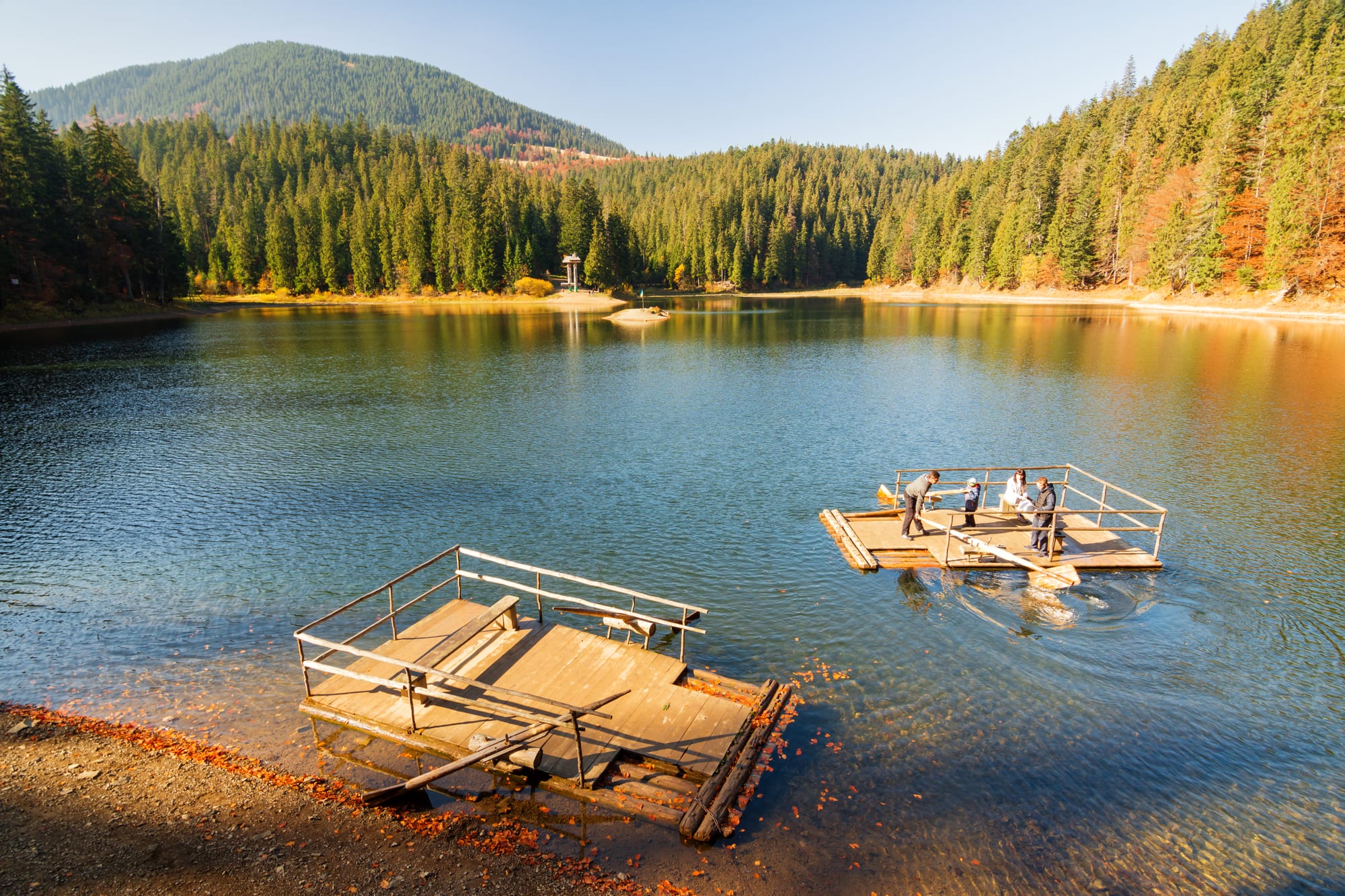
A clear mountain lake ringed by dense fir forest in autumn, with two wooden rafts on the water in the foreground

Ukraine

Western Ukraine & the Carpathians

Synevyr Lake in the Carpathian Mountains of Zakarpattia Oblast, in autumn. (Rbrechko / Wikimedia Commons · CC BY-SA 4.0)

The Habsburg and Polish-shaped west of Ukraine, from Lviv and the Volhynian lakes to the Carpathian ridges of the Hutsuls and the Hungarian-tinged valleys of Zakarpattia — the heartland of Ukrainian national feeling and the part of the country furthest from the front. This page is written to explain the region, not to encourage travel; most governments advise against all travel to Ukraine while the war continues.

Explore Western Ukraine & the Carpathians

History

The west was the core of the medieval principality of Galicia-Volhynia, whose ruler Danylo was crowned king in 1253; Lviv, named after his son Lev, and Lutsk were among its towns. From the 14th century Poland and Lithuania divided the land. Galicia and Volhynia became part of the Polish-Lithuanian Commonwealth, while Podolia's fortress of Kamianets-Podilskyi held the southern frontier, falling to the Ottomans from 1672 to 1699.

The partitions of Poland split the region. Austria took Galicia in 1772, and Bukovina in 1775, and made Lemberg — Lviv — a provincial capital, while Volhynia and Podolia went to Russia. Under relatively tolerant Habsburg rule, Galicia became the centre of the Ukrainian national movement, with its own press, schools and the Greek Catholic Church, earning it the nickname "Ukraine's Piedmont". Zakarpattia, south of the mountains, was ruled from Hungary.

After 1918 the West Ukrainian People's Republic lost a war with Poland, and the interwar west was divided between Poland, Romania and Czechoslovakia. The Soviet Union annexed the region in 1939–45. The Holocaust destroyed the large Jewish communities of towns such as Lviv, Chernivtsi and Ternopil, Volhynia saw mass killings of Poles in 1943, and the Ukrainian Insurgent Army fought Soviet rule into the early 1950s. Moscow banned the Greek Catholic Church in 1946, and its return in 1989 helped make the west a stronghold of the independence movement. Since 2022 the region has sheltered many people displaced from the east.

Culture & Customs

The west is the most Ukrainian-speaking and most religious part of the country, and the most strongly shaped by Central Europe. In Galicia the Ukrainian Greek Catholic Church, Byzantine in ritual but in union with Rome, is the main church, with its seat historically at St George's Cathedral in Lviv; Volhynia, Bukovina and Podolia are mainly Orthodox. Lviv's Habsburg heritage shows in its coffee houses, its theatres and opera, and a café culture that the city treats as part of its identity.

The Carpathians are home to the Hutsuls, highlanders known for embroidered costume, carved and inlaid wood, the long wooden trembita horn and the painted ceramics of Kosiv, which are on UNESCO's intangible heritage list. Boikos and Lemkos are other highland groups. Zakarpattia has a mixed population, with Rusyns, a Hungarian minority around Berehove and smaller Romanian and Slovak communities, and Bukovina has a Romanian minority around Chernivtsi.

The calendar is full of church feasts: Christmas carolling and the vertep nativity plays, Easter baskets blessed outside churches, and the Jordan blessing of water at Epiphany. Lviv is known for its annual chocolate festival, and Uzhhorod for its spring cherry blossom. Western Ukrainians are often thought of by the rest of the country as more reserved, more devout and more nationally minded.

Daily Life

Lviv, with over 700,000 people before the war, is the largest city and the region's economic and cultural centre. Chernivtsi, Ivano-Frankivsk, Ternopil, Lutsk, Rivne and Khmelnytskyi each have roughly 200,000 to 300,000 residents, while Uzhhorod is smaller, at about 115,000. Much of the population lives in villages and small towns, and the mountain districts have long depended on money sent home from work abroad, especially in Poland, the Czech Republic and Italy.

Lviv's economy is built on IT, education, tourism and services, while the smaller cities combine light industry, trade and administration; Khmelnytskyi grew on its huge clothing market. Farming dominates Volhynia and Podolia, forestry and small-scale tourism the Carpathians, and Zakarpattia trades across the borders with Hungary, Slovakia and Romania.

The war has changed the region's rhythm. Displaced people from the east have settled in Lviv and other cities. Days still follow a Central European pattern of coffee, work and evening walks, interrupted by air-raid sirens.

Food

The west's cooking is the most varied in Ukraine, drawing on Poland, Austria-Hungary and the mountains. The Hutsul staple is banosh, cornmeal cooked in sour cream and topped with crumbled bryndza sheep's cheese and crisp pork crackling, alongside kulesha, a firmer maize porridge. Wild mushrooms, especially ceps, go into soups and sauces, and trout comes from mountain streams. Zakarpattia's Hungarian heritage shows in bohrach, a paprika-rich meat soup, and in spicy sausages.

Lviv's contribution is sweet. The lvivskyi syrnyk is a baked cheesecake, and cake shops, chocolate makers and coffee houses line the old town. Varenyky, holubtsi and borscht are eaten throughout, often in local versions, and Easter tables carry paska bread, ham, sausage and horseradish.

To drink, Lviv is famous for coffee and for beer from its long-established brewery. Zakarpattia has vineyards in its south-west around Berehove, producing white, rosé and red wines, and mineral springs such as those at Truskavets and Morshyn in Lviv Oblast supply bottled waters sold across Ukraine. Home-made fruit spirits and herb-infused horilka are common in the mountains.

Attractions & Natural Wonders

Lviv's UNESCO-listed old town centres on Rynok Square and the town hall tower, with the Latin and Armenian cathedrals, the Dominican church, the opera house, St George's Cathedral and the hillside Lychakiv Cemetery. Castles ring the city, among them Olesko and, in Ternopil Oblast, Zbarazh. Ternopil itself sits beside a large lake, and its oblast also holds the Pochaiv Lavra monastery and long gypsum caves near Borshchiv.

In the south-west, Kamianets-Podilskyi's old town stands on a rock island in the Smotrych canyon, joined to its castle by a bridge, and Khotyn fortress guards the Dnister in Chernivtsi Oblast. Chernivtsi has its UNESCO-listed former metropolitans' residence, now the university, and a centre of Austrian-era streets. Ivano-Frankivsk, founded in the 17th century as the fortress town of Stanisławów, is the gateway to the mountains.

The Carpathians around Yaremche and Bukovel offer the Probiy waterfall, Hutsul markets, ski slopes and paths to Hoverla, at about 2,060 metres Ukraine's highest peak; wooden churches in the region form part of a UNESCO World Heritage Site. Across the mountains, Uzhhorod has its castle and riverside, Mukachevo the Palanok fortress, and Lake Synevyr and old beech forests lie in the hills. In the north, Lutsk has Lubart's Castle, Rivne Oblast the tree-lined railway "Tunnel of Love" at Klevan, and Volyn Oblast the Shatsk lakes.

Cities in Western Ukraine & the Carpathians

Planning basics

Budget

The west has long been one of the cheapest parts of Europe to visit and remains less expensive than Kyiv, though Lviv's centre and Bukovel in the ski season cost more than the smaller cities and mountain villages. Price is not the obstacle; the war is.

Daily Budget Midrange
USD 65–130 (mid-range hotel, restaurant dinners, taxis and guided trips)
Daily Budget Shoestring
USD 25–45 (hostel or guesthouse, canteen meals, trains and minibuses)

Do not plan leisure travel while the war continues; carry some cash in the mountains.

Safety

Most governments advise against all travel to Ukraine, including the west. The region is far from the front and relatively safer than the east and south, but Lviv, energy infrastructure and other targets across the region have been hit by Russian missiles and drones, air-raid alerts are frequent, and martial law applies. In the mountains, sudden weather and avalanches in winter are the natural hazards.

Follow air-raid alerts and go to shelter when sirens sound, carry identification at all times, and do not photograph military sites or infrastructure. Check current official travel advice before travelling.

Climate

Cooler and wetter than the rest of Ukraine. Lviv is known for frequent rain and grey skies, the Carpathians get heavy snow from December to March and summer thunderstorms, and Zakarpattia, sheltered on the south-western side of the mountains, is the mildest part of the region, warm enough for vineyards.

Summer
mild to warm, 20–26°C in Lviv, cooler on the ridges, with frequent showers
Winter
cold, around −6 to 0°C, with reliable deep snow in the mountains

Transportation

With civilian flights suspended, the west is the main overland gateway: trains and buses cross from Poland, Slovakia and Hungary, and Lviv is a few hours by train from the Polish border. Rail and minibus links connect Lviv with Ivano-Frankivsk, Ternopil, Chernivtsi, Uzhhorod and the Carpathian towns; mountain roads are slow and winding.

Expect long queues at the land borders; if travel is unavoidable, book trains early and keep a power bank charged.

Best Time to Visit

In peacetime, May to June and September suited the cities and mountain walking, December to March drew skiers to Bukovel, and April brought cherry blossom to Uzhhorod. At present air-raid alerts and missile and drone strikes can affect the whole region, so the calendar matters far less than current advice.