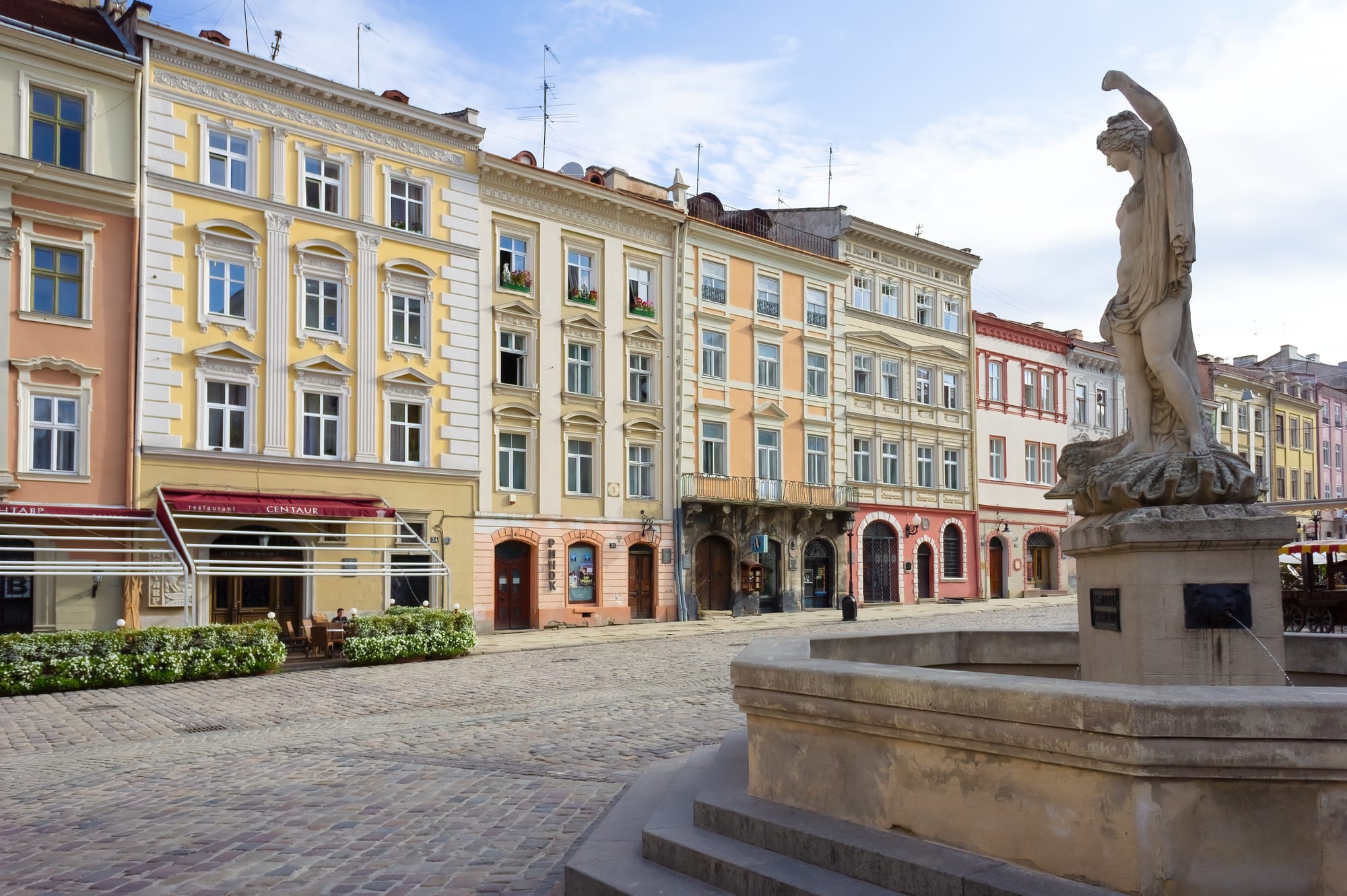
Pastel merchant houses on a cobbled square in Lviv, with a stone statue of a sea goddess on a fountain in the foreground

Western Ukraine & the Carpathians, Ukraine

Lviv

Merchant houses and the Amphitrite fountain on Market Square, the centre of Lviv's old town. (Petar Milošević / Wikimedia Commons · CC BY-SA 3.0)

The largest city of western Ukraine, about 70 km from the Polish border — founded by a Galician king in the 13th century, shaped by Polish and Austrian rule, and largely spared in the Second World War, so its UNESCO-listed old town of churches and merchant houses survives. Since 2022 it has sheltered displaced people and been struck by missiles and drones. This page is written to explain the city, not to encourage travel.

Neighbourhoods

  • Old Town
    • First-time visitors
    • Historic district
    • Best for food

    The UNESCO-listed historic centre around Market Square and its town hall, a dense grid of Renaissance and Baroque houses, churches of several faiths and coffee houses. Street signs are in Ukrainian and English, and the city's tourist information centre is on the square.

    Open in Maps
  • Svobody Avenue and the Opera
    • Close to public transport
    • Theatre
    • Walking

    The broad avenue beside the old town, ending at the opera house built in 1897–1900.

    Open in Maps
  • Lychakiv
    • Historic district
    • Quiet and residential
    • Parks

    The eastern district, home to the hillside Lychakiv Cemetery and the Shevchenkivskyi Hai open-air museum, with the High Castle park close by.

    Open in Maps
  • St George's Hill
    • Churches
    • Quiet and residential

    The hill west of the centre crowned by St George's Cathedral, the historic seat of the Ukrainian Greek Catholic Church, a short walk from the old town.

    Open in Maps

Things to do

The Old Town

  • Market Squarelandmark

    The central square of the old town, lined with merchant houses and fountains, with the town hall in its centre.

    Open in Maps
  • Lviv Town Halllandmark

    The four-storey town hall in the middle of Market Square, with a clock tower above the square.

    Open in Maps
  • Latin Cathedrallandmark

    The Roman Catholic cathedral at the south-west corner of Market Square, with the richly carved Boim Chapel beside it.

    Open in Maps
  • Boim Chapellandmark

    A family burial chapel built in 1609–15 on Cathedral Square, its facade densely covered with sandstone figures and ornament.

    Open in Maps
  • Armenian Cathedrallandmark

    The cathedral of the city's Armenian community, north of Market Square, which served as the seat of the Armenian Catholic archbishops until 1945.

    Open in Maps
  • Dominican Churchlandmark

    A Baroque church topped with a monumental dome, east of Market Square, built as a Roman Catholic church and now Greek Catholic.

    Open in Maps
  • Bernardine Churchlandmark

    A monastery church south of Market Square, whose monastery was incorporated into the city's fortifications in the 17th century.

    Open in Maps
  • Golden Rose Synagoguelandmark

    The remains of a historic Orthodox Jewish synagogue in the old town, desecrated in 1941 and ruined by the Nazis in 1943.

    Open in Maps

Museums and memorials

  • Pharmacy Museummuseum

    A working pharmacy and museum on the corner of Market Square, the oldest existing pharmacy in Lviv, with 16 rooms of antique pharmaceutical equipment, opened as a museum in 1966.

    Open in Maps
  • Lviv National Art Gallerymuseum

    The city's main collection of European and Ukrainian art, spread across several buildings.

    Open in Maps
  • Lychakiv Cemeterylandmark

    The historic hillside cemetery, now a state museum-reserve, with the sculpted tombs of many of the city's writers, artists and public figures.

    Open in Maps
  • Shevchenkivskyi Haimuseum

    An open-air museum of folk architecture on wooded hills in the north-east of the city, with historic buildings relocated from various regions of western Ukraine.

    Open in Maps

Churches and theatres beyond the centre

  • St George's Cathedrallandmark

    A Baroque-Rococo cathedral built in 1744–60 on a hill overlooking the city, the third church on the site.

    Open in Maps
  • Lviv Operaattraction

    The opera house at the end of Svobody Avenue, built in 1897–1900 when Lviv was the capital of Austrian Galicia, and named after the soprano Solomiya Krushelnytska in 2000.

    Open in Maps

Parks and viewpoints

  • High Castle Parkviewpoint

    A park on the highest hill in the city, 413 metres above sea level, on the site of the medieval castle, with views over the rooftops of the old town.

    Open in Maps

Sport

  • Arena Lvivattraction

    The football stadium in the south of the city, one of the eight venues of the Euro 2012 championship.

    Open in Maps

Seasonal events

  • Leopolis Jazz FestJune

    An international jazz festival held in Lviv since 2011, formerly known as Alfa Jazz Fest.

Eat and drink

Long-standing places and food districts in Lviv. Hours, ratings and directions come from your maps app, always current.

Lviv classics

  • Old Town cafésneighborhood

    The streets around Market Square, in a city with more than 1,300 cafés and restaurants and a coffee-house tradition dating from Austrian rule.

    Open in Maps
  • Lviv Breweryrestaurant

    The brewery producing Lvivske beer since 1715, now part of Carlsberg, with a beer-brewing museum on Kleparivska Street.

    Open in Maps

Markets

  • Halytskyi Marketmarket

    A market on Serbska Street, close to the old town.

    Open in Maps

Experience Lviv

History

Lviv was founded around 1250 by Daniel, King of Ruthenia, who named it after his son Lev; after Daniel's death, Lev rebuilt the town around 1270 and made it the capital of Galicia–Volhynia. In 1340 the city passed to Casimir III the Great of Poland, who granted it town rights in 1356 and built a new walled centre in a basin; the High Castle was rebuilt in stone in 1362. German settlers became the majority in the 15th century before being Polonised, and Armenian and Jewish communities grew alongside them. By the 17th century Lwów, with about 30,000 people, was the second city of the Polish–Lithuanian Commonwealth.

Austria annexed the city as Lemberg in 1772, and it grew from about 30,000 people to 196,000 by 1910, when it was the capital of the province of Galicia; that year 51 per cent of residents were Roman Catholic, 28 per cent Jewish and 19 per cent Greek Catholic. After 1918 Poles and Ukrainians fought for the city, and between the wars it belonged to Poland.

The Second World War destroyed its society though not its buildings. The Soviet Union annexed it in 1939; under German occupation from 1941 the Jews were confined to a ghetto in Zamarstyniv and the Janowska camp was set up, and only a few hundred survived. After the war 100,000 to 140,000 Poles were resettled to Poland, and Lviv, having lost 80 to 90 per cent of its pre-war population, was refilled from Ukrainian villages and the wider Soviet Union. In 2022 it became the country's de facto western capital and a refuge for more than 200,000 displaced people within weeks, and it has been struck repeatedly since, including by an Oreshnik missile on the night of 8 January 2026.

Culture & Customs

Lviv is one of the main cultural centres of Ukraine and overwhelmingly Ukrainian-speaking: in 2023, 96 per cent of residents said they spoke Ukrainian at home. Its layered past is visible in the churches of the old town — Roman Catholic, Armenian, Greek Catholic and Orthodox — and in the remains of the Golden Rose Synagogue. The UNESCO-listed historic centre has been listed as endangered because of the Russian invasion.

The city treats its café culture as part of its identity. By the 1840s an influx of Austrian and German-speaking Czech officials had given it a markedly Austrian character, with popular Austrian coffee houses; Soviet rule condemned its restaurants and coffee houses as bourgeois, and in 1979 the Virmenka coffee house became a gathering place for the local bohemians. Lviv has created a calendar of city feasts — coffee and chocolate festivals, a cheese and wine holiday, the feast of pampukh, the Day of Batyar and Bread Day — and the Leopolis Jazz Fest has been held each June since 2011.

The opera house, renamed in 2000 after the soprano Solomiya Krushelnytska, the many theatres and the Lviv National Art Gallery anchor a strong arts scene. Lychakiv Cemetery, a museum-reserve, holds the graves of many of the city's writers, artists and public figures.

Daily Life

With a population of 723,403 in a 2025 estimate, Lviv is the fifth-largest city in Ukraine and the largest in the west, and the administrative centre of Lviv Oblast. It lies on the edge of the Roztochia Upland, about 70 km from the Polish border and 160 km north of the eastern Carpathians.

The city's economic strategy has put tourism and information technology first, with business services and logistics also priorities, and Lviv is home to large food companies including the Lvivske brewery and the Svitoch confectionery, owned by Nestlé since 1998. Universities, hospitals and regional administration employ many more. Since 2022, embassies, government agencies and media organisations relocated from Kyiv and the arrival of displaced people from the east have added to the city's population and its pressures.

Days follow a Central European rhythm of coffee, work and evening walks through the old town, interrupted by air-raid sirens. A curfew runs from midnight to 5 a.m., trams carry most people across the city, and memorial services for the fallen are a constant reminder of the war.

Food

Lviv developed its own culinary tradition, part of a wider Galician cuisine with Austrian, Italian and Hungarian influences that also shaped Polish cooking. Typical Lviv breakfasts were milk coffee, bread and butter and cottage cheese with sour cream; historic meat dishes include pork schnitzel, zrazy, roast beef and fried chicken; and a traditional dessert is legumina, washed down with kompot. The city's kutia, the Christmas Eve dish, is made with boiled wheat, raisins, poppy seed, honey and lemon juice.

Across Galicia, typical dishes include zhur, knishes, machanka (a thick meat soup of Lemko origin), white borshch, banosh, holubtsi and spelt bread, and the favourite desserts are strudel and cheesecake. Soviet rule seriously damaged the city's restaurant and coffee-house traditions, which the new regime declared 'bourgeois'.

Lviv has historically been a centre of beer and wine production. Lvivske beer has been brewed in the city since 1715, and a beer-brewing museum stands on Kleparivska Street. Svitoch chocolate and confectionery are made in the city, and the Halytskyi market on Serbska Street sells produce close to the old town.

Planning tools

Budget

Lviv has long been an inexpensive city for visitors by European standards. Price is not the obstacle; the war is, and ordinary travel insurance usually excludes Ukraine.

Daily Budget Midrange
USD 65–130 (mid-range hotel, restaurant dinners, taxis and guided trips)
Daily Budget Shoestring
USD 30–50 (hostel, canteen meals, trams and buses)

Do not plan leisure travel while the war continues; most of the old town can be seen on foot.

Best Time to Visit

In peacetime, May to June and September were the most pleasant months, with the jazz festival in June. At present air-raid alerts and missile and drone strikes can come at any time of year, so the calendar matters far less than current advice.

Suggested Number of Days

In peacetime two or three days covered the old town, the churches and the museums; four or five allowed for the castles of the oblast and the edge of the Carpathians. Under martial law, alerts and the night curfew slow every plan.

First Visit
2–3 days
With Surroundings
4–5 days

Transportation

The tram network, with about 220 cars on 75 km of track, is the backbone of public transport, alongside buses, minibuses and trolleybuses. Many taxi apps do not operate during the midnight-to-5 a.m. curfew.

If arriving or leaving during the curfew, check in advance which taxi services run at night.

Airport & Station Connections

Lviv lies about 70 km east of the Polish border, and with Ukrainian airspace closed to civilian flights since 24 February 2022, Lviv Danylo Halytskyi International Airport has no passenger services. The city is reached overland by train and bus from Poland; border formalities by car take at least an hour.

Walkability

The old town is compact and best seen on foot, on cobbled streets that can be slippery in rain and ice. Svobody Avenue, St George's Hill and the High Castle are within walking distance; Lychakiv Cemetery and the outer districts are a tram ride away.

Safety

Most governments advise against all travel to most or all of Ukraine. Lviv is far from the front line, but the city and its surroundings have been struck by Russian missiles and drones since 2022 — on 18 April 2022 five missiles killed seven civilians, and the attack of 5 October 2025, with 140 drones and 23 missiles, was the largest of the war in the Lviv region, according to the regional governor. Martial law and a night curfew apply.

Install an air-raid alert app and go to shelter when sirens sound, carry identification at all times, and do not photograph military sites or infrastructure. Check current official travel advice before travelling.

Climate

A humid continental climate, on the edge of the Roztochia Upland, with warm summers and cold winters.

Summer
mild to warm — July averages about 18°C
Winter
cold — January averages about −3°C

Local Customs

Ukrainian is the language of the city: in a 2023 survey 96 per cent of residents spoke it at home. The Ukrainian Greek Catholic Church is the largest church, followed by the Orthodox churches. Tipping in restaurants has been gaining popularity.

Behave quietly in working churches and cemeteries, and do not photograph military sites, checkpoints or the aftermath of strikes.

Common Payment Methods

The currency is the hryvnia. ATMs and currency exchanges are common, particularly in the city centre; some cash is useful during power cuts.