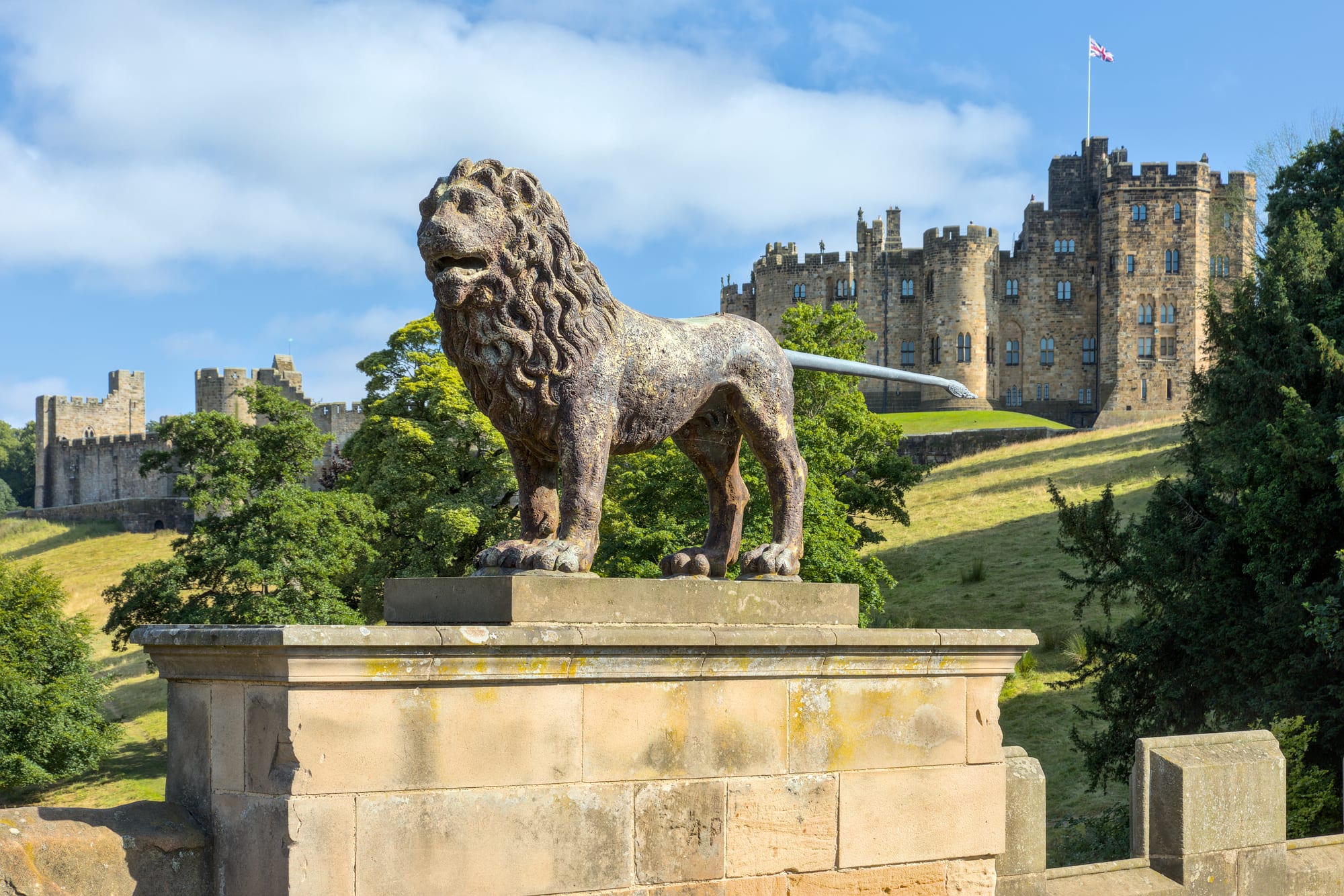
A stone lion statue on a bridge parapet in front of a large battlemented castle on a grassy slope under a blue sky

North East England, United Kingdom

Alnwick

The lion statue on the Lion Bridge, with Alnwick Castle above the River Aln. (Benjamin Smith / Wikimedia Commons · CC BY-SA 4.0)

The traditional county town of Northumberland, a small stone-built market town on the south bank of the River Aln, a few miles inland from the North Sea. It grew up around the castle of the Percy family, Earls and later Dukes of Northumberland, and today draws visitors to that castle, a Hogwarts stand-in in the Harry Potter films, and to the Alnwick Garden beside it.

Neighbourhoods

  • Market Place and Bondgate
    • First-time visitors
    • Shopping
    • Pubs

    The town centre, built around the Market Place with its market cross and the 19th-century Northumberland Hall. Bondgate Within runs east to the Bondgate Tower, the last standing gate of the medieval town wall, and most of the town's pubs, cafés and shops are within a few minutes' walk.

    Open in Maps
  • Bailiffgate and the castle
    • Historic district
    • Families

    The quieter streets on the north-west side of town leading to the castle gates, with St Michael's Church and the Bailiffgate Museum. Beyond the castle the land drops to the River Aln and the Lion Bridge.

    Open in Maps
  • Hulne Park
    • Walks
    • Historic district

    The Duke's walled estate north-west of the castle, landscaped by Capability Brown and open to walkers on most days. It holds the ruins of Hulne Priory, the Brizlee Tower folly and the site of Alnwick Abbey.

    Open in Maps

Things to do

The castle and the garden

  • Alnwick Castlelandmark

    The seat of the Dukes of Northumberland, founded after the Norman Conquest; its state rooms were redecorated in an Italianate style in Victorian times, and it stood in for Hogwarts in the Harry Potter films.

    Open in Maps
  • Alnwick Gardenpark

    Formal gardens beside the castle, revived at the turn of the 21st century around a central water cascade, with a Poison Garden of more than 100 toxic and narcotic plants added in 2005.

    Open in Maps

Around the town

  • Barter Booksattraction

    One of the largest second-hand bookshops in Europe, in the Victorian railway station of 1887, where customers can trade books for credit.

    Open in Maps
  • Bondgate Towerlandmark

    Also called the Hotspur Tower, the only upstanding survivor of the medieval town wall, named after Harry Hotspur, son of the first Earl of Northumberland.

    Open in Maps
  • St Michael's Churchlandmark

    The town's main parish church on Bailiffgate, a Grade I listed building of the 15th century with fragments from the 12th.

    Open in Maps
  • Bailiffgate Museummuseum

    A small independent museum of the history of Alnwick and north Northumberland, run by volunteers near the castle's Bailiffgate entrance.

    Open in Maps
  • Tenantry Columnlandmark

    An 83-foot column topped by the Percy Lion, erected in 1816 by the Duke's tenants in gratitude to the 2nd Duke of Northumberland.

    Open in Maps

Hulne Park

  • Hulne Priorylandmark

    The ruins of a Carmelite friary founded around 1240 inside the walled Hulne Park and suppressed in 1539.

    Open in Maps
  • Brizlee Towerviewpoint

    A Grade I listed folly tower on a hill in Hulne Park, designed by Robert Adam in 1777.

    Open in Maps

Short trips from the town

  • Alnmouthattraction

    A coastal village and former port at the mouth of the Aln, about 4 miles from Alnwick, with the area's nearest railway station.

    Open in Maps
  • Warkworth Castlelandmark

    A large ruined medieval castle in the coastal village of Warkworth, south of Alnwick.

    Open in Maps
  • Dunstanburgh Castlelandmark

    The ruins of a 14th-century castle on the Northumberland coast between the villages of Craster and Embleton.

    Open in Maps

Seasonal events

  • Scoring the HalesShrovetide, February or March

    A surviving Shrovetide football match between the parishes of St Michael and St Paul, first recorded in 1762, which begins with the ball thrown from the castle, traditionally by the Duke of Northumberland, and is played on The Pastures across the River Aln.

Eat and drink

Long-standing places and food districts in Alnwick. Hours, ratings and directions come from your maps app, always current.

Alnwick classics

  • The Station Buffet at Barter Bookscafe

    The bookshop's café, serving hot food at tables in the original tiled waiting rooms of the old railway station.

    Open in Maps
  • Craster kippersrestaurant

    Herring split, salted and cold-smoked over smouldering wood chips, usually oak — the speciality of the fishing village of Craster on the coast nearby.

    Open in Maps

Pubs and the town centre

  • Market Place and Bondgate pubsneighborhood

    Traditional pubs and cafés cluster around the Market Place and Bondgate Within in the compact town centre.

    Open in Maps

Experience Alnwick

History

The history of Alnwick is the history of its castle and its lords. After the Norman Conquest the estate was granted to Gilbert Tyson, one of William the Conqueror's standard-bearers, and about 1096 Ivo de Vesci founded a timber castle on the south bank of the Aln. The de Vesci family held it for more than 200 years; Alnwick Abbey was founded for Premonstratensian canons in 1147, and Hulne Priory followed around 1240. In 1309 the castle passed to the Percy family, who made it the home of the most powerful baronial family in the medieval north.

The town lay on the front line of the wars with Scotland. Malcolm III of Scotland was killed at the first Battle of Alnwick in 1093, and William the Lion was captured here in 1174 during the second. The Percys rebuilt and strengthened the castle in the 14th century; after they challenged Henry IV the king took it in 1403, and in the Wars of the Roses it changed hands between Lancastrians and Yorkists in 1463.

The abbey and Hulne Priory were suppressed in 1539, and for two centuries the Percys left the castle to decay, only returning to live there in the mid-18th century; they have stayed ever since, and the castle is now the home of the 12th Duke of Northumberland and his family. Robert Adam designed Brizlee Tower, the 2nd Duke's tenants raised the Tenantry Column in 1816, and the Victorians redecorated the castle's state rooms in an Italianate style. The railway reached the town, and its branch line closed in 1968; the station became Barter Books in 1991.

Culture & Customs

Alnwick's identity is bound up with the Percys. The Percy Lion, the family's symbol, stands on top of the Tenantry Column, and Harry Hotspur, Sir Henry Percy, gave his name to the Bondgate Tower. The castle has a long life on screen: it stood in for Hogwarts in the Harry Potter films and has been used for films and television from Becket and Robin Hood: Prince of Thieves to The Black Adder and Downton Abbey.

The Alnwick Garden, revived at the turn of the 21st century, brought a second major attraction to the town. Its revival was the subject of public disputes between the Duchess of Northumberland and garden experts, but the Poison Garden, opened in 2005 with more than 100 toxic, intoxicating and narcotic plants, made it a national tourist attraction.

Old customs survive. Each Shrovetide the town plays Scoring the Hales, a form of mob football first recorded in 1762 that begins with the Duke dropping the ball from the castle battlements. Barter Books, with its barter system for second-hand books, has become a local institution, and the Alnwick Playhouse on Bondgate is the town's theatre. The name is pronounced "Annick".

Daily Life

About 8,400 people lived in Alnwick at the 2021 census. It is the traditional county town of Northumberland, 32 miles south of Berwick-upon-Tweed and the Scottish border, 34 miles north of Newcastle and 5 miles inland from the North Sea at Alnmouth.

Tourism drives much of the economy: in 2016 the castle and the garden together received over 600,000 visitors a year, and Barter Books alone has over 350,000 visitors a year, 40 per cent of them from outside the area. The Department for Environment, Food and Rural Affairs is also among the employers in the town.

Life centres on the Market Place and Bondgate, with their shops, pubs and cafés, and on the A1 that runs past the town towards Newcastle and Edinburgh. A heritage railway project is slowly rebuilding the old branch line towards Alnmouth from a new station, Alnwick Lionheart, on the edge of town. The footballer Lucy Bronze played junior football with Alnwick Town, which has a plaque in her honour.

Food

Alnwick's food is that of rural Northumberland and its coast. Craster kippers come from the fishing village of Craster a few miles away, which has long had a herring-curing business: a kipper is a whole herring split from tail to head, gutted, salted or pickled and cold-smoked over smouldering wood chips, typically oak, and in Britain it is most often eaten for breakfast.

Pan haggerty, the Northumberland version of the northern casserole panackelty, is potatoes, onions and cheese baked in a dish. Singin' hinnies, rich griddle cakes of flour, lard or butter, currants and milk, are made especially in Northumberland and the North East's coal-mining areas and take their name from the sizzle they make on the griddle; "hinny" is a local term of endearment. The stottie, a round, flat bread split and filled with ham, bacon or egg and often pease pudding, is found across the North East.

Eating out is informal: pubs and cafés around the Market Place and Bondgate, and the Station Buffet at Barter Books, which serves hot food in the old station's tiled waiting rooms.

Planning tools

Budget

Alnwick's main costs are the tickets for the castle and the garden, the two big paid attractions, and rooms, which fill and rise in price in the summer holidays when the Northumberland coast is busiest. The town itself, Barter Books and Hulne Park cost nothing to enjoy.

Daily Budget Midrange
USD 160–290 (inn or guest house, restaurant dinners, castle and garden tickets, a hire car for the coast)
Daily Budget Shoestring
USD 65–110 (budget room or hostel nearby, cafés and pub meals, buses)

Book rooms early for July and August, when the whole Northumberland coast fills up.

Best Time to Visit

Spring to early autumn, when the castle and the garden are at their best and the coast and castles nearby are easiest to enjoy. Winter is quiet, with short days and cold winds, but the town's pubs and bookshop stay busy.

Suggested Number of Days

The town, the castle and the garden fill a long day or an overnight stay. Three or four days suit a base for the castles, villages and beaches of the Northumberland coast, and a car makes the longer stay much easier.

First Visit
1–2 days
With Surroundings
3–4 days

Transportation

Everything in the town can be reached on foot. Buses link the town with Alnmouth station and the village of Alnmouth, the coast and Newcastle. The outlying villages need a car or a bicycle; the land is fairly flat and good for cycling.

Use the X18 or X20 buses between Alnmouth station and the town, which together run about every half hour.

Airport & Station Connections

The nearest railway station is Alnmouth, about 4 miles away on the East Coast Main Line, a bus ride of about 13 minutes. The town sits beside the A1, about 35 miles north of Newcastle and 80 miles south of Edinburgh by road. Arriva's X15 bus from Newcastle's Haymarket takes about 90 minutes.

Walkability

Excellent. The town centre, the castle, the garden and Barter Books are all within a short walk of each other, and paths lead down to the River Aln and into Hulne Park.

Safety

The UK is generally safe, with the main risks being pickpocketing and phone theft in crowded parts of London and other cities, occasional late-night antisocial behaviour, and drink-related trouble around nightlife. Alnwick is a small, quiet market town; the main hazards are outdoors, on the coast and in the hills nearby.

Carry waterproofs for walks in Hulne Park and on the coast, where the weather changes quickly. Check current official travel advice before travelling.

Climate

Northumberland, in the far north of England and with much high land, is one of the coldest areas of the country, but as it lies on the east coast it has relatively low rainfall, most of it falling on the high land in the west.

Summer
cool for England — at Berwick-upon-Tweed, 32 miles up the coast, the average July high is 18.1°C
Winter
at Berwick-upon-Tweed, January averages a high of 7.0°C and a low of 2.1°C; across North East England frosts are more common inland, away from the sea

Local Customs

The UK does not have a strong culture of tipping; about 10–15 per cent is customary in restaurants for good service but is not expected. The Percy family still lives at the castle, and their lion emblem tops the Tenantry Column. The name is pronounced 'Annick'.

Parts of Hulne Park are a private estate open to walkers only, without dogs, and it may close for private events.

Common Payment Methods

The currency is the pound sterling. Shops widely accept foreign credit and debit cards, contactless cards and phone payments are recommended, and cash machines are very widely available, so there is no need to carry large amounts of cash.