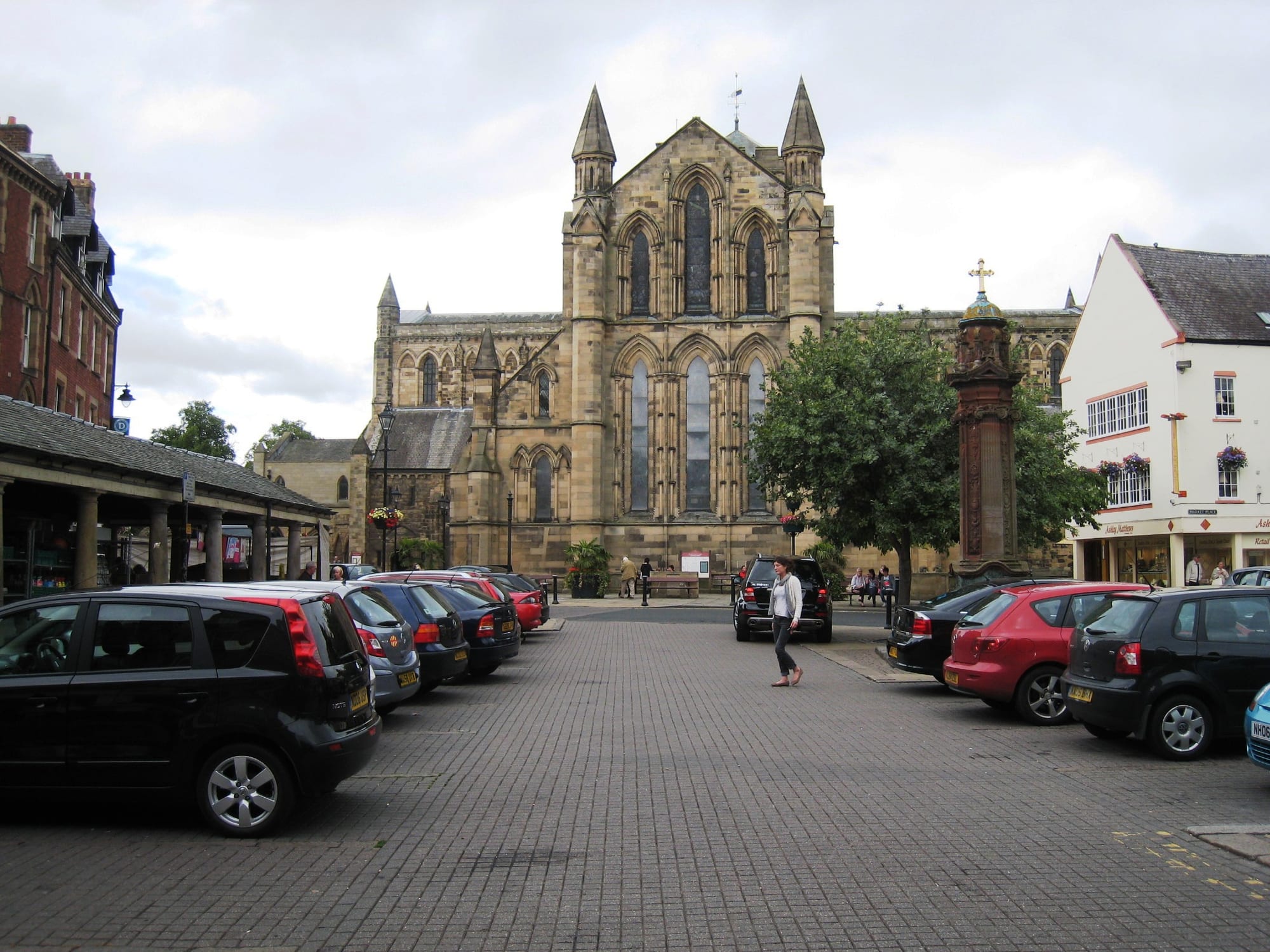
A tall stone abbey church at the end of a paved market square with parked cars

North East England, United Kingdom

Hexham

Hexham Abbey seen across the Market Place in Hexham. (Philip Barker / Wikimedia Commons · CC BY-SA 2.0)

A market town on the south bank of the River Tyne in Northumberland, just below the meeting of the North and South Tyne and close to Hadrian's Wall. It grew around an abbey founded by St Wilfrid in 674 and suffered centuries of border raids; today it is a prosperous market town and the usual base for the Roman forts along the wall.

Neighbourhoods

  • Market Place and the abbey
    • First-time visitors
    • Historic district
    • Shopping

    The heart of the town, with the abbey at the west end of the Market Place, the Shambles covered market of 1766 in the middle and the Moot Hall gatehouse at the east end. The Queen's Hall arts centre and library and the Forum cinema are close by, and the former gardens of three houses in the centre are now public parks.

    Open in Maps
  • Hallgate and Priestpopple
    • Local life
    • Close to public transport

    The streets just east of the Market Place, around the Old Gaol on Hallgate and Priestpopple, where the town's bus station stood from the 1930s until 2016, with shops and cafés.

    Open in Maps
  • Tyne Green and the riverside
    • Riverside walks
    • Families

    Open riverside land beside the Tyne at the edge of the town, where horse racing began in the early 18th century before moving to the hills above.

    Open in Maps

Things to do

The historic town

  • Hexham Abbeylandmark

    St Wilfrid's church of 674, rebuilt in Early English Gothic style from about 1170, whose Anglo-Saxon crypt reuses stones from Roman ruins; it has been the parish church since 1537.

    Open in Maps
  • Moot Halllandmark

    A Grade I listed medieval gatehouse at the east end of the Market Place, considered one of the best examples of a medieval courthouse in the north of England.

    Open in Maps
  • Old Gaolmuseum

    Built in 1330–33 behind the Moot Hall and one of the first purpose-built jails in England, now a museum.

    Open in Maps
  • The Shamblesmarket

    The covered market hall in the Market Place, built by Sir Walter Blackett in 1766 and now a listed building.

    Open in Maps
  • Hexham Racecourseattraction

    A National Hunt course set in a natural amphitheatre at Yarridge Heights in the hills above the town, with steeplechase meetings through the year.

    Open in Maps

Hadrian's Wall and the Roman forts

  • Corbridge Roman Townlandmark

    The excavated remains of Coria, a Roman fort and town at the village of Corbridge, about 3 miles east of Hexham.

    Open in Maps
  • Chesters Roman Fortlandmark

    The best-preserved Roman cavalry fort on Hadrian's Wall, with a museum built in the 1890s for John Clayton's collection of finds from the wall.

    Open in Maps
  • Housesteads Roman Fortlandmark

    The 'grandest station' on the wall, set dramatically on the Whin Sill crags, one of the best-preserved forts, with its own site museum.

    Open in Maps
  • Vindolandalandmark

    A Roman fort just south of the wall near Bardon Mill, occupied from about AD 85 to 370 and famous for its wooden writing tablets.

    Open in Maps

Seasonal events

  • Hexham Book Festivalspring

    The town's book festival, held in spring.

Eat and drink

Long-standing places and food districts in Hexham. Hours, ratings and directions come from your maps app, always current.

Markets

  • Hexham Farmers' Marketmarket

    Local producers' stalls in the Market Place on the second and fourth Saturday of the month.

    Open in Maps
  • Market Place cafésneighborhood

    Coffee shops, from chains to family-run independents, around the Market Place, the abbey and the Old Gaol.

    Open in Maps

Country pubs

  • Tyne valley pubsneighborhood

    Country pubs in the villages around the town, some with their own breweries, popular for a Sunday roast.

    Open in Maps

Experience Hexham

History

Hexham grew around its church. In 671 or 672 the Northumbrian queen Æthelthryth gave St Wilfrid land for a church, and the monastery he founded in 674 used stones taken from nearby Roman ruins, probably Corbridge or Hadrian's Wall; its crypt still survives beneath the abbey. The Northumbrian king Ælfwald, murdered in 788, was buried in the church. The name probably comes from the Old English Hagustaldes ham, though a later medieval form, Hextildesham, may honour Hextilda of Tynedale.

Lying near the border, the town suffered in the wars between England and Scotland. William Wallace burned it in 1297; in 1312 Robert the Bruce took £2,000 from the town and monastery to spare them; and in 1346 the monastery was sacked by David II's army. The Old Gaol of 1330–33 and the later Moot Hall date from these troubled times. In 1464, during the Wars of the Roses, the Battle of Hexham was fought south of the town, and the defeated Lancastrian commander, the Duke of Somerset, was executed in the Market Place. The town's name lives on in the popular expression "Gang to Hexham!".

Until 1572 Hexham was the centre of the Liberty of Hexhamshire. In 1715 the Earl of Derwentwater raised the Jacobite standard in the Market Place, and in 1761 militia troops fired on protesters there, killing some 45 people in the Hexham Riot. The town grew rich on leather and gloves, and the Newcastle and Carlisle Railway arrived in 1837. It was the administrative centre of the Tynedale district from 1974 to 2009.

Culture & Customs

The abbey dominates both the skyline and the town's sense of itself: it has been the parish church since the dissolution of the monasteries in 1537, and it remains open all year to visitors. Around it the Market Place keeps the shape of a medieval market town, with the Shambles, the Moot Hall and the Old Gaol, and the old gardens of Abbey House, Hexham House and Sele House now form a group of listed public parks.

Cultural life centres on the Queen's Hall of 1866, which holds the arts centre and the library with its large local history collection, and on the Art Deco Forum cinema in the Market Place. Hexham Book Festival brings writers each spring. The Hexham Courant has served the town and Tynedale since 1864.

Sport is local and rural. National Hunt racing has been held at Yarridge Heights above the town since the early 19th century, after starting on Tyne Green, and Tynedale Cricket Club, founded in 1888, plays on Prior's Flat. Hexham's reputation as a place to live is strong: it won the town award in Britain in Bloom in 2005, was named England's Favourite Market Town by Country Life the same year, and was voted the happiest place to live in Britain in 2019 and 2021.

Daily Life

Hexham had about 13,000 people at the 2011 census and sits in the Tyne valley, ringed by villages such as Corbridge, Acomb, Haydon Bridge and Allendale. Newcastle is 25 miles to the east and Carlisle 37 miles to the west.

The largest employer is the Austrian firm Egger, whose chipboard factory sends up steam visible from miles away. Leather and glove-making once employed more than a thousand women in the town, and Hexham remains a flourishing market town with a mart for cattle and other farm animals. The botanical brewery Fentimans is based here. The high street has the shops of a typical English market town — supermarkets, clothes and charity shops, banks, estate agents, antique shops — and many cafés, from chains to family-run independents.

The Tyne Valley Line and the A69 link the town with Newcastle, and the bus station moved to Dene Avenue in 2016. Schools follow Northumberland's three-tier system, with Queen Elizabeth High School, partly housed in a former hydropathic hotel, the town's main school. Since July 2024 the Hexham constituency has been represented by Labour's Joe Morris.

Food

Hexham's food is that of the Northumberland countryside around it. The farmers' market fills the Market Place on the second and fourth Saturday of each month, and the town's cafés, pubs and restaurants stay open all year. Country pubs in the villages around the town are known for Sunday roasts, and some brew their own beer.

The dishes of the wider North East are found here too. Pan haggerty, the Northumberland version of the northern casserole panackelty, is potatoes, onions and cheese baked in a dish. Singin' hinnies are rich griddle cakes of flour, lard or butter, currants and milk, made especially in Northumberland and the North East's coal-mining areas and named after the sizzling sound they make as they cook; "hinny" is a term of endearment in the dialects of the Newcastle area. The stottie, a round, flat bread split and filled with ham, bacon or egg, is often served with pease pudding, a savoury dish of boiled split yellow peas, often cooked with a bacon or ham joint.

Fentimans, the botanical brewery, is a Hexham business, and the town's mart for cattle and other farm animals is a reminder that Hexham is a farming town as well as a tourist one.

Planning tools

Budget

Hexham is a well-off market town but prices are moderate by English standards. The main extra costs are entry to the Roman forts and getting to them, by the Hadrian's Wall bus, taxis or a hire car. Rooms in the area are busiest in summer, the main walking season.

Daily Budget Midrange
USD 160–290 (inn or guest house, restaurant dinners, fort and museum tickets, a hire car for the wall)
Daily Budget Shoestring
USD 65–110 (budget room or hostel along the wall, cafés and pub meals, trains and the wall bus)

Book summer rooms well ahead in walking season, and check the Hadrian's Wall bus timetable, which runs more often in summer.

Best Time to Visit

May to September for walking on Hadrian's Wall and visiting the forts, with late spring and early autumn quieter on the wall. The town itself keeps its abbey, arts centre, cinema, cafés and pubs open all year, so it makes a good base even out of season.

Suggested Number of Days

The town itself needs a day. Allow three or four days to see the Roman forts and walk parts of the wall, and longer for anyone walking the whole Hadrian's Wall Path.

First Visit
1–2 days
With Surroundings
3–4 days

Transportation

The town centre is small and easily walked. Buses run from the bus station on Dene Avenue, and the AD122 Hadrian's Wall bus runs year-round between Hexham and Haltwhistle with more services in summer, ideal for walking one way along the wall and riding back. Otherwise the forts need a car or taxi.

The A69 between Newcastle and Carlisle is the main road, a fast low-level route that stays open in bad weather.

Airport & Station Connections

Hexham railway station is on the Tyne Valley Line between Newcastle and Carlisle, part of the original railway of 1837; trains from Newcastle run about every 30 minutes and take around 40 minutes, continuing west to Haltwhistle and Carlisle. Newcastle International Airport is about 20 miles away by road; by public transport, take the Metro from the airport to Newcastle and the train from there.

Walkability

Good. The Market Place, the abbey, the Old Gaol, the parks behind the abbey and the shopping streets are all within a few minutes of each other, and the station and the riverside are a short walk downhill. The racecourse is in the hills above the town.

Safety

The UK is generally safe, with the main risks being pickpocketing and phone theft in crowded parts of London and other cities, occasional late-night antisocial behaviour, and drink-related trouble around nightlife. Hexham is a quiet market town; the real hazards are on the hills and moors along the wall, where weather can turn quickly.

Carry waterproofs, warm layers and a map on Hadrian's Wall, keep to the path and respect the farmland it crosses. Check current official travel advice before travelling.

Climate

Northumberland, in the far north of England and with much high land, is one of the coldest areas of the country, but as it lies on the east coast it has relatively low rainfall, most of it falling on the high land in the west.

Summer
across North East England, mild rather than hot; the region's warmest summers, around Stockton-on-Tees, average a July high of 20.4°C
Winter
frosts are more common inland than on the coast; at Newcastle, 25 miles east, a typical year has 5–10 days of lying snow and the record low is −14.0°C

Local Customs

The UK does not have a strong culture of tipping; about 10–15 per cent is customary in restaurants for good service but is not expected. Hexham is a farming town as much as a tourist one, with a livestock mart as well as its street markets, and the abbey is a working parish church.

On Hadrian's Wall, walkers keep to the path rather than the wall itself and close farm gates after passing through.

Common Payment Methods

The currency is the pound sterling. Shops widely accept foreign credit and debit cards, contactless cards and phone payments are recommended, and cash machines are very widely available, so there is no need to carry large amounts of cash.