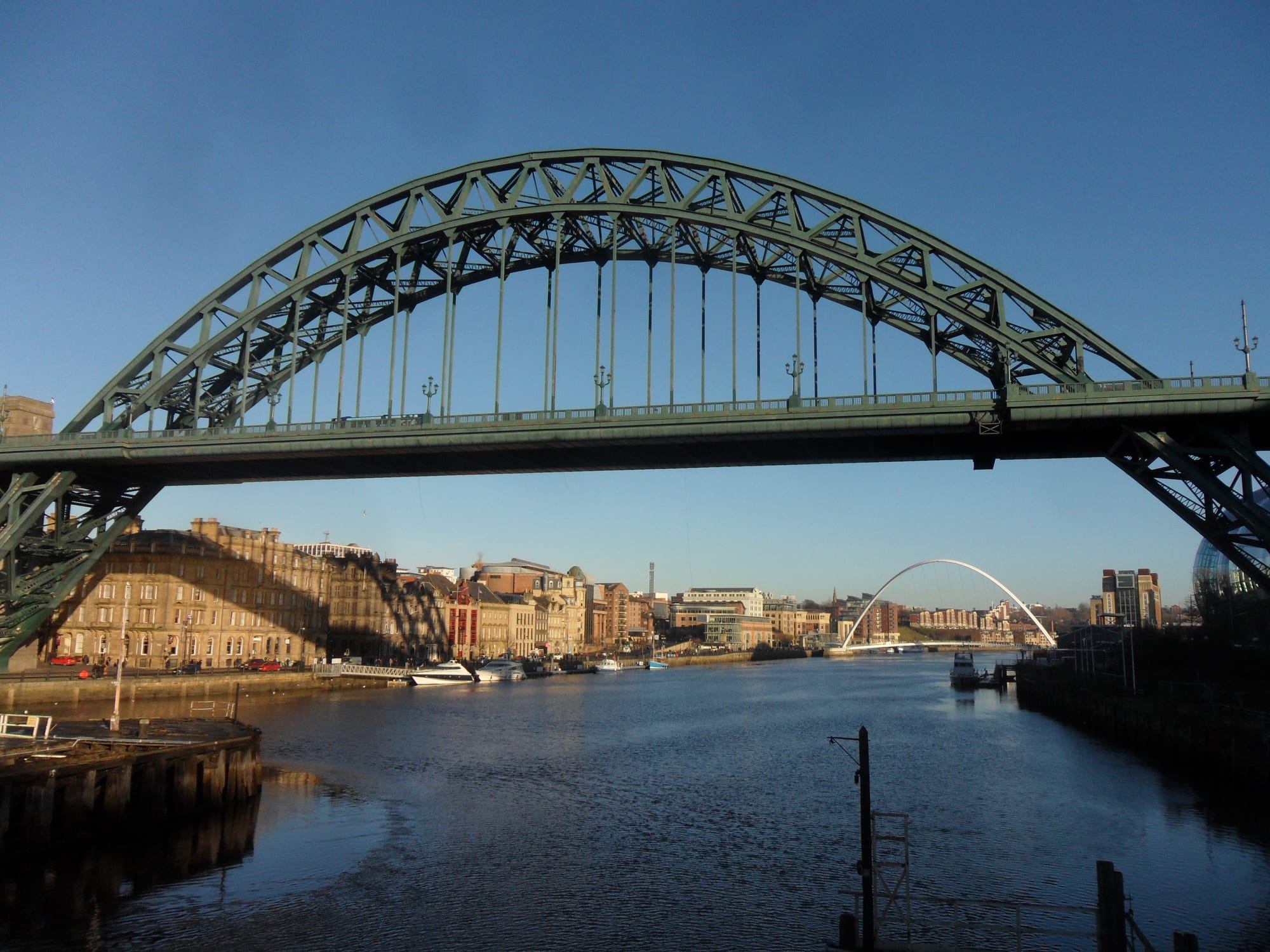
A green steel arch bridge over a calm river, with stone buildings along the quay

North East England, United Kingdom

Newcastle upon Tyne

The Tyne Bridge and Newcastle's Quayside on the River Tyne. (Anthony Foster / Wikimedia Commons · CC BY-SA 2.0)

The largest city of North East England, on the steep north bank of the River Tyne facing Gateshead. It grew from a Roman bridge fort and a Norman castle into a coal port and a giant of shipbuilding and engineering; today its classical Grainger Town streets, the bridges and Quayside, two universities, football and a famous night out define it.

Neighbourhoods

  • Grainger Town
    • First-time visitors
    • Historic district
    • Shopping

    The classical city centre laid out by Richard Grainger and John Dobson in the 1830s, with Grey Street curving down from Grey's Monument, the Theatre Royal and the Grainger Market. Chinatown on Stowell Street lies at its north-west corner, and Monument Metro station is underneath.

    Open in Maps
  • The Quayside
    • Riverside walks
    • Nightlife
    • Architecture

    The riverfront below the old town, where the Tyne's bridges cross to Gateshead and buildings of the 15th to 18th centuries, among them old merchants' houses, stand on Sandhill and the Close among modern ones. Bars and restaurants line both banks, and the Millennium Bridge leads across to the Baltic and the Glasshouse.

    Open in Maps
  • Ouseburn Valley
    • Arts and culture
    • Live music
    • Pubs

    A former industrial valley just east of the Quayside where the Ouseburn reaches the Tyne, now home to Seven Stories, the Cluny music venue, studios and pubs, with a summer festival of its own.

    Open in Maps
  • Jesmond
    • Best for food
    • Students and nightlife
    • Parks

    A suburb north-east of the centre, popular with students and young professionals. Osborne Road is lined with restaurants and bars, and the wooded gorge of Jesmond Dene runs along its eastern edge.

    Open in Maps
  • Gosforth
    • Quiet and residential
    • Close to public transport

    A residential district to the north, beyond the Town Moor, with one of the city's two largest suburban shopping streets and quick Metro links to the centre.

    Open in Maps

Things to do

Famous landmarks

  • Tyne Bridgelandmark

    The green steel arch completed in 1928 between Newcastle and Gateshead, the best-known symbol of Tyneside.

    Open in Maps
  • Newcastle Castlelandmark

    The castle that gave the city its name, first built of wood in 1080 by Robert Curthose and rebuilt in stone; its keep and Black Gate survive on either side of the railway viaduct.

    Open in Maps
  • Grey Streetlandmark

    The curving classical street of the 1830s that Nikolaus Pevsner called one of the finest streets in England.

    Open in Maps
  • Grey's Monumentlandmark

    A tall column at the top of Grey Street honouring Earl Grey, the Prime Minister of the Reform Act of 1832, and a favourite meeting point.

    Open in Maps
  • Newcastle Cathedrallandmark

    The medieval parish church of St Nicholas, a cathedral since the diocese was founded in 1882.

    Open in Maps
  • Gateshead Millennium Bridgelandmark

    A tilting footbridge and cycle bridge across the Tyne, linking the Newcastle and Gateshead quaysides.

    Open in Maps

Museums and galleries

  • Laing Art Gallerymuseum

    The city's art gallery, opened in 1904 in a building paid for by a gift from the local wine merchant Alexander Laing.

    Open in Maps
  • Great North Museum: Hancockmuseum

    A museum of natural history and ancient civilisations, with displays on the Romans and Hadrian's Wall, ancient Egypt and Greece, and natural history and geology.

    Open in Maps
  • Discovery Museummuseum

    A museum of Tyneside's science, industry and maritime history, home to Turbinia, the ship Charles Parsons built to show the advantages of steam-turbine power.

    Open in Maps
  • Seven Storiesmuseum

    The National Centre for Children's Books, opened in 2005 in the Ouseburn Valley.

    Open in Maps
  • Baltic Centre for Contemporary Artmuseum

    A contemporary art gallery on the Gateshead bank by the Millennium Bridge, the venue for the Turner Prize in 2011.

    Open in Maps
  • Literary and Philosophical Societyattraction

    The 'Lit & Phil', founded in 1793 and the largest independent library outside London, with more than 150,000 books.

    Open in Maps

Parks

  • Town Moorpark

    A huge area of common land north of the centre, larger than Hyde Park and Hampstead Heath together, where freemen may still graze cattle and the Hoppings fair is held.

    Open in Maps
  • Jesmond Denepark

    The wooded gorge of the Ouseburn, a park of paths, waterfalls and old mill buildings linked to Heaton Park and the Ouseburn Valley.

    Open in Maps

Markets

  • Grainger Marketmarket

    A Grade I listed covered market designed by John Dobson and opened in 1835, with more than 100 businesses and Marks and Spencer's Original Penny Bazaar of 1895.

    Open in Maps

Music, sport and nights out

  • St James' Parkattraction

    Newcastle United's stadium since 1886, standing on the hill above the city centre.

    Open in Maps
  • Theatre Royalattraction

    The city's largest theatre, opened on Grey Street in 1837 and designed by John and Benjamin Green.

    Open in Maps
  • The Glasshouseattraction

    Norman Foster's curved glass concert hall on the Gateshead quayside, formerly called Sage Gateshead.

    Open in Maps
  • Tyneside Cinemaattraction

    An independent cinema on Pilgrim Street, restored and reopened in its original building in 2008.

    Open in Maps

Short trips from the city

  • Angel of the Northlandmark

    Antony Gormley's 20-metre steel sculpture of an angel with a 54-metre wingspan, in Gateshead.

    Open in Maps
  • Segedunummuseum

    The excavated Roman fort at Wallsend, at the eastern end of Hadrian's Wall, the most thoroughly excavated fort along the wall, with baths and a museum.

    Open in Maps
  • Tynemouthattraction

    A seaside town at the mouth of the Tyne, on the Metro, with a medieval priory and castle on the headland and popular east-facing beaches.

    Open in Maps
  • Beamish Museummuseum

    A large open-air museum in County Durham, with a town, a pit village, a colliery and a farm, showing everyday life in the North East in the early 20th century.

    Open in Maps

Seasonal events

  • Chinese New YearJanuary or February

    Carnivals and parades centred on Chinatown along Stowell Street.

  • The HoppingsJune

    A huge gathering of travelling fairs on the Town Moor, which began as a temperance fair in 1882.

  • Northern Pridemid-July

    The Pride festival and parade, held in Leazes Park and the city's gay community area.

  • Ouseburn Festivallate July

    A family weekend festival in the Ouseburn Valley near the city centre, with a family fun day and a carnival day.

  • Great North RunSeptember

    The largest half marathon in the world, run from Newcastle across the Tyne Bridge to South Shields since 1981.

Eat and drink

Long-standing places and food districts in Newcastle upon Tyne. Hours, ratings and directions come from your maps app, always current.

Newcastle classics

  • Stottie cake with ham and pease puddingrestaurant

    The North East's round, flat bread, split and filled with ham and pease pudding, a savoury spread of boiled split yellow peas — sold by bakeries and sandwich shops across the city.

    Open in Maps

Food districts and markets

  • Grainger Marketmarket

    The Victorian covered market in the centre, with butchers, bakers, cafés and food stalls among its more than 100 businesses.

    Open in Maps
  • Chinatownneighborhood

    Chinese restaurants, supermarkets and bakeries along Stowell Street, entered under a Chinese arch at its northern end.

    Open in Maps
  • Osborne Road, Jesmondneighborhood

    Jesmond's main commercial street, lined with bars and restaurants, which came fourth in the 'foodie' category of the UK Google Street View awards in 2010.

    Open in Maps

Bars and nights out

  • The Quaysideneighborhood

    Bars and restaurants along both banks of the river beneath the bridges, busiest on weekend evenings.

    Open in Maps
  • Bigg Marketneighborhood

    The old market street in the centre, famous for its crowded bars and lively weekend nights.

    Open in Maps

Experience Newcastle upon Tyne

History

The first settlement here was Pons Aelius, a Roman fort and bridge over the Tyne founded in the 2nd century AD and named after the family of the emperor Hadrian, whose wall ran through the site; fragments survive along the West Road. In Anglo-Saxon Northumbria the place was known as Monkchester. In 1080 Robert Curthose, eldest son of William the Conqueror, built a wooden castle here, replaced in stone in 1087 and rebuilt under Henry II in 1172, and the town took its name from this new castle. Throughout the Middle Ages Newcastle was England's northern fortress against Scotland; it was defended against the Scots three times in the 14th century and was made a county of itself in 1400.

Coal made the town rich. From 1530 a royal act forced all coal shipped from Tyneside through Newcastle's Quayside, giving a monopoly to the merchants known as the Hostmen, and the phrase "taking coals to Newcastle" is recorded from 1538. Plague killed more than a third of the population in the 1630s, and Charles I was held here by the Scots in 1646–47. A great fire and explosion in 1854 destroyed much of the Quayside and killed 53 people.

The 19th century brought Grainger Town's classical streets, city status in 1882 and a boom in shipbuilding and heavy engineering, with William Armstrong's guns, Joseph Swan's electric lamps and Charles Parsons' steam turbine. The Tyne Bridge opened in 1928, but the Depression brought record unemployment, and the last coal pit closed in 1956. Newcastle University, founded in 1963, Northumbria University, a university since 1992, and the regenerated Quayside have shaped the city since.

Culture & Customs

People from Newcastle and the surrounding area are Geordies, and the Geordie dialect keeps many words from Old English, such as "gan" for go, alongside Scandinavian ones such as "bairn" for child and "hyem" for home. The city's old music mixed Northumbrian folk with 19th-century dialect songs, among them George Ridley's "Blaydon Races", still sung as an unofficial Tyneside anthem. Sting, Bryan Ferry and Dire Straits all have connections to the city.

Football is close to a civic religion. Newcastle United have played at St James' Park since 1886, and their League Cup win in 2025 was their first domestic trophy since 1955. The Great North Run, the largest half marathon in the world, starts in the city each September and crosses the Tyne Bridge on its way to South Shields.

Newcastle has a long cultural life. The Literary and Philosophical Society, founded in 1793, is the largest independent library outside London; the Theatre Royal has stood on Grey Street since 1837; the Laing Art Gallery opened in 1904; and Seven Stories, the National Centre for Children's Books, opened in 2005. The adult comic Viz began in Jesmond. Chinatown celebrates Chinese New Year with parades, the Hoppings fills the Town Moor every June, and in 2006 the Rough Guide to Britain placed the city's nightlife as Great Britain's number one tourist attraction.

Daily Life

The metropolitan borough had an estimated 320,605 people in 2024 — about 320,000 — and around 880,000 live in the Tyneside urban area, which takes in Gateshead and North and South Tyneside. Students from Newcastle and Northumbria universities add a large temporary population in term time.

Heavy industry declined in the second half of the 20th century, and offices, services and shops are now the staples. The economy rests on science, finance, retail, education, tourism and nightlife, which alone is estimated to be worth £340 million a year; the Centre for Life beside Central Station was the UK's first biotechnology village. The city centre is the region's main shopping destination, with Eldon Square, Grainger Street and the first and largest Fenwick department store, and Gosforth and Byker are the biggest suburban shopping areas.

Most people live in the suburbs that spread north, east and west of the centre, from the student streets of Jesmond and Heaton, where two-storey Tyneside flats survive, to Gosforth's quieter avenues. The Metro carries commuters in from the coast and Sunderland, the Quayside and the Bigg Market fill at weekends, and the Town Moor, larger than Hyde Park and Hampstead Heath together, gives the city a vast open space close to the centre.

Food

The city's everyday food is plain and filling. The stottie cake is a round, flat bread about 8 inches across, made from ordinary white-bread dough given only one rise and baked on the bottom of the oven; it is split and filled with ham, bacon, sausage or egg, often with pease pudding, a savoury dish of boiled split yellow peas with salt and spices, often cooked with a bacon or ham joint. Singin' hinnies are rich griddle cakes of flour, fat, currants and milk, named after the sizzling sound they make as they cook — "hinny" is a local term of endearment.

Newcastle Brown Ale was launched in the city in 1927 and became a working man's beer with a long association with heavy industry; its brewing moved away from Newcastle in 2005, to Dunston and then Tadcaster, and since 2017 it has also been brewed in the Netherlands. The bakery chain Greggs was founded in Newcastle and still has its headquarters here, and salt and vinegar crisps were first made by the city's Tudor Crisps in 1967.

For eating out, the Grainger Market's stalls and cafés have traded since 1835, Chinatown on Stowell Street has the city's Chinese restaurants and supermarkets, and Osborne Road in Jesmond is a long strip of restaurants and bars. The Quayside's bars and restaurants line both banks of the river.

Planning tools

Budget

Many of Newcastle's museums and galleries charge no entry. Prices rise on big football, concert and race weekends and for the Great North Run. Public transport within Tyne and Wear is inexpensive with a day ticket that covers buses, the Metro, local trains and the ferry.

Daily Budget Midrange
USD 160–290 (city-centre hotel, restaurant dinners, a match or show, day tickets and a trip to the coast)
Daily Budget Shoestring
USD 65–110 (hostel or budget hotel, bakeries, pub meals and the Metro)

Book rooms early for Newcastle United home matches and the Great North Run weekend.

Best Time to Visit

May to September brings the longest days, the Hoppings in June, Pride and the Ouseburn Festival in July and the Great North Run in September. The city also works in winter, when the football season and the theatres carry it through.

Suggested Number of Days

Two days are enough for a first look at the city and the Gateshead bank. Four or five allow time for the coast, the Roman frontier and County Durham, all within reach by Metro, train or bus.

First Visit
2 days
With Surroundings
4–5 days

Transportation

The centre, the universities, the Quayside and the Gateshead riverbank are best covered on foot. The Tyne and Wear Metro, with its Green and Yellow lines, is quick and inexpensive for the suburbs, the airport, the coast and Sunderland, and its ticket machines take cards or cash. Buses fill the gaps, and a regional day ticket covers bus, Metro, local rail and the ferry across the river mouth.

Use the Metro rather than a car; parking in the centre is limited, and park-and-ride sites sit on the Metro lines.

Airport & Station Connections

Newcastle International Airport is about 7.7 miles from the city centre, a Metro ride of around 20–25 minutes. Newcastle Central Station is on the East Coast Main Line, with trains from London King's Cross every 30 minutes taking about three hours, and from Edinburgh every 30 minutes; trains also come from Carlisle along the Tyne valley. Overnight DFDS ferries from IJmuiden near Amsterdam reach the Port of Tyne, about 7 miles east of the centre.

Walkability

Good, but hilly. Grainger Town sits on high ground and the streets and stairs drop steeply to the Quayside, so walks from the centre to the river are short downhill and harder on the way back. The Millennium Bridge makes the Gateshead bank an easy stroll, and Jesmond and the Ouseburn are within walking distance of the centre.

Safety

The UK is generally safe, with the main risks being pickpocketing and phone theft in crowded parts of London and other cities, occasional late-night antisocial behaviour, and drink-related trouble around nightlife. Newcastle's nightlife around the Bigg Market and the Quayside is boisterous at weekends, and the city centre's usual petty crime applies.

Keep phones and bags secure in crowded bars and on match days, and take a licensed taxi late at night. Check current official travel advice before travelling.

Climate

An oceanic climate, with less rain than the UK average and little seasonal variation in rainfall. Newcastle receives more snow than most major English cities, though snowfall is becoming less frequent.

Summer
mild, with occasional heat — the city's record high is 37.0°C, set on 19 July 2022
Winter
cold and often grey, with five to ten days of lying snow in a typical year; the record low is −14.0°C

Local Customs

The UK does not have a strong culture of tipping; about 10–15 per cent is customary in restaurants for good service but is not expected. People from Newcastle and the surrounding area are Geordies, and the Geordie dialect has words of its own, such as 'gan' for go and 'bairn' for child. In 2019 a travel site named Newcastle the friendliest city in the UK.

Football loyalties run deep: the Tyne–Wear rivalry with Sunderland is fierce, so avoid wearing rival colours on match days.

Common Payment Methods

The currency is the pound sterling. Shops widely accept foreign credit and debit cards, contactless cards and phone payments are recommended, and cash machines are very widely available, so there is no need to carry large amounts of cash.