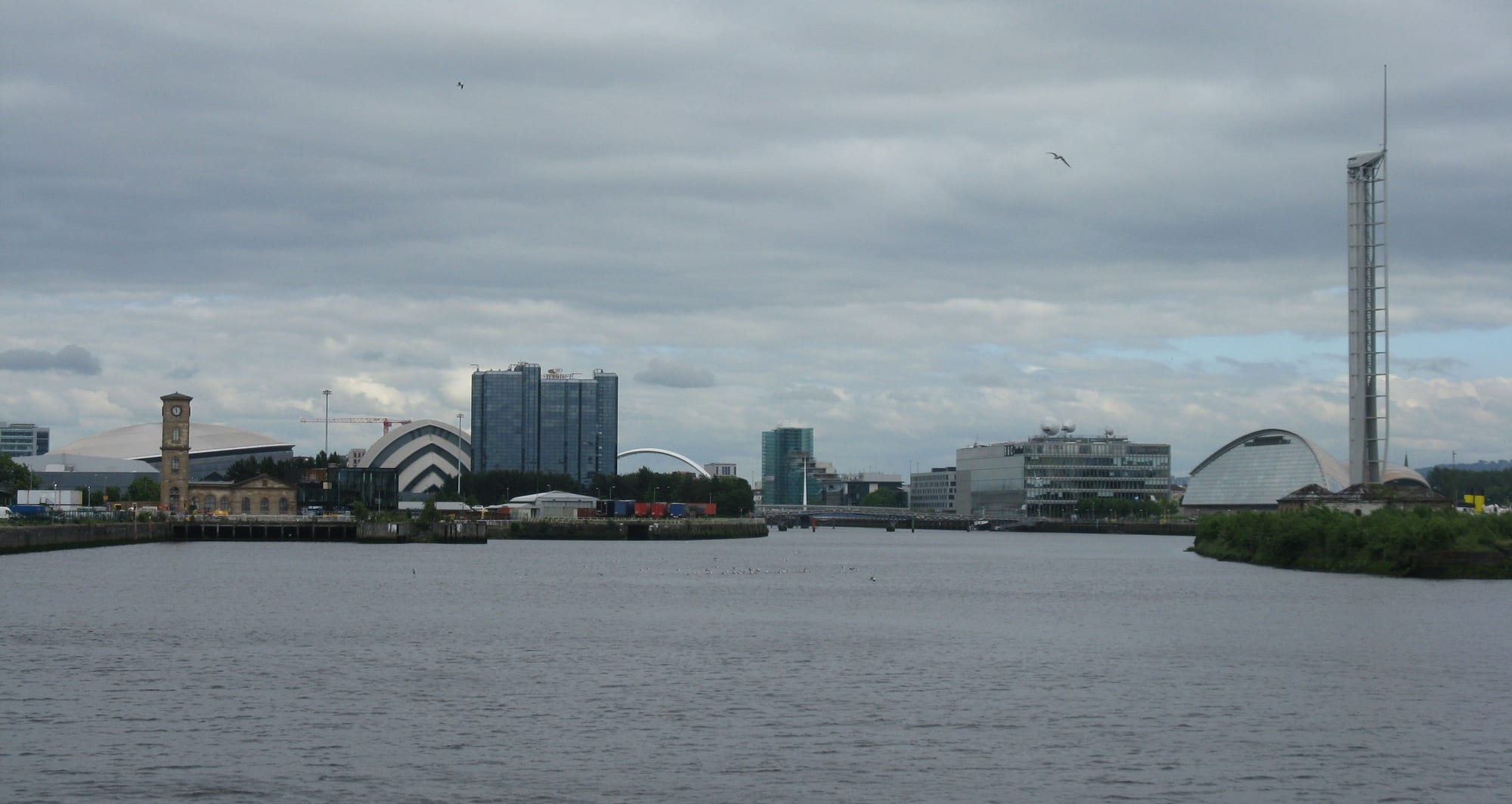
A wide grey river with a clock tower, curved arena roofs, glass office towers and a tall slender tower on the far banks

Edinburgh, Glasgow & Southern Scotland, United Kingdom

Glasgow

The River Clyde in Glasgow, with the riverside arenas and the Science Centre tower on its banks. (M J Richardson / Wikimedia Commons · CC BY-SA 2.0)

Scotland's largest city, on the River Clyde in the west of the Central Belt. It grew from a medieval cathedral town into a hub of Atlantic trade and then the shipbuilding 'second city of the British Empire'. Today it is known for its Victorian streets, Mackintosh buildings, free museums, live music and football.

Neighbourhoods

  • City Centre
    • First-time visitors
    • Shopping
    • Close to public transport

    A grid of Victorian sandstone streets between the two main railway stations and George Square, with the main shopping streets of Buchanan, Sauchiehall and Argyle Street.

    Open in Maps
  • Merchant City
    • Historic district
    • Bars and restaurants

    The old trading quarter east of George Square, where many streets still carry the names of the 18th-century tobacco lords. Its warehouses and merchants' buildings now hold flats, bars, restaurants and boutiques.

    Open in Maps
  • West End
    • Students and nightlife
    • Museums
    • Cafés

    A prosperous quarter along the River Kelvin around the University of Glasgow, Kelvingrove Park and the Botanic Gardens. Byres Road and the cobbled Ashton Lane are its main streets for cafés, pubs and restaurants.

    Open in Maps
  • Finnieston
    • Best for food
    • Concerts

    A former dock district between the city centre and the West End, where many new bars and restaurants have opened around Argyle Street. The area is home to the SEC Centre and the OVO Hydro, the riverside venues for concerts and conferences.

    Open in Maps
  • Southside
    • Quiet and residential
    • Parks

    A mostly residential area south of the Clyde, with Victorian villas and tenements, a large South Asian community around Pollokshields, Pollok Country Park and the Burrell Collection, and Hampden Park.

    Open in Maps
  • East End
    • Local life
    • Football

    The old industrial east of the city, with Glasgow Green, the Barras market and the Barrowland Ballroom near the centre and Celtic Park further out. The athletes' village of the 2014 Commonwealth Games was built here.

    Open in Maps

Things to do

Famous landmarks

  • Glasgow Cathedrallandmark

    The medieval cathedral at the top of High Street, on the site where St Mungo is said to have founded the city, and one of the few Scottish medieval churches to come through the Reformation with its roof intact.

    Open in Maps
  • Glasgow Necropolislandmark

    A Victorian garden cemetery of grand monuments on the hill behind the cathedral, with views across the city.

    Open in Maps
  • Provand's Lordshipmuseum

    A medieval house of 1471 within sight of the cathedral, now a historic house museum.

    Open in Maps
  • George Square and the City Chamberslandmark

    The council's grand headquarters of the 1880s on the east side of George Square, the city's main civic square.

    Open in Maps

Museums and galleries

  • Kelvingrove Art Gallery and Museummuseum

    A red sandstone museum in Kelvingrove Park with a huge range of art, natural history and arms and armour, one of the most visited museums in Scotland.

    Open in Maps
  • Riverside Museummuseum

    Glasgow's museum of transport in a zigzag building by Zaha Hadid on the Clyde, with the tall ship Glenlee moored alongside.

    Open in Maps
  • Burrell Collectionmuseum

    Shipowner William Burrell's collection of art and antiquities in Pollok Country Park, reopened in March 2022 after a long refurbishment.

    Open in Maps
  • Hunterian Museummuseum

    Scotland's oldest museum, at the University of Glasgow, with an art gallery that holds most of Mackintosh's watercolours.

    Open in Maps
  • Gallery of Modern Artmuseum

    The city's modern art gallery in a tobacco lord's townhouse of 1778 on Royal Exchange Square, with the statue of the Duke of Wellington outside.

    Open in Maps
  • Glasgow Science Centremuseum

    A science museum on the south bank of the Clyde beside the Glasgow Tower, which can rotate to face into the wind.

    Open in Maps

Mackintosh buildings

  • Willow Tearoomslandmark

    Tearooms on Sauchiehall Street designed by Charles Rennie Mackintosh for Catherine Cranston, restored between 2014 and 2018 and renamed The Mackintosh Tearooms in 2026.

    Open in Maps
  • Scotland Street School Museummuseum

    A Mackintosh-designed school on the Southside, now a museum of education.

    Open in Maps
  • Queen's Cross Churchlandmark

    The only church designed by Mackintosh to be built, in the north of the city.

    Open in Maps
  • House for an Art Loverattraction

    A house built in Bellahouston Park in the 1990s to designs Mackintosh drew up for a competition in 1901.

    Open in Maps

Parks and the river

  • Kelvingrove Parkpark

    The Victorian park along the River Kelvin below the University of Glasgow's tower, with the museum at its edge.

    Open in Maps
  • Glasgow Green and the People's Palacepark

    The city's oldest park, on the north bank of the Clyde in the East End, with the People's Palace museum of Glasgow life and the Doulton Fountain.

    Open in Maps
  • Glasgow Botanic Gardenspark

    Gardens at the northern end of Byres Road known for the Kibble Palace, a large Victorian glasshouse.

    Open in Maps
  • Pollok Country Parkpark

    A large park on the Southside with woodland, Highland cattle, Pollok House and the Burrell Collection.

    Open in Maps

Music, sport and markets

  • Barrowland Ballroomattraction

    A former dance hall by the Barras market in the Calton district, with a large animated neon sign, and a prominent feature of the city's music scene.

    Open in Maps
  • The Barrasmarket

    The East End's long-running weekend street market on the Gallowgate.

    Open in Maps
  • Celtic Parkattraction

    The home ground of Celtic in the East End, the largest football stadium in Scotland.

    Open in Maps
  • Ibrox Stadiumattraction

    The home ground of Rangers on the south side of the Clyde.

    Open in Maps

Short trips from the city

  • Loch Lomondpark

    The largest loch in Britain by surface area, at the heart of a national park, reached by train or road at Balloch.

    Open in Maps
  • New Lanarklandmark

    A restored cotton-mill village on the River Clyde, where Robert Owen ran his model community, now a UNESCO World Heritage Site.

    Open in Maps

Seasonal events

  • Celtic ConnectionsJanuary

    A winter festival of folk, roots and world music in venues across the city.

  • Glasgow Film FestivalFebruary to March

    A film festival launched in 2005, first based at the Glasgow Film Theatre.

  • Glasgow International Comedy FestivalMarch

    Stand-up and comedy shows in venues across the city.

  • West End FestivalJune

    A community festival of music, arts and a parade in the West End.

  • World Pipe Band ChampionshipsAugust

    Pipe bands from around the world compete on Glasgow Green.

Eat and drink

Long-standing places and food districts in Glasgow. Hours, ratings and directions come from your maps app, always current.

Glasgow classics

  • Shish Mahal and the city's curry housesrestaurant

    Glasgow is one of the places credited with inventing chicken tikka masala, said to have been improvised at the Shish Mahal restaurant, and curry houses are found across the city.

    Open in Maps
  • Willow Tearoomscafe

    Tearooms in the restored Mackintosh interiors on Sauchiehall Street, renamed The Mackintosh Tearooms in 2026.

    Open in Maps

Food districts

  • Ashton Laneneighborhood

    A cobbled lane off Byres Road in the West End, lined with bars, restaurants and a cinema.

    Open in Maps
  • Finniestonneighborhood

    A former dock district where many new bars and restaurants have opened around Argyle Street.

    Open in Maps
  • Merchant Cityneighborhood

    Bars and restaurants in the old merchants' buildings east of George Square.

    Open in Maps

Experience Glasgow

History

Glasgow is said to have been founded by the missionary St Mungo in the 6th century, and the small town that grew around his church, later the cathedral, ran down the hill to the Clyde. It became a bishop's burgh, and in 1451 the University of Glasgow was founded, the second oldest in Scotland.

The union of 1707 opened the markets of the British Empire to the city's merchants, and Glasgow became a hub of Atlantic trade in sugar, tobacco and cotton — crops produced by enslaved people in the Americas. By the late 18th century more than half of Britain's tobacco trade passed through the Clyde, and the tobacco lords built the Merchant City. Industry followed: by the end of the 19th century Glasgow, the "second city of the Empire", was producing more than half of Britain's shipping tonnage and a quarter of the world's locomotives. It was one of the first European cities to reach a million people, and its wealth paid for the City Chambers, Kelvingrove and the Subway.

The 20th century brought decline. Shipyards and heavy industry closed, slum clearance moved many thousands to estates and new towns, and the population fell steeply from its peak of over a million. Culture led the recovery: Glasgow became a UNESCO City of Music in 2008 and hosted the Commonwealth Games in 2014 and again in 2026. In 2025 it opened the UK's first official drug consumption room, and in March 2026 a fire at Union Corner badly disrupted Glasgow Central station.

Culture & Customs

Music is central to the city's culture: UNESCO named it a City of Music in 2008, and the Barrowland Ballroom, the Hydro and dozens of smaller venues host gigs every night, while Celtic Connections fills January with folk and roots music. The Glasgow School of Art has produced many of Scotland's leading contemporary artists and a string of Turner Prize winners, although Mackintosh's own art school building was gutted by fires in 2014 and 2018.

Charles Rennie Mackintosh, the main exponent of Art Nouveau in Britain, is the city's best-known designer, and his buildings, from the Willow Tearooms to Queen's Cross Church, draw visitors from around the world. The architect Alexander "Greek" Thomson left a different Victorian legacy of churches and terraces.

Football is a passion and, between Celtic and Rangers — the Old Firm — a rivalry traditionally drawn along Catholic and Protestant lines, still with a sectarian edge. The city is also home to Scotland's national stadium, Hampden Park. Glasgow has long been a city of migrants, from the Highlands and Ireland to Jewish, Italian, South Asian and Chinese communities and, more recently, asylum seekers; in 2023 almost nine in ten of Scotland's asylum seekers lived here.

Daily Life

Glasgow City had an estimated population of about 630,000 in 2020, and more than a million people live in the Greater Glasgow urban area. The city lost the districts of Rutherglen and Cambuslang to South Lanarkshire in 1996, and its density is far above the Scottish average.

The economy has moved from shipbuilding and engineering to university education, finance, commerce, shopping and culture, and the Queen Elizabeth University Hospital in Govan is one of the largest hospitals in the country. Health inequality is stark: a 2008 World Health Organization report found male life expectancy ranging from 54 years in Calton to 82 in nearby Lenzie.

Most Glaswegians live in sandstone tenements, post-war housing schemes or suburban houses. The working week is followed by busy evenings in the pubs and music venues of the centre and the West End, and weekends often revolve around football, shopping on Buchanan Street, the parks when the weather allows and trips to the coast or the lochs.

Food

Glasgow is one of the places credited with chicken tikka masala. One version of its origin says that Ali Ahmed Aslam, owner of the Shish Mahal restaurant, improvised the sauce from condensed tomato soup and spices for a customer who found his chicken too dry; a rival restaurant claimed to have invented it first. Either way, the city's large South Asian community has given it a long tradition of curry houses, from the city centre to the Southside.

Haggis, Scotland's national dish, is served with neeps and tatties here as elsewhere, and many Italian Scots settled in the city, often from Frosinone in Lazio and Lucca in Tuscany, many of them first working as "Hokey Pokey" men. Tea rooms are part of the city's history too: Catherine Cranston's tearooms, designed by Mackintosh, were a fashionable alternative to the pub at the start of the 20th century.

Today the main restaurant areas include Finnieston, where many new bars and restaurants have opened, the Merchant City and the West End around Byres Road and Ashton Lane. Irn-Bru, the bright orange soft drink, is made at Cumbernauld nearby.

Planning tools

Budget

Glasgow makes a cheaper base than Edinburgh during the August festivals, when Edinburgh's hotel rooms cost noticeably more, and Kelvingrove, its most popular museum, is free to enter. Prices rise for big concerts at the riverside arenas, Old Firm matches and major events.

Daily Budget Midrange
USD 180–320 (mid-range hotel, restaurant dinners, a concert or match ticket, taxis)
Daily Budget Shoestring
USD 80–130 (hostel bed, cafés and curry houses, the Subway and buses)

Staying in Glasgow and taking the train to Edinburgh is a common way to save money in August.

Best Time to Visit

May to September brings the longest days and the best chance of dry weather for the parks and the river. Glasgow is an indoor city as much as an outdoor one, so it works in any season: January has Celtic Connections, and winter is the busiest time for concerts. It is a wet city, so waterproofs are useful all year.

Suggested Number of Days

Two or three days are enough for a first look at the city. Four or five leave time for trips to the lochs, the Clyde valley or Edinburgh. A concert or a football match can be the reason to add a night.

First Visit
2–3 days
With Surroundings
4–5 days

Transportation

The Subway, a single circular underground line, links the city centre with the West End and the south side of the river, with trains every few minutes and shorter hours on Sundays. Buses cover the rest of the city, and a dense network of suburban trains runs from Central and Queen Street stations. Licensed taxis and private hire cars are easy to find.

Locals call the underground simply 'the Subway', never the 'tube' or the 'metro'.

Airport & Station Connections

Glasgow Airport is in Paisley, about 7 miles west of the city, with an express bus to the centre every 10–15 minutes through the day. Trains from Edinburgh take about 50 minutes, and trains from England arrive at Glasgow Central, the busiest station in Scotland; services there were severely disrupted, with trains cancelled for at least a week, after a fire at the adjoining Union Corner building in March 2026. Long-distance coaches use Buchanan bus station.

Walkability

The city centre grid is compact and easy to walk, with long pedestrian streets, and the Merchant City adjoins it. The West End is about a half-hour walk away, or a few stops on the Subway. Some streets climb steeply, notably around Blythswood Hill and in the West End.

Safety

The UK is generally safe, with the main risks being pickpocketing and phone theft in crowded parts of London and other cities, occasional late-night antisocial behaviour, and drink-related trouble around nightlife. Football shirts, especially Celtic or Rangers ones, mark supporters out as rivals, and many bars ban all football colours.

Avoid wearing football shirts, especially Celtic or Rangers colours, in bars and around matches. Check current official travel advice before travelling.

Climate

Mild, cloudy and wet, with a maritime climate that keeps both summer and winter moderate. Glasgow is noticeably wetter than Edinburgh, and showers are possible on any day of the year.

Summer
cool to mild and changeable, with occasional warm spells — the city's record, set in 2018, is 31.9°C
Winter
mild for its latitude but damp and dark — even in December 2010, the coldest month on record, the average high stayed above freezing, at 1.6°C

Local Customs

Glaswegian speech has a sing-song pattern, probably a legacy of the migrants who came from the Gaelic-speaking Highlands. Football loyalties run deep and are tied to old religious divisions, so the Old Firm is best discussed with care. The city has many accents, reflecting its waves of immigration.

Tipping in restaurants is discretionary; ask before photographing people, and avoid wearing football colours in unfamiliar pubs.

Common Payment Methods

The currency is the pound sterling, and three Scottish banks issue their own banknotes, which circulate in Scotland but are not legal tender. The airport express bus takes cash, with change given, or cards.