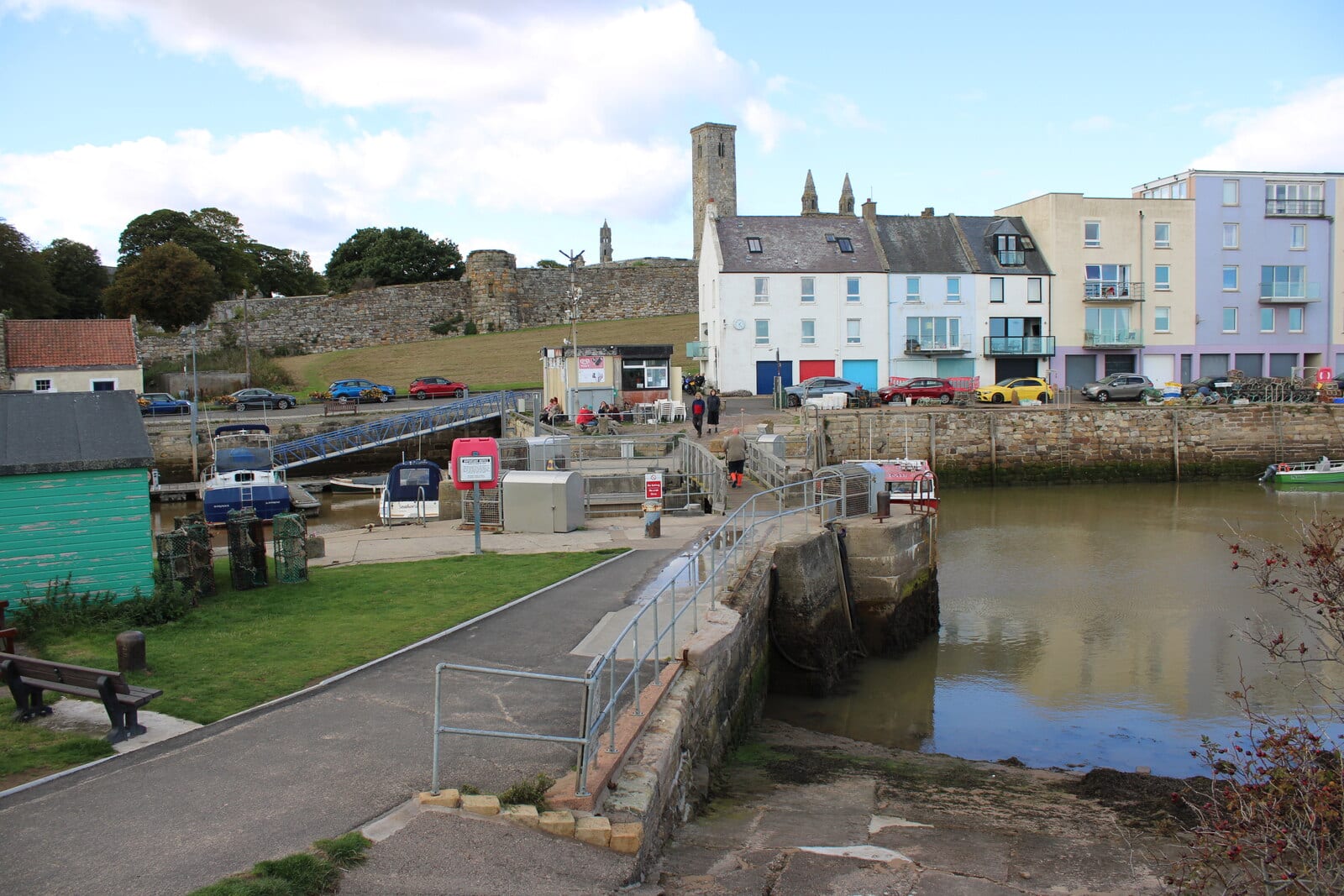
A small stone harbour with moored boats and painted houses, below an old wall and a tall square medieval tower

Edinburgh, Glasgow & Southern Scotland, United Kingdom

St Andrews

St Andrews harbour, with St Rule's Tower and the cathedral ruins rising behind. (Richard Sutcliffe / Wikimedia Commons · CC BY-SA 2.0)

A coastal university town on the east coast of Fife, once the greatest pilgrimage centre of medieval Scotland. The ruins of its cathedral and castle stand above the sea, the oldest university in Scotland fills its streets, and the Old Course has made it known worldwide as the home of golf.

Neighbourhoods

  • The old town
    • First-time visitors
    • Historic district
    • Students

    The medieval burgh laid out west of the cathedral along three main streets — North Street, Market Street and South Street — with the university's colleges, cafés, pubs and shops between them, and the Scores along the clifftop to the north.

    Open in Maps
  • The Links and West Sands
    • Golf
    • Beaches

    The north-west edge of town, where the Old Course and the other links courses run beside the two-mile West Sands beach, with the golf museum and the clubhouse of the Royal and Ancient at the end of the Scores.

    Open in Maps
  • The harbour and East Sands
    • Quiet and residential
    • Waterfront

    The small harbour below the cathedral, once an important fishing port, and the half-mile East Sands beach beyond it, with a leisure centre and a quieter, residential feel.

    Open in Maps

Things to do

Historic St Andrews

  • St Andrews Cathedrallandmark

    The ruins of the largest cathedral ever built in Scotland, begun in the 12th century and wrecked during the Reformation, with St Rule's Tower from an earlier church beside it.

    Open in Maps
  • St Andrews Castlelandmark

    The ruined clifftop castle of the bishops and archbishops of St Andrews, with a rock-cut bottle dungeon and siege tunnels.

    Open in Maps
  • St Salvator's Chapellandmark

    The Late Gothic chapel of St Salvator's College, founded in 1450 by Bishop James Kennedy.

    Open in Maps

Golf and the seafront

  • Old Courseattraction

    Considered the oldest golf course in the world and the most frequent venue for the Open Championship, acquired by the town in 1894 and now a public course held in trust.

    Open in Maps
  • R&A World Golf Museummuseum

    The museum of the history of golf opposite the Royal and Ancient clubhouse, known as the British Golf Museum until it reopened under its new name in 2021.

    Open in Maps
  • West Sandsbeach

    A two-mile sandy beach beside the links courses, used in the opening scene of the film Chariots of Fire.

    Open in Maps
  • St Andrews Aquariumattraction

    A small aquarium on the Scores with seals, fish, reptiles and penguins.

    Open in Maps
  • St Andrews Botanic Gardenpark

    Gardens founded by the university in 1889, laid out in zones of woodland, meadow, dunes, a large rockery and ponds.

    Open in Maps

Short trips from the town

  • Crailneighborhood

    One of the fishing villages of the East Neuk of Fife, south along the coast, with a small harbour.

    Open in Maps
  • Anstrutherneighborhood

    The largest community in the East Neuk, with several fish and chip shops and boat trips to the Isle of May from April to October.

    Open in Maps
  • Isle of Maypark

    An island in the Firth of Forth, a national nature reserve with seabird colonies including puffins, reached by boat from Anstruther.

    Open in Maps
  • V&A Dundeemuseum

    A museum of design on the Dundee waterfront, across the Firth of Tay to the north.

    Open in Maps

Seasonal events

  • The Open ChampionshipJuly, in the years it comes to St Andrews

    Golf's oldest major championship returns to the Old Course more often than to any other venue, and the town fills completely.

  • Alfred Dunhill Links ChampionshipSeptember or October

    A pro-am golf tournament played over the Old Course, Carnoustie and Kingsbarns links.

Eat and drink

Long-standing places and food districts in St Andrews. Hours, ratings and directions come from your maps app, always current.

St Andrews food

  • Chips and cheeserestaurant

    The town's chip shops serve fish suppers and, for the late-night student crowd, chips and cheese.

    Open in Maps
  • Old town cafés and pubsneighborhood

    Market Street, South Street and the lanes between them hold the town's cafés, bakeries, ice cream shops and student pubs.

    Open in Maps
  • Anstruther fish and chipsneighborhood

    The East Neuk town along the coast has several fish and chip shops, among them the award-winning Anstruther Fish Bar.

    Open in Maps

Experience St Andrews

History

The town takes its name from Andrew the Apostle, several of whose relics were held by its cathedral; its Gaelic name is Cill Rìmhinn. A burgh was laid out west of the cathedral precinct under a charter of 1170, and the great cathedral begun in 1160, the largest in Scotland, made St Andrews the most important centre of pilgrimage in medieval Scotland and one of the most important in Europe. The University of St Andrews, the oldest in Scotland and the third oldest in the English-speaking world, was founded in the early 15th century.

In the 16th century the town was at the centre of religious turbulence. Protestant preachers were burned as heretics, a cardinal was killed in revenge, John Knox preached here, and the cathedral and the bishops' castle were wrecked; St Andrews declined after the Reformation, and around 1697 the university even considered moving to Perth.

In the 18th century the town was still in decline, but its links were becoming known to golfers. The Royal and Ancient Golf Club was founded in 1754 and until 2004 exercised authority over the rules of the game in most of the world, and the town acquired the Old Course in 1894. Today St Andrews lives from education, golf, tourism and conferences.

Culture & Customs

Golf defines the town's image abroad. The Royal and Ancient Golf Club exercised authority over the rules of the game worldwide, except in the United States and Mexico, until 2004, and the Old Course has hosted the Open Championship more often than any other venue. In tournament weeks the town is mobbed, and golfers come all year to play its links.

The university shapes everyday life just as much. It was ranked the best university in the UK by the 2022 Good University Guide, and students make up a large share of the town. Its colleges, quadrangles and chapels sit among the old streets, and its traditions — gowns, ceremonies and student customs — give the town the feel of a small collegiate city.

The town also carries the weight of Scottish religious history, from the medieval pilgrimage to the relics of St Andrew to the violence of the Reformation, and its ruins are its main monuments. The beaches play their own part: West Sands was used for the opening scene of Chariots of Fire.

Daily Life

St Andrews had a population of about 16,500 in the 2022 census, making it Fife's fourth-largest settlement. The town grew from about 14,200 people in 2001 to about 16,800 in 2012 before falling slightly. The population is unusually young: people aged 16 to 29 form the largest group, at 37 per cent, because of the university.

The town's economy rests on education, golf, tourism and conferences, with the university by far the largest presence. The academic year sets the rhythm: term time brings crowded streets, busy pubs and late-night queues at the chip shops, while the summer holidays bring golfers and tourists instead. The median age of residents is far below the Scottish average.

Daily life is that of a small, prosperous Scottish town. Residents shop on Market Street and South Street, walk on the beaches, and travel to Dundee, about 10 miles to the north, for larger shops and services; buses to Leuchars connect with trains to Edinburgh and Aberdeen.

Food

Food in St Andrews follows the rhythms of a student and golfing town. The fish and chip shops serve fish suppers and, for a late-night filler after the pubs, chips and cheese, while the cafés and bakeries of Market Street and South Street feed the students during the day, and the town's ice cream shops are busy whenever the weather allows. One acclaimed local bakery is best known for its fudge doughnuts.

The Fife coast supplies much of what is eaten here. Crail, to the south, has long fished mainly for shellfish, Anstruther has several fish and chip shops, and seafood restaurants stand on the Scores and by the golf museum. South Street also has a specialist cheese shop.

Drinking is centred on the pubs of the old town, many of them full of students in term time and golfers in summer. Outside the town, Kingsbarns Distillery and Eden Mill Distillery both produce whisky and gin.

Planning tools

Budget

St Andrews is a small, comfortable town with prices close to Edinburgh's for rooms and meals. Accommodation is scarce and expensive during major golf tournaments, when the town is mobbed. Walking the town, the beaches and the ruins' grounds costs nothing.

Daily Budget Midrange
USD 200–360 (mid-range hotel, restaurant dinners, cathedral and castle tickets, buses or taxis)
Daily Budget Shoestring
USD 85–140 (hostel or student-let room in summer, chip shops and cafés, buses)

The best chance of a round is on the town's other links courses rather than the Old Course.

Best Time to Visit

May to September has the longest days and the best weather for the beaches and the links. The town is quieter in the student summer holidays except when a major tournament is in town. Winters are cool and windy but the ruins and the coast keep their atmosphere.

Suggested Number of Days

One or two days are enough for the town itself. Three or four leave time for the fishing villages along the coast and the countryside of Fife. Golfers who want to play several courses usually stay longer.

First Visit
1–2 days
With Surroundings
3–4 days

Transportation

The town is small enough to walk. Stagecoach and Moffat & Williamson buses connect it with Leuchars station, Dundee and the other towns of Fife, and a coastal bus runs south through the fishing villages of the East Neuk. Taxi ranks are at the bus station and on Bell Street.

Buses to Leuchars and Dundee run frequently; services along the coast are less frequent.

Airport & Station Connections

St Andrews has no railway station: the nearest is Leuchars, on the Edinburgh–Aberdeen line, about 6 miles away, linked to the town by frequent buses. Edinburgh is about 30 miles to the south-west; since May 2025 a direct bus runs from Edinburgh Airport, or travellers can take the tram to Edinburgh Gateway and a train to Leuchars. Dundee Airport, about 15 miles north, has a few domestic flights.

Walkability

Very walkable: the old town, the cathedral, the castle, the harbour, both beaches and the Old Course are all within a short walk of each other on mostly level streets. Paths along the cliffs and the shore are exposed to wind and sea spray.

Safety

The UK is generally safe, with the main risks being pickpocketing and phone theft in crowded parts of London and other cities, occasional late-night antisocial behaviour, and drink-related trouble around nightlife. St Andrews is a small, safe town; the main hazards are the sea, the tides and the cold water off its beaches, and stray golf balls near the links.

Watch for golfers when crossing the links paths, and check tides before walking below the cliffs. Check current official travel advice before travelling.

Climate

A mild, cool coastal climate, often windy, with weather recorded at nearby Leuchars. Summers are rarely hot and winters are cool rather than bitterly cold.

Summer
mild — in a typical year the warmest day reaches about 26°C, and the record is 31.3°C, set in July 2022
Winter
cool — daytime temperatures average around 7°C and can fall below freezing

Local Customs

St Andrews is a university town first: students make up a large share of the population in term time, and university traditions, gowns and ceremonies are part of the town's life. Golf etiquette applies on and around the links.

Tipping in restaurants is discretionary; ask before photographing students in gowns and do not walk across greens during play.

Common Payment Methods

The currency is the pound sterling, and three Scottish banks issue their own banknotes, which circulate in Scotland but are not legal tender.