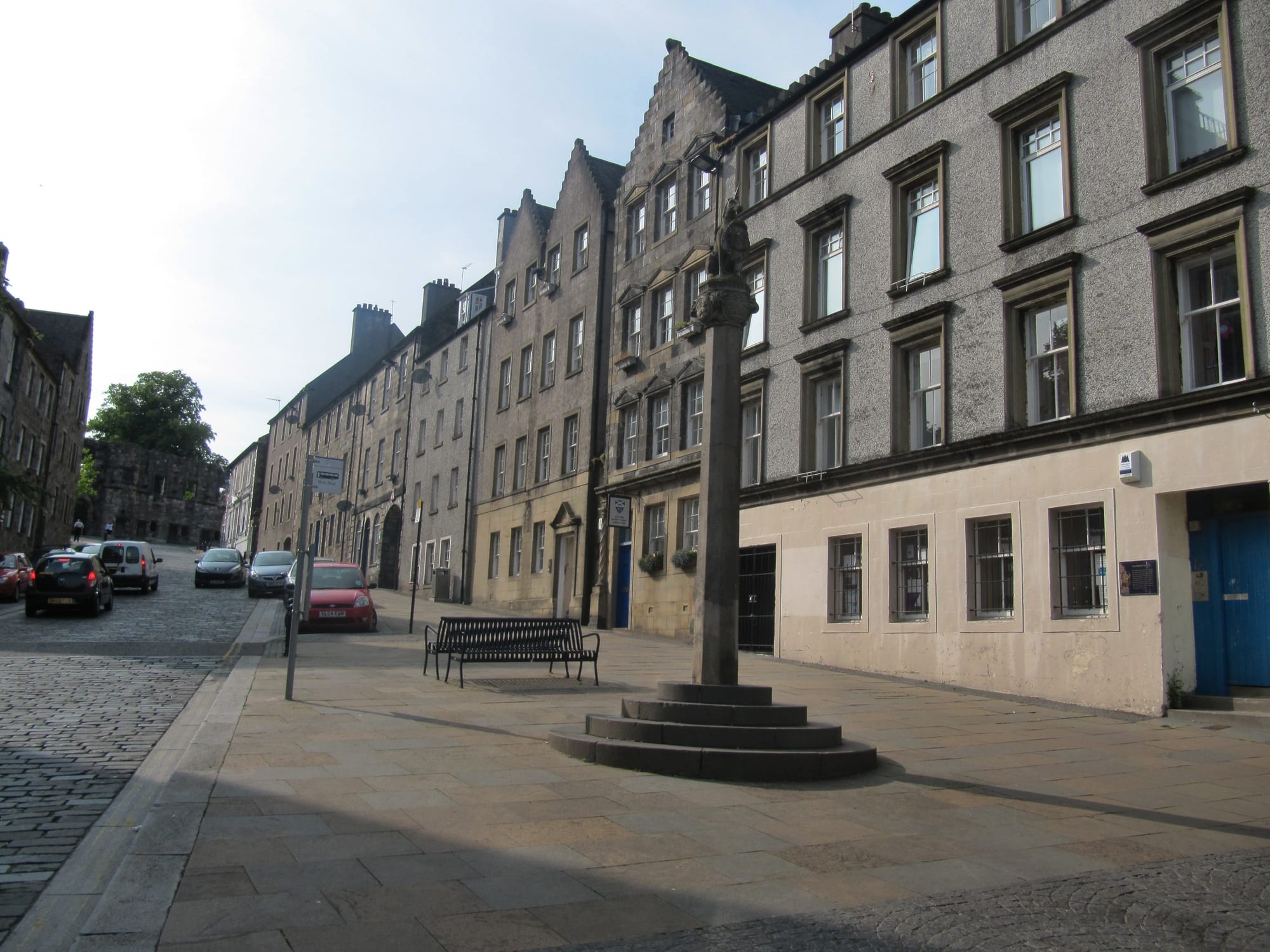
A cobbled street of tall stone town houses with stepped gables, and a stone market cross on a stepped base

Edinburgh, Glasgow & Southern Scotland, United Kingdom

Stirling

Broad Street in Stirling's old town, with its market cross. (Palickap / Wikimedia Commons · CC BY-SA 4.0)

A small city on the River Forth, where the Lowlands meet the Highlands, built on the slope below one of the principal royal castles of the Kingdom of Scotland. The battles of Stirling Bridge and Bannockburn were fought within sight of it; today it is a university and market city with an old town of cobbled streets.

Neighbourhoods

  • Old Town
    • First-time visitors
    • Historic district

    The medieval burgh climbing the ridge to the castle, with Broad Street, the Church of the Holy Rude, the Old Town Jail and the town houses of the nobility who served the royal court. It is steep and cobbled, and quiet in the evenings.

    Open in Maps
  • City centre
    • Close to public transport
    • Shopping

    The lower town around Port Street, Murray Place and the shopping centre, between the old town and the railway station. Most shops, pubs, restaurants and the bus station are here.

    Open in Maps
  • Bridge of Allan
    • Quiet and residential
    • Students

    A former Victorian spa town north of the river, beside the University of Stirling's campus and below the Wallace Monument, with a main street of cafés, pubs and shops.

    Open in Maps
  • Bannockburn
    • History
    • Quiet and residential

    An area immediately south of the centre, where the Wilson family wove tartans in the late 18th and early 19th centuries, best known for the battlefield of 1314 nearby.

    Open in Maps
  • Cambuskenneth
    • Quiet and residential
    • Walks

    A small village in a loop of the Forth east of the centre, reached on foot by a footbridge, around the ruins of its medieval abbey.

    Open in Maps

Things to do

Castle and old town

  • Stirling Castlelandmark

    One of the largest and most important castles in Scotland, on a crag above the town, with the restored Great Hall and Renaissance royal palace of the Stuart kings.

    Open in Maps
  • Church of the Holy Rudelandmark

    The medieval parish church below the castle, founded in 1129 and the oldest building in the city after the castle, where James VI was crowned as an infant in 1567.

    Open in Maps
  • Argyll's Lodginglandmark

    A 17th-century Renaissance town house in Castle Wynd, on the uphill approach to the castle.

    Open in Maps
  • Mar's Warklandmark

    The richly carved facade of a mansion built in 1570–1572 by the Regent and Earl of Mar, at the head of the processional route to the castle.

    Open in Maps
  • Old Town Jailattraction

    A Victorian prison on St John Street, which also houses the town's tourist office.

    Open in Maps
  • Stirling Old Bridgelandmark

    A late-medieval stone bridge over the Forth, built near the site of the wooden bridge where the Battle of Stirling Bridge was fought in 1297.

    Open in Maps

Museums and battlefields

  • National Wallace Monumentlandmark

    A Victorian tower on the Abbey Craig honouring William Wallace, with exhibitions inside and wide views over the Forth valley from the top.

    Open in Maps
  • Battle of Bannockburn visitor centremuseum

    The site south of the city where Robert the Bruce defeated Edward II in 1314, with a memorial and a visitor centre telling the story of the battle.

    Open in Maps
  • Stirling Smith Art Gallery and Museummuseum

    The city's art and local history museum on Dumbarton Road, founded in 1874.

    Open in Maps
  • Cambuskenneth Abbeylandmark

    The ruins of a medieval abbey in a bend of the Forth, with a surviving bell tower and the grave of James III.

    Open in Maps

Short trips from the city

  • Doune Castlelandmark

    A well-preserved medieval courtyard castle north-west of Stirling, used as a film location for Monty Python and the Holy Grail and Outlander.

    Open in Maps
  • Blair Drummond Safari Parkattraction

    A safari park about five miles from Stirling, with reserves of African animals and lions.

    Open in Maps
  • The Falkirk Wheelattraction

    A rotating boat lift linking the Forth and Clyde Canal with the Union Canal near Falkirk.

    Open in Maps
  • The Kelpieslandmark

    Two giant steel horse-head sculptures beside the Forth and Clyde Canal at Falkirk.

    Open in Maps

Seasonal events

  • Stirling Highland GamesAugust

    A day of Highland games at the city's sports village.

  • Stirling Photography FestivalSeptember

    An annual festival of photography exhibitions and events around the city.

Eat and drink

Long-standing places and food districts in Stirling. Hours, ratings and directions come from your maps app, always current.

Stirling food

  • Stirling Farmers' Marketmarket

    A monthly farmers' market on Port Street in the city centre, held on the second Saturday of the month.

    Open in Maps
  • Old Town pubs and restaurantsneighborhood

    Pubs and restaurants on the streets below the castle.

    Open in Maps
  • Bridge of Allanneighborhood

    Henderson Street, the main street of the old spa town near the university, with cafés, a bakery and restaurants.

    Open in Maps

Experience Stirling

History

Stirling grew up at the point where the River Forth could be crossed below a rocky crag, a position that made it one of the keys to Scotland. Scholars have long linked it with "urbs Giudi", a stronghold mentioned in early sources, and a 2023 study supported the identification. King David I made it a royal burgh between 1124 and 1127, and in 2024 the city marked its 900th anniversary.

The castle commanded the main route north, so the Wars of Scottish Independence were fought around it. In 1297 Andrew Moray and William Wallace defeated an English army at the wooden bridge over the Forth, and in 1314 Robert the Bruce defeated Edward II at nearby Bannockburn. Under the Stuart kings the castle became a favoured royal residence, rebuilt with a Renaissance palace and a great hall; Mary, Queen of Scots, was crowned in its chapel royal as an infant in 1543, and her son James VI was crowned in the Church of the Holy Rude in 1567. Nobles built town houses on the streets below.

After the court left for London in 1603, Stirling became a quiet market town, living from agriculture; before the railways, huge cattle drives crossed the bridge on their way to markets in the south. The University of Stirling opened on a greenfield site outside the town in 1967, and Stirling was granted city status in 2002 as part of the Golden Jubilee celebrations.

Culture & Customs

Stirling's identity is bound up with Scottish history, and especially with the two great victories of the Wars of Independence. The National Wallace Monument on the Abbey Craig and the Bannockburn memorial and visitor centre are memorials as well as sights, and the castle's restored palace shows the court culture of the Stuart kings.

The University of Stirling gives the city a young population in term time and a strong sporting culture. The government named it Scotland's University for Sporting Excellence in 2008, and the Scottish National Swimming Academy on its campus has trained Olympic medallists. The Macrobert Arts Centre at the university offers cinema, music, theatre, dance and exhibitions.

The calendar is local in scale: Highland games in August, a photography festival in September, and a farmers' market once a month. Bridge of Allan, the Victorian spa village on the city's northern edge, keeps its own small-town character, and the wider council area runs from the city itself to sparsely peopled, mainly highland country in the north and west.

Daily Life

The 2022 census counted about 49,900 people in the Stirling settlement, almost the same as in 2011, and about 92,600 in the wider council area. Its share of people aged 65 or over is slightly above the Scottish average, balanced by a large student population.

The University of Stirling and Stirling Council are two of the biggest employers, and knowledge industries, research and life sciences have clustered in the innovation park near the campus. Tourism brings visitors to the castle all year, and many residents commute to Glasgow and Edinburgh by train; about half of Scotland's population lives within an hour's travel of the city. The Forthside regeneration scheme is reconnecting the city centre with the river, cut off since the A9 bypass was built in the 1960s.

Daily life is that of a small Scottish city: shopping in the lower town, students in Bridge of Allan, families in suburbs such as Bannockburn, St Ninians and Raploch, and quiet evenings in the old town once the day visitors have gone.

Food

Scottish staples are the everyday fare. Haggis, a savoury pudding of sheep's offal with oatmeal, onion, suet and spices, comes with neeps and tatties, mashed swede and potatoes; Scotch pies, traditionally filled with minced mutton but now generally beef, and fish suppers from the chip shop are common too. Haggis is traditionally the main course of a Burns supper, held on or near the poet's birthday, 25 January, and is often served with a dram of whisky. Scotch pies are often sold at football grounds, traditionally with a hot drink of Bovril, and "supper" is the Scottish word for any item served with chips.

The monthly farmers' market on Port Street brings local producers into the city centre on the second Saturday of each month. Henderson Street, Bridge of Allan's main street, has a bakery, cafés and restaurants.

Whisky is the drink with the strongest local identity, and Stirling Distillery, on Lower Castlehill in the old town, makes both gin and whisky and offers tours.

Planning tools

Budget

Stirling is cheaper than Edinburgh for rooms and meals, and many visitors see it on a day trip from either Edinburgh or Glasgow. Stirling Castle and the Wallace Monument are the main paid sights.

Daily Budget Midrange
USD 170–300 (mid-range hotel, restaurant dinners, castle and monument tickets, taxis)
Daily Budget Shoestring
USD 75–120 (hostel bed or budget guest house, cafés and pub meals, local buses)

Many visitors combine the castle and the old town in one stop, so a night in the city gives quieter evenings in the old streets.

Best Time to Visit

May to September has the longest days and the best weather for the castle ramparts, the battlefields and the walk up the Abbey Craig. August brings the Highland games. The castle is open all year, and the winter months are quiet, though short days limit the time outdoors.

Suggested Number of Days

One or two days cover the city itself. Three or four give time for the surrounding castles, canals and the edge of the Highlands to the west. Without a car, bus timetables to outlying sights add time.

First Visit
1–2 days
With Surroundings
3–4 days

Transportation

Local buses run from the bus station to the university, Bridge of Allan, Bannockburn and the surrounding villages, and a bike hire scheme has stations around the city from Bannockburn to Bridge of Allan. Taxis are useful for the Wallace Monument and the battlefield. A car makes it easier to reach the castles and parks outside the city.

The Wallace Monument and Bannockburn are outside the centre — take a bus or taxi rather than walking along the main roads.

Airport & Station Connections

Stirling has trains every 30 minutes from Glasgow Queen Street, Edinburgh and Perth, hourly trains from Aberdeen and Dundee, and inter-city services to London King's Cross. Edinburgh Airport is the nearest airport; Citylink buses run from Edinburgh via the airport in about 90 minutes, or travellers can change to the train at Edinburgh Park or Haymarket. The bus station is beside the railway station.

Walkability

The centre and the old town are compact, but the climb from the station to the castle is steep, on cobbled streets. The Old Bridge and Cambuskenneth are an easy walk from the centre; the Wallace Monument and Bannockburn are better reached by bus.

Safety

The UK is generally safe, with the main risks being pickpocketing and phone theft in crowded parts of London and other cities, occasional late-night antisocial behaviour, and drink-related trouble around nightlife. Stirling is a small, quiet city, and visitors rarely meet trouble beyond busy pubs on weekend nights.

Wear shoes with grip for the cobbles and the steep paths up to the castle and the Wallace Monument. Check current official travel advice before travelling.

Climate

Mild and changeable, between the drier east and the wetter west of central Scotland. Showers are possible in any season, and the castle rock and the Abbey Craig are exposed to the wind.

Summer
mild — in nearby Edinburgh summer temperatures rarely exceed 22°C
Winter
cool and damp — in nearby Edinburgh daytime temperatures rarely fall below freezing (0°C)

Local Customs

Stirling is a quiet, local place outside the main visitor season, with a large student population in term time. The history of Wallace and Bruce matters here, and the battle sites are treated as memorials as well as attractions.

Tipping in restaurants is discretionary; ask before photographing people, and treat the churchyards around the Holy Rude with respect.

Common Payment Methods

The currency is the pound sterling, and three Scottish banks issue their own banknotes, which circulate in Scotland but are not legal tender. Port Street, in the city centre, has the usual high-street banks.