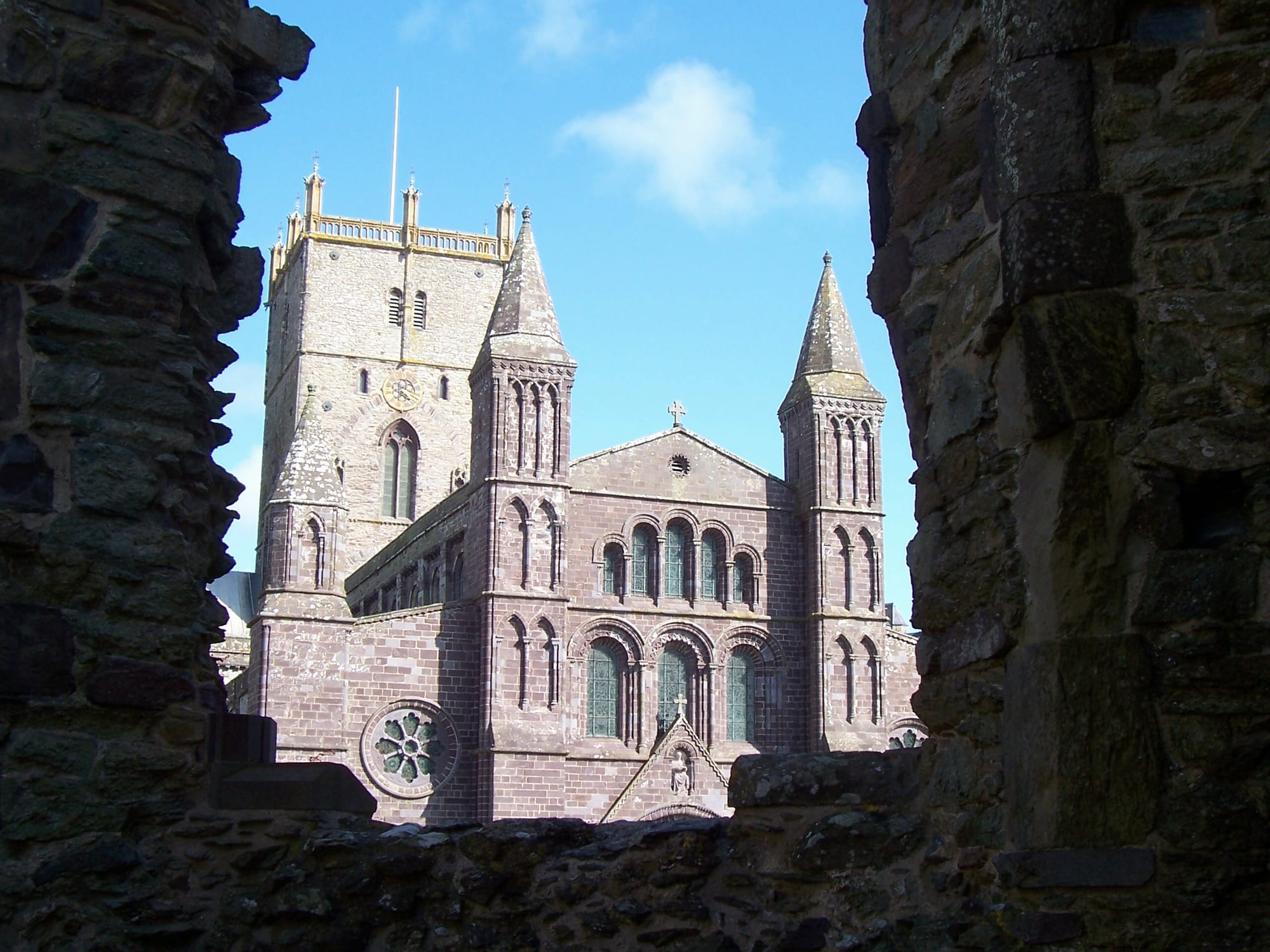
A purple-grey stone cathedral with a square tower and pointed corner turrets, framed by ruined stone walls under a blue sky

Wales, United Kingdom

St Davids

St Davids Cathedral, the resting place of Saint David. (PJMarriott / Wikimedia Commons · CC BY 3.0)

The United Kingdom's smallest city by population, near the western tip of Pembrokeshire. It grew around the monastery Saint David founded in the 6th century, became a famous centre of medieval pilgrimage, declined after the Reformation and is now a village-sized cathedral city on the coast path, with its cathedral and ruined Bishop's Palace beside the River Alun.

Neighbourhoods

  • Cross Square and the High Street
    • First-time visitors
    • Best for food

    The small centre around the old cross in Cross Square and along the High Street, with shops, galleries, cafés and pubs.

    Open in Maps
  • The Cathedral Close
    • Historic district
    • Quiet

    The area around the cathedral and the ruined Bishop's Palace, which stand on either side of the small River Alun. For 50 years after 1920 it was a civil parish of its own.

    Open in Maps
  • Whitesands and the western coast
    • Beaches
    • Walks

    The coast west and north of the city, with the surfing beach of Whitesands Bay, the headland of St Davids Head and the lifeboat station at St Justinian looking across Ramsey Sound.

    Open in Maps

Things to do

Cathedral and city

  • St Davids Cathedrallandmark

    The cathedral on the site of Saint David's monastery, rebuilt in the Norman era with sections dating back to the 12th century, and the resting place of the patron saint of Wales.

    Open in Maps
  • St Davids Bishop's Palacelandmark

    The ruins of the medieval palace of the bishops beside the cathedral, neglected after its roof lead was sold in 1536 and now cared for by Cadw.

    Open in Maps
  • Chapel of St Nonlandmark

    The ruined chapel on the cliffs south of the city, where Saint David is said to have been born to Saint Non around AD 500.

    Open in Maps

Beaches and walks

  • Whitesands Baybeach

    A large sandy beach about two miles west of the city, popular for water sports, with views of Ramsey Island and a lifeguarded area for swimmers and surfers.

    Open in Maps
  • St Davids Headviewpoint

    The headland north of Whitesands Bay, reached on foot along the coast path.

    Open in Maps

Islands, harbours and the sea

  • Ramsey Islandpark

    The largest island off the coast and the only inhabited one, an RSPB reserve circled by boat trips to watch seals, dolphins and seabirds.

    Open in Maps
  • St Davids Lifeboat Stationattraction

    The lifeboat station at St Justinian, built on stilts above the water, with displays on rescues among the fast tides of Ramsey Sound.

    Open in Maps
  • Porthclaisattraction

    The small harbour south of the city where, by tradition, Saint David was baptised by Saint Elvis.

    Open in Maps
  • Pembrokeshire Coast Pathtrail

    The national trail that circles the peninsula around St Davids, linking St Non's, Porthclais, St Justinian, Whitesands and St Davids Head.

    Open in Maps

Seasonal events

  • St David's Day1 March

    The feast of Wales's patron saint, marked across Wales with daffodils, leeks and school celebrations, and with particular meaning in the city where he is buried.

  • Organ festivalend of May

    An annual festival of organ music at the cathedral.

Eat and drink

Long-standing places and food districts in St Davids. Hours, ratings and directions come from your maps app, always current.

Food in the city

  • Cross Square and the High Streetneighborhood

    The city's cafés, pubs and restaurants are around Cross Square and along the High Street.

    Open in Maps
  • Whitesands Bay cafécafe

    A small shop and café in the beach car park at Whitesands Bay.

    Open in Maps

Experience St Davids

History

Long before the cathedral, the far western tip of Wales was a holy place. After the Romans left, the area was known in Latin as Menevia and in Welsh as Mynyw, and some medieval texts say Saint Patrick founded a church here around 470. Saint David is said to have been born to Saint Non around 500, where the Chapel of St Non now stands, and to have been baptised at Porthclais. He founded a church and monastery at Glyn Rhosyn on the banks of the River Alun, where the cathedral stands today.

The monastery, known as Tyddewi, "House of David", became a famous centre of pilgrimage and a religious and intellectual centre, and suffered numerous Viking attacks by the ninth century. As the Normans advanced into Pembrokeshire it became a marcher borough, the present cathedral was begun in 1181, and St Davids was given city status in the same century. Pope Calixtus II decreed that two pilgrimages to St Davids equalled one to Rome, and William the Conqueror, Henry II and Edward I with Queen Eleanor all came.

The Reformation ended the pilgrim trade. In 1536 Bishop William Barlow sold the lead from the Bishop's Palace roof, and in 1542 he moved the bishop's residence to Abergwili; the city declined, and by the 19th century only the cathedral kept its former glory. City status was lost in 1886 and restored in 1994 at the request of Elizabeth II, who presented the letters patent in the cathedral on 1 June 1995. Better transport and tourism brought new prosperity in the later 20th century.

Culture & Customs

Everything in St Davids returns to its saint. Saint David is the patron saint of Wales, and his day, 1 March, is marked across the country with daffodils and leeks; here, at his resting place, it carries particular weight. The cathedral remains a working church and a place of modern pilgrimage, and in summer it fills with visitors as well as worshippers. Each year it hosts an organ festival at the end of May.

The city's 210 listed buildings, from the cross in Cross Square to the cathedral close, make it a destination for walkers, tourists and pilgrims alike, and many of the ancient buildings, including the Bishop's Palace, are maintained by Cadw and open to the public.

The sea shapes local life as much as the church. The lifeboat station at St Justinian, built on stilts above the water, tells the story of rescues among the rocks and fast tides of Ramsey Sound, where the lifeboat was once a large wooden rowing boat. Rugby is followed closely, with St Davids RFC playing in the Welsh Rugby Union League West.

Daily Life

About 1,750 people lived in the community of St Davids and the Cathedral Close at the 2021 census, making it the smallest city in the United Kingdom by population. The community was formed in 1987 by merging the city parish with the Cathedral Close, which had been run as a separate civil parish for 50 years after the disestablishment of the Church in Wales in 1920.

Tourism has brought the city new prosperity since the later 20th century, from guest houses, cafés and art galleries to boat trips around Ramsey Island and water sports at Whitesands Bay. The city council is based at St Davids City Hall on the High Street, completed in 1924, and the city is served by the Haverfordwest-based Western Telegraph newspaper.

The seasons set the pace. In high summer the streets, car parks and Whitesands Bay are crowded, and the coastal buses and boat trips run full; in winter the city is quiet.

Food

St Davids eats much as the rest of Wales does. Cawl, recognised as a national dish of Wales, is a broth of lamb or beef with leeks, potatoes and root vegetables; Welsh rarebit is a hot cheese sauce, often with ale or mustard, on toast; and laverbread, or bara lawr, is made from laver, an edible seaweed, and traditionally eaten fried with bacon and cockles as part of a Welsh breakfast.

Two teatime classics turn up in Welsh cafés. Welsh cakes, or picau ar y maen, are small spiced fruit cakes cooked on a bakestone or griddle, and bara brith is a fruit loaf made with tea-soaked dried fruit. Welsh beef is registered as a Protected Geographical Indication. On St David's Day, eating cawl and Welsh cakes is part of the traditional festivities.

The cafés, pubs and restaurants are grouped around Cross Square and along the High Street, and there is a small shop and café at the Whitesands Bay car park for beach days.

Planning tools

Budget

St Davids is a small place with limited rooms, and prices rise in the summer holidays, when the city and beaches are at their busiest. All car parks charge, including the large one at Whitesands. Walking the coast path and visiting the cathedral cost little; boat trips to Ramsey Island are the main extra.

Daily Budget Midrange
USD 160–300 (B&B or guest house, restaurant dinners, Bishop's Palace ticket, a boat trip, a hire car)
Daily Budget Shoestring
USD 65–110 (hostel or campsite, café and pub meals, coastal buses)

Book rooms early for July and August, and boat trips around Ramsey Island well before a summer visit.

Best Time to Visit

May to September for the coast path, the beaches and the boat trips to Ramsey Island, with May often the sunniest month in Wales and July and August the busiest. The cathedral's organ festival comes at the end of May. Winter is quiet, windy and wet, with fewer visitors in the city and on the coast path.

Suggested Number of Days

The city and cathedral need a day; a second allows for the beaches and a stretch of the coast path. Three to five days make it a base for the far west of Pembrokeshire, with boat trips and walks that depend on the weather and the sea.

First Visit
1–2 days
With Surroundings
3–5 days

Transportation

The city is walkable end to end, and cycling is a good way to reach the coast. The A487 between Fishguard and Haverfordwest passes through the city, making a sharp turn here, and seasonal coastal bus services run along the peninsula. In summer, Whitesands car park overflows into neighbouring fields.

Most built-up roads in Wales have a 20 mph limit; country lanes to the coast are narrow, so the coastal buses are often easier in summer.

Airport & Station Connections

St Davids is near the end of the road in west Pembrokeshire, and most visitors arrive by car on the A487 from Haverfordwest or Fishguard. The best rail route is to Haverfordwest station and then the T11 bus to the city; National Express coaches also connect at Haverfordwest. Fishguard, to the north-east, has a few trains and ferries from Rosslare in Ireland, with a less frequent bus to St Davids.

Walkability

Very good within the city: Cross Square, the High Street and the cathedral are a few minutes apart, and the Bishop's Palace lies across a small river from the cathedral. Paths run out to St Non's, Porthclais and the coast path; Whitesands Bay is about two miles away.

Safety

The UK is generally safe, with the main risks being pickpocketing and phone theft in crowded parts of London and other cities, occasional late-night antisocial behaviour, and drink-related trouble around nightlife. St Davids is a very quiet place; the real dangers are the coast's cliff edges and strong tides, among the fastest in UK waters in Ramsey Sound.

Keep to the coast path away from cliff edges, swim in the lifeguarded areas at Whitesands, and take a waterproof coat on fast boat trips. Check current official travel advice before travelling.

Climate

A mild, windy maritime climate. The south-western coast is the sunniest part of Wales, averaging over 1,700 hours of sunshine a year; coastal areas are the windiest, with gales most often in winter.

Summer
warm and often sunny at low elevations in Wales, with average maximum temperatures of about 19–22°C
Winter
fairly wet across Wales, with temperatures at low levels usually staying above freezing (0°C)

Local Customs

The city's Welsh name is Tyddewi, 'David's house'. The cathedral is a working church and a place of modern pilgrimage, and at the 2021 census about 17 per cent of people in Pembrokeshire spoke Welsh. Tipping is not a strong custom in Britain; something extra for good service is welcome but not expected.

The cathedral is a working church — visit quietly, and avoid photographing during worship.

Common Payment Methods

The currency is the pound sterling. Many shops accept foreign credit and debit cards, and cash machines are very widely available in Britain; some businesses no longer accept cash, and the lifeboat station welcomes a donation from visitors.