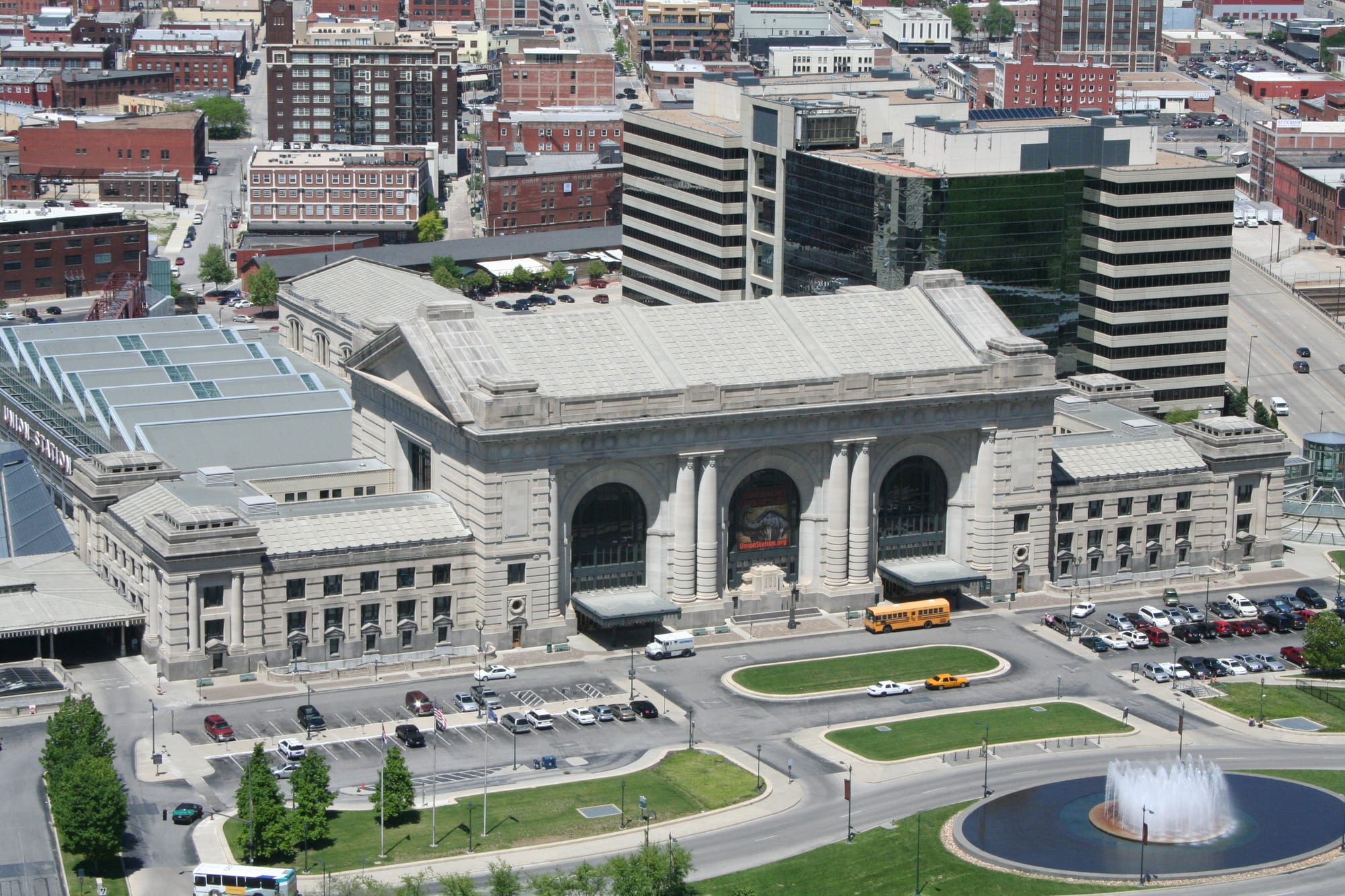
The pale stone Beaux-Arts front of Kansas City Union Station with a fountain in the foreground and brick and glass buildings behind

The Great Plains, United States

Kansas City

Kansas City Union Station, opened in 1914, seen from the National World War I Museum and Memorial. (Dual Freq / Wikimedia Commons · CC BY 3.0)

Missouri's largest city, where the Kansas River meets the Missouri on the state line with Kansas — a river landing on the trails west that grew into a railway, stockyard and jazz city. It is known for its barbecue, the 18th and Vine jazz district, more than 200 fountains, wide boulevards and devoted football and baseball fans.

Neighbourhoods

  • Downtown and the Power & Light District
    • First-time visitors
    • Nightlife
    • Close to public transport

    The business district inside the freeway loop, where the nine-block Power & Light District of restaurants, bars and shops sits beside the arena. Old office towers have been turned into flats and hotels, and the free streetcar runs along Main Street.

    Open in Maps
  • Crossroads
    • Galleries
    • Breweries
    • Best for food

    The city's main art gallery district, just south of the downtown loop, with historic warehouses, a cluster of craft breweries known as Brewer's Alley, and many of the city's award-winning restaurants.

    Open in Maps
  • River Market
    • Markets
    • Historic district
    • Close to public transport

    The oldest district of the city, between the downtown loop and the Missouri River, on the site of Westport Landing, with the City Market's stalls, restaurants and loft flats on the streetcar line.

    Open in Maps
  • 18th and Vine
    • Jazz
    • Museums
    • African American history

    The historic hub of Black Kansas City and one of the birthplaces of jazz, a national historic district east of downtown with the Negro Leagues Baseball Museum, the American Jazz Museum and live music.

    Open in Maps
  • Crown Center and Union Station
    • Families
    • Museums
    • Close to public transport

    Hallmark Cards' headquarters and shopping complex, linked by covered walkways to Union Station, with the World War I museum on the hill above.

    Open in Maps
  • Westport
    • Nightlife
    • Live music

    A historic town, older than Kansas City, absorbed in 1897, which was a supply point for the trails west and is now a main entertainment district.

    Open in Maps
  • Country Club Plaza
    • Shopping
    • Fountains
    • Walks

    A 14-block shopping district opened in 1923, built in a style echoing Seville, with towers, fountains and statues; the Nelson-Atkins museum and the boulevards of the Country Club District are close by.

    Open in Maps

Things to do

Famous landmarks

  • Kansas City Union Stationlandmark

    The great railway station of 1914, restored in the late 1990s, which now holds Science City, restaurants, theatres and the city's Amtrak station.

    Open in Maps
  • National World War I Museum and Memorialmuseum

    Opened in 1926 as the Liberty Memorial, with a tower overlooking Union Station, and since 2004 the country's official museum of the First World War.

    Open in Maps
  • Country Club Plazalandmark

    Considered the first planned large outdoor suburban shopping centre in the United States, with 40 statues, fountains and sculptures and 12 towers.

    Open in Maps

Museums

  • Nelson-Atkins Museum of Artmuseum

    A free encyclopedic art museum known especially for its Asian art, with the Bloch Building addition of 2007.

    Open in Maps
  • Negro Leagues Baseball Museummuseum

    Founded in 1990 in the 18th and Vine district, telling the story of Negro league baseball in America.

    Open in Maps
  • American Jazz Museummuseum

    The history of jazz, and Kansas City jazz in particular, with exhibits on Charlie Parker, Duke Ellington, Ella Fitzgerald and others.

    Open in Maps
  • Kemper Museum of Contemporary Artmuseum

    Missouri's first and largest contemporary art museum, opened in 1994.

    Open in Maps

Parks and boulevards

  • Swope Parkpark

    The city's largest park, more than twice the size of Central Park, with the zoo and aquarium, the Starlight Theatre and a nature centre.

    Open in Maps
  • Loose Parkpark

    A park near the Plaza with a lake, Civil War markers and a rose garden.

    Open in Maps

Markets

  • City Marketmarket

    The farmers' market at the heart of the River Market district, held since 1857.

    Open in Maps

Music, sport and nights out

  • Kauffman Center for the Performing Artsattraction

    Moshe Safdie's downtown performing arts centre, opened in 2011, home to the Kansas City Symphony, the Kansas City Ballet and the Lyric Opera.

    Open in Maps
  • Arrowhead Stadiumattraction

    The Kansas City Chiefs' stadium, opened in 1972, which hosted several matches of the 2026 FIFA World Cup.

    Open in Maps
  • Kauffman Stadiumattraction

    The Royals' modernist ballpark beside Arrowhead, whose fountains are the largest privately funded fountains in the world.

    Open in Maps

Short trips from the city

  • Harry S. Truman Presidential Library and Museummuseum

    The presidential library and resting place of Harry S. Truman, the first created under the Presidential Libraries Act.

    Open in Maps

Seasonal events

  • Heart of America Shakespeare Festivalmid-June to early July

    Outdoor Shakespeare in Southmoreland Park near the Nelson-Atkins museum, held since 1993.

  • Kansas City Irish FestLabor Day weekend, late August or early September

    Irish music, dance and culture on eight stages at Crown Center, founded in 2003.

  • American RoyalSeptember to November

    A livestock show, horse show, rodeo and what it claims is the world's biggest barbecue contest.

Eat and drink

Long-standing places and food districts in Kansas City. Hours, ratings and directions come from your maps app, always current.

Kansas City barbecue

  • Arthur Bryant'srestaurant

    Sometimes called the most famous barbecue restaurant in the country, successor to Henry Perry's pit and credited with originating burnt ends.

    Open in Maps
  • Gates Bar-B-Qrestaurant

    Opened in 1946 by George W. Gates, one of Henry Perry's cooks; with Bryant's, one of the two definitive Kansas City barbecue restaurants.

    Open in Maps
  • Burnt endsrestaurant

    Charred pieces from the point of a smoked brisket, usually chopped and served with sauce; their origin is credited to Arthur Bryant's.

    Open in Maps

Food districts and markets

  • City Marketmarket

    Market stalls and restaurants in the River Market district.

    Open in Maps
  • Crossroadsneighborhood

    Many of the city's award-winning restaurants, and the breweries of Brewer's Alley.

    Open in Maps
  • Westportneighborhood

    Bars, restaurants and live music in the historic entertainment district.

    Open in Maps

Experience Kansas City

History

In 1821 the French Chouteau fur-trading family of St. Louis set up a trading post, Chouteau's Landing, at the meeting of the Kansas and Missouri rivers. In the 1830s John Calvin McCoy, son of the missionary Isaac McCoy, founded Westport a few miles inland and Westport Landing on the Missouri, and the area became an outfitting point for traders on the Santa Fe Trail and for emigrants and gold seekers heading west. The landing was incorporated as the town of Kansas, named after the nearby Native people, in 1850, became the City of Kansas in 1853 and took the name Kansas City in 1889. The Battle of Westport in 1864 effectively ended Confederate efforts to regain Missouri.

Railways and the stockyards, second only to Chicago's in size, made the city a centre of transport, cattle and meatpacking. The landscape architect George Kessler gave it a network of boulevards and parks in the City Beautiful style, Union Station opened in 1914 and the Liberty Memorial in 1926, and J. C. Nichols opened the Country Club Plaza in 1923. Tom Pendergast's political machine dominated the city by 1925 and fell only in 1939, when he pleaded guilty to tax evasion.

The stockyards never recovered from the Great Flood of 1951 and eventually closed. On 17 July 1981 the collapse of hotel walkways at Crown Center killed 114 people. Since the 2000s the Power & Light District, a downtown arena, the Kauffman Center and the streetcar have revived the centre, a new airport terminal opened in 2023, and the city was one of the host cities of the 2026 FIFA World Cup.

Culture & Customs

Kansas City jazz of the 1930s, centred on the 18th and Vine district, marked the transition from the big bands to the bebop of the 1940s; Count Basie and Charlie Parker are among the names linked with it. The district, a centre of Black business and culture in the first half of the 20th century, now holds the American Jazz Museum and the Negro Leagues Baseball Museum, and live music is also concentrated in Westport. The Kansas City Symphony, Ballet and Lyric Opera perform at the Kauffman Center.

The city calls itself the City of Fountains, with more than 200 working fountains, and it has more boulevards than any city except Paris, earning the name Paris of the Plains. Walt Disney lived here after returning from the First World War, and Hallmark Cards has its headquarters at Crown Center.

Sport is central to local identity. The Chiefs won Super Bowls in 2020, 2023 and 2024; the Royals won the World Series in 1985 and 2015; and the Kansas City Current play in a riverfront stadium built for the team, opened in 2024. The American Royal's barbecue contest and the city's many barbecue restaurants make food a shared passion, and the Irish community's festival at Crown Center draws large crowds over Labor Day weekend.

Daily Life

Kansas City had about 508,000 residents at the 2020 census, making it the largest city in Missouri, and its metropolitan area, which straddles the state line, has about 2.25 million. The city covers about 319 square miles across four counties, so much of it is suburban, while Kansas City, Kansas, is a separate city across the state line.

Major employers and institutions include Hallmark Cards, the Federal Reserve Bank of Kansas City, which opened a new building near Union Station in 2008, and one of the largest drug manufacturing plants in the country, in the south of the city. Downtown has filled with flats in converted office buildings and new apartment towers. Homelessness, put at about 3,000 people in 2022, is a recognised problem.

The Hispanic population, largely Mexican and Central American, is spread across the metropolitan area, with concentrations in the north-east and south-west of downtown, and Southeast Asian residents live around Columbus Park, a historically Italian neighbourhood. Life follows the seasons and the sporting calendar, from baseball in summer to the Chiefs in autumn and winter.

Food

Kansas City is one of the world's barbecue capitals, with more than 90 barbecue restaurants in the metropolitan area. The local style grew from the pit of Henry Perry, a migrant from Memphis credited with opening the city's first barbecue stand in 1921; the style blossomed in the 18th and Vine area. Arthur Bryant took over Perry's business and sweetened the sauce; Bryant's and Gates are the two definitive Kansas City barbecue restaurants, and Fiorella's Jack Stack is also well regarded.

The style uses a range of slow-smoked meats under a thick, sweet tomato-based sauce, with molasses popularised as a sweetener. Burnt ends, the charred pieces from the point of a smoked brisket, are credited to Arthur Bryant's and were made famous by the essayist Calvin Trillin. The American Royal hosts what it claims is the world's biggest barbecue contest each autumn.

Steak is the other tradition: in the days of the stockyards the city gave its name to the Kansas City strip steak. Most of the city's award-winning restaurants are in the Crossroads, downtown and Westport, and the Crossroads has a cluster of craft breweries.

Planning tools

Budget

Kansas City is one of the cheaper big cities in the United States, and a barbecue lunch remains one of its best-value meals. The Nelson-Atkins museum is free, the streetcar costs nothing to ride, and the fountains, boulevards and parks are free to enjoy. Hotel prices rise for big events.

Daily Budget Midrange
USD 180–330 (downtown or Plaza hotel, sit-down dinners with tax and tip, museum tickets, ride-hailing)
Daily Budget Shoestring
USD 80–140 (budget motel or hostel bed, barbecue and market lunches, buses and the free streetcar)

Stay near the streetcar line between the River Market and Union Station to see much of the centre without a car.

Best Time to Visit

April to June and September to October are the most pleasant months, the fountains are running and the patios are open. Summers are hot and humid, with highs above 90°F on about 47 days a year. Spring brings severe storms and the risk of tornadoes. Winters are cold with modest snow, and the Chiefs' season fills the autumn and winter weekends.

Suggested Number of Days

Two or three days are enough for a first visit to the city. Add a day for Independence and the Kansas side of the metropolitan area. The sights are spread over a large area, so a visit without a car takes a little longer.

First Visit
2–3 days
With Surroundings
3–4 days

Transportation

RideKC runs the buses, the MAX bus rapid transit lines and the free streetcar, which opened in 2016 between the River Market and Union Station and was extended to Berkley Riverfront Park in May 2026. The MAX links the River Market, downtown, Union Station, Crown Center and the Plaza. Beyond these corridors the city is spread out, and most people drive.

Kansas City, Missouri and Kansas City, Kansas are separate cities in different states; check which one an address is in.

Airport & Station Connections

Kansas City International Airport, known locally as KCI, is about 15 miles north-west of downtown; its new single terminal opened in February 2023. Amtrak's Southwest Chief, between Chicago and Los Angeles, and the Missouri River Runner to St. Louis stop at Union Station.

Walkability

The streetcar corridor from the River Market through downtown and the Crossroads to Union Station and Crown Center is easy on foot, and the Plaza, Westport and the Nelson-Atkins are walkable once there. The distances between districts are long, and summer heat makes long walks tiring.

Safety

For most visitors the US is safe, with the main risks being petty theft and car break-ins in tourist areas of some cities, road accidents over long distances, extreme weather, and the hazards of the outdoors. Violent crime is high in parts of Kansas City, mostly away from the main visitor districts. The city lies in Tornado Alley, and spring storms can be severe.

Leave nothing visible in parked cars, use ride-hailing between districts late at night, and follow tornado warnings in spring. Check current official travel advice before travelling.

Climate

On the border between humid continental and humid subtropical. Summers are hot and humid, with moist air from the Gulf of Mexico; winters are cold, with modest snowfall, and freezing nights are likely from late October to early April.

Summer
hot and humid — July averages about 81°F, with highs above 90°F on about 47 days and above 100°F on five or six
Winter
cold — January averages about 31°F, and about 22 days a year stay at or below freezing

Local Customs

Tipping of roughly 18–22 per cent is expected in restaurants. Sales tax is added at the till. Barbecue is a point of local pride, and the Chiefs are followed with devotion.

Identification is asked for when buying alcohol (the legal age is 21).

Common Payment Methods

The currency is the US dollar. Cards and contactless payment are accepted almost everywhere, and some venues no longer take cash. A little cash is useful at market stalls and older barbecue counters.