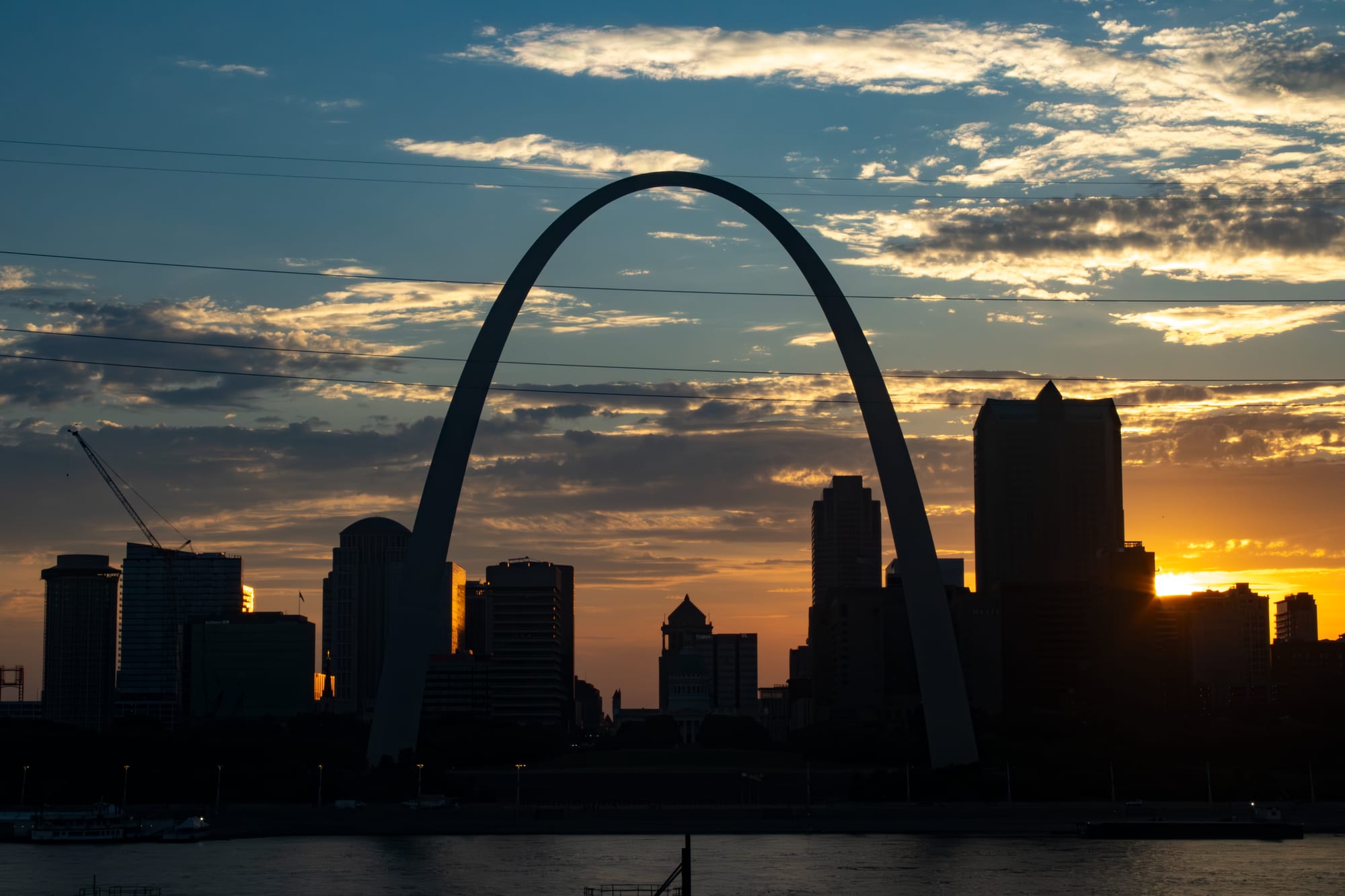
The Gateway Arch and downtown St. Louis towers in silhouette against the sky above the Mississippi River

The Great Plains, United States

St. Louis

The Gateway Arch and the St. Louis skyline, seen across the Mississippi from the Illinois bank. (Panini! / Wikimedia Commons · CC0)

A Mississippi River city near the meeting of the Mississippi and the Missouri, founded by French fur traders in 1764 and for half a century the fourth-largest city in the country. The Gateway Arch marks its riverfront, Forest Park holds free museums and a zoo, and the city is known for blues, baseball, brewing and its own distinctive foods.

Neighbourhoods

  • Downtown and Laclede's Landing
    • First-time visitors
    • Sport
    • Riverfront

    The riverfront centre around the Gateway Arch, the Old Courthouse and the baseball stadium. Just north of the Arch, Laclede's Landing keeps cobblestone streets and brick and cast-iron warehouses of 1850–1900, now shops, restaurants and bars, in the northern part of the original French settlement.

    Open in Maps
  • Central West End
    • Best for food
    • Close to Forest Park
    • Architecture

    A district of grand houses, restaurants and cafés on the eastern edge of Forest Park, home to the Cathedral Basilica with its mosaics and to the Cortex innovation district.

    Open in Maps
  • Soulard
    • Bars
    • Markets
    • Historic district

    A historic district of red-brick houses south of downtown, home of the Soulard Farmers Market, many bars and restaurants and the city's Mardi Gras.

    Open in Maps
  • The Hill
    • Best for food
    • Local life

    One of the largest Little Italy neighbourhoods in the country, on high ground south of Forest Park, settled by northern Italian immigrants who formed its majority in the early 20th century, with Italian restaurants.

    Open in Maps
  • Lafayette Square
    • Historic homes
    • Quiet and residential

    Restored Victorian and Second Empire houses around Lafayette Park, the city's oldest public park, created in 1836; the area declined after the 1896 tornado and has been renovated since the 1970s.

    Open in Maps
  • Grand Center
    • Theatre
    • Music
    • Arts

    The arts district north of Saint Louis University, with the Fox Theatre, Powell Symphony Hall, the Contemporary Art Museum and the Pulitzer Arts Foundation.

    Open in Maps
  • Delmar Loop
    • Nightlife
    • Students
    • Shopping

    An entertainment and restaurant strip mostly in University City, at the city's western edge near Washington University, named one of the 10 Great Streets in America in 2007.

    Open in Maps

Things to do

Famous landmarks

  • Gateway Archlandmark

    Eero Saarinen's 630-foot stainless-steel arch on the site of the city's 1764 founding, completed in 1965 as a monument to westward expansion, the world's tallest arch.

    Open in Maps
  • Old Courthousemuseum

    The domed courthouse where the Dred Scott case began, now part of Gateway Arch National Park with historical exhibits.

    Open in Maps
  • Cathedral Basilica of Saint Louislandmark

    The Catholic cathedral in the Central West End, completed in 1914, with the second-largest collection of mosaics in the world.

    Open in Maps
  • St. Louis Union Stationlandmark

    The great railway station of 1894, once the largest in the world, which lost its last passenger train in 1978 and is now an entertainment and shopping complex.

    Open in Maps
  • Anheuser-Busch Brewerylandmark

    A brewery complex of red-brick Romanesque buildings south of downtown, a National Historic Landmark since 1966, where visitors can see the Budweiser Clydesdale horses.

    Open in Maps

Forest Park and its free museums

  • Forest Parkpark

    A 1,300-acre park opened in 1876 on the city's western edge, which hosted the 1904 World's Fair and Olympics and now holds the city's main museums and the zoo.

    Open in Maps
  • Saint Louis Art Museummuseum

    A free art museum with collections from around the world in a building on the hill of Forest Park.

    Open in Maps
  • Saint Louis Zoopark

    A free zoo in Forest Park, established in 1910 around a flight cage bought after the World's Fair.

    Open in Maps
  • Missouri History Museummuseum

    Free exhibitions on the history of Missouri and St. Louis, run by the Missouri Historical Society, founded in 1866.

    Open in Maps

Gardens and other museums

  • Missouri Botanical Gardenpark

    Henry Shaw's garden, known locally as Shaw's Garden, with one of the largest herbaria in North America.

    Open in Maps
  • Tower Grove Parkpark

    A long Victorian park on the south side, given to the city by Henry Shaw in 1868.

    Open in Maps
  • City Museummuseum

    A climbable fantasy of reused architectural and industrial salvage in a former shoe factory downtown, opened in 1997.

    Open in Maps

Markets

  • Soulard Farmers Marketmarket

    The oldest operating public market in the city, and reputedly the oldest west of the Mississippi.

    Open in Maps

Music, sport and nights out

  • Fox Theatreattraction

    A 1929 movie palace in Grand Center, restored in 1982 and now a performing arts centre.

    Open in Maps
  • Busch Stadiumattraction

    The downtown ballpark of the St. Louis Cardinals, opened in 2006.

    Open in Maps

Short trips from the city

  • Cahokia Moundslandmark

    The site of the largest city of the Mississippian culture, about 1050–1350 AD, with the largest pre-Columbian earthworks north of Mexico; a UNESCO World Heritage Site.

    Open in Maps
  • Grant's Farmattraction

    A farm built by Ulysses S. Grant and later home to the Busch family, where some of the Clydesdales and other animals are kept.

    Open in Maps

Seasonal events

  • Soulard Mardi Graslate winter, before Lent

    The city's French-heritage carnival, centred on the bars and streets of Soulard.

  • Fair Saint LouisIndependence Day, early July

    A festival at Gateway Arch National Park over the Fourth of July holiday.

Eat and drink

Long-standing places and food districts in St. Louis. Hours, ratings and directions come from your maps app, always current.

St. Louis classics

  • Toasted raviolirestaurant

    Breaded, deep-fried ravioli served as a starter with a dipping sauce, created and popularised in St. Louis.

    Open in Maps
  • Gooey butter cakerestaurant

    A flat, dense St. Louis cake with a rich egg-and-butter topping dusted with sugar, sold by local bakeries.

    Open in Maps
  • Ted Drewesrestaurant

    A frozen custard stand famous for its 'concrete', custard blended with other ingredients so thick that the spoon stays put when the cup is turned upside down.

    Open in Maps

Food districts and markets

  • The Hillneighborhood

    Italian restaurants in the city's Little Italy.

    Open in Maps
  • Soulard Farmers Marketmarket

    Produce, fish, cheese and other stalls in the city's oldest public market.

    Open in Maps
  • Bevo Millneighborhood

    The south-side neighbourhood with the highest concentration of the city's Bosnian community and its businesses.

    Open in Maps

Experience St. Louis

History

The land around the meeting of the Mississippi and Missouri rivers was home to Native American cultures for thousands of years; across the river, Cahokia was the largest city of the Mississippian culture around 1050–1350. In February 1764, after France had lost the Seven Years' War, the merchant Pierre Laclède sent his 14-year-old stepson Auguste Chouteau with about 30 settlers to clear the site for a fur-trading post, named after King Louis IX of France. Spanish, then briefly French, then from 1804 American, it became the gateway to the West, and the Old Courthouse later saw the first trials of the Dred Scott case.

Steamboats and railways made it a great port and industrial city — from 1870 until 1920 it was the fourth-largest city in the United States. German immigrants built breweries, including Anheuser-Busch, and companies such as Ralston Purina were founded here. The city separated from St. Louis County in 1877, fixing its boundaries. A tornado in 1896 killed at least 255 people, and in 1904 the city hosted the World's Fair and the first Olympic Games held outside Europe, leaving its mark on Forest Park.

In the 20th century people and industry moved to the suburbs, and the Pruitt–Igoe housing project, demolished less than two decades after it was built, became a symbol of failed public housing. The Gateway Arch was completed in 1965. Bosnian refugees arrived in large numbers from the 1990s, the Cortex innovation district has grown since 2002, and on 16 May 2025 an EF3 tornado up to 1.8 miles wide, the largest recorded in the region, struck parts of the city, causing damage the mayor put at up to $1.6 billion.

Culture & Customs

St. Louis is identified with music and the performing arts, especially blues, jazz and ragtime. The St. Louis Symphony Orchestra plays at Powell Symphony Hall in Grand Center, and the restored Fox Theatre is a performing arts centre. The free art museum, zoo and history museum, paid for by a regional cultural tax, are a source of civic pride.

Sport is followed passionately. The Cardinals have won 11 World Series, more than any other National League team, most recently in 2011; the Blues won the Stanley Cup in 2019, making St. Louis one of only eight North American cities with titles in all four major leagues; and St. Louis City SC began playing Major League Soccer in 2023.

The city's French origins survive in its Mardi Gras and Bastille Day celebrations in Soulard, its German heritage in breweries and churches, and its Italian heritage on the Hill. The metropolitan area has an estimated 70,000 Bosnians, tied with Chicago for the largest Bosnian population in the United States, many living around Bevo Mill. The Cathedral Basilica in the Central West End houses the second-largest collection of mosaics in the world.

Daily Life

St. Louis had about 302,000 residents at the 2020 census, a fraction of its former size, while its metropolitan area, which extends into Illinois, has more than 2.8 million. Because the city has been separate from St. Louis County since 1877, most of the metropolitan population lives in suburbs outside its limits.

The economy rests on services, manufacturing, trade, transport and aviation. Anheuser-Busch, now owned by the Belgian-based InBev, Enterprise Holdings, Bunge Global, Wells Fargo Advisors, World Wide Technology and the grocery chain Schnuck Markets are among the large companies headquartered in the region, and Boeing's defence business continues the work of McDonnell Douglas. The Cortex district in the Central West End has drawn technology firms.

The city is sharply divided. The north side is overwhelmingly African American, while the south side has the Bosnian community of Bevo Mill and Hispanic residents around Cherokee Street; Italian Americans are concentrated on the Hill. Neighbourhoods in the central corridor, such as Forest Park Southeast, have seen major investment since the early 2010s.

Food

St. Louis has a list of foods found almost nowhere else. Toasted ravioli — breaded, deep-fried and served with a dipping sauce — was created here, and St. Louis-style pizza has a thin crust, Provel cheese and is cut into small squares. Gooey butter cake, a flat, dense cake with a rich topping, comes from the city's bakeries; the slinger and the Gerber sandwich are other local dishes, and grilled pork steaks are a regional favourite.

The Hill, one of the largest Little Italy neighbourhoods in the United States, is the place for Italian restaurants. The Soulard Farmers Market, the city's oldest public market, sells produce, fish and cheese, and Bevo Mill has many Bosnian-owned businesses. The Delmar Loop and the Central West End have many of the newer restaurants.

Frozen custard is the summer treat: Ted Drewes serves its 'concrete', custard blended with ingredients so thick that the spoon stays put when the cup is turned upside down. Beer is part of the city's identity, from the Anheuser-Busch brewery, with its historic buildings and Clydesdale horses, to newer craft breweries.

Planning tools

Budget

St. Louis is one of the cheaper large cities in the country. Many of its best sights cost nothing: the art museum, the zoo and the history museum in Forest Park are free through a public cultural tax, and the riverfront, Forest Park and Tower Grove Park cost nothing to walk. Hotel prices rise for big events.

Daily Budget Midrange
USD 180–330 (downtown or Central West End hotel, sit-down dinners with tax and tip, attraction tickets, ride-hailing)
Daily Budget Shoestring
USD 80–140 (budget motel or hostel bed, toasted ravioli and market lunches, MetroLink)

Spend a day in Forest Park, where the main museums and the zoo are free; MetroLink links the airport with downtown and the Central West End.

Best Time to Visit

April to June and September to October are the most comfortable months. Summers are hot and humid, though baseball season and the Fourth of July festival draw crowds. Spring brings severe thunderstorms and the risk of tornadoes. Winters are chilly to cold but quiet.

Suggested Number of Days

Two or three days are enough for a first visit to the city. Allow about four to include the Illinois side of the river and the wider county. Summer heat and spread-out districts can make a stay feel shorter.

First Visit
2–3 days
With Surroundings
4 days

Transportation

MetroLink light rail has two lines, running from the airport through the Central West End and Union Station to downtown and across the Mississippi into Illinois. Buses cover the rest of the city. Most residents drive, and a car or ride-hailing is useful for the south side, the Hill and the county.

MetroLink stations near Forest Park, the Central West End and downtown make a car unnecessary for the main sights.

Airport & Station Connections

St. Louis Lambert International Airport, the largest in Missouri, is about 14 miles north-west of downtown and is linked to the city by MetroLink. Amtrak and Greyhound use the Gateway Transportation Center near Union Station.

Walkability

Downtown, the riverfront and Laclede's Landing are walkable, as are the Central West End, Soulard and the paths of Forest Park, but the distances between districts are long and many streets are built for cars. Summer heat makes long walks tiring.

Safety

For most visitors the US is safe, with the main risks being petty theft and car break-ins in tourist areas of some cities, road accidents over long distances, extreme weather, and the hazards of the outdoors. Violent crime rates in St. Louis are high relative to other American cities; the riverfront, Forest Park, the Central West End and Soulard are busy visitor areas. St. Louis is one of the most frequently tornado-struck metropolitan areas in the country.

Leave nothing visible in parked cars, use ride-hailing between districts at night, and follow tornado warnings in spring. Check current official travel advice before travelling.

Climate

A humid subtropical climate on the edge of humid continental, open to both Arctic cold and humid Gulf air. Spring storms can be severe, with high winds, large hail and tornadoes.

Summer
hot and humid — temperatures reach 100°F on about three days a year
Winter
chilly to cold — the temperature falls to 0°F on about one day a year

Local Customs

Tipping is expected: roughly 18–22 per cent in restaurants. Sales tax is added at the till. The city is devoted to the Cardinals and proud of its local foods.

Identification is asked for when buying alcohol (the legal age is 21).

Common Payment Methods

The currency is the US dollar. Cards and contactless payment are accepted almost everywhere, and some venues no longer take cash. A little cash is useful at the Soulard market stalls and older custard stands.