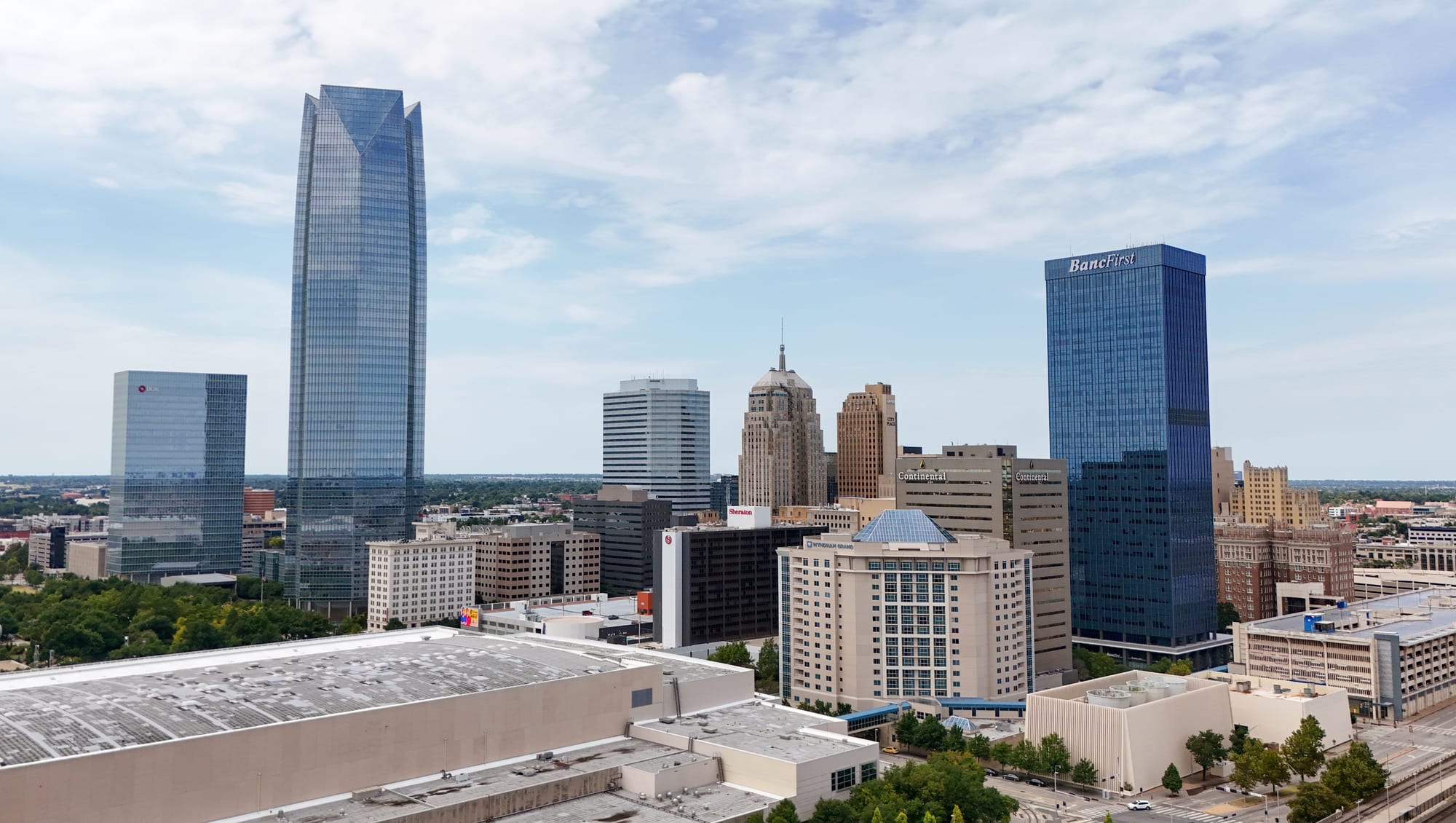
Downtown Oklahoma City towers under a cloudy blue sky, led by the tall glass Devon Energy Center on the left

The Great Plains, United States

Oklahoma City

The downtown Oklahoma City skyline, with the Devon Energy Center the tallest tower. (Quintin Soloviev / Wikimedia Commons · CC BY 4.0)

Oklahoma's capital and largest city, on the North Canadian River in the centre of the state, founded in a single day in the Land Run of 1889. Oil, cattle and the highways made it; a redevelopment programme since the 1990s has rebuilt its downtown, which also holds the national memorial to the 1995 bombing.

Neighbourhoods

  • Downtown
    • First-time visitors
    • Close to public transport

    The business district around the Devon Energy Center, with the National Memorial, and the Myriad Botanical Gardens and Scissortail Park to the south. Once left almost empty, it has filled with new housing, offices and parks since the 1990s, and the streetcar loops through it.

    Open in Maps
  • Bricktown
    • Nightlife
    • Sport
    • Best for food

    A former warehouse district just east of downtown, rebuilt as an entertainment quarter around a canal with water taxis. Red-brick buildings hold restaurants, bars, a cinema and the banjo museum, and the baseball park stands at its edge.

    Open in Maps
  • Midtown and Automobile Alley
    • Best for food
    • Bars
    • Historic district

    Automobile Alley, along North Broadway, keeps the low and mid-rise buildings of the city's old car dealerships, now home to many of its best bars, restaurants and shops. Neighbouring Midtown, on the streetcar line, mixes restored streets, new housing and St. Anthony's, the state's oldest hospital.

    Open in Maps
  • Asia District
    • Best for food
    • Local life

    The centre of the state's Asian American community, stretching north along Classen Boulevard from the Gold Dome and the Milk Bottle Grocery. Restaurants, supermarkets and shops line the road.

    Open in Maps
  • Paseo Arts District
    • Arts and culture
    • Quiet and residential

    A district of Spanish-style stucco buildings, built in 1929 as the first shopping district north of downtown, now an artists' quarter of galleries, studios and small restaurants on the edge of older residential streets.

    Open in Maps
  • Stockyards City
    • Western heritage
    • Best for food

    The district built around the city's cattle market, one of the largest in the world, with the state's oldest restaurant. South of the river, the city is more working-class and industrial, and home to a large Latino community.

    Open in Maps

Things to do

Landmarks and memorials

  • Oklahoma City National Memorial and Museumlandmark

    The memorial on the site of the Alfred P. Murrah Federal Building, honouring the 168 people killed, the survivors and the rescuers of the 1995 bombing; the outdoor memorial was dedicated in 2000 and the museum opened in 2001.

    Open in Maps
  • Oklahoma State Capitollandmark

    The seat of state government, built in 1914–17 and given its dome only in 2002; its grounds are the only state capitol grounds in the country with active oil rigs.

    Open in Maps
  • Myriad Botanical Gardenspark

    A 15-acre downtown botanical garden around the Crystal Bridge Conservatory.

    Open in Maps
  • Scissortail Parkpark

    A large park opened in 2021 just south of the Myriad Gardens, with a lake with paddle boats, a concert lawn, the Skydance Bridge and a farmers' market in season.

    Open in Maps

Museums

  • National Cowboy & Western Heritage Museummuseum

    More than 28,000 works of Western and American Indian art and artefacts, with the world's largest collections of rodeo photographs, barbed wire and saddlery, and the Hall of Great Western Performers.

    Open in Maps
  • First Americans Museummuseum

    A museum opened in 2021 on the histories and cultures of the many tribal nations of Oklahoma.

    Open in Maps
  • Oklahoma City Museum of Artmuseum

    The downtown art museum, known for a large collection of Chihuly glass including a 55-foot glass tower in its atrium, with a cinema showing independent and classic films.

    Open in Maps
  • American Banjo Museummuseum

    A Bricktown museum tracing the banjo from its arrival in North America through the Atlantic slave trade to modern times.

    Open in Maps
  • Oklahoma History Centermuseum

    The state history museum, opened in 2005 across the street from the governor's mansion, covering Oklahoma from prehistory to the present.

    Open in Maps

Districts and outdoors

  • Bricktown Canalattraction

    A mile-long canal through the old warehouse district, opened in 1999, with water taxis and walking trails.

    Open in Maps
  • Stockyards Cityneighborhood

    The district around one of the largest cattle markets in the world, with something of a Wild West air.

    Open in Maps
  • Lake Hefnerpark

    A reservoir in the north-west of the city built in the 1940s, ringed by 9.5 miles of trails for walking, cycling and skating, with restaurants near its lighthouse.

    Open in Maps
  • Oklahoma City Zoo and Botanical Gardenattraction

    A 130-acre zoo in the north-east of the city with more than 2,000 animals of more than 500 species.

    Open in Maps

Sport and nights out

  • Paycom Centerattraction

    The downtown arena of the Oklahoma City Thunder, who moved from Seattle in 2008 and won the NBA championship in 2025.

    Open in Maps
  • Chickasaw Bricktown Ballparkattraction

    The Bricktown baseball park, home of the Oklahoma City Comets, the Los Angeles Dodgers' Triple-A team.

    Open in Maps
  • Civic Center Music Hallattraction

    An Art Deco concert hall, renovated in 2023, where the city's ballet, opera and philharmonic perform.

    Open in Maps

Short trips from the city

  • Arcadia Round Barnlandmark

    A round wooden barn built in 1898 on what became Route 66, rebuilt by volunteers after its roof collapsed in 1988.

    Open in Maps
  • Guthrieattraction

    The territorial capital and first state capital, which lost the seat of government to Oklahoma City in 1910.

    Open in Maps

Seasonal events

  • Festival of the ArtsApril

    An annual arts festival in Bicentennial Park, near the civic centre downtown.

  • Oklahoma State Fairmid-September

    An eleven-day fair at the state fairgrounds that draws close to a million people, with horse shows and rodeos.

Eat and drink

Long-standing places and food districts in Oklahoma City. Hours, ratings and directions come from your maps app, always current.

Oklahoma City classics

  • Cattlemen's Steakhouserestaurant

    A steakhouse in Stockyards City and the oldest restaurant still running in Oklahoma.

    Open in Maps
  • Florence's Restaurantrestaurant

    A long-established restaurant named one of America's Classics by the James Beard Foundation in 2022, the first James Beard award for an Oklahoma entity.

    Open in Maps
  • Fried onion burgerrestaurant

    Oklahoma's own burger, ground beef cooked with thinly sliced onions, created in El Reno, west of the city, in the 1920s.

    Open in Maps
  • Chicken-fried steakrestaurant

    A tenderised beefsteak coated in seasoned flour and fried, part of Oklahoma's official state meal and a staple of the city's diners.

    Open in Maps

Food districts

  • Asia Districtneighborhood

    The centre of the city's Vietnamese community, with restaurants and supermarkets along Classen Boulevard.

    Open in Maps
  • Bricktown and Automobile Alleyneighborhood

    The two most concentrated dining and bar districts near downtown, from canal-side restaurants to the bars in old car showrooms on Broadway.

    Open in Maps

Experience Oklahoma City

History

Oklahoma City was born in a single day. On 22 April 1889 the Unassigned Lands, in what had been Indian Territory, were opened to settlement in the Land Run, and by nightfall some 10,000 homesteaders had claimed land where the city now stands. The population doubled in the following decade, and by the time Oklahoma became a state in 1907 the city had overtaken the territorial capital, Guthrie; the seat of government moved here in 1910. Stockyards and meat-packing plants drew trade from Chicago and Omaha, Route 66 passed through, and in 1928 oil was struck within the city limits, including under the State Capitol.

After the Second World War the interstates made the city a major crossroads, and federal lobbying brought Tinker Air Force Base. Between 1959 and 1961 a "Great Annexation Drive" expanded the city to more than 475 square miles. As in many American cities, families moved to the suburbs, urban renewal cleared much of downtown without replacing it, and the collapse of Penn Square Bank in 1982 and the oil bust after 1985 brought hard years.

In 1993 voters approved the Metropolitan Area Projects (MAPS), a redevelopment programme that paid for a ballpark, a library, the Bricktown Canal and more, and began the revival of the centre. On 19 April 1995 a bomb destroyed the Alfred P. Murrah Federal Building, killing 168 people; the site became the National Memorial. The Thunder arrived in 2008, the Devon Energy Center became the state's tallest building in 2012, and a third MAPS round added the streetcar.

Culture & Customs

The city's identity mixes the cowboy West, oil money and the South. The Stockyards still hold one of the world's largest livestock markets, and the National Cowboy & Western Heritage Museum is one of its main attractions. Oklahoma is home to many tribal nations, and the First Americans Museum, opened in 2021, tells their histories and cultures.

Basketball is the great shared passion. The Thunder, who moved from Seattle in 2008, play downtown at the Paycom Center and won the NBA championship in 2025; the Comets play baseball in Bricktown, and the annual Women's College World Series makes the city a centre of college softball. The 2028 Summer Olympics are due to hold their canoe slalom and softball events here.

The arts are concentrated in a few districts: the Paseo's galleries and studios, the ballet, opera and philharmonic at the Art Deco Civic Center Music Hall, and the Oklahoma City Museum of Art with its Chihuly glass. Concerts fill venues in Bricktown, the historic Film Row district and the 1937 Tower Theatre on 23rd Street, on old Route 66. Each April the Festival of the Arts fills Bicentennial Park downtown.

Daily Life

Oklahoma City had about 681,000 people at the 2020 census, and its metropolitan area an estimated 1.49 million, the largest in the state. It is also enormous in area — second only to Houston among American cities that are not merged with their counties — so much of the land inside the limits is suburb, farmland or watershed. The Oklahoma River divides the city: the north side has fashionable urban districts near the centre and sprawling suburbs beyond, while the south side is more working-class and industrial, grew up around the stockyards and meat-packing plants, and is the centre of the fast-growing Latino community.

Oil, natural gas and related industries are the largest part of the economy. Devon Energy and Expand Energy have their headquarters here, as does Love's Travel Stops, and the city has one of the world's largest livestock markets. Government is the other pillar: Tinker Air Force Base employs about 27,000 people and the Mike Monroney Aeronautical Center houses offices of the Federal Aviation Administration. Health care, universities and services have grown alongside them.

Life is lived by car, with long commutes on the interstates that meet in the city. Downtown, once almost empty after office hours, has about 7,600 residents and a steady stream of new housing. Spring brings a shared routine of watching the sky and the television forecasts: about 150 tornadoes have struck within the city limits since 1890.

Food

Oklahoma City eats like the meeting point of the South and the cattle country. Steak is the local pride, and Cattlemen's Steakhouse in Stockyards City is the oldest restaurant still running in the state. Chicken-fried steak — a tenderised cube steak coated in seasoned flour and fried — is on most diner menus and is part of Oklahoma's official state meal, the only one in the country, which also lists barbecued pork, sausage with biscuits and gravy, fried okra, grits, black-eyed peas, cornbread and pecan pie.

The fried onion burger was created in El Reno, west of the city, in the 1920s as a way to stretch expensive beef during the railway strike of 1922, with thinly sliced onions cooked into the ground beef. Florence's, which the Oklahoman called the "Grand Dame of all local restaurants", became in 2022 the first Oklahoma recipient of a James Beard award, named one of America's Classics.

Immigration has added much more. The Asia District along Classen Boulevard is the centre of the city's large Vietnamese community, with restaurants, supermarkets and shops, and the south side is the centre of the fast-growing Latino community. Many of the best bars and restaurants have gathered in Automobile Alley, and food trucks and a farmers' market come to Scissortail Park in season.

Planning tools

Budget

Oklahoma City is one of the cheaper large American cities for rooms, food and drink. The memorial grounds, the downtown parks, the Capitol and the canal walks are free; the main costs are the paid museums, a car or ride-hailing, and hotel prices that rise for big events such as the state fair.

Daily Budget Midrange
USD 180–320 (downtown hotel, restaurant dinners with tax and tip, museum tickets, a hire car or ride-hailing)
Daily Budget Shoestring
USD 80–140 (budget motel, onion burgers and pho, buses and the streetcar)

Staying downtown, in Bricktown or Midtown puts the main sights within walking distance or on the streetcar line.

Best Time to Visit

Autumn, from late September to November, is the most comfortable season, with warm days and the state fair. Spring is mild and green but is also the height of the severe-weather season, especially April and May. Summers are hot, with about 70 days a year reaching 90°F, and winters are mostly mild, broken by sharp cold spells and occasional ice storms.

Suggested Number of Days

Two days covers the city's main sights for most visitors. Three or four allow for more of the museums, the outer districts and Route 66 towns. The sights are spread out, so a visit without a car takes longer.

First Visit
2 days
With Surroundings
3–4 days

Transportation

The city is very large in area and built for the car, and most visitors drive or use ride-hailing. Embark runs the buses on a hub-and-spoke network with limited coverage, and the 4.8-mile streetcar, opened in 2018, links downtown, Bricktown and Midtown. Water taxis run along the Bricktown Canal, and trails follow the canal, the Oklahoma River and the shores of Lake Hefner.

Interstates 35, 40 and 44 meet in the city, so most sights outside the centre are a quick drive outside rush hour.

Airport & Station Connections

OKC Will Rogers International Airport, known as Will Rogers World Airport until 2024, is about 6 miles south-west of downtown and is the busiest airport in the state. Amtrak's Heartland Flyer runs daily from the Santa Fe Depot downtown to Fort Worth, Greyhound and other bus companies use a station east of downtown.

Walkability

Downtown, Bricktown, Midtown and Automobile Alley sit close together and are pleasant on foot, joined by the streetcar and the canal path. Beyond them the city is very spread out, with long distances between districts.

Safety

For most visitors the US is safe, with the main risks being petty theft and car break-ins in tourist areas of some cities, road accidents over long distances, extreme weather, and the hazards of the outdoors. Oklahoma City lies in Tornado Alley and is one of the most tornado-prone major cities in the world, with an active severe-weather season from March to June; hail, flash floods, summer heat and winter ice storms are the other hazards.

Learn the warning signals and where the nearest shelter is during the storm season, follow local alerts closely, and never drive into flooded roads. Check current official travel advice before travelling.

Climate

A humid subtropical climate with strong continental influences. Summers are long and hot; winters are mostly mild, but northerly winds bring cold spells, and ice storms and snowstorms happen from time to time. Droughts and heavy rain with flash flooding both occur regularly.

Summer
hot — July averages about 83°F, nearly 70 days a year reach 90°F, and about ten reach 100°F
Winter
mostly mild — January averages about 39°F, with only about eight days a year staying below freezing

Local Customs

Tipping of roughly 18–22 per cent is expected in restaurants, and sales tax is added to prices at the till. Dress is casual. Oklahoma is home to many tribal nations, whose histories are told at the First Americans Museum. The memorial is a place of mourning: visitors are expected to behave quietly and respectfully there.

Identification is asked for when buying alcohol. The outdoor memorial is open at all hours and free; keep voices low there.

Common Payment Methods

The currency is the US dollar. Cards and contactless payment are accepted almost everywhere, and some venues no longer take cash at all. ATMs are easy to find; a little cash is useful for small diners and market stalls.