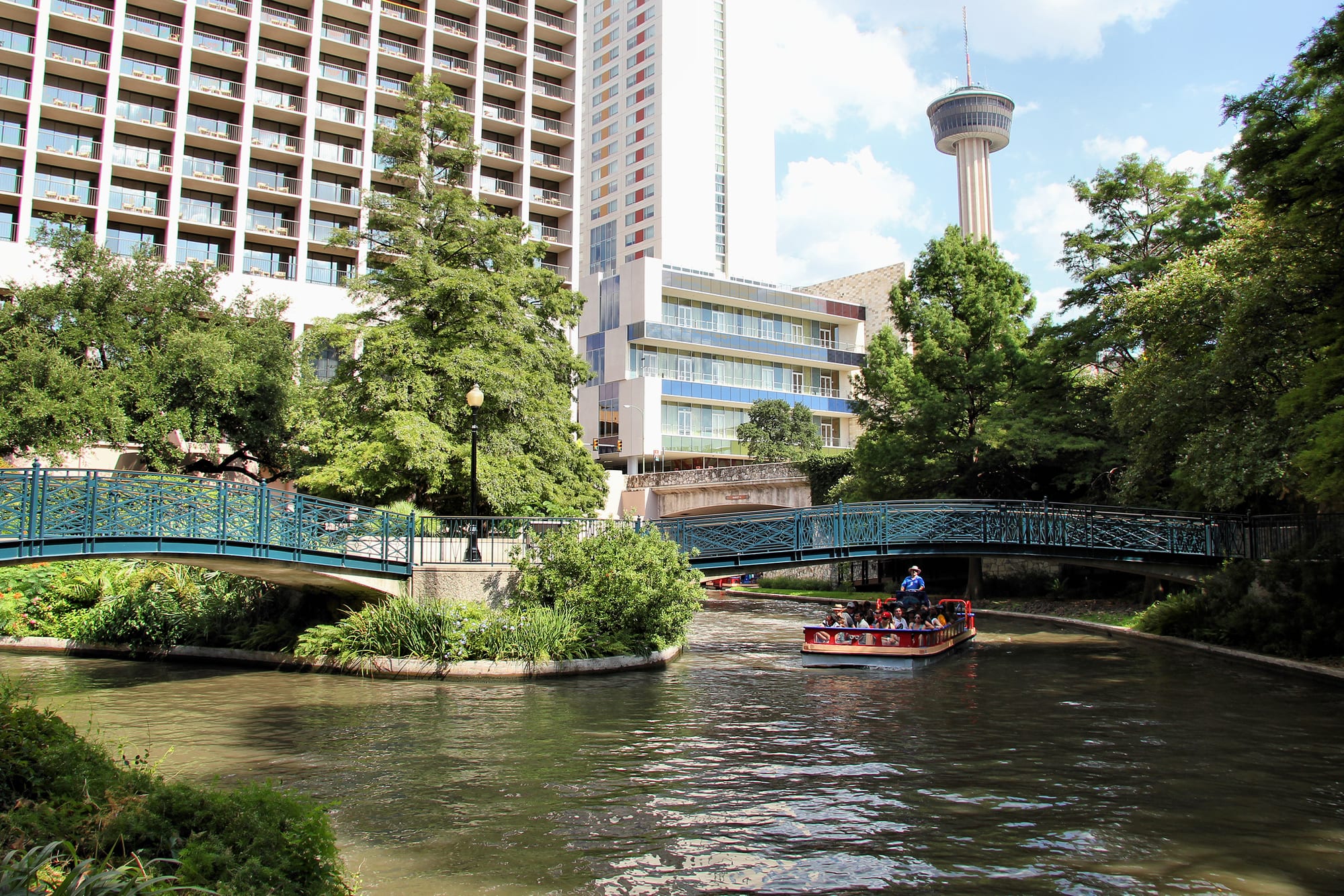
A tour boat on the green San Antonio River passing under blue footbridges, with the Tower of the Americas behind the trees

Texas, United States

San Antonio

The San Antonio River Walk, with the Tower of the Americas rising beyond the downtown buildings. (Larry D. Moore / Wikimedia Commons · CC BY 4.0)

Texas's second-largest city, on the San Antonio River, founded as a Spanish mission and presidio in 1718. Home of the Alamo and four more colonial missions that together form a UNESCO World Heritage Site, it is a majority-Hispanic city of military bases, Tex-Mex cooking and a river walk winding below street level.

Neighbourhoods

  • Downtown and the River Walk
    • First-time visitors
    • Historic district
    • Close to public transport

    The heart of the old Spanish town, where the Alamo, San Fernando Cathedral, the Spanish Governor's Palace and Market Square stand within walking distance. The River Walk loops through it one level below the streets, lined with restaurants and shops, and most of the city's hotels are here.

    Open in Maps
  • La Villita and Hemisfair
    • Arts and culture
    • First-time visitors

    La Villita, one of the city's first neighbourhoods on the south bank of the river, is now an arts village of galleries, craft shops and restaurants. Next to it, the grounds of the 1968 World's Fair hold the Tower of the Americas and the convention centre.

    Open in Maps
  • King William
    • Historic district
    • Quiet and residential
    • Architecture

    A district near downtown, subdivided in 1853–66 and settled by prominent German merchants, with mansions along King William Street and the King William River Walk. A First Friday art walk is held there each month.

    Open in Maps
  • The Pearl
    • Best for food
    • Markets

    The former Pearl Brewery north of downtown, closed in 2001 and redeveloped as a district of restaurants, shops and offices beside the river, with a weekend farmers' market. The Museum Reach of the River Walk links it to the centre.

    Open in Maps
  • Brackenridge Park
    • Parks
    • Museums
    • Families

    The district around the large park on the Broadway corridor just north of downtown, with the Witte Museum, the Japanese Tea Garden in an old quarry, and the San Antonio Museum of Art and the McNay a short way off.

    Open in Maps

Things to do

Famous landmarks

  • The Alamolandmark

    The mission founded in 1718 where the Battle of the Alamo was fought in 1836, now a museum and part of the San Antonio Missions World Heritage Site.

    Open in Maps
  • San Antonio River Walkattraction

    Paths along the river one level below the streets, built from 1939 on Robert Hugman's plan after a deadly 1921 flood, lined with restaurants and shops and extended north to the Pearl and south to the missions.

    Open in Maps
  • San Fernando Cathedrallandmark

    The mother church of the Archdiocese of San Antonio on the main plaza, one of the oldest cathedrals in the United States.

    Open in Maps
  • Spanish Governor's Palacemuseum

    The last visible trace of the 18th-century presidio and the only surviving aristocratic Spanish colonial town house in Texas.

    Open in Maps
  • Tower of the Americasviewpoint

    A 750-foot observation tower built for the 1968 World's Fair, with a deck and revolving restaurant at the top giving views across the city.

    Open in Maps

The Spanish missions

  • San Antonio Missions National Historical Parkpark

    Four 18th-century missions south of downtown — Concepción, San José, San Juan and Espada — and the Espada Aqueduct, named with the Alamo a UNESCO World Heritage Site in 2015.

    Open in Maps
  • Mission Concepciónlandmark

    The oldest unrestored stone church in America, where traces of the frescoes that once covered it survive on the facade and inside the convento.

    Open in Maps
  • Mission San Josélandmark

    A Spanish mission named in part after the Marquis de San Miguel de Aguayo, part of the national historical park.

    Open in Maps

Museums

  • San Antonio Museum of Artmuseum

    A museum spanning 5,000 years of world art, housed in the 1886 Lone Star Brewery on the Museum Reach of the River Walk.

    Open in Maps
  • McNay Art Museummuseum

    The first modern art museum in Texas, founded in 1954 in Marion Koogler McNay's Spanish Colonial Revival mansion, with works by Cézanne, Picasso, Matisse, O'Keeffe and Hopper.

    Open in Maps
  • Witte Museummuseum

    A museum in Brackenridge Park, established in 1926, telling the stories of Texas from prehistory to the present, with dinosaur bones and cave drawings.

    Open in Maps

Parks and markets

  • Brackenridge Parkpark

    A park of nearly 344 acres along the river on the Broadway corridor, just north of downtown.

    Open in Maps
  • San Antonio Japanese Tea Gardenpark

    A sunken garden laid out in an abandoned limestone quarry in Brackenridge Park in the early 20th century.

    Open in Maps
  • Market Squaremarket

    A three-block plaza of shops and restaurants downtown, the largest Mexican market in the United States, around the 1930s El Mercado building.

    Open in Maps
  • La Villitaneighborhood

    One of San Antonio's first neighbourhoods, restored in 1939 and now an arts village of galleries and craft shops beside the River Walk and the Arneson River Theatre.

    Open in Maps

Sport and theme parks

  • Frost Bank Centerattraction

    The arena on the east side of the city where the San Antonio Spurs, five-time NBA champions, play their home games.

    Open in Maps
  • SeaWorld San Antonioattraction

    One of the largest marine life parks in the world, on the city's west side, about 13 miles from downtown.

    Open in Maps
  • Six Flags Fiesta Texasattraction

    A large theme park in the north of the city.

    Open in Maps

Seasonal events

  • San Antonio Stock Show & RodeoFebruary

    A three-week livestock show and professional rodeo with concerts by major recording artists.

  • Fiesta San AntonioApril

    The city's signature festival since 1891, commemorating the battles of the Alamo and San Jacinto with more than 100 events across the city and more than three million participants.

  • Alamo Bowllate December

    A college football bowl game played at the Alamodome every year since 1993.

Eat and drink

Long-standing places and food districts in San Antonio. Hours, ratings and directions come from your maps app, always current.

San Antonio classics

  • Mi Tierra Café y Panaderíarestaurant

    One of the two main restaurants in Market Square, a Mexican café and bakery at the heart of the old market.

    Open in Maps
  • Chili con carnerestaurant

    The spicy beef stew that the city's 'chili queens' once sold cheaply, and which a San Antonio stand helped popularise across the country in 1893.

    Open in Maps
  • Tex-Mexrestaurant

    Texas-Mexican cooking, found everywhere from family taquerías to the cafés of Market Square and the River Walk.

    Open in Maps

Food districts and markets

  • Market Squaremarket

    Snack stalls, sweet shops and restaurants around the largest Mexican market in the country.

    Open in Maps
  • The Pearlneighborhood

    The redeveloped brewery district north of downtown, with restaurants, shops and a farmers' market on weekend mornings.

    Open in Maps
  • River Walk restaurantsneighborhood

    Riverside tables along the downtown loop, many of them Tex-Mex, with a German restaurant above the River Walk as a reminder of the city's other heritage.

    Open in Maps

Experience San Antonio

History

The Payaya people lived by the springs of the river, which they called Yanaguana, "refreshing waters". Spanish explorers reached it on 13 June 1691, the feast of St Anthony of Padua, and named it San Antonio. In 1718 Father Antonio de Olivares founded the Misión San Antonio de Valero — later known as the Alamo — with a presidio across the river, to hold Texas against the French. Canary Island families arrived in 1731 and formed San Fernando de Béxar, the first regularly organised civil government in Texas, and four more missions were set up along the river. The town became the capital of Spanish, then Mexican, Texas.

During the Texas Revolution, Texian forces took the town in December 1835. From 23 February to 6 March 1836 the army of Antonio López de Santa Anna besieged the Alamo, and all its defenders were killed; "Remember the Alamo" became the rallying cry of the victory at San Jacinto weeks later. Tejanos such as Juan Seguín fought for independence, but by 1850 they were no longer a majority in the city they had built, and would not be again until 1968.

German immigrants arrived in large numbers in the 19th century, the railway came in 1877 and the city prospered on cattle. After a flood killed 51 people in 1921, the architect Robert Hugman proposed keeping the river's downtown bend as a walk, built from 1939 by the Works Progress Administration. The 1968 World's Fair left the Tower of the Americas, and in 2015 the five missions were inscribed together as a UNESCO World Heritage Site.

Culture & Customs

San Antonio has had a Tejano majority again since 1968, and its culture blends Mexican and Tejano traditions with those of the German settlers who once made up a third of its people. The old plazas and missions still anchor the city's identity, and the Alamo — "Alamo City" is one of its nicknames — draws visitors from across the country. In 1859 Frederick Law Olmsted wrote of its "jumble of races, costumes, languages and buildings", a quality that only New Orleans could rival.

Fiesta San Antonio, held each April since 1891, is the city's great celebration, with more than 100 events and three million participants commemorating the battles of the Alamo and San Jacinto. In February the Stock Show & Rodeo brings three weeks of livestock judging, rodeo and concerts, and the King William district holds a First Friday art walk each month.

Basketball unites the city behind the Spurs, five-time NBA champions and its only top-level professional team. The military is woven into daily life — San Antonio is nicknamed "Military City, USA" — and in 2017 UNESCO named it a Creative City of Gastronomy, recognising a food culture rooted in its Mexican and Tejano heritage.

Daily Life

San Antonio had about 1.43 million people at the 2020 census, making it the second-largest city in Texas and the seventh-largest in the United States, and its metropolitan area has an estimated 2.76 million. Together with Austin, 80 miles to the north, it anchors a region of about five million people. Its population nearly doubled between 1970 and 2005, through growth and the annexation of new suburbs.

The economy rests on the military, health care, government, business services, oil and gas, and tourism. Lackland and Randolph air force bases, Fort Sam Houston and Brooke Army Medical Center make it one of the country's largest concentrations of military bases, and the South Texas Medical Center lies north- west of downtown. Valero Energy and USAA have their headquarters here, as does H-E-B, the supermarket chain that is one of the largest private companies in the country. Tourism supports more than 130,000 jobs.

The city and its metropolitan area were rated the poorest in 2019, and growth has brought a steady stream of new professional jobs and newcomers, including African Americans moving from the North and West. Summer heat sets the rhythm of the day, and the threat of flash floods is part of life in one of the most flood-prone regions of North America.

Food

San Antonio's cooking grew from its Mexican roots. In the 19th century the "chili queens" sold chili con carne — a spicy beef stew with chilli peppers — from casual "chili joints", and a San Antonio stand at the 1893 world's fair in Chicago gave many Americans their first taste of it; in 1908 Willie Gebhardt, later of San Antonio, produced the first canned chili. Tex-Mex, the Texas version of Mexican cooking, is everywhere, from family taquerías to the cafés of Market Square, the largest Mexican market in the United States, where the café and bakery Mi Tierra is one of the main eateries.

The city's other heritage shows in its German restaurants and the old Pearl and Lone Star breweries; the Pearl's buildings now house restaurants, shops and a weekend farmers' market. San Antonio is also home to the barbecue chain Bill Miller Bar-B-Q and to H-E-B, whose groceries shape what Texans cook at home.

In 2017 UNESCO named San Antonio a Creative City of Gastronomy. Along the River Walk, restaurants and cafés put their tables beside the water, and Tex-Mex restaurants are among the most common, with a German restaurant above the river as a reminder of the city's other roots.

Planning tools

Budget

San Antonio is one of the more affordable big cities in the United States. Hotel prices are highest during Fiesta in April, around big conventions and on holiday weekends; the missions, the River Walk, the cathedral and the Alamo church are free to walk, and the main costs are hotels, the theme parks and a car or ride-hailing for anything beyond downtown.

Daily Budget Midrange
USD 200–360 (downtown hotel, restaurant meals with tax and tip, river boat ride, museum tickets, ride-hailing or a hire car)
Daily Budget Shoestring
USD 90–150 (budget motel or hostel, Tex-Mex plates and market food, buses)

Stay downtown or near the River Walk to see the main sights on foot; book early for Fiesta and the rodeo.

Best Time to Visit

Spring and autumn are the best seasons — March to May, with Fiesta in April, and October to November. Summers are long, hot and humid, with July and August highs averaging about 95°F. Winters are mild, with cool nights and only rare snow. May, June and October are among the wettest months.

Suggested Number of Days

Two or three days covers downtown, the River Walk and the missions at a comfortable pace. Four or five allows for the museums, the theme parks and a trip to the Hill Country towns or Austin. Summer heat slows any visit.

First Visit
2–3 days
With Surroundings
4–5 days

Transportation

San Antonio is spread out and largely car-dependent, but downtown is compact. VIA Metropolitan Transit runs the city buses, including the VIA Primo rapid line, opened in 2012, which links downtown to the South Texas Medical Center. River boats run along the River Walk, and the Mission Reach trail links downtown with the missions by bike or on foot.

Cycling or walking the Mission Reach trail is the most pleasant way to see the four park missions, but start early in summer.

Airport & Station Connections

San Antonio International Airport is about 8 miles north of downtown, in Uptown, a short drive by taxi, ride-hailing or bus. Amtrak's daily Texas Eagle from Chicago and the thrice-weekly Sunset Limited between New Orleans and Los Angeles stop at a station next to the Alamodome. Austin is about 80 miles north on Interstate 35.

Walkability

Downtown is very walkable, and the River Walk makes a pleasant, shaded route between the Alamo, La Villita, the King William district and the Pearl. Beyond the centre the city sprawls, and summer heat makes midday walking hard work.

Safety

For most visitors the US is safe, with the main risks being petty theft and car break-ins in tourist areas of some cities, road accidents over long distances, extreme weather, and the hazards of the outdoors. In San Antonio the chief natural hazards are summer heat and flash flooding: the city and nearby New Braunfels are among the most flood-prone places in North America, and low-water crossings flood quickly in heavy rain.

Drink plenty of water in summer, never drive or walk into flooded roads, and keep valuables out of sight in parked cars. Check current official travel advice before travelling.

Climate

A humid subtropical climate bordering on semi-arid to the west, with long, very hot and humid summers, mild winters cooled by northern fronts, and warm, rainy springs and autumns. Snow is rare, and the area is among the most flood-prone in North America.

Summer
long and hot — July and August highs average about 95°F, and the record is 111°F
Winter
mild — the record low is 0°F, set in 1949; about a dozen nights a year drop below freezing, and snow, sleet or freezing rain comes about once every two or three winters

Local Customs

Tipping of roughly 18–22 per cent is expected in restaurants, and sales tax is added at the till. The Alamo and the missions are historic and religious sites, and visitors are expected to behave quietly inside the churches.

Identification is asked for when buying alcohol. Avoid disturbing services at the cathedral and the missions.

Common Payment Methods

The currency is the US dollar. Cards and contactless payment are accepted almost everywhere, and ATMs are easy to find downtown; a little cash is useful at market stalls.