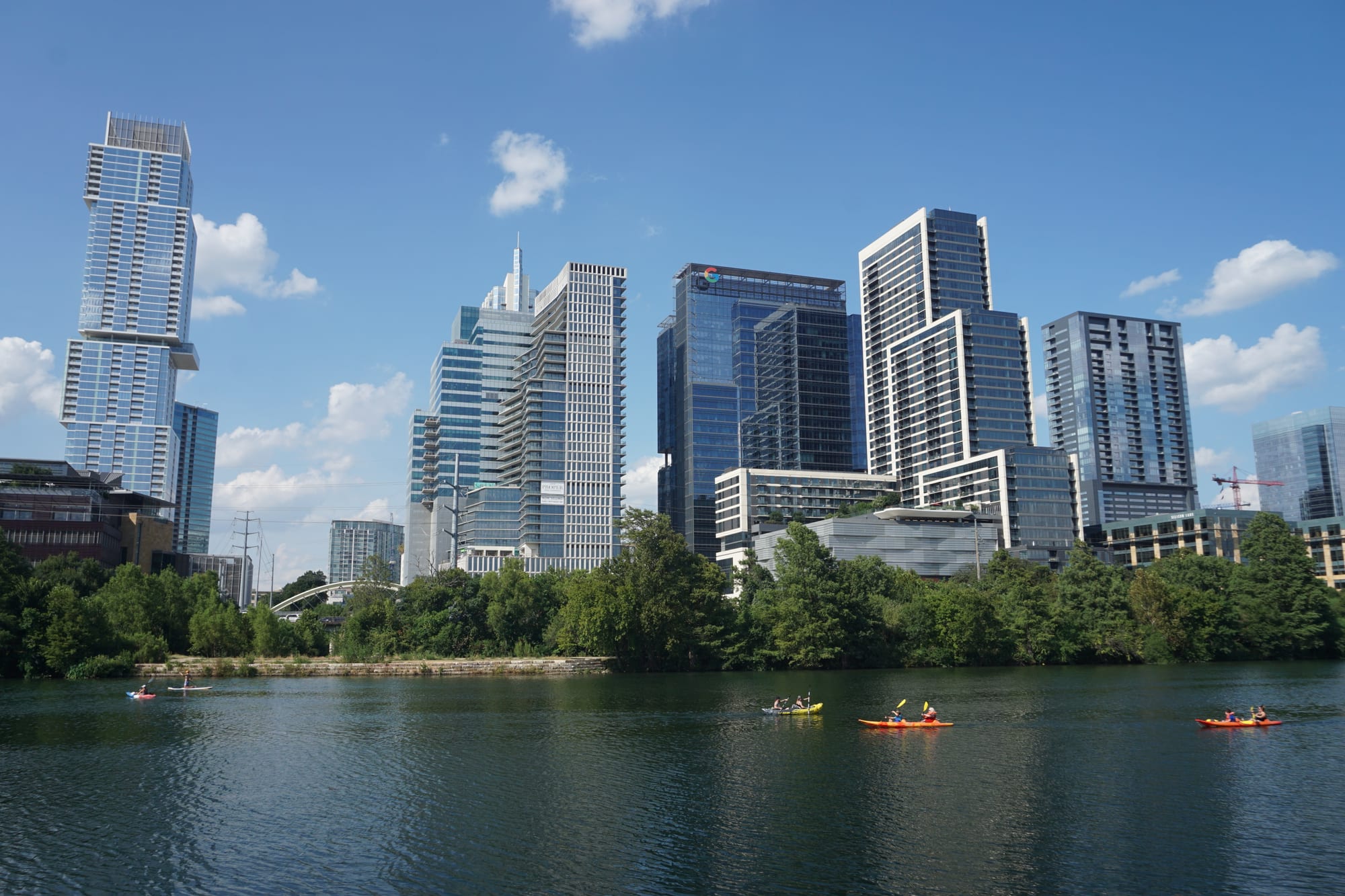
Kayakers paddling on Lady Bird Lake below the tall glass towers of downtown Austin under a blue sky

Texas, United States

Austin

Downtown Austin's towers rising above the tree-lined shore of Lady Bird Lake. (Michael Barera / Wikimedia Commons · CC BY-SA 4.0)

The capital of Texas, on the Colorado River at the edge of the Hill Country, chosen in 1839 as the seat of the Republic of Texas. A government and university town that became a centre of live music and then of technology, it has been one of the fastest-growing large American cities since 2010, with spring-fed swimming, barbecue and breakfast tacos.

Neighbourhoods

  • Downtown
    • First-time visitors
    • Nightlife
    • Close to public transport

    The grid laid out in 1839 between Lady Bird Lake and the Capitol, with Congress Avenue as its spine. High-rise condos and offices have multiplied, but Sixth Street's music bars, the Paramount Theatre and the Capitol grounds are all within walking distance, and the lakeside trail runs along its southern edge.

    Open in Maps
  • Rainey Street
    • Nightlife
    • Bars

    A street of early 20th-century bungalows in the south-east corner of downtown, near Lady Bird Lake and Interstate 35, many of them turned into bars and restaurants with porches and yards.

    Open in Maps
  • South Congress
    • Best for food
    • Shopping
    • Music

    South Congress Avenue runs due south from the bridge with the bats, lined with independent shops, restaurants, music and art venues and food trucks, and with a straight view back to the Capitol. The older South Austin neighbourhoods of Travis Heights and Bouldin Creek lie on either side.

    Open in Maps
  • Hyde Park
    • Quiet and residential
    • Historic district

    Austin's first suburb, laid out in 1891 just north of the University of Texas, now one of the densest neighbourhoods in the urban core, with tree-shaded streets of older houses and a few local cafés and restaurants.

    Open in Maps
  • Clarksville
    • Historic district
    • Quiet and residential

    A historic district west of downtown near Lady Bird Lake, founded in 1871 by the freedman Charles Clark and the oldest surviving freedmen's town west of the Mississippi, with many historic homes on quiet streets.

    Open in Maps

Things to do

Famous landmarks

  • Texas State Capitollandmark

    The seat of the Texas government, built in 1882–88 and just over 302 feet tall, taller than the United States Capitol in Washington; protected view corridors keep it visible across the city.

    Open in Maps
  • Congress Avenue Bridge batsattraction

    The bridge over Lady Bird Lake shelters the world's largest urban bat colony — up to 1.5 million Mexican free-tailed bats from March, which pour out at dusk to hunt and leave for Mexico in winter.

    Open in Maps
  • Sixth Streetneighborhood

    A historic street of Victorian commercial buildings that has been the city's main entertainment district since the 1970s, with bars and live music venues, closed to traffic on weekend evenings.

    Open in Maps
  • Paramount Theatrelandmark

    A downtown theatre opened in 1915 that has hosted vaudeville, films, theatre, music and comedy.

    Open in Maps

Museums

  • Bullock Texas State History Museummuseum

    The state history museum, a few blocks north of the Capitol, telling the story of Texas.

    Open in Maps
  • Blanton Museum of Artmuseum

    One of the largest university art museums in the country, at the University of Texas, with a wide-ranging permanent collection.

    Open in Maps
  • LBJ Presidential Librarymuseum

    The presidential library and museum of Lyndon B. Johnson on the University of Texas campus, with an animatronic LBJ among the exhibits.

    Open in Maps
  • Mexic-Arte Museummuseum

    A downtown museum of Mexican and Mexican American art, founded in 1983.

    Open in Maps

Parks, springs and the lake

  • Barton Springs Poolpark

    A swimming pool in Zilker Park filled entirely by natural springs from the Edwards Aquifer, cool all year and lined with grassy, shaded banks.

    Open in Maps
  • Zilker Parkpark

    A 350-acre park on the lake with open lawns, a botanical garden, a sculpture garden, a hillside theatre, a nature centre and a miniature train, and views of the downtown skyline.

    Open in Maps
  • Lady Bird Lake and the Butler Trailtrail

    A river-like reservoir on the Colorado used for kayaks, paddleboards and rowing, circled by the 10-mile Ann and Roy Butler Hike and Bike Trail, completed in 2014 with a boardwalk.

    Open in Maps
  • Barton Creek Greenbelttrail

    A 7-mile greenbelt of limestone cliffs and woods running from Zilker Park, used for hiking, climbing and mountain biking, with swimming holes in wet years.

    Open in Maps
  • Deep Eddy Poolpark

    The oldest swimming pool in Texas, a man-made pool that began as a swimming hole on the Colorado River.

    Open in Maps
  • Lady Bird Johnson Wildflower Centerpark

    A 284-acre botanical garden and arboretum of more than 900 species of native Texas plants, at its best when the spring wildflowers bloom.

    Open in Maps

Music and sport

  • ACL Live at the Moody Theaterattraction

    The downtown venue where Austin City Limits, the longest-running concert programme on American television, is recorded.

    Open in Maps
  • Circuit of the Americasattraction

    A motor racing circuit opened in 2012 just east of the airport, home to the Formula One United States Grand Prix and a NASCAR race each March.

    Open in Maps

Short trips from the city

  • McKinney Falls State Parkpark

    A 744-acre state park inside the city limits at the meeting of Onion Creek and Williamson Creek, opened in 1976 and named for the 19th-century rancher who owned the land.

    Open in Maps
  • Hamilton Pool Preservepark

    A natural pool in the Hill Country about 23 miles west of the city, formed when the dome of an underground river collapsed, ringed by limestone and a grotto; visits need a reservation.

    Open in Maps

Seasonal events

  • South by SouthwestMarch

    The conference and festival of music, film and interactive media held since 1987; with the convention centre being renovated until 2029, it runs as a campus-style event spread across the city from 2026 to 2028.

  • Zilker Park Summer Musicalsummer

    A long-running outdoor musical staged at the Zilker Hillside Theater.

  • Austin City Limits Music Festivaltwo weekends in early October

    A music festival in Zilker Park, founded in 2002 and inspired by the television series, held over two consecutive three-day weekends since 2013.

Eat and drink

Long-standing places and food districts in Austin. Hours, ratings and directions come from your maps app, always current.

Austin classics

  • Franklin Barbecuerestaurant

    The barbecue restaurant founded by Aaron Franklin in 2009, which has sold out of brisket every day since it opened and draws a national following.

    Open in Maps
  • Breakfast tacosrestaurant

    A soft corn or flour tortilla filled with eggs, meat or cheese; Austin is sometimes called the home of the breakfast taco.

    Open in Maps
  • Queso and Tex-Mexrestaurant

    Queso, a melted cheese dip, is one of the city's most popular foods, and Tex-Mex is, with barbecue, its signature cooking.

    Open in Maps

Food districts and trucks

  • South Congressneighborhood

    Restaurants, cafés and food trucks along the avenue south of the river, with the Capitol in view.

    Open in Maps
  • Food trucksneighborhood

    More than 1,200 food trucks were operating in the city in 2016, serving many kinds of food.

    Open in Maps
  • Rainey Street and East Sixthneighborhood

    Bungalow bars on Rainey Street and the music bars of Sixth Street make up the city's busiest night-time strip near downtown.

    Open in Maps

Experience Austin

History

People have lived around Austin for more than 11,000 years, and in 1730 Spanish missionaries briefly set up a mission beside the Colorado River in what is now Zilker Park before moving it to San Antonio. After Texas won independence from Mexico in 1836, Mirabeau Lamar, who had hunted buffalo here, urged the new republic to put its capital on the north bank of the Colorado. The site, briefly called Waterloo, was renamed in 1839 after Stephen F. Austin, the "Father of Texas", and Edwin Waller laid out a grid with Congress Avenue running up from the river. Sam Houston opposed the remote location and in the "Archive War" tried to remove the state papers; the residents kept them, and in 1845 Austin was confirmed as the capital.

After the Civil War freed Black Texans founded settlements such as Clarksville, and the railway's arrival in 1871 made the town a trading centre for cotton and cattle. The University of Texas held its first classes in 1883 and the granite Capitol was finished in 1888. In the early 20th century segregation separated Anglos, African Americans and Mexican Americans in housing and public life, while dams on the Colorado created the Highland Lakes.

From the 1960s defence electronics and computer firms arrived — Tracor, IBM, Texas Instruments and Motorola — and Dell and many others followed, earning the nickname "Silicon Hills". In the 1970s Willie Nelson and venues such as the Armadillo World Headquarters put Austin on the national music map. Since 2010 it has been one of the fastest-growing large cities in the country.

Culture & Customs

Austin calls itself the "Live Music Capital of the World". The music centres on the bars and clubs of Sixth Street, on Austin City Limits — the longest-running concert programme on American television — and on two festivals: South by Southwest each March, a gathering of music, film and technology that began in 1987, and the Austin City Limits Music Festival in Zilker Park each October. The city's music history runs from the Victory Grill, a renowned venue on the Chitlin' Circuit, to Stevie Ray Vaughan and Willie Nelson, honoured with a memorial and a statue.

The unofficial slogan "Keep Austin Weird" expresses a wish to protect small local businesses from large corporations, and a strong taste for the odd and homemade — murals, quirky statues and the Zilker Park Summer Musical. Rapid growth and rising prices have fed nostalgia for an "Old Austin" of cheap rents and bohemian freedom.

The University of Texas, with more than 50,000 students, shapes the city's character, and its Longhorns teams command loyalty across the region. Austin FC became the city's first major-league professional team in 2021, and the Circuit of the Americas brings Formula One and NASCAR. Outdoor life is central: swimming at Barton Springs, paddling on Lady Bird Lake and gathering at dusk to watch the bats leave the Congress Avenue Bridge.

Daily Life

Austin had about 962,000 people at the 2020 census, making it the fifth-largest city in Texas and the second-largest state capital in the country after Phoenix, and its metropolitan area has an estimated 2.55 million. Together with San Antonio, 80 miles to the south, it anchors a region of about five million people along Interstate 35. The population is a mix of government employees, students, musicians, high-tech workers and blue-collar workers.

Technology dominates the modern economy. Dell, Tesla — whose headquarters are in its Gigafactory Texas, employing more than 20,000 — and Apple, with its largest campus outside Cupertino, are among the major employers, alongside the state government, the school district, the city and the university. Downtown's residential population grew from about 5,000 in 2005 to about 12,000 in 2015 as condo towers rose.

The cost of that growth is felt every day: rising rents and house prices, gentrification of older neighbourhoods and heavy traffic on Interstate 35 and MoPac. Voters approved a large transit plan, Project Connect, in 2020. Days follow the heat — early runs on the lakeside trail, a swim at Barton Springs, and evenings on patios and in music bars.

Food

Austin's food rests on two Texas traditions, barbecue and Tex-Mex. Brisket is the prize of the barbecue pits, and Franklin Barbecue, opened in 2009, has sold out of it every day since and draws a national following. Queso, a melted cheese dip, is one of the city's most popular foods. Kolaches, filled pastries brought by Texas's Czech and German immigrants, are common in Austin bakeries.

The day starts with breakfast tacos — soft corn or flour tortillas filled with eggs, meat or cheese — and Austin is sometimes called the "home of the breakfast taco". Food trucks and trailers are a defining part of the scene: more than 1,200 were operating in 2016, serving many kinds of food. South Congress mixes them with restaurants and cafés, and Austin's first food hall opened in the base of a downtown office tower.

The city also has a large craft beer scene, with more than 50 microbreweries in the metropolitan area, and the bars of Sixth Street and Rainey Street are the busiest places to drink near downtown. West of the city, the Oasis on Lake Travis, the largest outdoor restaurant in Texas, calls itself the "Sunset Capital of Texas".

Planning tools

Budget

Austin is one of the more expensive cities in Texas, and hotel prices climb steeply during SXSW in March, the two ACL Festival weekends in October, Formula One race weekend and University of Texas home football games. Food can be cheap — food trucks, tacos and barbecue — and many of the best things, from the bats to the Capitol and the lakeside trail, are free.

Daily Budget Midrange
USD 220–400 (downtown or South Congress hotel, restaurant meals with tax and tip, ride-hailing, museum and pool tickets)
Daily Budget Shoestring
USD 100–160 (hostel bed or budget motel, tacos and food trucks, buses and bike share)

Book months ahead for festival and race weekends, or come in a quieter month; arrive early for the best-known barbecue, which sells out.

Best Time to Visit

Spring (March to May) and autumn (October and November) are the best seasons: warm, with the wildflowers in spring and the music festivals in both. Summers are long and very hot, with highs of 90°F or more from about June to mid-September, though the spring-fed pools and the lake help. Winters are short and mild, broken by occasional cold snaps and ice storms. The bats are under the bridge from March into the autumn.

Suggested Number of Days

Three days covers the city's main sights, music and food at a comfortable pace. Four to six allows for more of the swimming holes, the Hill Country and a day in San Antonio. Festival weekends are crowded, and summer heat slows the pace of any visit.

First Visit
3 days
With Surroundings
4–6 days

Transportation

Austin is a car-oriented city, boxed by Interstate 35 and the MoPac Expressway, and traffic is heavy. CapMetro runs local and express buses and a single commuter rail line, opened in 2010, between downtown and the northern suburb of Leander. CapMetro Bikeshare has electric-assist bikes in the centre, and ride-hailing is widely used. A light rail plan was approved by voters in 2020.

Dockless scooters and bikes are banned from city parks and the lakeside trail; ride them on the streets.

Airport & Station Connections

Austin–Bergstrom International Airport, on the site of a former air force base, is about 5 miles south-east of downtown — a short drive by taxi, ride-hailing or bus — and is the third-busiest airport in Texas. Amtrak's Texas Eagle stops daily at a station west of downtown on its route between Chicago and San Antonio, and Greyhound and Mexican bus lines also serve the city. San Antonio is about 80 miles south on Interstate 35.

Walkability

Downtown, the Capitol, Rainey Street and the lakeside trail are easy to walk, and the bridge leads on foot to South Congress. Beyond the centre the city sprawls, and summer heat makes long walks hard work in the middle of the day.

Safety

For most visitors the US is safe, with the main risks being petty theft and car break-ins in tourist areas of some cities, road accidents over long distances, extreme weather, and the hazards of the outdoors. In Austin the main concerns are summer heat, sudden storms with flash flooding, and heavy, fast traffic; the late-night crowds on Sixth Street call for the usual care.

Drink plenty of water in summer, never drive or walk into flooded low-water crossings, and check creek levels before swimming in the greenbelt. Check current official travel advice before travelling.

Climate

A humid subtropical climate on the border between the dry Southwest and the humid South, with long, very hot summers, short mild winters and warm springs and autumns. Humidity changes quickly with the wind. Severe storms can strike in any season, ice storms occur about every two years, and snow is rare.

Summer
very hot — highs reach 90°F on about 123 days a year and 100°F on about 29
Winter
short and mild — January's average high is about 62°F, and nights fall below freezing about 12 times a year

Local Customs

Tipping of roughly 18–22 per cent is expected in restaurants, and sales tax is added at the till. Dress is relaxed almost everywhere. Locals are proud of the city's independent businesses and music — the unofficial slogan is "Keep Austin Weird" — and many mourn an "Old Austin" lost to fast growth. University of Texas Longhorns games are followed with devotion.

Identification is asked for when buying alcohol, and laws on alcohol, cannabis and firearms in Texas differ from those in many other states.

Common Payment Methods

The currency is the US dollar. Cards and contactless payment are accepted almost everywhere, including at most food trucks, and some venues no longer take cash. ATMs are easy to find; a little cash is useful for tips and small vendors.