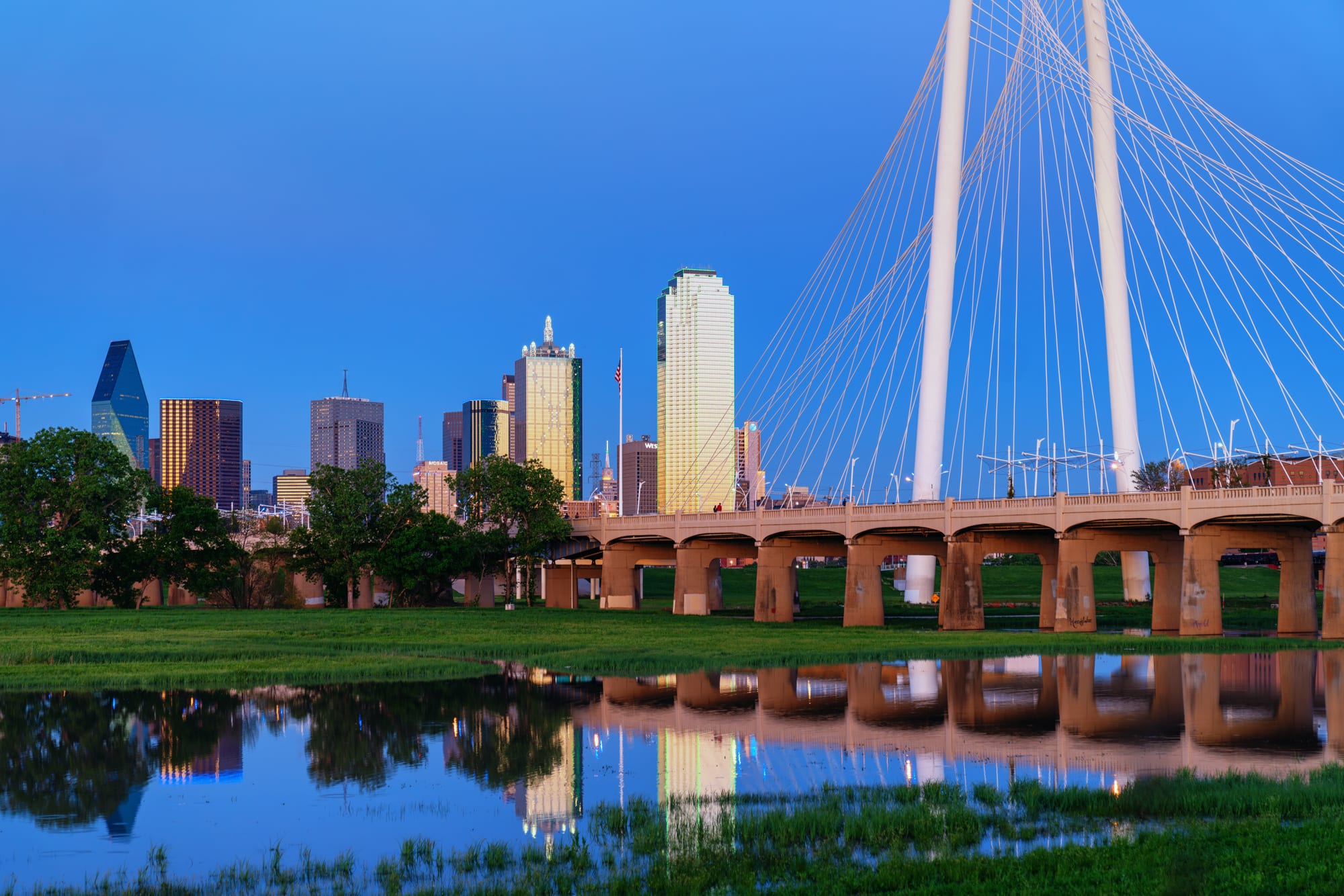
Downtown Dallas towers lit at dusk beside the white cables of the Margaret Hunt Hill Bridge, reflected in floodwater on the Trinity River plain

Texas, United States

Dallas

The Dallas skyline and the Margaret Hunt Hill Bridge across the Trinity River floodplain. (Tony Webster / Wikimedia Commons · CC BY-SA 2.0)

A city of North Texas on the Trinity River and, with Fort Worth, the heart of the largest metropolitan area in the state. Founded as a trading post in 1841, it grew on railways, cotton, oil money and banking, and is now a corporate and financial centre of glass towers with a large arts district, Tex-Mex kitchens and the museum overlooking Dealey Plaza.

Neighbourhoods

  • Downtown and the Arts District
    • First-time visitors
    • Arts and culture
    • Close to public transport

    The business centre of glass towers, with the West End and Dealey Plaza at its western edge and, to the north, the Arts District — the largest contiguous arts district in the United States, home to the art museum, the symphony hall and the opera house. DART light rail lines meet here.

    Open in Maps
  • Uptown
    • Nightlife
    • Best for food
    • Walkable

    A dense district of flats, restaurants and bars just north of downtown, linked to it by Klyde Warren Park over the freeway. It is one of the most pedestrian-friendly areas in Texas and popular with young professionals.

    Open in Maps
  • Deep Ellum
    • Live music
    • Nightlife
    • Street art

    A historic district east of downtown whose name is a corruption of Elm Street. In the 1920s and 1930s it was a hotbed of early jazz and blues; today its old brick buildings hold bars, music venues, restaurants and tattoo parlours.

    Open in Maps
  • Bishop Arts District and Oak Cliff
    • Best for food
    • Independent shops
    • Local life

    About two miles south-west of downtown across the Trinity River, a small district of independent boutiques, restaurants, coffee shops and galleries in hilly North Oak Cliff, a former separate city annexed by Dallas in 1903.

    Open in Maps
  • Lower Greenville and Lakewood
    • Bars
    • Quiet and residential

    In East Dallas, Greenville Avenue is lined with restaurants and long-standing bars, while the older residential streets of Lakewood lead to White Rock Lake and the arboretum.

    Open in Maps

Things to do

History and landmarks

  • The Sixth Floor Museum at Dealey Plazamuseum

    A museum on the sixth floor of the former Texas School Book Depository examining the life, assassination and legacy of President John F. Kennedy, and the investigations and theories that followed.

    Open in Maps
  • Dealey Plazalandmark

    A small city park in the West End, sometimes called the birthplace of Dallas, where Kennedy was shot in 1963; the plaza and surrounding buildings form a National Historic Landmark district.

    Open in Maps
  • Reunion Towerviewpoint

    A 561-foot observation tower topped by a lit geodesic sphere, named after La Réunion, the short-lived 19th-century French socialist commune on the Trinity River.

    Open in Maps
  • Margaret Hunt Hill Bridgelandmark

    A white cable-stayed bridge by Santiago Calatrava across the Trinity River, linking downtown to West Dallas.

    Open in Maps

Museums

  • Dallas Museum of Artmuseum

    One of the largest art museums in the country, with more than 24,000 objects from the third millennium BC to the present, in the Arts District.

    Open in Maps
  • Nasher Sculpture Centermuseum

    A museum opened in 2003 beside the art museum for Patsy and Raymond Nasher's collection of modern and contemporary sculpture, with a garden.

    Open in Maps
  • Perot Museum of Nature and Sciencemuseum

    A natural history and science museum in Victory Park, just north-west of downtown.

    Open in Maps

Parks and open spaces

  • Klyde Warren Parkpark

    A 5.4-acre park opened in 2012 on a deck over the Woodall Rodgers Freeway, joining downtown's Arts District to Uptown.

    Open in Maps
  • Fair Parkpark

    A 277-acre complex just east of downtown, much of it built for the Texas Centennial Exposition of 1936, home of the State Fair and the Cotton Bowl stadium; a National Historic Landmark.

    Open in Maps
  • White Rock Lakepark

    A reservoir of more than 1,200 acres in East Dallas, ringed by a path popular with walkers, runners and cyclists.

    Open in Maps
  • Dallas Arboretum and Botanical Gardenpark

    A 66-acre botanical garden on the south-eastern shore of White Rock Lake.

    Open in Maps

Markets, music and sport

  • Dallas Farmers Marketmarket

    One of the oldest and largest farmers' markets in Texas, on the south-east side of downtown, with produce sellers and an indoor food hall.

    Open in Maps
  • American Airlines Centerattraction

    The arena of the Dallas Mavericks basketball team and the Dallas Stars ice hockey team, in Victory Park.

    Open in Maps

Short trips from the city

  • AT&T Stadiumattraction

    The Dallas Cowboys' 80,000-seat stadium with a retractable roof in Arlington, opened in 2009, which hosted matches of the 2026 FIFA World Cup.

    Open in Maps
  • Fort Worth Stockyardsneighborhood

    Fort Worth's historic livestock district, with western-wear shops, saloons, weekend rodeos at the Cowtown Coliseum and cattle drives through the streets.

    Open in Maps
  • Kimbell Art Museummuseum

    Fort Worth's art museum, a celebrated building by Louis Kahn holding a collection of only about 350 works, chosen for quality, from Europe, Asia and the ancient world.

    Open in Maps

Seasonal events

  • State Fair of Texaslate September to October, for 24 days

    Dallas's signature event at Fair Park, held since 1886, presided over by the 55-foot cowboy statue Big Tex and known for its corny dogs and new deep-fried foods each year.

  • Red River RivalryOctober, during the State Fair

    The college football game between the University of Texas and the University of Oklahoma, played at the Cotton Bowl in Fair Park.

  • St Patrick's Day paradeMarch

    A parade along Lower Greenville Avenue.

Eat and drink

Long-standing places and food districts in Dallas. Hours, ratings and directions come from your maps app, always current.

Dallas classics

  • Tex-Mex and the frozen margaritarestaurant

    Enchiladas, fajitas and queso are everyday food, and the frozen margarita machine was invented here by the restaurateur Mariano Martinez in 1971.

    Open in Maps
  • Fletcher's corny dogsrestaurant

    Battered, deep-fried hot dogs on a stick, sold for years at the State Fair and the taste of autumn in Dallas.

    Open in Maps

Food districts and markets

  • Dallas Farmers Marketmarket

    Farm stalls, wholesale produce dealers and an indoor food hall of local vendors.

    Open in Maps
  • Bishop Arts Districtneighborhood

    A bohemian corner of Oak Cliff full of independent restaurants, bars and coffee shops.

    Open in Maps
  • Lower Greenvilleneighborhood

    A long avenue of restaurants and older bars in East Dallas.

    Open in Maps
  • Deep Ellumneighborhood

    Bars, barbecue, pizza and late-night food between the music venues on Elm, Main and Commerce streets.

    Open in Maps

Experience Dallas

History

In 1839, three years after Texas won its independence, John Neely Bryan surveyed land by three forks of the Trinity River, at a white-rock crossing where wagons could ford the water. He returned in 1841 to found a permanent settlement and named it Dallas. In the mid-1800s French socialists set up La Réunion, a short-lived commune along the river in what is now West Dallas, and the name survives in Reunion Tower.

The railways made the town. Lines crossing North Texas brought access to cotton, cattle and later oil, and by the end of the 19th century Dallas was a booming business and trading centre. In 1914 it was chosen as the seat of the Eleventh Federal Reserve District, and when the East Texas oil field was struck about 100 miles to the east, Dallas became the financial centre of the oil industry of Texas and Oklahoma. Latin American families, drawn by better living conditions and the upheaval of the Mexican Revolution, settled in a neighbourhood known as Little Mexico.

The city's most remembered day came in 1963, when President John F. Kennedy was assassinated as his motorcade passed through Dealey Plaza; the depository building overlooking it now holds a museum of his life and death. In the decades after, interstates and the opening of Dallas Fort Worth International Airport in 1974 made the city a transport and corporate hub, and technology firms such as Texas Instruments grew along the Telecom Corridor to the north. In 2026 AT&T Stadium in nearby Arlington was one of the venues of the FIFA World Cup.

Culture & Customs

Dallas pairs business with big cultural investment. The Arts District north of downtown, the largest contiguous arts district in the United States, holds the Dallas Museum of Art, the Nasher Sculpture Center, the Crow Collection of Asian Art, the Meyerson Symphony Center and, in the AT&T Performing Arts Center, the Winspear Opera House and the Wyly Theatre, home of the Dallas Theater Center and the Dallas Black Dance Theatre. Next to them stands the Cathedral of Guadalupe, the seat of a very large Catholic diocese.

Deep Ellum was a hotbed of early jazz and blues in the 1920s and 1930s, when Blind Lemon Jefferson and Lead Belly played there; it is now the city's live-music and nightlife district. Oak Lawn and Bishop Arts have long been the centres of LGBT life.

Sport is followed intensely. The Mavericks and the Stars play downtown, and the Cowboys, winners of five Super Bowls, and the Texas Rangers, World Series champions in 2023, play in Arlington. The State Fair, held in autumn since 1886, is the city's signature event, and the Texas–Oklahoma football game is played at the Cotton Bowl in Fair Park each October. The population is diverse: Hispanic residents are the largest group in the city, and the suburbs hold large Chinese, Indian, Iranian and Russian-speaking communities.

Daily Life

About 1.3 million people lived in Dallas at the 2020 census, making it the third-largest city in Texas, and about 8.5 million in the Dallas–Fort Worth metroplex, the fourth-largest metropolitan area in the country. The city has no navigable link to the sea yet is a major inland port, thanks to its railways, interstates and airport.

The economy is broad: defence, banking and private equity, information technology, telecommunications and transport. Many large companies have their headquarters in the city or its northern suburbs — among them Texas Instruments, 7-Eleven, Neiman Marcus and Mary Kay — and American Airlines is based beside the airport.

Most people in the metroplex live in the suburbs and drive. Oak Cliff and the south-west are largely Hispanic and the southern part of the city mostly Black, while North Dallas has enclaves of white, Black and especially Hispanic residents. Uptown and the area around downtown have filled with flats for young professionals. Summer heat indices regularly pass 105°F, and life moves indoors to air-conditioning.

Food

Dallas is known for barbecue, Mexican food and Tex-Mex: cheese enchiladas, sizzling fajitas, bowls of queso and chips, all washed down with margaritas. The frozen margarita machine was invented here in 1971 by the restaurateur Mariano Martinez, and the drink has been a fixture of the city's Tex-Mex restaurants ever since.

Barbecue centres on beef brisket, slowly cooked in smoke in a wood-fired pit, as across Texas. Chicken-fried steak — a breaded, fried steak that German and Austrian immigrants adapted from their schnitzel recipes — is an important dish across the state.

Autumn means the State Fair, where Fletcher's corny dogs — hot dogs dipped in cornmeal batter and deep-fried on a stick — have been sold for decades, and where new deep-fried inventions, from fried butter to chicken-fried bacon, appear every year. The Dallas Farmers Market, one of the oldest in Texas, has farm stalls and an indoor food hall. For eating out, Uptown, Deep Ellum, Lower Greenville and the Bishop Arts District have the densest mix of restaurants and bars.

Planning tools

Budget

Dallas is mid-priced for a large American city. Hotels downtown and in Uptown cost the most and fill up for conventions, big games and the State Fair; the suburbs and the airport areas are cheaper. The metro area is spread out, so a hire car or ride-hailing adds to the cost.

Daily Budget Midrange
USD 200–380 (mid-range hotel, restaurant meals with tax and tip, museum tickets, hire car or ride-hailing)
Daily Budget Shoestring
USD 90–150 (hostel bed or budget motel, taquerías and barbecue counters, DART rail and buses)

Klyde Warren Park, Dealey Plaza, Deep Ellum's murals and the White Rock Lake trail cost nothing.

Best Time to Visit

March to May and October to November. Spring is warm but brings severe thunderstorms, hail and occasional tornadoes; autumn is pleasant and is State Fair season. July and August are very hot, and winters are mostly mild, broken by sudden cold fronts.

Suggested Number of Days

Two or three days cover the centre, its museums and neighbourhoods. Four or five allow time for Fort Worth and Arlington as well. The State Fair or a big game can add a day, and traffic makes everything slower.

First Visit
2–3 days
With Surroundings
4–5 days

Transportation

Dallas Area Rapid Transit (DART) runs light rail and buses through the city and many suburbs; its four light rail lines link downtown with the northern suburbs, South Dallas and Dallas Fort Worth International Airport. Beyond the rail lines the city is built for driving, with four interstates converging on it and a loop around it, and most visitors use a hire car or ride-hailing.

Rush-hour traffic on the freeways is heavy; plan cross-town journeys outside the peaks.

Airport & Station Connections

Dallas Fort Worth International Airport, the largest hub of American Airlines and one of the busiest airports in the world, is about 16 miles north-west of downtown, roughly halfway to Fort Worth. Dallas Love Field, the city's airport until 1974 and the home base of Southwest Airlines, is about 6 miles north-west of downtown. Most other visitors arrive by car on the interstates.

Walkability

Downtown, the Arts District, Klyde Warren Park and Uptown join up well on foot, and Uptown is among the most walkable areas in Texas. Deep Ellum is a short walk or ride east of downtown. Elsewhere distances are long and roads wide, and summer heat makes walking hard in the middle of the day.

Safety

For most visitors the US is safe, with the main risks being petty theft and car break-ins in tourist areas of some cities, road accidents over long distances, extreme weather, and the hazards of the outdoors. In Dallas, the crime rate is higher than the national average. Severe weather is a real risk: the city lies at the lower end of Tornado Alley, and spring storms bring hail and tornadoes.

For most visitors the US is safe, with the main risks being petty theft and car break-ins in tourist areas of some cities, road accidents over long distances, extreme weather, and the hazards of the outdoors. Leave nothing visible in a parked car, use ride-hailing after dark outside the central districts, and follow warnings during spring storms. Check current official travel advice before travelling.

Climate

Humid subtropical with hot summers. Spring and autumn are warm and stormy as cold fronts meet humid Gulf air; winters are usually mild, but strong cold fronts known as 'blue northers' can bring sudden cold spells, and ice and snow occur in some years.

Summer
very hot — July and August average highs are around 96°F, and the heat index often passes 105°F
Winter
mild with sharp swings — January averages a high of about 57°F and a low of about 37°F

Local Customs

Tipping of roughly 18–22 per cent is expected in restaurants, and Texas sales tax is added at the till. Dallas is friendly and outgoing, and dress is casual outside the business district.

Identification is asked for when buying alcohol (the legal age is 21). At Dealey Plaza, remember that it is a place where a president was killed, and behave accordingly.

Common Payment Methods

The currency is the US dollar. Cards and contactless payment are accepted almost everywhere, and some venues take no cash at all.