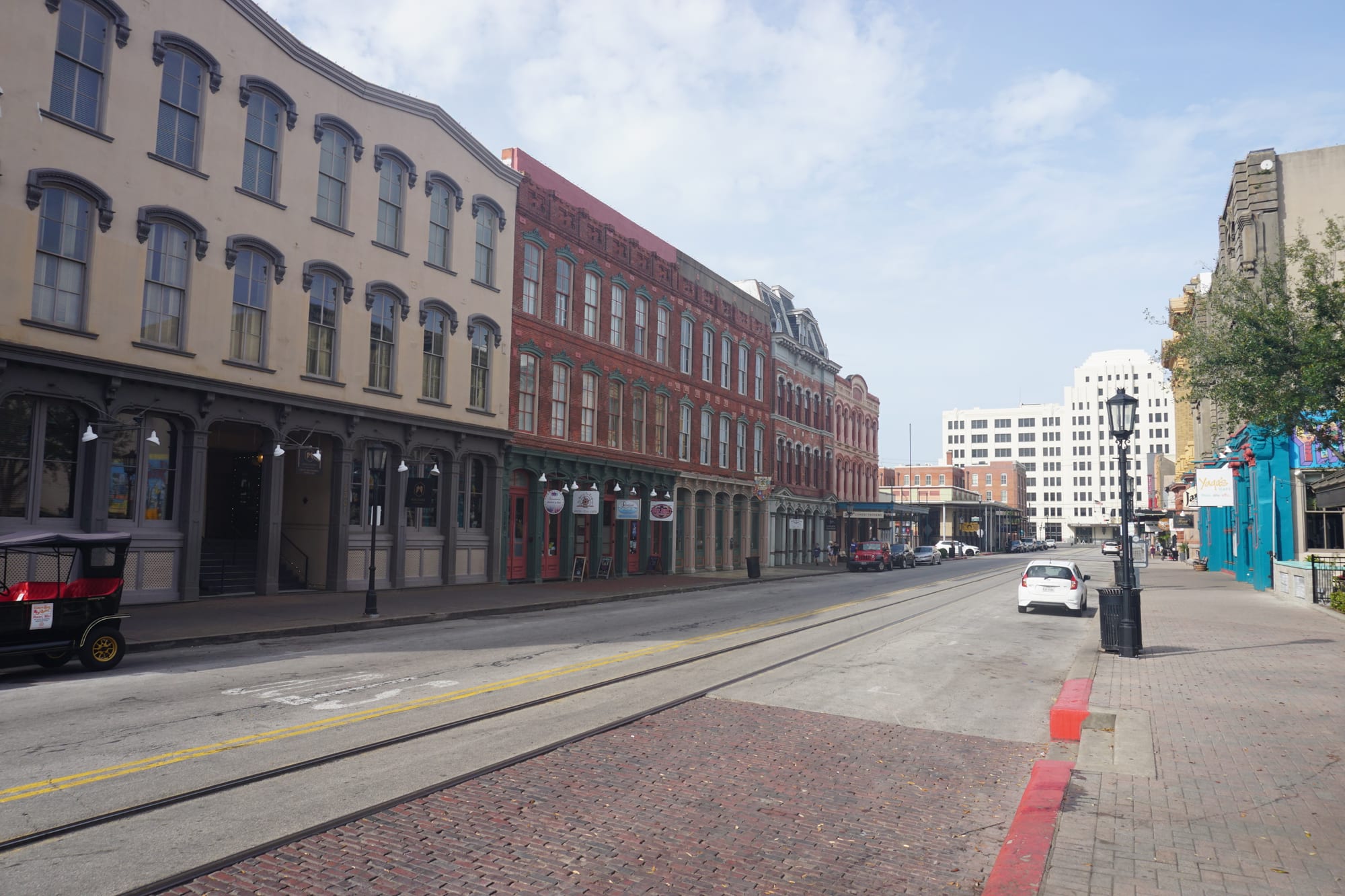
A brick-paved street with trolley tracks lined by three- and four-storey Victorian commercial buildings with arched windows and iron shopfronts

Texas, United States

Galveston

Victorian commercial buildings in the Strand Historic District, Galveston. (Michael Barera / Wikimedia Commons · CC BY-SA 4.0)

An island city on the Texas Gulf Coast at the southern edge of Greater Houston. In the 19th century it was Texas's great port and, for a time, its largest city, until the hurricane of 1900 — the deadliest natural disaster in US history — nearly wiped it out. Today its Victorian Strand district, seawall beaches and cruise terminals make it the region's seaside resort.

Neighbourhoods

  • The Strand and downtown
    • First-time visitors
    • Historic district
    • Shopping

    The five-block business district between 20th and 25th streets near the wharf, a National Historic Landmark of Victorian commercial buildings now filled with restaurants, antique and curio shops. The railway museum, the opera house and the harbour piers with the tall ship Elissa are close by.

    Open in Maps
  • East End and the Broadway mansions
    • Architecture
    • Quiet and residential

    A historic district of more than 550 buildings on both sides of Broadway and Market Street, with Victorian houses large and small. The Bishop's Palace stands here, and Ashton Villa and the Moody Mansion are a few blocks west along Broadway.

    Open in Maps
  • Seawall Boulevard
    • Beaches
    • Families

    The road along the top of the seawall, with a sidewalk of about 10 miles beside the Gulf, the Pleasure Pier, hotels, seafood restaurants and the beaches below. Bikes and pedal cars can be hired along it.

    Open in Maps
  • The West End
    • Beaches
    • Nature
    • Quiet

    West of the end of the seawall, the island narrows into a long strip of beach houses, marshes and the dunes of Galveston Island State Park, with quieter beaches and birdwatching.

    Open in Maps

Things to do

Historic Galveston

  • Bishop's Palacelandmark

    An ornate stone Victorian house designed by Nicholas J. Clayton and completed in 1892, also called Gresham's Castle, used by the Catholic diocese for four decades and now open for tours.

    Open in Maps
  • Ashton Villalandmark

    A red-brick Italianate house of 1859 on Broadway, built by enslaved workers, remembered as the place where General Granger's order of 19 June 1865 freeing the enslaved people of Texas was read.

    Open in Maps
  • Moody Mansionmuseum

    A 31-room Romanesque mansion completed in 1895 and later the home of the financier William Lewis Moody Jr., open for tours.

    Open in Maps
  • Grand 1894 Opera Houseattraction

    A restored Romanesque Revival theatre of about 1,000 seats, named the official opera house of Texas in 1993.

    Open in Maps

Museums and the harbour

  • Elissa and the Texas Seaport Museummuseum

    A three-masted barque launched in 1877, one of the oldest ships still sailing, now a museum ship at the historic seaport on the harbour.

    Open in Maps
  • Galveston Railroad Museummuseum

    A railway museum in the former Santa Fe station at the end of the Strand, with old locomotives and carriages.

    Open in Maps
  • Ocean Star Offshore Drilling Rig and Museummuseum

    A retired offshore drilling rig moored in the harbour and turned into a museum of the offshore oil and gas industry.

    Open in Maps

Beaches and seafront

  • Galveston Seawalllandmark

    The concrete wall about 17 feet high built after the 1900 storm and extended to more than 10 miles, topped by what is claimed to be the longest continuous sidewalk in the world.

    Open in Maps
  • Galveston Island Historic Pleasure Pierattraction

    An amusement pier opened in 2012 off Seawall Boulevard, with a roller coaster, about 15 rides and carnival games over the Gulf.

    Open in Maps
  • Galveston Island State Parkpark

    A state park of about 2,000 acres on the West End, opened in 1975, stretching from Gulf beach to bay marshes.

    Open in Maps
  • Moody Gardensattraction

    A non-profit attraction founded in 1986 by the Moody Foundation, with three pyramids: an aquarium, a rainforest and the Discovery Pyramid of travelling exhibits.

    Open in Maps

Short trips from the city

  • Bolivar ferrytransit hub

    A free car and foot ferry across the mouth of Galveston Bay to the Bolivar Peninsula, a short crossing on which gulls follow the stern.

    Open in Maps
  • Space Center Houstonmuseum

    The visitor centre of NASA's Johnson Space Center at Clear Lake, with flown spacecraft and tram tours to the historic Mission Control.

    Open in Maps

Seasonal events

  • Mardi Gras GalvestonFebruary or early March, before Lent

    One of the largest Carnival celebrations in Texas, with parades through the Strand and downtown.

  • Juneteenth19 June

    Commemorations of 19 June 1865, when General Gordon Granger announced in Galveston that the enslaved people of Texas were free — the origin of the federal holiday.

  • Dickens on the Strandearly December

    A Victorian-themed Christmas festival in the Strand honouring the works of Charles Dickens, above all A Christmas Carol.

Eat and drink

Long-standing places and food districts in Galveston. Hours, ratings and directions come from your maps app, always current.

Galveston classics

  • Gulf seafood on Seawall Boulevardneighborhood

    Shrimp, oysters, crab and Gulf fish, fried, grilled or boiled, at restaurants facing the beach.

    Open in Maps
  • Harbour-side restaurants by the Strandneighborhood

    Restaurants along the harbour by the piers near the Strand, with views of shrimp boats and cruise ships.

    Open in Maps
  • Gaido'srestaurant

    A seafood restaurant on Seawall Boulevard.

    Open in Maps

Food districts

  • The Strandneighborhood

    Cafés, bars, sweet shops and restaurants in the Victorian buildings of the old business district.

    Open in Maps

Experience Galveston

History

The island was named after Bernardo de Gálvez, an 18th-century Spanish governor. The first European settlement was built around 1816 by the French privateer Louis-Michel Aury, and the Port of Galveston was established by the Mexican Congress in 1825. During the Texas Revolution the island was the main port of the Texas Navy and briefly the republic's capital. On 19 June 1865, two months after the end of the Civil War, Union General Gordon Granger informed the enslaved people of Texas in Galveston that they were free — the event commemorated as Juneteenth.

In the 19th century Galveston was one of the nation's largest cotton ports and, for a time, the largest city in Texas, known as the "Queen City of the Gulf". Cotton passed through its wharves, immigrants — Germans and Jewish merchants among them — arrived through its port, and its merchants built Victorian mansions along Broadway.

In September 1900 a hurricane drove a storm surge of 8 to 12 feet across the low island, destroying about 7,000 buildings and killing at least 6,000 people — the deadliest natural disaster in US history. The city built a seawall and recovered, encouraging new immigration, including about 10,000 Eastern European Jews in the Galveston Movement of 1907–14, but the Houston Ship Channel brought Houston's port into competition with its own. During Prohibition the island reinvented itself as the "Free State of Galveston", a resort of illegal gambling and drinking clubs that lasted into the 1950s. Hurricane Carla struck in 1961 and Hurricane Ike in 2008; after Ike the city rebuilt, adding the Pleasure Pier in 2012.

Culture & Customs

Galveston's culture is shaped by the sea and its own long memory. The Victorian architecture of the Strand, the East End and the Silk Stocking District is protected and celebrated, the Galveston Historical Foundation keeps the Bishop's Palace open for tours, and the 1900 storm is remembered with the 1900 Storm Memorial on the seawall.

The island is the birthplace of Juneteenth: Granger's order of 19 June 1865 is commemorated every year, and Ashton Villa on Broadway is remembered as the place where it was read. Celebrations of the day began in Texas in 1866 and spread across the South and, with the Great Migration, the rest of the country; it is now a federal holiday.

The festival year is crowded for a city of its size. Mardi Gras Galveston, one of the largest Carnival celebrations in Texas, fills the Strand before Lent, and Dickens on the Strand brings Victorian costume and street performers in early December. The Grand 1894 Opera House, the official opera house of Texas, is run as a performing-arts theatre, and the boxer Jack Johnson, the "Galveston Giant", who grew up on the island and became the first Black world heavyweight champion in 1908, is honoured with a statue. The St Joseph's Church built by German immigrants in 1859–60 is the oldest German Catholic church in Texas.

Daily Life

About 53,700 people lived in Galveston at the 2020 census, making it the second-largest city in Galveston County, of which it is the county seat. The city covers Galveston Island and Pelican Island, and much of it is at the southern edge of the Houston metropolitan area.

The University of Texas Medical Branch, founded in 1891, is a major economic force, with more than 70 buildings and over 2,500 students; Texas A&M University at Galveston, a marine-focused campus, and Galveston College add to the student population. Tourism is the other pillar: summer beachgoers, cruise passengers — Galveston is ranked the leading cruise port on the Gulf Coast — and weekend visitors from Houston. The Moody family's businesses and foundation remain important in civic life.

Summer brings beachgoers from across the Houston area. The seawall protects the city centre, but it also caused the old wide beach in front of it to wash away, and storms remain the island's abiding concern: Ike in 2008 wrecked the old pleasure pier and a landmark seafront hotel, and every hurricane season brings the possibility of evacuation.

Food

Seafood from the Gulf is the heart of Galveston eating: shrimp, oysters, blue crab and Gulf fish such as red snapper, fried in Southern style, grilled or boiled with spices. The restaurants along Seawall Boulevard and the harbour by the Strand serve it with views of the water; Gaido's is one of the seafood restaurants on the seawall, and a restaurant beside the tall ship Elissa is known for its seafood too.

The island's mixed history shows on the table. Mexican cafés are popular, and there are Greek and Italian restaurants too, a reminder of the immigrants who came through the port after 1900. The island also shares the wider food of the Texas coast and Houston: Tex-Mex, barbecue and crawfish boils in season.

The Strand is the place for sweets, with a block of old-fashioned candy shops, and ice cream and other treats are sold on the Pleasure Pier. Mardi Gras and Dickens on the Strand bring street food and drink into the district.

Planning tools

Budget

Galveston is a seaside resort for the Houston area, so prices follow the season: rooms cost most on summer weekends, during Mardi Gras and on holidays, and drop sharply in winter. Many visitors rent beach houses on the West End. Cruise passengers often spend a night before sailing, which keeps hotels busy year-round.

Daily Budget Midrange
USD 200–380 (mid-range hotel on the seawall, seafood dinners with tax and tip, museum and mansion tickets, car and parking)
Daily Budget Shoestring
USD 90–150 (budget motel or campsite at the state park, seafood shacks and tacos, free ferry and beaches)

The Bolivar ferry is free, and the beaches, the seawall walk and the Strand cost nothing to enjoy.

Best Time to Visit

April to June and September to November balance warm water with fewer crowds, though the hurricane season runs from June to November. High summer is hot, humid and busy with beachgoers. Winters are mild and quiet, with Mardi Gras in late winter and Dickens on the Strand in December.

Suggested Number of Days

Two days cover the historic districts and a day on the beach. Three or four allow time for the West End, the ferry and the space centre on the way to Houston. Cruise passengers usually add a night before sailing.

First Visit
2 days
With Surroundings
3–4 days

Transportation

The island's main link to the mainland is the Interstate 45 causeway across West Bay. On the island, a car is useful but not essential near the centre: replica trolleys run through the historic downtown and along part of the seawall, and bikes and pedal cars can be rented on the Strand and Seawall Boulevard.

Expect long waits for the Bolivar ferry on busy weekends and holidays, when drivers can park and walk on instead.

Airport & Station Connections

Most visitors drive down Interstate 45 from Houston and fly into one of Houston's two airports. The Port of Galveston is a major cruise terminal, with ships to the Caribbean. A free ferry links the island to the Bolivar Peninsula, and a toll bridge at San Luis Pass to the south-west.

Walkability

The Strand and Seawall Boulevard are pleasant on foot, and the East End mansions are a short walk from downtown. Replica trolleys link the historic downtown with part of the seawall, and the West End beaches need a car.

Safety

For most visitors the US is safe, with the main risks being petty theft and car break-ins in tourist areas of some cities, road accidents over long distances, extreme weather, and the hazards of the outdoors. Galveston's main hazards are natural: hurricanes, from the storm of 1900 to Hurricane Ike, which made landfall on the island in September 2008, and strong currents off the beaches.

For most visitors the US is safe, with the main risks being petty theft and car break-ins in tourist areas of some cities, road accidents over long distances, extreme weather, and the hazards of the outdoors. Swim near lifeguards, watch for rip currents, and leave the island when evacuation orders are given. Check current official travel advice before travelling.

Climate

Humid subtropical, moderated by the Gulf. Summers are long, hot and humid with warm nights; winters are mild, and frost is rare.

Summer
hot and humid — temperatures regularly exceed 90°F, and nights average around 80°F
Winter
mild — typical January highs are above 60°F and lows near 50°F

Local Customs

Tipping of roughly 18–22 per cent is expected in restaurants, and Texas sales tax is added at the till. Galveston is relaxed and casual, a beach town with an old port's mix of communities. Locals born on the island are proud of it, and the 1900 storm remains part of the city's identity.

Identification is asked for when buying alcohol (the legal age is 21). Respect the 1900 Storm Memorial on the seawall.

Common Payment Methods

The currency is the US dollar. Cards and contactless payment are accepted almost everywhere; carry a little cash for beach vendors and parking where cards are not taken.