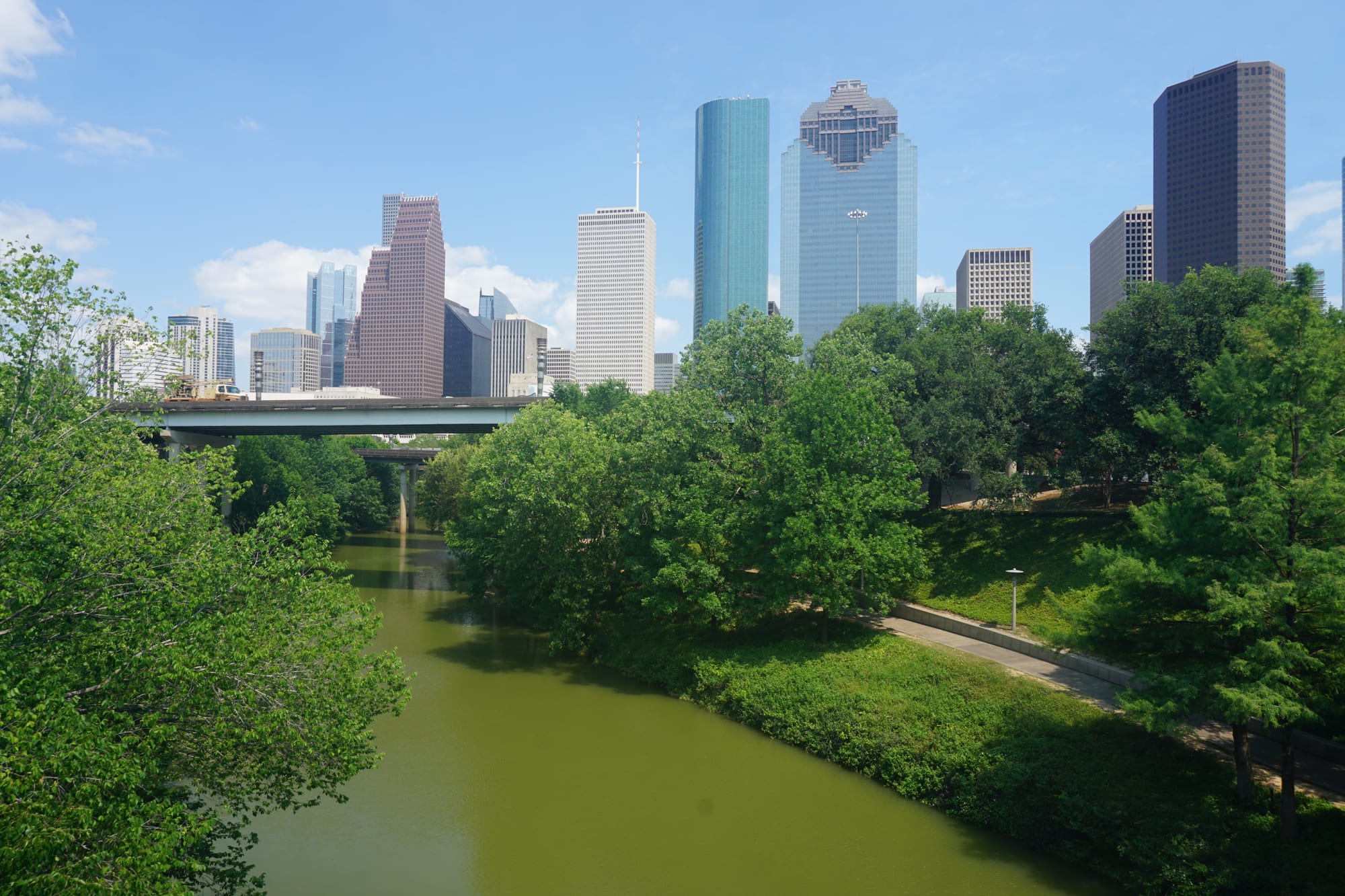
Downtown Houston's glass and stone towers rising behind green trees and the olive-coloured water of Buffalo Bayou under a blue sky

Texas, United States

Houston

Downtown Houston seen above Buffalo Bayou Park. (Michael Barera / Wikimedia Commons · CC BY-SA 4.0)

Texas's largest city and the fourth-largest in the United States, spread across the flat, bayou-crossed coastal plain near Galveston Bay. Founded by land speculators in 1836, it grew on cotton, a dredged ship channel and oil, then added NASA's Mission Control and the world's largest medical centre. Today it is one of the most ethnically diverse cities in the country, known for its museums and its food.

Neighbourhoods

  • Downtown
    • First-time visitors
    • Sport and theatre
    • Close to public transport

    The largest business district in Texas, built around Allen's Landing, where the city was founded on Buffalo Bayou. Its Theater District holds venues such as the Alley Theatre and Jones Hall, the Astros and Rockets play here, and Discovery Green park sits on its east side. Light rail lines meet in the middle.

    Open in Maps
  • Museum District and Hermann Park
    • Museums
    • Parks
    • Close to public transport

    An association of 21 museums south-west of downtown, from the Museum of Fine Arts to the natural science museum, many of them free at set times. The district is easy to walk and is served by several stops on the METRORail Red Line, with Hermann Park, the zoo and Rice University at its southern end.

    Open in Maps
  • Montrose
    • Arts and culture
    • Best for food
    • Nightlife

    A neighbourhood established in 1911 west of downtown, with renovated mansions, porched bungalows and tree-lined boulevards. It is known for its art scene, restaurants and bars, was the centre of the city's gay community in the 1980s, and holds the Menil Collection and the Rothko Chapel.

    Open in Maps
  • Midtown
    • Nightlife
    • Close to public transport

    A grid of blocks between downtown and the Museum District along Main Street and the light rail line. Once a Victorian residential area that emptied out in the late 20th century, it was redeveloped from the 1990s and filled with flats, bars and restaurants.

    Open in Maps
  • The Heights
    • Historic district
    • Best for food
    • Quiet and residential

    A community north-west of downtown that was founded as its own municipality in the 1890s and later annexed by Houston. Heights Boulevard keeps its older houses and large trees, and boutiques and restaurants have opened in the area.

    Open in Maps
  • Third Ward
    • History
    • Local life

    One of the city's six historic wards, south-east of downtown, which became the centre of Houston's African American community. Texas Southern University, the University of Houston and Emancipation Park, bought in 1872 for Juneteenth celebrations, are here.

    Open in Maps
  • Chinatown and Southwest Houston
    • Best for food
    • Local life

    A large Asian commercial district in south-west Houston, also called Bellaire after Bellaire Boulevard, with Chinese, Vietnamese and other Asian restaurants, bakeries and supermarkets in strip malls. The Mahatma Gandhi District of Indian and Pakistani shops lies a short drive north.

    Open in Maps

Things to do

Museums

  • Museum of Fine Arts, Houstonmuseum

    One of the largest art museums in the Americas, with nearly 80,000 works spanning more than 5,000 years, spread over several buildings in the Museum District, including the Kinder Building for modern art, opened in 2020.

    Open in Maps
  • Menil Collectionmuseum

    The museum in Montrose built for the art collection of John and Dominique de Menil, who settled in Houston in 1941 — often compared with the great private museums of the United States.

    Open in Maps
  • Rothko Chapelattraction

    A non-denominational chapel founded by the de Menils, its octagonal interior hung with fourteen dark paintings by Mark Rothko, open to people of all faiths.

    Open in Maps
  • Houston Museum of Natural Sciencemuseum

    A natural history museum on the edge of Hermann Park, founded in 1909, with four floors of halls, a planetarium and the Cockrell Butterfly Center.

    Open in Maps
  • Bayou Bend Collection and Gardensmuseum

    The former home of the philanthropist Ima Hogg in River Oaks, now run by the Museum of Fine Arts as a museum of American decorative arts, paintings and furniture, set in gardens.

    Open in Maps

Parks and the bayous

  • Buffalo Bayou Parkpark

    A park of 160 acres stretching 2.3 miles along the bayou west of downtown, opened in 2015, with walking and cycling trails, a skate park and skyline views.

    Open in Maps
  • Hermann Parkpark

    A 445-acre park at the southern end of the Museum District, with the Houston Zoo, the Miller Outdoor Theatre, a reflection pool, gardens and McGovern Lake.

    Open in Maps
  • Discovery Greenpark

    A downtown park opened in 2008 on former car parks beside the convention centre, with a lake, bandstands, lawns and a busy calendar of free events.

    Open in Maps
  • Emancipation Parkpark

    A park in the Third Ward bought in 1872 by four men, led by Jack Yates, to commemorate the end of slavery and long used for Juneteenth celebrations; it is the oldest park in Houston and in Texas.

    Open in Maps

Sport and nights out

  • Daikin Parkattraction

    The downtown baseball park of the Houston Astros, opened in 2000 with a retractable roof and formerly called Minute Maid Park.

    Open in Maps
  • Theater Districtneighborhood

    A cluster of downtown venues including the Alley Theatre, the Hobby Center, Jones Hall and the Wortham Theater Center, home to nine major performing arts organisations.

    Open in Maps

Short trips from the city

  • Space Center Houstonmuseum

    The visitor centre of NASA's Johnson Space Center at Clear Lake, home of Mission Control, with more than 400 space artefacts including flown Mercury, Gemini and Apollo capsules, and tram tours to the historic Mission Control.

    Open in Maps
  • San Jacinto Monumentlandmark

    A 567-foot Art Deco column on the ship channel about 16 miles east of downtown, marking the battlefield where Texas won its independence in 1836, with a history museum in its base and an observation deck.

    Open in Maps
  • Kemah Boardwalkattraction

    A boardwalk and amusement park on the shores of Galveston Bay and Clear Lake, with rides, restaurants, a marina and free entry to walk the waterfront.

    Open in Maps

Seasonal events

  • Houston Livestock Show and Rodeoearly to late March, over 20 days

    The largest livestock show and rodeo in the world, with rodeo events and big-name concerts at the stadium, opened by a downtown parade and a barbecue contest.

  • Art Car Paradespring

    A parade of cars turned into rolling sculptures, held since 1986.

  • Juneteenth19 June

    Commemorations of the end of slavery in Texas, with long roots in the city's African American community and in Emancipation Park.

  • Houston Pridelate June

    A night-time parade and celebrations at the end of June.

Eat and drink

Long-standing places and food districts in Houston. Hours, ratings and directions come from your maps app, always current.

Houston classics

  • Tex-Mexrestaurant

    Fajitas, enchiladas and queso, served everywhere from family places to large dining rooms across the city.

    Open in Maps
  • Gulf seafood and crawfishrestaurant

    Crawfish, shrimp creole, gumbo and other Louisiana Creole dishes, Gulf seafood, and the 'Viet-Cajun' crawfish of the city's Vietnamese restaurants.

    Open in Maps

Food districts

  • Chinatownneighborhood

    Bellaire Boulevard and the streets around it are lined with Chinese, Vietnamese and other Asian restaurants, noodle shops, bakeries and large Asian supermarkets.

    Open in Maps
  • Mahatma Gandhi Districtneighborhood

    Around Hillcroft Avenue and Harwin Drive, the city's South Asian district of Indian and Pakistani restaurants, sweet shops and grocers.

    Open in Maps
  • Montrose and the Heightsneighborhood

    The inner-city neighbourhoods where much of Houston's newer cooking, cocktail bars and cafés are concentrated.

    Open in Maps

Experience Houston

History

Houston was founded on 30 August 1836 by two land investors from New York, the brothers Augustus Chapman and John Kirby Allen, at the meeting of Buffalo Bayou and White Oak Bayou, a spot now known as Allen's Landing. They named it after Sam Houston, who had won Texas its independence at San Jacinto a few months earlier, and persuaded the Republic of Texas to make it the temporary capital until the government moved to Austin in 1839. The town grew as a trading centre for cotton, and by 1860 it had become a commercial and railway hub for the cotton export trade, much of it worked by enslaved people.

The 20th century transformed it. The 1900 hurricane crippled Galveston, then the state's main port; in 1901 oil was struck at Spindletop near Beaumont; and the deep-water Port of Houston, reached by a ship channel dug through the bayou, was opened by President Wilson in 1914. Refineries and petrochemical plants lined the channel during the Second World War, the Texas Medical Center was founded in the 1940s, and NASA's Manned Spacecraft Center, now the Johnson Space Center, opened in 1963; its Mission Control, known by the radio call sign "Houston", was first used for Gemini 4 in 1965. The Astrodome, the world's first domed sports stadium, followed in 1965.

The city boomed again in the late 1970s as people moved from the Rust Belt, and survived the collapse of Enron, a Houston energy company, in 2001. Floods are its recurring trial: Tropical Storm Allison in 2001, a run of floods in 2015 and 2016, and Hurricane Harvey in August 2017, which stalled over the region, dropped more than 50 inches of rain in places and killed more than 70 people. A derecho caused widespread damage in May 2024, and in 2026 the city was one of the hosts of the FIFA World Cup.

Culture & Customs

Houston is often described as the most ethnically and culturally diverse metropolitan area in the United States. Around a fifth of the people of the metro area were born abroad, most of them from south of the Mexican border, and there are large Vietnamese, Chinese, Indian and Pakistani communities — the South-West has a Chinatown and the Mahatma Gandhi District — as well as the largest Muslim community in the southern United States. The city is also the most politically diverse in a generally conservative state.

The Museum of Fine Arts and the Menil Collection are among the major museums of the country, and the city is one of the few in the country with permanent professional companies in opera, ballet, orchestral music and theatre, most of them based in the Theater District downtown. Houston hip-hop has a strong identity, from the Geto Boys to Destiny's Child, Bun B, Travis Scott and Megan Thee Stallion.

The calendar's biggest event is the Livestock Show and Rodeo each March, when western wear appears in offices across the city. Juneteenth has deep roots here, celebrated since the 1870s at Emancipation Park in the Third Ward. Houston follows the Astros in baseball, the Texans, formed in 2002, in football and the Rockets in basketball, and Montrose has long been the centre of the city's LGBT community.

Daily Life

About 2.3 million people lived in the city at the 2020 census, and about 7.8 million in Greater Houston, the fifth-largest metropolitan area in the country. The city covers more than 640 square miles, and with no zoning code, offices, houses, shops and bars sit side by side; besides downtown there are office districts in Uptown around the Galleria, the Medical Center, Greenway Plaza and the Energy Corridor.

Energy is still the backbone of the economy, from oil company headquarters to the refineries and petrochemical plants along the ship channel, which is itself a large part of the economic base. Wind and solar are growing, and the Texas Medical Center, the largest medical complex in the world, employs more than 120,000 people. The University of Houston, with some 49,000 students near the Third Ward, and Rice University beside Hermann Park are the main universities.

Life is lived by car: more than three-quarters of commuters drive alone, on a system of freeway loops and long straight roads. Summer days are spent moving between air-conditioned houses, offices and shops, and evenings and mild winters bring people out to the bayou parks. Flooding, traffic and air pollution, much of it from the ship channel industries, are long-running concerns. The mayor is John Whitmire.

Food

Houston is highly regarded for its diverse food and restaurant culture. Tex-Mex — fajitas of grilled skirt steak, cheese enchiladas, queso and margaritas — is the everyday local cooking, and Texan steakhouses and barbecue are never far away.

Louisiana Creole cooking — boudin, shrimp creole, crawfish, gumbo and jambalaya — is part of the city's table, and Vietnamese restaurateurs serve "Viet-Cajun" crawfish, seasoned inside and outside the shell. Vietnamese and Chinese restaurants, once clustered east of downtown and in Midtown, have largely moved to the new Chinatown along Bellaire Boulevard, which now holds kitchens from across Asia, while the Mahatma Gandhi District around Hillcroft Avenue is the place for Indian and Pakistani food. Other neighbourhoods have their own kitchens, such as Salvadoran, Honduran and Mexican food in Gulfton.

Montrose and the Heights are known for their restaurants, and the oldest restaurant still operating in Houston in 2022 was Christie's Seafood and Steaks. Kolaches, sweet buns of fruit in yeast dough brought by Czech immigrants, are known across Texas, where the name also covers the sausage-filled klobasnek first made by Czech settlers in the state.

Planning tools

Budget

Houston is reasonably priced for a large American city. Hotels cluster downtown, in the Galleria/Uptown area and near the Medical Center, and prices rise during the rodeo in March and for big conventions and sporting events. The city is spread out, so a hire car or regular ride-hailing is a real part of the cost.

Daily Budget Midrange
USD 200–380 (mid-range hotel, restaurant meals with tax and tip, museum and Space Center tickets, hire car or ride-hailing)
Daily Budget Shoestring
USD 90–150 (hostel bed or budget motel, taquerías and strip-mall restaurants, light rail and buses)

Many Museum District museums are free all the time or on set days, and the parks along the bayous cost nothing.

Best Time to Visit

October to April. Autumn and spring are warm and pleasant, and the rodeo fills March. Summers are long, hot and very humid, with afternoon storms, and the hurricane season on the Gulf runs from June to November; the museums and much of the city are air-conditioned.

Suggested Number of Days

Two or three days cover the centre and its museums. Four or five allow for the space centre to the south-east and the coast at Galveston. Distances are large and traffic heavy, so time spent driving adds up.

First Visit
2–3 days
With Surroundings
4–5 days

Transportation

Houston is an automobile-dependent city of freeways and loops, and most visitors drive or use ride-hailing. METRO runs buses and three light rail lines; the Red Line links downtown, Midtown, the Museum District, the Texas Medical Center and the stadium area, which covers many sights. There are more than 160 miles of bikeways, and the bayou trails are good for cycling.

Avoid the West Loop near the Galleria in rush hour if possible, and never drive into water on a flooded road.

Airport & Station Connections

George Bush Intercontinental Airport, a major United Airlines hub, is about 23 miles north of downtown. William P. Hobby Airport, Houston's older airport and a Southwest Airlines base, is about 7 miles from the city centre. Most visitors arrive by air or drive in on the interstates from Dallas, Austin, San Antonio and Louisiana.

Walkability

Downtown, Midtown, Montrose and the Museum District are walkable on their own, and the Museum District has wide, well-kept pavements; light rail links several of them. Between other districts distances are long and roads wide. Summer heat and humidity make walking hard in the middle of the day.

Safety

For most visitors the US is safe, with the main risks being petty theft and car break-ins in tourist areas of some cities, road accidents over long distances, extreme weather, and the hazards of the outdoors. In Houston, the crime rate is notably higher than the national average. Flooding is the most serious natural hazard: Tropical Storm Allison in 2001 and Hurricane Harvey in 2017 caused severe floods, and a derecho brought widespread damage in May 2024.

For most visitors the US is safe, with the main risks being petty theft and car break-ins in tourist areas of some cities, road accidents over long distances, extreme weather, and the hazards of the outdoors. Leave nothing visible in a parked car, follow local warnings in storms and hurricane season, and never drive through flooded underpasses. Check current official travel advice before travelling.

Climate

Humid subtropical. Summers are long, hot and very humid, with frequent thunderstorms; winters are short and mild, with occasional cold snaps. Rain falls in every season, and heavy downpours can flood streets quickly.

Summer
hot and humid — the temperature reaches 90°F or more on about 106 days a year, including most days from June to September
Winter
mild — January's mean temperature is about 53°F, with around 13 nights a year at or below freezing

Local Customs

Tipping of roughly 18–22 per cent is expected in restaurants, and Texas sales tax is added at the till. Houston is informal and friendly, with dress casual almost everywhere, and the city's mix of communities means signs in Spanish, Vietnamese and Chinese are common. The rodeo season brings out western wear across the city.

Identification is asked for when buying alcohol (the legal age is 21). Dress modestly and keep quiet inside the Rothko Chapel, which is a place of worship and meditation.

Common Payment Methods

The currency is the US dollar. Cards and contactless payment are accepted almost everywhere, and some venues take no cash at all. A little cash is useful for small food stalls and tips.