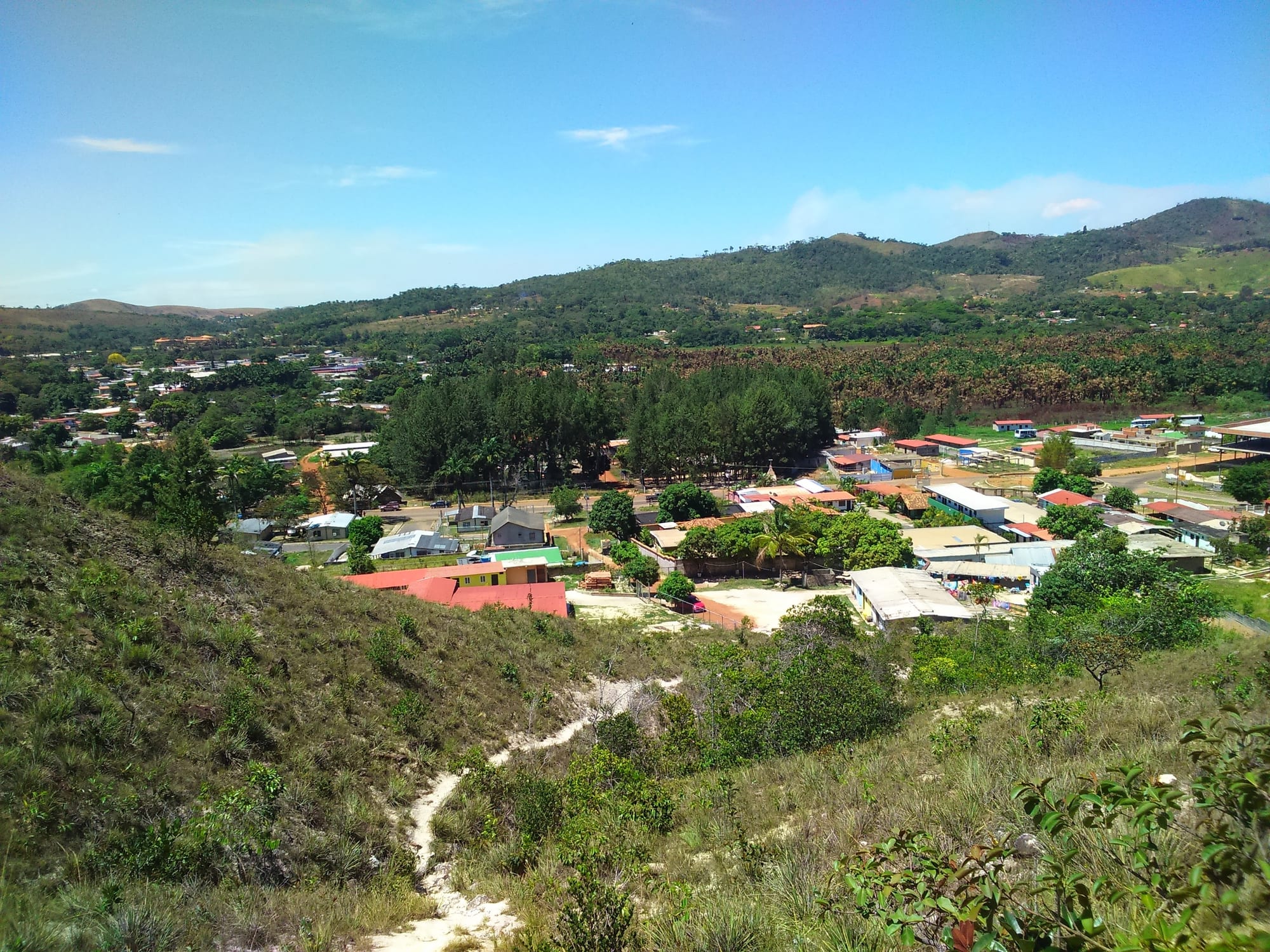
Low houses with red and white roofs among pines and palms, seen from a grassy hillside path, with green hills beyond

Angel Falls, Canaima & the Guayana South, Venezuela

Santa Elena de Uairén

Santa Elena de Uairén seen from a hillside on the edge of town. (Jason R Nascimento / Wikimedia Commons · CC BY-SA 3.0)

A small frontier town in the Gran Sabana of south-eastern Venezuela, a few kilometres from the only road crossing into Brazil. Founded in 1923 during a diamond rush, it now lives from cross-border trade, mining and tourism, and is the usual starting point for treks to Mount Roraima. This page is written to explain the city, not to encourage travel.

Neighbourhoods

  • Town centre
    • First-time visitors
    • Shops and trade

    The grid of low-rise streets around the stone cathedral, where shops, tour agencies, simple restaurants and posadas cluster. At weekends it fills with shoppers from across the Brazilian border.

    Open in Maps
  • Manakrü
    • Indigenous community
    • Quiet and residential

    A neighbourhood populated by Pemón people, where the schools teach in both Spanish and the Pemón language. It is a residential district rather than a visitor area.

    Open in Maps

Things to do

In town

  • Santa Elena Cathedrallandmark

    The town's main church, built in the mid-20th century from the stone that is plentiful around the town.

    Open in Maps

Short trips from the town

  • Pacaraimaattraction

    The Brazilian town on the far side of the border, known locally as La Línea, where the Venezuelan highway meets Brazil's BR-174 to Boa Vista and Manaus.

    Open in Maps
  • Jasper Creekattraction

    Quebrada de Jaspe, a river and series of cascades flowing over a smooth bed of red and black jasper in the Gran Sabana, reached from Santa Elena.

    Open in Maps
  • Mount Roraimatrail

    The highest of the Pacaraima tepuis, rising to 2,810 metres on the plateau shared by Venezuela, Brazil and Guyana; the easier south side makes it a popular multi-day trek from the Pemón village of Paraitepui.

    Open in Maps
  • Kukenán-tepuiviewpoint

    The tepui beside Roraima, 2,680 metres high, with a waterfall of 674 metres at its south end; it has been closed to climbers since 1997 and is seen from the Roraima trail.

    Open in Maps

Eat and drink

Long-standing places and food districts in Santa Elena de Uairén. Hours, ratings and directions come from your maps app, always current.

Food districts

  • Brazilian por-kilo lunchesneighborhood

    Brazilian-style comida a kilo, a self-service lunch buffet paid for by weight, is part of eating in this border town.

    Open in Maps
  • Pacaraima across the borderneighborhood

    The Brazilian border town a short drive away, the source of many of the Brazilian products sold in Santa Elena.

    Open in Maps

Experience Santa Elena de Uairén

History

The Gran Sabana was Pemón country long before any town stood here. Santa Elena de Uairén was founded in 1923 by Lucas Fernández Peña, a pharmacist turned landowner who had been drawn to the region by its diamond boom. He named it after his daughter Elena and the Uairén river that crosses the valley. The settlement grew up in a tense frontier: settlers from British Guiana were moving in on the back of the diamond trade, and from 1929 English Adventist missionaries set up mission houses in the valley. Fernández Peña campaigned to assert Venezuelan control, and the last of the British missionaries left in 1931.

Capuchin missionaries followed, and their mission became the centre of missionary work in the town; the stone cathedral was built in the middle of the 20th century. In the 1920s settlers from Spain, many of them Basques and Castilians, were also brought to the region. Santa Elena became a municipality in 1945 and is now the capital of the Gran Sabana municipality.

In 1999 the town was declared a free port, and trade with Brazil became the core of its economy. Its small airport was renovated and reopened in 2009. In February 2019, as troops were sent to the Brazilian border during the attempt to bring humanitarian aid into Venezuela, security forces shot Pemón civilians in the town, leaving several dead and many injured, an event that drew widespread criticism. The military action of 3 January 2026 and the earthquakes of 24 June 2026 both struck the north of the country, far from the Guayana south.

Culture & Customs

Santa Elena has a mixed population of Venezuelans, Brazilians, Guyanese and descendants of Spanish settlers. Pemón people, whose language belongs to the Carib family, lived here long before the town was founded, and the Taurepang variety of Pemón is spoken alongside Spanish. In the indigenous neighbourhood of Manakrü the schools teach in both languages. Because Brazil is so close, many residents also speak Portuguese, and Brazilian influence runs through shops, food and sport.

In Pemón tradition the mountains are home to ancestor spirits, and one story makes Mount Roraima the stump of the tree of the world; Pemón guides lead the treks that start near the town. The Capuchin mission is the centre of missionary work in the town, and the stone cathedral is one of its main sights.

Football, strengthened by the Brazilian influence, is the most popular sport, and bolas criollas, the Venezuelan bowls game, comes second. Relations between Pemón communities and the state are tense in places, above all over mining and the border, a subject handled with care in conversation.

Daily Life

About 28,000 people lived in Santa Elena at the 2011 census. The town has grown quickly, and it is the capital of the Gran Sabana municipality. It is a place of low houses and a small centre, with the savanna and the hills beginning at the edge of town.

The economy rests on commerce and mining. Brazilians cross the border, especially at weekends, to buy cheaper food, electronics and household goods, while Venezuelan fuel has long flowed the other way. Tour agencies organise trips into Canaima National Park, flights over Angel Falls and treks to Roraima. Gold mining, much of it informal and violent, dominates the wider region.

Ties with Brazil are close, and some students from Santa Elena attend school across the border in Pacaraima. Shortages of fuel and medicine, scarce cash and an unreliable power supply shape daily routines, as they do across the south. Spanish, Portuguese and Pemón are all heard in the town's streets and shops.

Food

Everyday food in Santa Elena is the Venezuelan standard — arepas, empanadas and pabellón criollo, the national plate of shredded beef, black beans and rice, often with fried plantain — with a strong Brazilian accent. Brazilian-style restaurants serve comida a kilo, a self-service lunch buffet charged by weight, and Brazilian products fill the shops alongside Venezuelan ones.

The Pemón and other indigenous peoples of the south cook with cassava. Casabe, a large, dry flatbread of grated bitter cassava, is made across the region, and mañoco is another staple made from bitter cassava. Fresh juices of tropical fruit are common with meals, and in Amazonas, further west, catara is a hot sauce of cassava juice, spices and ants.

The tour operators for the Roraima trek are based in the town, and strong black coffee is drunk throughout the day, as it is everywhere in Venezuela. The bakeries sell cachitos, ham-filled pastries, and other breads found across the country, and a long day on the trail usually ends with simple, filling plates of rice, beans and meat.

Planning tools

Budget

Organised trips are the main cost: a guided Roraima trek with guides, porters and food, or tours of the Gran Sabana, are priced in US dollars and cost far more than daily life in the town. Simple posadas and meals in Santa Elena itself are cheaper, but cash is scarce and cards rarely work for visitors.

Daily Budget Midrange
USD 150–300 (comfortable posada, guided Gran Sabana tours or a Roraima trek with porters and meals)
Daily Budget Shoestring
USD 50–90 (basic posada, simple meals, a guided group trek on Roraima)

Book a Roraima trek or Gran Sabana tour through an established operator, and bring all the US dollar cash needed for the trip.

Best Time to Visit

December to March, the drier season, is better for the Roraima trek and the Gran Sabana. The wet months from about April to November bring heavy rain, fuller rivers and waterfalls, and frequent cloud on the tepuis. Security matters more than the season.

Suggested Number of Days

The town itself needs only a day or two. The surrounding highlands add most of the time: a multi-day trek normally takes five or six days, so the length of a visit depends almost entirely on whether a trek is included.

First Visit
1–2 days
With Surroundings
6–8 days

Transportation

The town is small enough to cross on foot, and taxis cover the outskirts, the bus terminal on the edge of town and the airport. Shared taxis run to the Brazilian border. Trips into the Gran Sabana and to the start of the Roraima trek are usually made with a tour operator.

Travel outside the town only with an established operator, and avoid driving the southern highway, which passes through mining areas.

Airport & Station Connections

Santa Elena de Uairén Airport, about 6.5 kilometres south of the town, has had small-plane flights from Ciudad Bolívar and Puerto Ordaz. By road the town is about 350 kilometres from El Dorado on the trunk highway across the Gran Sabana, and long-distance buses run from Ciudad Bolívar, Puerto Ordaz and Boa Vista in Brazil. The border crossing at Pacaraima, the only road crossing between Venezuela and Brazil, is a short shared-taxi ride away.

Walkability

The centre is compact and easy to walk, with low buildings and little traffic. The bus terminal is about half an hour's walk from the centre, and the airport and the border are best reached by taxi.

Safety

The Brazilian border is one of the areas governments single out as dangerous, and much of Bolívar state is affected by illegal gold mining run by armed groups. In 2019, as troops were sent to the Brazilian border, security forces shot Pemón civilians in the town, killing several people. Malaria is widespread in mining areas, and medical care is limited.

Most governments advise against all or all-but-essential travel. Anyone who does go should keep to organised trips with established operators, stay away from mining zones and the border area, and take malaria precautions. Check current official travel advice before travelling.

Climate

At about 900 metres in the Gran Sabana, Santa Elena is milder than the Orinoco lowlands, with an average temperature of about 22°C. Rain is heavy from about April to November, and the tepui summits nearby are cold, wet and often in cloud.

Summer
the wet season, April to November: rainy, with full rivers and frequent cloud; the Gran Sabana averages around 20°C
Winter
the drier season, December to March: sunnier, with nights in the savanna that can drop to about 13°C

Local Customs

Santa Elena mixes Venezuelans, Pemón communities and many Portuguese speakers from Brazil, and Portuguese is widely understood. In Pemón tradition the mountains are home to ancestor spirits; trekkers climb Roraima with an indigenous guide, and taking crystals from the mountain is forbidden, with heavy penalties.

Ask before photographing Pemón people or their communities, dress modestly in the cathedral, and never photograph security forces, checkpoints or the border post.

Common Payment Methods

The currency is the bolívar, but US dollars in cash are used in practice, and card and ATM access for foreigners barely works. As a free port since 1999 the town is busy with trade in Brazilian goods, so carrying enough cash for the whole stay is essential.