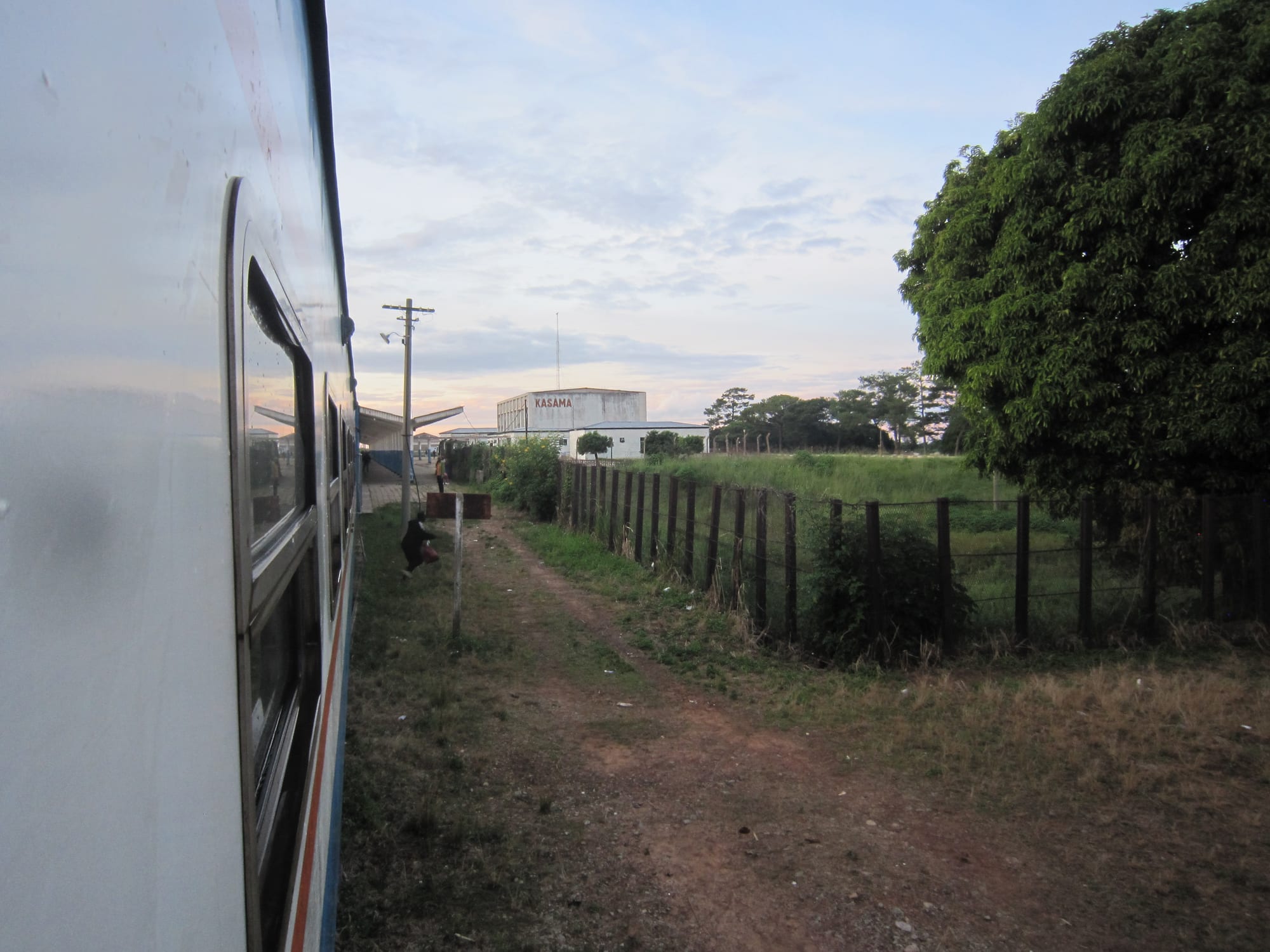
A train standing beside a dirt path at Kasama station, with a low white station building lettered KASAMA and green bush beyond

Kasama, Bangweulu & the North, Zambia

Kasama

A TAZARA train at Kasama station, the main town of northern Zambia. (Peter in s / Wikimedia Commons · CC BY 4.0)

The capital of Zambia's Northern Province and the main town of the Bemba heartland, on the high, wet plateau of northern Zambia, south of Lake Tanganyika. A mission and administrative centre that later gained a TAZARA railway station and an airport, it is the base for the Mwela rock paintings and the Chishimba falls nearby.

Neighbourhoods

  • The town centre
    • First-time visitors
    • Shopping
    • Close to public transport

    A small grid of shops, banks, government offices, guesthouses and bars around the main road, with the market and the minibus and bus ranks alongside. Almost everything a visitor needs is within a few streets, and trade is busiest in the morning.

    Open in Maps
  • The boma and mission quarter
    • History
    • Quiet and residential
    • Churches

    The older administrative ground where the colonial offices were built, near the Catholic mission institutions established by the White Fathers. Brick buildings, schools, a hospital and shaded avenues sit apart from the commercial streets.

    Open in Maps
  • The station area
    • Transport
    • Local life

    The district around the TAZARA railway station on the edge of town, with freight sheds, small traders and lodgings that fill on train days. It is quiet between services and busy when a train from Kapiri Mposhi or Dar es Salaam arrives.

    Open in Maps
  • The township neighbourhoods
    • Local life
    • Markets
    • Street food

    The residential areas spreading out from the centre, where most of Kasama lives in small brick houses with maize and cassava gardens behind them, served by neighbourhood markets, bars and churches.

    Open in Maps

Things to do

Rock art and waterfalls

  • Mwela Rock Paintingslandmark

    One of the largest concentrations of rock art in southern Africa, spread over granite boulders and shelters about five kilometres east of the town and protected as a national monument since 1964.

    Open in Maps
  • Chishimba Fallsattraction

    Three separate waterfalls and rapids on the Luombe River, dropping about 60 metres in all, roughly 40 kilometres north-west of Kasama and listed among Zambia's national monuments.

    Open in Maps

In the town

  • Kasama marketmarket

    The town's main market, trading cassava and maize meal, dried fish from the northern lakes, groundnuts, mushrooms in season and household goods.

    Open in Maps
  • Kasama railway stationtransit hub

    The TAZARA station on the line between Kapiri Mposhi and Dar es Salaam, the busiest point in town when a train is due.

    Open in Maps
  • Kasama Airporttransit hub

    The small provincial airport on the edge of town, handling small aircraft, with an upgrade to take larger ones completed in 2023.

    Open in Maps

Short trips from the town

  • Mungwineighborhood

    The district east of Kasama where the Bemba paramount chief, the Chitimukulu, keeps his headquarters, in farming country of villages and miombo woodland.

    Open in Maps

Seasonal events

  • Independence Day24 October

    Parades, church services and sport mark the national holiday in the provincial capital.

Eat and drink

Long-standing places and food districts in Kasama. Hours, ratings and directions come from your maps app, always current.

Where people eat in Kasama

  • Town-centre eating housesrestaurant

    Plain restaurants near the market serve nshima — often made with cassava meal here — with beans, greens in groundnut sauce, dried fish or chicken.

    Open in Maps
  • Kasama marketmarket

    Cassava and finger millet meal, smoked and dried fish from Bangweulu and Lake Tanganyika, groundnuts, honey and wild mushrooms in the rains.

    Open in Maps
  • Grills and barsrestaurant

    Charcoal grills and bars around the centre cook beef, goat and chicken, served with nshima or chips, and pour bottled lager and Chibuku.

    Open in Maps

Experience Kasama

History

The granite hills around Kasama hold rock paintings made by Stone Age hunter-gatherers up to two thousand years ago, and the Mwela site east of the town is one of the largest concentrations of rock art in southern Africa. Farming communities later settled the plateau, and from the eighteenth century the area became the centre of the Bemba kingdom, whose paramount chief, the Chitimukulu, built power through control of ivory, raiding and trade with Swahili-Arab caravans coming inland from the east coast.

The British South Africa Company and the Catholic missionaries of the White Fathers arrived in the 1890s, and Kasama was established as the administrative boma for the surrounding district around the turn of the century, with mission stations founded nearby. During the First World War it was briefly occupied by German forces from East Africa, in the last days of the campaign that ended with the surrender at Abercorn — now Mbala — in November 1918.

The town grew slowly as a government and mission centre. Northern Province became a nationalist stronghold in the 1950s and 1960s, and after independence in 1964 Kasama was confirmed as its capital. The Chinese-built TAZARA railway, opened in the 1970s to carry copper to Dar es Salaam without crossing white-ruled Rhodesia, passes through the town and gave it a station and a share of the freight trade. Since then Kasama has remained what it has long been: the administrative, commercial and educational centre of a large, rural and predominantly farming region.

Culture & Customs

Kasama is the cultural capital of the Bemba, whose language has spread far beyond the group itself to become the common speech of northern Zambia and the Copperbelt. The Chitimukulu, whose headquarters lie in Mungwi district east of the town, remains an important figure, and the chiefs beneath him control customary land and settle disputes; installation ceremonies and royal observances are followed closely across the province, and the province's Ukusefya Pa Ng'wena is one of Zambia's government-recognised traditional ceremonies, its name recalling Ng'wena, the first capital of the Bemba kingdom.

Bemba tradition recalls the migration of the people eastward from the Luba lands and the founding of the chieftaincy, whose royal clan takes the crocodile, ing'wena, as its totem. Older practices persist in village life, among them chitemene, the system of lopping and burning miombo branches to fertilise millet gardens, and the seasonal round of initiation and marriage rites for which the Bemba are well known.

Catholicism is unusually strong here, the legacy of the White Fathers missions, and mission schools have long given the province an educated class out of proportion to its wealth; other churches have grown alongside. The north is known elsewhere in Zambia for its blunt political talk and its humour, and Kasama's bars, markets and radio stations trade in both. Greetings are formal and unhurried, and respect for elders and chiefs is expected.

Daily Life

Kasama counted about 114,000 people in 2010 and has grown since, while the surrounding district adds many more living in villages and small settlements rather than in the town itself, which remains compact. Residents live mainly in low-rise neighbourhoods of brick houses with gardens behind, and the centre is for trade and offices rather than housing.

The economy is government, farming and trade. Provincial administration, schools, colleges and a hospital employ a large share of the town's salaried workers, while the countryside grows cassava, finger millet, maize, beans and groundnuts, much of it for subsistence. Dried and smoked fish from Bangweulu, Mweru and Lake Tanganyika passes through on its way to the Copperbelt, and traders bring goods north from Lusaka. Honey from the miombo woodland and small-scale timber add income.

The rhythm of the year is set by the rains. Fields are prepared and planted from November, and the wet season makes many roads difficult, which shapes what can be bought and sold; the dry months from May bring travel, ceremonies and building work. Everyday concerns are the price of fertiliser and mealie meal, the state of the roads, and jobs for young people, many of whom leave for the Copperbelt or Lusaka. Power cuts during drought years reach the north as they do the rest of the country.

Food

Northern Zambia is cassava country, and here nshima — ubwali in Bemba — is often made from cassava meal, or from a mixture of cassava and finger millet, rather than the white maize meal used further south. It is eaten by hand with a relish, and in the north the relish is above all fish: fresh or smoked bream and catfish from the lakes and rivers, and small dried fish from Bangweulu and Lake Tanganyika.

Ifisashi, greens simmered in pounded groundnuts, is the everyday vegetable dish, along with pounded cassava leaves, beans and okra. Chikanda, the firm savoury loaf of wild orchid tubers and ground peanuts known as African polony, is a Bemba speciality of this region, sold sliced in markets and bars. Village chicken and goat appear at ceremonies and in the grills around the centre.

The woodland supplies a great deal. The rains bring wild mushrooms, sold in heaps by the roadside, and edible caterpillars, dried and fried with onion and tomato; honey is collected from miombo hives; and flying termites are eaten after the first storms. To drink there is munkoyo, the lightly fermented maize-and-root drink, home-brewed millet beer in the villages, cartons of thick Chibuku in the bars, and bottled Mosi lager with very sweet tea in the mornings.

Planning tools

Budget

Kasama is among the cheapest places to travel in Zambia, because very little here is priced for tourists: government rest houses and small lodges, market food and local buses. Costs rise only when a vehicle has to be hired to reach the falls, the rock art or the wetlands further out.

Daily Budget Midrange
USD 100–250 (lodge room, restaurant meals, a hired 4x4 with driver for the falls and rock art)
Daily Budget Shoestring
USD 30–60 (guesthouse, market and canteen meals, buses and shared taxis)

Carry enough kwacha cash: ATMs exist in the town but are scarce beyond it, and card acceptance is limited.

Best Time to Visit

May to October is the dry season, when the roads are passable and travel in the north is straightforward. The waterfalls are at their fullest early in that window, roughly April to June. The rains from November to April are heavy on this plateau and turn side roads to mud, though the countryside is at its greenest.

Suggested Number of Days

A day or two is enough for the town and the rock art on its edge. Three to five days suit a wider trip through the north, taking in waterfalls, the Bemba chiefdoms and the road towards Mbala and Lake Tanganyika. Road conditions, not distance, decide how long anything takes.

First Visit
1–2 days
With Surroundings
3–5 days

Transportation

Minibuses and shared taxis run within the town and to nearby villages, and long-distance coaches use the Great North Road towards Mpika, Lusaka and the Tanzanian border. TAZARA trains call at Kasama on the line between Kapiri Mposhi and Dar es Salaam. Reaching the falls and rock art means hiring a vehicle or a taxi for the trip.

Hire a taxi or a 4x4 with a driver for the day to reach sights outside town, and agree the fare before setting off.

Airport & Station Connections

Kasama lies off the Great North Road, roughly 850 km from Lusaka, a very long day or an overnight coach journey away, with buses running daily. TAZARA trains stop here on the Kapiri Mposhi to Dar es Salaam route, and and the small airport on the edge of town takes small aircraft, its upgrade to handle larger ones completed in 2023.

Walkability

The centre is compact and flat enough to walk: the market, banks, bus rank and most lodgings are within a few blocks. Pavements are limited, and the station, the airport and the residential areas are a long walk or a short taxi ride out. Streets are poorly lit after dark, and the sights outside town are too far to reach on foot.

Safety

Kasama is quiet and crime aimed at visitors is rare. The risks are those of a remote region: long journeys on poor roads, limited medical care, patchy mobile coverage outside the town, and high malaria transmission in the wet season. Crocodiles and bilharzia make swimming in rivers and lakes unwise.

Carry water, fuel and a spare tyre on rural roads, travel by day, and arrange guides for the wetlands and waterfalls. Take malaria precautions year-round. Check current official travel advice before travelling.

Climate

The plateau lies well above 1,000 metres, so temperatures are mild for the latitude, and this is among the wettest parts of Zambia. The rains run from November to April and are heavy; May to August is dry with cool nights; September and October are hot and hazy before the rains return.

Summer
December to February is warm, humid and very wet, with days around 25–28°C
Winter
June and July are dry and sunny, with days around 22–26°C and cool nights

Local Customs

This is the Bemba heartland, and Bemba is spoken almost universally alongside English. The paramount chief, the Chitimukulu, and the lesser chiefs hold real authority over customary land and are treated with formality. Catholicism is strong, a legacy of the White Fathers missions, and churches shape the week. Greetings are unhurried and elders are addressed first.

Dress modestly, ask before photographing people or ceremonies, and avoid photographing government buildings, the railway and police or military posts. A small payment or a guide is usual at the rock art and falls.

Common Payment Methods

The currency is the Zambian kwacha, and cash is what most transactions use. Banks and ATMs are in the town centre, but they are scarce in the surrounding districts, and card payment is limited to a few lodges and supermarkets. Mobile money is widely used by residents.