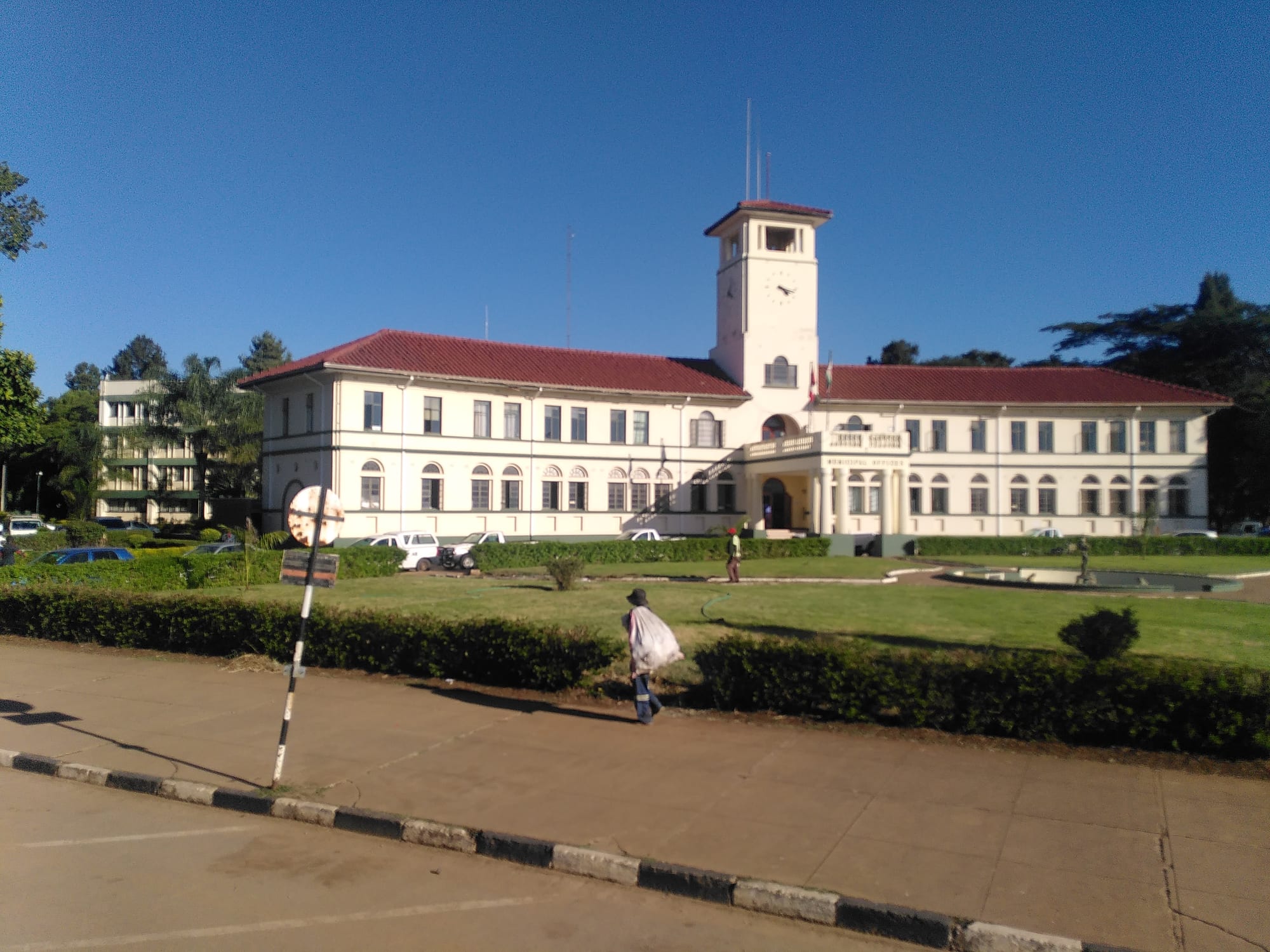
A long white two-storey civic building with a red roof and a clock tower, cars parked in front and lawns and clipped hedges in the foreground

Great Zimbabwe, Masvingo & the Midlands, Zimbabwe

Gweru

The municipal offices in the centre of Gweru, the capital of Zimbabwe's Midlands province. (Peter in s / Wikimedia Commons · CC BY-SA 4.0)

The capital of Zimbabwe's Midlands province, on the highveld midway along the road and railway between Harare and Bulawayo. Founded in 1894 as Gwelo and renamed after independence, it grew as a railway, garrison and light-industrial town, and is now a university city with a military museum and a game park on its edge.

Neighbourhoods

  • The city centre
    • First-time visitors
    • Shops and banks
    • Close to public transport

    A grid of wide streets laid out around the railway, with the municipal offices and their clock tower, shops, banks and colonial-era buildings under jacarandas. The bus ranks, the main market and most of the city's hotels are within a few blocks.

    Open in Maps
  • Mkoba
    • Local life
    • Markets
    • Music and nights out

    The largest high-density suburb, a string of numbered villages west of the centre built from the 1960s onwards, now home to a large share of the city's population. It has its own markets, bars, churches and a teachers' college, and kombis run constantly to town.

    Open in Maps
  • Mtapa and Senga
    • Local life
    • Students
    • Quiet and residential

    Mtapa is an older working-class suburb north of the centre; Senga, to the south-east, is a mixed residential area that grew around Midlands State University and is full of student lodgings, tuckshops and small takeaways.

    Open in Maps
  • Windsor Park and the eastern suburbs
    • Quiet and residential
    • Gardens

    Low-density suburbs of large plots, hedges and old shade trees east of the centre, laid out in the colonial period for white residents and now mixed. Guesthouses, schools and sports clubs are scattered among the houses.

    Open in Maps

Things to do

Museums and landmarks

  • Military Museummuseum

    The city's military and aviation museum, with aircraft, armoured cars, uniforms and weapons in its grounds and galleries.

    Open in Maps
  • Boggie Clock Towerlandmark

    A memorial clock tower at the corner of Main Street and Robert Mugabe Way, built in 1928 in memory of Major William James Boggie and long the city's best-known landmark.

    Open in Maps
  • Midlands State Universityattraction

    A large state university created by an Act of Parliament in 1999 on the edge of the city, whose students shape the life of the surrounding suburbs.

    Open in Maps

Wildlife and the outdoors

  • Antelope Parkpark

    A privately run game park on open grassland outside the city, best known for its lion programme, and one of the Midlands' main draws for visitors.

    Open in Maps

Short trips from the city

  • Kwekweattraction

    A gold-mining town on the Harare road whose National Mining Museum is housed partly in the Paper House, a prefabricated wood-framed building shipped from Britain in 1894.

    Open in Maps
  • Shurugwiattraction

    A chrome-mining town in the hills of the Great Dyke, reached by the winding Boterekwa pass, which drops through granite and msasa woodland with long views over the valley.

    Open in Maps

Eat and drink

Long-standing places and food districts in Gweru. Hours, ratings and directions come from your maps app, always current.

Gweru classics

  • Sadza and relishrestaurant

    Stiff maize-meal sadza eaten by hand with muriwo greens, beans, dried matemba fish or a beef or goat stew, the standard plate in cafés and takeaways across the city.

    Open in Maps
  • Braai beefrestaurant

    Midlands ranching country means plentiful beef, grilled over coals and served with sadza and a tomato-and-onion relish, the usual food for a weekend gathering.

    Open in Maps
  • Road runner chickenrestaurant

    Free-range village chicken stewed slowly with tomato and onion, valued well above commercial broiler meat and common on local menus.

    Open in Maps

Markets and food streets

  • The city centre food stallsneighborhood

    Bakeries, grills, butcheries and takeaway counters cluster around the bus ranks and the main streets, selling chicken and chips, meat pies, bread and sadza plates through the day.

    Open in Maps
  • Kudzanayi market areamarket

    The produce trade around the long-distance bus terminus, with vegetables, tomatoes, maize, groundnuts and roasted cobs sold from stalls and braziers.

    Open in Maps
  • Mkoba's bars and takeawaysneighborhood

    The suburb's shopping centres have bottle stores, braai stands and small kitchens where Chibuku sorghum beer, grilled meat and sadza are the evening order.

    Open in Maps

Experience Gweru

History

Gweru began in 1894, when Leander Starr Jameson's administration laid out a military outpost beside the Gweru River — a place the Ndebele knew for its steep banks — where the wagon roads of the new colony crossed, on land taken after the war against the Ndebele kingdom the year before. The railway from Bulawayo reached it in 1902 and the line north followed, fixing the town as a junction halfway between the two largest centres and giving it the yards, workshops and warehouses that shaped its first half-century.

Around it lay the mining country of the Great Dyke — gold at Kwekwe, chrome and asbestos in the hills towards Shurugwi and Zvishavane — and ranching on the open highveld, and Gwelo became the commercial and administrative centre for both. An air base was built on Thornhill farm outside the town from 1941, and training began there in 1942 under the Royal Air Force scheme that trained aircrew in Southern Rhodesia during the Second World War; the base remained in use afterwards, and light industry, shoe and clothing factories among them, grew in the post-war decades. The town gained municipal status in 1914 and was declared a city in 1971.

At independence in 1980 it became the capital of the Midlands province, and soon afterwards Gwelo was renamed Gweru, after the river. Parts of the province were caught up in the Fifth Brigade's Gukurahundi campaign of the 1980s. The factories thinned during the economic crises that began in the 1990s and deepened after 2000, and the city's centre of gravity shifted towards education and services: a university was established in 1999 and grew quickly, and the colleges, schools and hospitals are now among the largest employers.

Culture & Customs

Gweru sits on the linguistic frontier between Shona and Ndebele, and that mixture defines it. Both languages are heard in the streets and markets, many families have roots in both, and English works as the common language of offices, shops and the university. It gives the city a reputation among Zimbabweans for being less partisan than either Harare or Bulawayo, and its residents are used to switching languages mid-conversation.

It is above all a student city. Midlands State University, a teachers' college in Mkoba and several technical and nursing colleges fill the suburbs with young people in term time, and with them come cheap eating places, bars, church fellowships, sports fixtures and a steady turnover of music and slang. Sungura, gospel and Zimbabwean hip hop play from bottle stores and kombis; football and, less loudly, cricket and athletics are followed through the school and club system.

Church life is strong and varied, from the Catholic and Reformed missions of the colonial period to Pentecostal halls and the white-robed apostolic congregations that gather under trees at the edge of town on Sundays. Family ceremonies — funerals, memorial rituals for ancestors, lobola negotiations — bring relatives back from Harare, Bulawayo and South Africa. Manners are formal: greetings before anything else, deference to elders, and a handshake supported at the wrist.

Daily Life

About 160,000 people live in Gweru, which makes it one of Zimbabwe's larger cities without being anything like Harare or Bulawayo in scale. Most live in the high-density suburbs west and north of the railway, Mkoba above all, and commute to the centre by kombi; the low-density eastern suburbs of large gardens and old trees are quieter and wealthier.

Work is in government offices and the provincial administration, the university and colleges, schools and hospitals, retail, transport along the highway and what remains of the light industry that once made shoes, clothing and ferrochrome products. The mines of the Great Dyke and the farms and cattle ranches around the city underpin much of the rest, and a large informal sector — vendors, tuckshops, minibus crews, small-scale gold panners — absorbs those without formal jobs.

The working day starts early and the ranks are busiest before seven. Power cuts are routine, so shops run generators and households cook and charge phones around the schedule; water supply is intermittent in parts of the city. Drought years, including 2024, push up the price of maize meal and bring rural families into town to trade. Most prices are quoted and paid in US dollars, with the ZiG alongside, and small change is a daily problem.

Food

Sadza carries every meal: a stiff porridge of white maize meal, eaten by hand and dipped into a relish. The everyday relishes are muriwo — covo, rape or pumpkin leaves stewed with tomato and onion, often enriched with peanut butter — beans, matemba (small dried fish), and, in a ranching province, beef, either stewed or grilled over coals. Goat is the meat of ceremonies, and mazondo, slow-cooked trotters, are a favourite in the beer gardens.

Road runner, the free-range village chicken, is the dish people ask for when they want something better than a broiler: tougher meat, longer cooking, more flavour. Groundnuts run through the cooking, in relish, in rice cooked with peanut butter, and roasted and sold in cones; madora, the dried and fried mopane worms brought up from the lowveld, are eaten as a crisp, salty relish.

Street and market food is simple and cheap — maputi, or puffed maize, by the bag; roasted maize cobs over braziers; bread and meat pies from the bakeries; chicken and chips from the takeaway counters around the ranks. To drink there is maheu, the thick fermented maize drink, sour milk taken with sadza, opaque Chibuku sorghum beer in cartons at the bottle stores, bottled lagers and Mazoe orange cordial at home.

Planning tools

Budget

Gweru is inexpensive by Zimbabwean standards, with cheap guesthouses and hotels in the centre, student-priced food in Senga and Mkoba, and kombis that cost a few cents. The game park on the edge of the city and its activities are priced separately and in US dollars, and a hire car is the main extra cost for anyone wanting to reach Shurugwi or Kwekwe.

Daily Budget Midrange
USD 100–250 (hotel or lodge, restaurant meals, car hire and paid activities)
Daily Budget Shoestring
USD 30–55 (guesthouse, market and takeaway food, kombis and buses)

Carry small, clean US dollar notes for transport, markets and fuel, as change is scarce and cards work only in the larger hotels.

Best Time to Visit

April to October is dry and clear, good for the museum, the game park and the drive over the Boterekwa pass, though June and July nights on the highveld are cold. The rains from November to March turn the Midlands green but bring heavy afternoon storms, and October before the break is hot and dusty.

Suggested Number of Days

A day covers the city itself. Two or three allow for the game park, the hills to the south-east and the mining towns along the highway, and travellers breaking the Harare–Bulawayo journey often stop only for a night. Public transport rather than a car adds time.

First Visit
1 day
With Surroundings
2–3 days

Transportation

The centre is compact and walkable, and kombis (minibuses) run from the ranks to Mkoba, Senga, Mtapa and the outer suburbs all day for a few cents. Taxis wait at the ranks and the hotels. Long-distance coaches on the Harare–Bulawayo route stop in the city, and a hire car is needed for the game park and the surrounding towns.

Fix a taxi fare before getting in, and expect kombis to leave only when they are full rather than to a timetable.

Airport & Station Connections

Gweru sits on the main highway and railway between Harare and Bulawayo, about 275 kilometres south-west of the capital and about 165 kilometres north-east of Bulawayo — roughly three to four hours from either by road. Coaches and kombis on that route are how most people arrive, and the city stands on the Bulawayo–Harare railway line. The nearest airports with regular flights are at Harare and Bulawayo, and the air base at Thornhill outside the city is military.

Walkability

The colonial grid of the centre is easy and pleasant on foot, with wide streets, shade trees and short blocks between the shops, the municipal offices and the bus ranks. The suburbs are further out than they look — Mkoba and Senga are kombi rides rather than walks — and pavements thin out beyond the centre. Streets are unlit during power cuts.

Safety

Gweru is a calm city where the ordinary concerns are pickpocketing around the bus ranks and markets, walking alone after dark, and traffic on the busy Harare–Bulawayo highway, which is dangerous at night. Informal gold-mining sites in the surrounding Midlands are best avoided, and police roadblocks are common on the roads out of town.

Take malaria precautions in the low-lying areas, avoid political gatherings, don't drive at night, keep documents and small change ready for roadblocks, and don't swim in still fresh water outside managed sites. Check current official travel advice before travelling.

Climate

Gweru stands on the highveld, which keeps it temperate for its latitude. Summer, December to February in the southern hemisphere, is warm and wet; winter is dry, sunny and cold at night. Drought is a recurring problem in the region, as in 2024.

Summer
warm and wet, with days around 25–28°C and afternoon thunderstorms
Winter
dry and sunny with days around 21–24°C and nights that can fall to freezing

Local Customs

The Midlands is a meeting ground of Shona and Ndebele speakers and the city is bilingual, with English used in offices and shops. Greetings come before business, an older person is greeted first, and both hands or a slight bow show respect. Dress in town is neat and modest, and churches are well attended on Sundays.

Ask before photographing people or market stalls, and do not photograph the air base, soldiers, police, roadblocks or government buildings. Tipping is not obligatory, though guides and drivers appreciate small US dollar notes.

Common Payment Methods

Most transactions are in US dollars in practice, alongside the gold-backed ZiG introduced in 2024. Bring clean, recent dollar notes in small denominations, since change is a constant difficulty. Cards are taken at larger hotels and some fuel stations, mobile money is widely used by residents, and ATMs cannot be relied on.