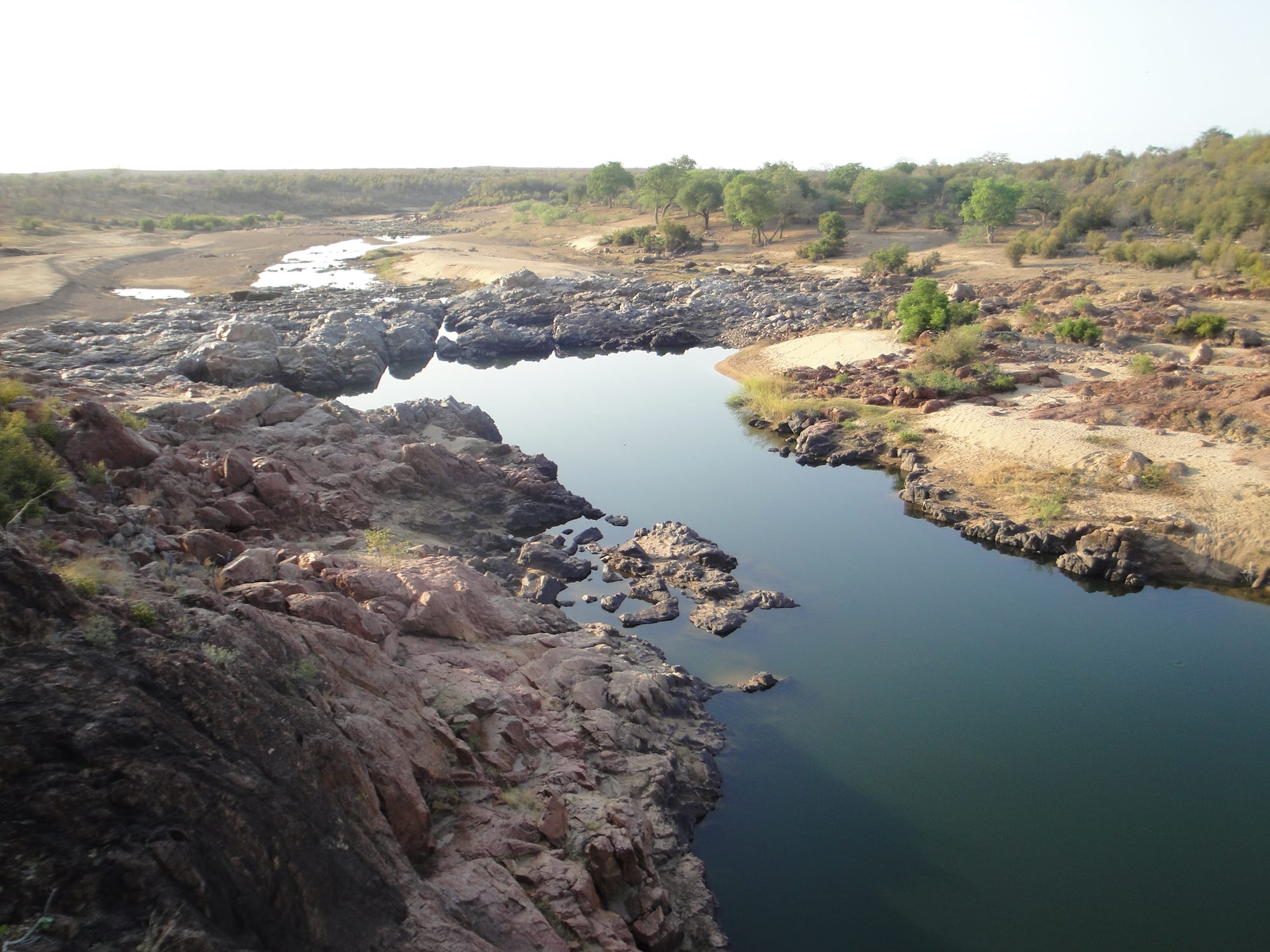
A still dark river winding between pinkish rock slabs and sandbanks, with dry bush on the far bank

Zimbabwe

Great Zimbabwe, Masvingo & the Midlands

The Makokwani Pools on the Mwenezi River in Gonarezhou National Park. (Babakathy / Wikimedia Commons · CC0)

South-central Zimbabwe — the Midlands mining and farming belt around Gweru and Kwekwe, and Masvingo Province, which falls from the plateau to the hot south-eastern lowveld. It holds the stone city of Great Zimbabwe that gave the country its name, the Mutirikwi lake beside it and the wild Gonarezhou park on the Mozambican border.

Explore Great Zimbabwe, Masvingo & the Midlands

History

The region is the cradle of the Zimbabwe state. From about the eleventh century, ancestors of the Shona built stone enclosures on the plateau south-east of present Masvingo, and by the thirteenth and fourteenth centuries Great Zimbabwe was the capital of a state that controlled gold and ivory trade with the Swahili coast; Chinese pottery, Arabian coins and glass beads have been found on the site. It declined in the fifteenth century, and the tradition continued at Khami in the south-west.

European colonists long refused to believe that Africans had built the city, attributing it to Phoenicians or the Queen of Sheba. The first scientific excavations, in 1905–06, began the long work of refuting those theories, which dominated writing on the site through the twentieth century. After independence the country took its name from the site, and the soapstone Zimbabwe Bird found there became the national emblem.

Fort Victoria, now Masvingo, was founded by the Pioneer Column in 1890, one of the first settler towns in the country. Gweru and Kwekwe grew as railway and gold towns, and the Great Dyke gave the Midlands chrome, platinum and asbestos mines. During the Gukurahundi of the 1980s, the Fifth Brigade's campaign also extended to parts of the Midlands. In the lowveld, irrigated sugar estates at Triangle and Hippo Valley, fed by the Mutirikwi dam from 1960, transformed the south-east.

Culture & Customs

Most of Masvingo Province speaks the Karanga dialect of Shona, and the area around Great Zimbabwe is regarded as a spiritual heartland. In the lowveld live Shangaan (Tsonga) communities, part of a people spread across South Africa, Mozambique and Zimbabwe.

The Midlands is a meeting ground of Shona and Ndebele, and towns such as Gweru are bilingual; intermarriage and mixed neighbourhoods are common. Gweru is a university city, home to Midlands State University, and has an air force base and the Military Museum.

Religious life is diverse, from Reformed and Catholic missions founded in the colonial era to apostolic churches and ancestral rituals. Mission boarding schools such as Gokomere and Pamushana are among the most respected in the province, and their teachers' colleges draw students from across the south.

Daily Life

Gweru, with about 150,000 people, is the largest town in the region and the capital of the Midlands, and other towns include Kwekwe, Masvingo, Zvishavane and the lowveld town of Chiredzi. Most people live in villages, farming maize and other crops.

Mining drives the Midlands economy: gold around Kwekwe, chrome and platinum along the Great Dyke, and a huge informal sector of small-scale gold miners. The Redcliff steelworks near Kwekwe, once a pillar of industry, closed during the economic crisis of the 2000s. In Masvingo Province, sugar estates in the lowveld and cattle ranches employ many, and Bikita has a lithium mine.

Drought is the recurring hardship in the south, and currency turmoil, from hyperinflation to the ZiG, pushes most trade into US dollars. Many young people work in South Africa, which lies just down the highway from Masvingo.

Food

Sadza from maize is eaten daily with muriwo greens, beans, dried fish or stewed meat, and peanut butter thickens many relishes. Beef is plentiful in ranching country, and rice cooked with peanut butter and sour milk with sadza are familiar dishes here as across Zimbabwe.

The lowveld gives distinctive wild foods. Mopane worms, called madora, are harvested in the mopane woodlands and fried until crisp, and the dry, powdery pulp of baobab fruit is eaten in season.

Maheu, the non-alcoholic fermented maize drink, and home-brewed sorghum beer are central to gatherings and ceremonies, and Chibuku sells widely in the towns.

Attractions & Natural Wonders

Great Zimbabwe, a UNESCO World Heritage Site near Masvingo, is the region's centrepiece. The Hill Complex crowns a granite ridge with walls built around boulders, and below it the Great Enclosure, with walls about 11 metres high and a conical tower, is part of the largest stone structure in precolonial Southern Africa. Soapstone bird carvings found at the site inspired the national emblem.

Next to the ruins, Lake Mutirikwi fills a valley among granite hills, with a recreational park on its northern shore. Far to the south-east, Gonarezhou National Park, part of the Great Limpopo Transfrontier Park, protects baobab woodland, large elephant herds and the sandstone Chilojo Cliffs above the Runde River.

In the Midlands, Gweru has Antelope Park and the Military Museum, and Kwekwe has the National Mining Museum, housed in the Paper House, a prefabricated wood-framed building shipped from the United Kingdom in 1894.

Cities in Great Zimbabwe, Masvingo & the Midlands

Planning basics

Budget

This is one of the cheaper parts of Zimbabwe to travel. Masvingo, Gweru and Kwekwe have inexpensive hotels and guesthouses, and Great Zimbabwe has a site hotel, lodges and a campsite nearby. Gonarezhou is the exception: its campsites are simple but the park is remote, and reaching it usually means a 4x4 and fuel for long distances, or an upmarket camp.

Daily Budget Midrange
USD 100–250 (lodges, car hire, guided visits; more for Gonarezhou)
Daily Budget Shoestring
USD 35–60 (guesthouses or camping, buses, site entry at Great Zimbabwe)

Carry small US dollar notes; fuel and cash are hard to find once past Chiredzi on the way to Gonarezhou.

Safety

The towns are generally calm, though the Harare–Beitbridge highway carries heavy truck traffic and is dangerous at night. Informal gold-mining sites in the Midlands are best avoided. Gonarezhou is remote, with elephants that can be wary of vehicles.

Drive only by day, avoid informal mining sites, and give elephants plenty of space in Gonarezhou. Check current official travel advice before travelling.

Climate

The Midlands around Gweru sit on the highveld, with warm, wet summers and dry winters with cold nights. Masvingo is a little lower and warmer, and the south-eastern lowveld around Chiredzi and Gonarezhou is hot and dry, with some of Zimbabwe's highest temperatures and least reliable rains.

Summer
warm and wet on the plateau at 25–30°C; very hot in the lowveld, often above 35°C
Winter
dry and sunny with days around 20–24°C and cold nights on the plateau; warm in the lowveld

Transportation

Masvingo lies on the main highway between Harare and Beitbridge, about four hours by road from the capital, and Great Zimbabwe is a short drive south-east of the town. Gweru and Kwekwe are on the Harare–Bulawayo highway and railway. Chiredzi is the gateway to Gonarezhou, and park tracks require a high-clearance 4x4. Long-distance buses link the main towns, while local kombis serve the smaller centres.

Visit Great Zimbabwe with a guide from the site museum, and travel to Gonarezhou fully self-sufficient or with an operator.

Best Time to Visit

April to October suits Great Zimbabwe and the Midlands, with dry weather and clear skies; June and July mornings are cold. Gonarezhou is best from about May to October, when game gathers at the rivers, and many of its tracks become impassable in the rains from November to March.