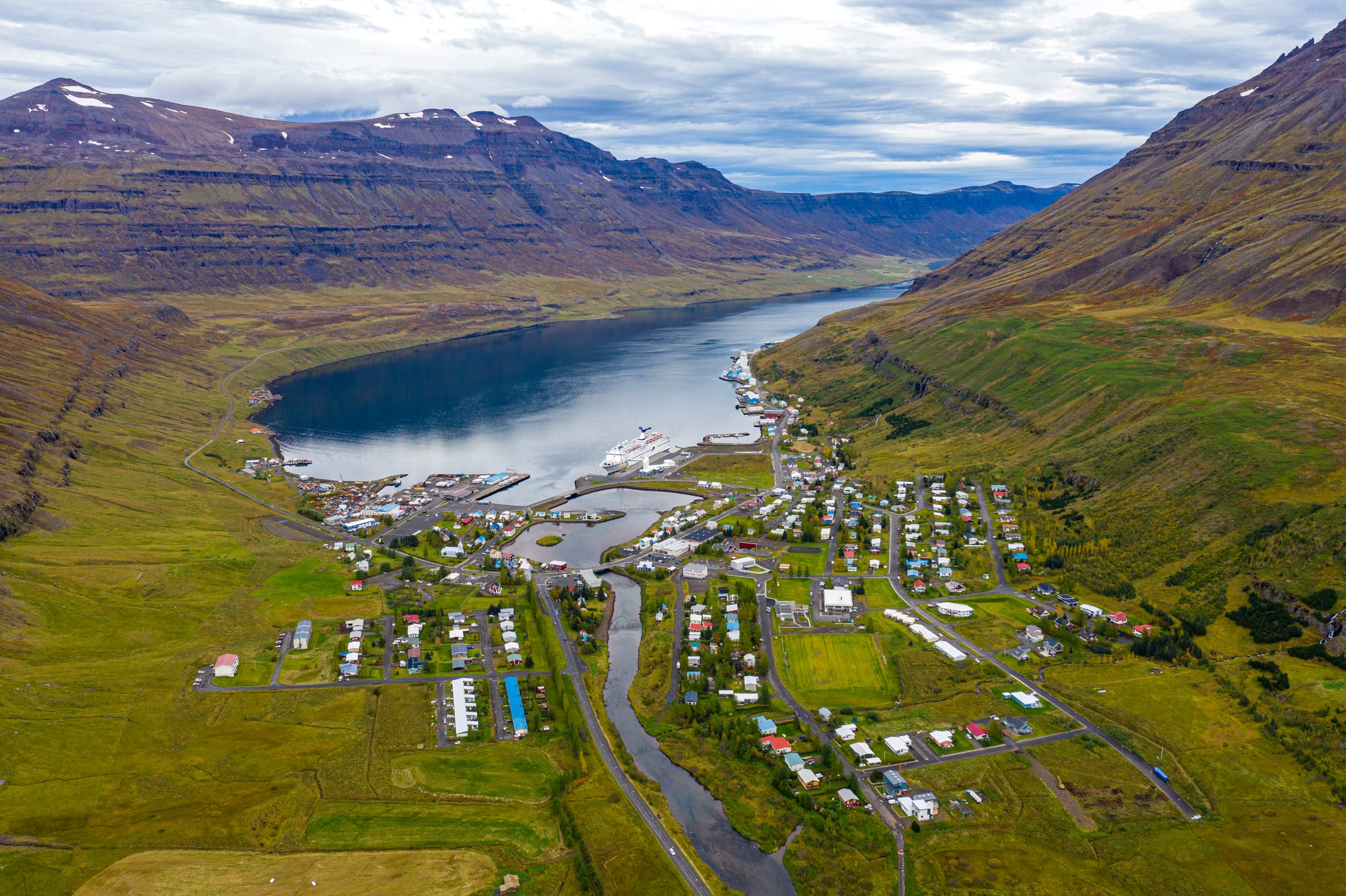
Aerial view of Seyðisfjörður town at the head of a narrow fjord between steep terraced mountains, a ship at the quay

Iceland

East Iceland

Seyðisfjörður at the head of its fjord, seen from above in September 2019. (Kasa Fue / Wikimedia Commons · CC BY-SA 4.0)

Iceland's far side, some 650 to 700 kilometres from Reykjavík whichever way round the Ring Road — a coast of narrow fjords and fishing villages from Vopnafjörður south to Djúpivogur, the farming valley and forest around Egilsstaðir and the Lagarfljót lake, reindeer highlands rising to Snæfell, and in the south-east corner the langoustine port of Höfn beneath the outlet glaciers of Vatnajökull.

Explore East Iceland

History

The east was the first landfall for ships from Norway. By saga tradition the Faroese Viking Naddoddur was blown ashore at Reyðarfjörður in the 9th century, saw no smoke from a mountain top and sailed home calling the place Snowland, and Papey island is named for the Irish hermits, the papar, whom the Norse said they found here. Hrafnkels saga is set among the chieftains and farmers of the east. Skriðuklaustur in Fljótsdalur, the last monastery founded in Catholic Iceland, opened in 1493 and served as a hospital until the Reformation closed it. In 1627 the Barbary corsairs who went on to strike the Westman Islands raided the farms around Djúpivogur first and carried off about 110 people.

The modern towns were made by foreigners: Norwegian herring men built Seyðisfjörður in the late 19th century, the first telegraph cable linking Iceland to Europe came ashore there in 1906, and French fishermen used Fáskrúðsfjörður as their base into the 1930s, leaving a hospital and a cemetery of 49 graves. Askja's eruption in 1875 triggered a wave of emigration to North America. Allied forces used Seyðisfjörður as a base in the Second World War, and German aircraft crippled the tanker El Grillo there in 1944.

Egilsstaðir was founded only in 1947, as a service town at the Lagarfljót bridge, and Höfn was joined to Reykjavík by road only when the last bridges of the Ring Road opened in 1974. The Kárahnjúkar dam, built between 2003 and 2009 to power Alcoa's aluminium smelter at Reyðarfjörður, flooded highland wilderness and has been a constant source of protest and controversy. Avalanches killed twelve people in Neskaupstaður in 1974, and in December 2020 mudslides after days of heavy rain destroyed more than ten buildings in Seyðisfjörður.

Culture & Customs

Seyðisfjörður, with fewer than 700 people, is one of the country's art towns. The Skaftfell centre was founded in 1998, after the Swiss artist Dieter Roth, who had a studio here, helped start an art collective in the town; and above the town stands Tvísöngur, five linked concrete domes tuned to the fifths of Icelandic two-part song. In midwinter the sun stays behind the mountains, and its return is a moment the town marks.

Each village has its weekend. The Bræðslan music festival brings musicians to Borgarfjörður eystri each summer; Eistnaflug brings heavy metal to Neskaupstaður, a town nicknamed Little Moscow for its strong socialist tradition; Fáskrúðsfjörður, whose street signs are in Icelandic and French, keeps its French graves; and Höfn celebrates its langoustine at Humarhátíð. Borgarfjörður eystri is also the stronghold of belief in the hidden people — the rock Álfaborg is said to be the seat of the elf queen — and was the childhood home of the painter Jóhannes Kjarval, whose altarpiece in the village church shows Christ on an elf hill.

The east's emblem is the reindeer, brought from Norway in the 18th century and surviving nowhere else in Iceland; the autumn hunt, run on a strict quota, is a regional institution. Djúpivogur, the only Icelandic member of the Cittaslow movement of slow towns, has set out 34 large stone eggs by the sculptor Sigurður Guðmundsson at Gleðivík, one for each local nesting bird. Flámæli, a pronunciation heard in the Eastfjords as in the south-west, which blurred i into e and u into ö, was drilled out of schoolchildren in the mid-20th century.

Daily Life

Around 11,000 people live between Vopnafjörður and Djúpivogur, most of them in two large municipalities: Múlaþing, centred on Egilsstaðir (about 2,600 people), and Fjarðabyggð, a federation of fjord towns — Neskaupstaður (1,500), Reyðarfjörður (1,400), Eskifjörður (1,000) and Fáskrúðsfjörður (700) — linked by road tunnels. Höfn and the farms of Hornafjörður, long counted with the east, now look south for their police and parliamentary constituency.

The Alcoa Fjarðaál smelter at Reyðarfjörður, opened in 2007, employs about 450 people. The fjord towns live by fishing and fish processing, with one of Europe's most advanced plants at Neskaupstaður, so a failed capelin season is felt in every household. Salmon pens now occupy several fjords, and sheep graze the inland valleys. In Vopnafjörður the purchase of dozens of farms along the salmon rivers by the British industrialist Jim Ratcliffe prompted a change in the law limiting how much land one owner may hold.

Hot water is scarcer here than in much of Iceland: Höfn gained geothermal district heating only in 2021. Winter isolates: Fjarðarheiði, the 620-metre pass that is the only road to Seyðisfjörður, is often closed, and a long-promised 13-kilometre tunnel remains unbuilt. Avalanche barriers now stand above Neskaupstaður, and whole streets are evacuated when the forecast demands it.

Food

Reindeer is the east's own meat. Some 1,200 to 1,500 animals are shot each year, and from September the restaurants of Egilsstaðir and the fjords serve it as steak, carpaccio, burgers and meatballs, usually with a sauce of crowberries or blueberries. Lamb from the highland pastures of Jökuldalur and Fljótsdalur is the everyday alternative.

Höfn celebrates its humar, the small langoustine grilled in garlic butter or served on pizza and in soup at the harbour restaurants. The fjord towns eat what they land — cod, haddock and wolffish — and dry their own harðfiskur.

The Hérað valley around Egilsstaðir holds Hallormsstaður, the largest forest in Iceland, and berries and mushrooms are gathered in its woods in late summer. Vallanes farm grows organic barley and vegetables and sells them as Móðir Jörð, and Klausturkaffi at Skriðuklaustur is a well-known restaurant. Small breweries have appeared in the villages.

Attractions & Natural Wonders

Egilsstaðir is the hub. The road round Lagarfljót, the 25-kilometre glacial lake said to hide a serpent, passes Hallormsstaður, Iceland's largest forest, the path up to Hengifoss, a 128-metre fall over cliffs banded with red clay, and Skriðuklaustur, with the monastery ruins and the 1939 house of the novelist Gunnar Gunnarsson; from there a road climbs to the Kárahnjúkar dam and the reindeer country below Snæfell, at 1,833 metres the tallest stratovolcano in Iceland not buried under ice. The Vök Baths float on a lake outside town, and to the west in Jökuldalur the Stuðlagil canyon shows walls of basalt columns above a river that runs turquoise in summer.

Seyðisfjörður lies 27 kilometres from Egilsstaðir over Fjarðarheiði, down a valley of waterfalls to the painted timber houses, the blue church and the Tvísöngur sound sculpture. North of it, Borgarfjörður eystri has a large puffin colony by the harbour, the Dyrfjöll peaks, the boulder field of Stórurð and trails to the deserted inlets; further north still is the turf farm of Bustarfell at Vopnafjörður.

South of Seyðisfjörður the Eastfjords unfold one after another: Neskaupstaður under its avalanche walls, the Iceland-spar mine of Helgustaðir near Eskifjörður, the French hospital at Fáskrúðsfjörður, Petra's stone collection at Stöðvarfjörður, and Djúpivogur below the pyramid of Búlandstindur. Beyond the Lón lagoon the road reaches Stokksnes, where the jagged gabbro of Vestrahorn rises above black dunes, and Höfn, whose harbour looks across to the eastern glacier tongues of Vatnajökull — Hoffellsjökull, Fláajökull, Heinabergsjökull and Skálafellsjökull, where snowmobile and super-jeep tours climb onto the ice cap.

Cities in East Iceland

Planning basics

Budget

East Iceland costs much the same as the rest of the country but has fewer visitors and fewer beds, so guesthouses in Seyðisfjörður, Borgarfjörður eystri and Höfn fill early for July and August. Egilsstaðir and Höfn have the budget supermarkets and the cheapest fuel; village shops charge more and close early. The main paid activities are glacier trips from Höfn — a snowmobile or super-jeep tour onto Vatnajökull, a guided glacier walk or a winter ice cave — and the Vök Baths; the puffin colony at Borgarfjörður eystri, Stuðlagil, Hengifoss and nearly every walk are free apart from some parking fees. Campsites and municipal pools are good value.

Daily Budget Midrange
USD 290–490 (guesthouse or farm stay, one restaurant meal a day, a hire car, a glacier tour or the baths)
Daily Budget Shoestring
USD 120–200 (campsite or hostel, supermarket food, a shared hire car)

Fuel and groceries are cheapest in Egilsstaðir and Höfn, so stock up before driving the fjords, and book summer rooms in the small villages well ahead.

Safety

Crime is negligible. The hazards are weather and terrain: fog and snow on the passes, above all Fjarðarheiði; rockfall and violent gusts on the scree slopes of Hvalnesskriður and Þvottárskriður between Djúpivogur and Höfn; single-lane bridges on the south-east coast; and reindeer and sheep on the road, especially at dusk in winter. Avalanches and mudslides threaten the fjord towns, and Civil Protection closes streets and evacuates houses when the risk rises, as at Seyðisfjörður in 2020. Glaciers are crevassed and ice caves unstable: both are for guided parties only. At Stuðlagil the columns are slippery and the river is cold and fast.

Heed road closures and evacuation notices without argument, keep to the marked platforms at Stuðlagil, and book glacier trips only with licensed guides. Check current official travel advice before travelling.

Climate

The east has Iceland's most varied weather. The inland Hérað valley around Egilsstaðir is sheltered and, when south-westerly winds blow warm and dry off the highlands, records the hottest days in the country; Iceland's all-time high, 30.5°C, was measured at Teigarhorn near Djúpivogur in 1939. The fjords are wetter and snowier, and easterly winds bring the Austfjarðaþoka, a dense sea fog that can sit on the coast for days in summer. Several fjord towns, Seyðisfjörður among them, see little or no direct sun in midwinter. Höfn and the south-east coast are milder, wet and very windy, with violent gusts below the mountains.

Summer
9–14°C on average; 20–25°C in the Hérað valley under south-westerly winds, while fog can hold the fjords near 8°C
Winter
-4 to 3°C; deep snow in the northern fjords and on the passes, milder, wetter and windier at Höfn

Transportation

Egilsstaðir is about 650 kilometres from Reykjavík by the northern half of the Ring Road and 700 by the southern, a long day's drive either way, or a short scheduled flight; Höfn, on the south-coast route from the capital, has an airport with flights to Reykjavík. Strætó buses link Egilsstaðir with Mývatn and Akureyri, and local buses connect it with Seyðisfjörður and the Fjarðabyggð towns, but there is no useful public transport between Egilsstaðir and Höfn, so a car is close to essential. The Ring Road now follows the coast through the Fáskrúðsfjörður tunnel; the Öxi pass is a summer shortcut to Djúpivogur. Smyril Line's Norröna sails weekly from Hirtshals in Denmark via the Faroe Islands to Seyðisfjörður, the only car ferry to Iceland.

Check road.is for Fjarðarheiði before driving to or from the ferry at Seyðisfjörður, and allow slack: in winter the pass can close for a day or more.

Best Time to Visit

June to August: puffins are at Borgarfjörður eystri, the river in Stuðlagil runs at its clearest, the highland road to Snæfell and the mountain shortcuts are open, and village festivals fill July. September adds autumn colour at Hallormsstaður and reindeer on the menus, with far fewer visitors. From November to March the draw is the ice caves and glacier walks near Höfn, skiing at Oddsskarð and Stafdalur and the northern lights, but the passes to Seyðisfjörður and Vopnafjörður close often and the days are short.