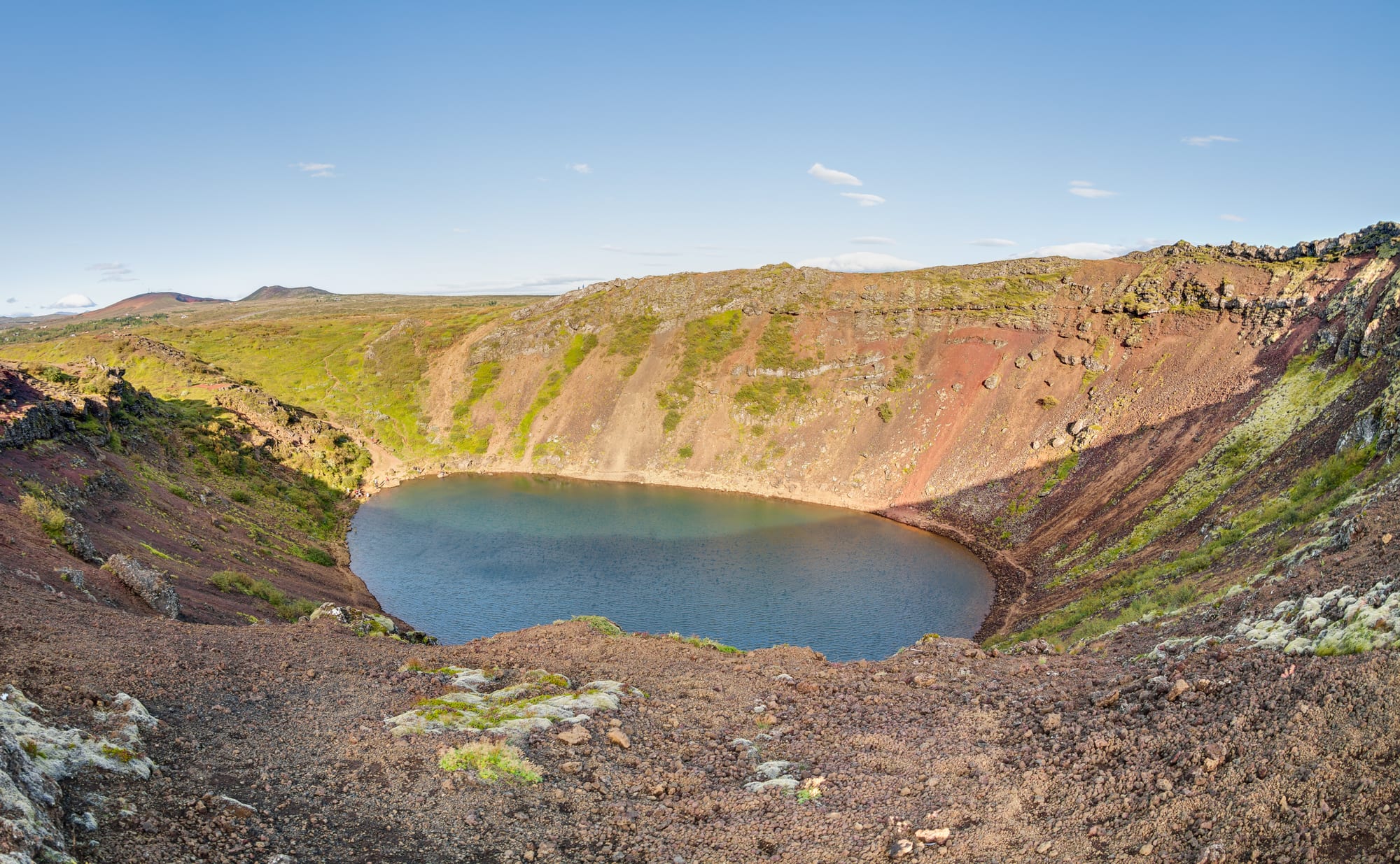
A still blue-green lake at the bottom of a volcanic crater with steep red and brown slopes patched with moss, under a clear sky

Iceland

Reykjavík & the South

Kerið, a volcanic crater lake in the Grímsnes area of South Iceland. (Diego Delso / Wikimedia Commons · CC BY-SA 4.0)

Iceland's capital and its southwest and south, from the lava fields of the Reykjanes peninsula and Keflavík airport through Reykjavík and the Golden Circle to the waterfall-lined south coast, the black beaches at Vík and the glacier lagoon at Jökulsárlón — home to two-thirds of Icelanders and to the sights most visitors see first.

Explore Reykjavík & the South

History

The south is where Iceland began. Ingólfur Arnarson, the first permanent Norse settler, is said to have farmed where his high-seat pillars washed ashore in 874, at a bay he named Reykjavík, "smoky bay", for the steam of its hot springs. In 930 the chieftains chose a rift valley 40 kilometres inland, Þingvellir, for the Althing; it met there every summer for eight centuries, decided the conversion to Christianity in the year 1000 and last sat there in 1798. Skálholt, a farm in the Biskupstungur lowlands, was the seat of the southern bishop from 1056 to 1785, and it was there in 1550 that Jón Arason, the last Catholic bishop, was beheaded with two of his sons.

The south also took the island's worst blows. Barbary corsairs raided Heimaey in 1627 and carried some 240 islanders into slavery in Algiers, and the Laki fissure in the Síða district erupted for eight months from June 1783, poisoning pasture across the country and bringing on the famine that followed.

Reykjavík was a farm until Skúli Magnússon set up wool workshops there in 1752; chartered as a trading town in 1786, it gathered the bishop, the Latin school and, from 1845, the revived Althing. British troops landed there on 10 May 1940, the Americans built the Keflavík airfield in 1942–43 and kept a NATO base beside it until 2006, and the republic was proclaimed at Þingvellir on 17 June 1944. Since then the region has lived through the Heimaey eruption of January 1973, when 5,000 islanders were evacuated overnight and the new hill of Eldfell buried some 400 houses; the Reagan–Gorbachev summit at Höfði house in October 1986; the "pots and pans" protests outside the Althing after the 2008 crash; Eyjafjallajökull's ash cloud in 2010; and the Reykjanes fissures, which reopened in 2021 after eight quiet centuries and emptied Grindavík in November 2023.

Culture & Customs

Two-thirds of Icelanders live in the capital area, so much of the national culture is simply this region's, but the south has accents of its own. Reykjavík is a UNESCO City of Literature, and its calendar runs through Reykjavík Pride and Culture Night in August, when the city stays out for a fireworks display, to Iceland Airwaves in November, the music festival that has filled its bars and churches since 1999. The pools are the true meeting places: Laugardalslaug, Vesturbæjarlaug and Sundhöllin each have their regulars in the hot pots, and the rule of washing thoroughly before entering is enforced by attendants and fellow bathers alike.

Beyond the city the lowlands are saga country and horse country. Njáls saga unfolds around Hlíðarendi and Bergþórshvoll near Hvolsvöllur, where Njáll and his family were burned in their farmhouse, and the town's Saga Centre retells it. The Icelandic horse is bred on the farms of Rangárvellir and Skeið, and the September réttir, when sheep are driven down from the highland pastures and sorted in stone pens, is still the farming year's social peak. Southern speech keeps the old hv sound, so that hvalur, a whale, opens with a breath rather than the "kv" heard in most of the country.

The Westman Islanders are a people apart, with a stubborn local pride: their Þjóðhátíð, held in the Herjólfsdalur valley since 1874 on the weekend before the first Monday in August, draws thousands to four days of bonfires, fireworks and a mass sing-along on the hillside. Keflavík, beside the former American base, calls itself Bítlabærinn, the Beatles town, for the rock bands it produced in the 1960s, and houses the Icelandic Museum of Rock 'n' Roll.

Daily Life

Reykjavík has around 140,000 residents and its built-up area — with Kópavogur, Hafnarfjörður (about 31,000), Garðabær, Mosfellsbær and Seltjarnarnes — around 250,000, two-thirds of the country. Reykjanesbær, the merged Keflavík and Njarðvík beside the airport, has about 22,000 people; Selfoss on the Ölfusá, the south's service town, has about 10,000; Heimaey about 4,500; and Hveragerði, Hella, Hvolsvöllur, Vík and Kirkjubæjarklaustur are villages of a few hundred to a thousand or so.

The capital does the country's governing, banking, publishing and university teaching, and hosts its software and technology firms — CCP, maker of Eve Online, and Marel and Össur in food-processing and prosthetics — alongside the hotels of the tourism boom. Hafnarfjörður has the Straumsvík aluminium smelter; Reykjanes lives off the airport, Grindavík's fishing fleet and the Svartsengi geothermal plant that feeds the Blue Lagoon; and Hellisheiði, above Hveragerði, is the largest geothermal power station in the country. The lowlands east of it are Iceland's farm belt: dairy herds, the Selfoss dairy, horse studs, and greenhouses at Hveragerði, Flúðir and Reykholt growing tomatoes, cucumbers and mushrooms under geothermal heat and electric light. Heimaey still lives from its harbour and fishing fleet.

The working day starts early and the capital area is built around the car, with Strætó buses and a long-planned Borgarlína rapid-bus line. About a fifth of Iceland's residents are immigrants, Poles by far the largest group, and in Reykjavík and Reykjanesbær immigrants and their children make up about a quarter of the population. Housing is the region's grievance — prices and rents in the capital area have outrun the rest of the country — while the people of Grindavík, evacuated in November 2023, do not know whether their town has a future, and the pressure of over two million visitors a year on the Golden Circle, Reynisfjara and the villages around them sets the local political agenda.

Food

The capital has most of the country's restaurants and the arguments about them. Dill, a New Nordic restaurant, won Iceland's first Michelin star in 2017, and Kolaportið, the city-centre flea market, opens every weekend.

Geothermal cooking is a southern speciality. Rúgbrauð, the dense, dark rye bread, is traditionally baked in pots or boxes set into holes dug near the hot springs; the greenhouses of Hveragerði grow vegetables under geothermal heat; and Flúðir has a mushroom farm. Lamb from the Rangárvellir and Skaftafell pastures is the roast for special occasions, and kjötsúpa, the lamb-and-root-vegetable soup, is winter's everyday dish.

The coast eats fish: saltfiskur, the salted cod in which Grindavík's fishing rights were paid as early as the 13th century and whose history it tells in an exhibition at Kvikan, and on Heimaey puffin, still caught in small numbers for the islanders' festival. Drinks are brewed here too — Ölgerðin, the Reykjavík brewer founded in 1913, makes Egils Gull and the Christmas mix of malt and Appelsín; and Ölvisholt, a farm brewery near Selfoss, makes a beer called Lava.

Attractions & Natural Wonders

Reykjavík is compact enough to walk: Hallgrímskirkja's 74-metre tower for the view over the coloured roofs, the glass Harpa concert hall on the harbour, the Settlement Exhibition built around a 10th-century longhouse, the National Museum, the Perlan exhibition on its hot-water tanks, and whale-watching from the Old Harbour. Esja, 914 metres, fills the view north and is the city's hill walk, and the Sky Lagoon in Kópavogur and the hot river at Reykjadalur above Hveragerði are the alternatives to the Blue Lagoon.

The Reykjanes peninsula has the Blue Lagoon at Svartsengi, the boiling Gunnuhver mud springs and Reykjanesviti lighthouse at its tip, the Bridge Between Continents over the rift at Sandvík, the steaming slopes of Seltún at Krýsuvík and the fresh lava fields of the Fagradalsfjall eruptions of 2021 to 2023. The Golden Circle takes in Þingvellir, with the Almannagjá rift walk, Öxarárfoss and snorkelling in the Silfra fissure, the Geysir field where Strokkur erupts every few minutes, and Gullfoss, dropping 32 metres in two steps into the Hvítá canyon, with the Kerið crater lake as a detour.

Inland lie the highlands: Landmannalaugar's rhyolite mountains and hot stream in the Fjallabak reserve, the start of the 55-kilometre Laugavegur trail to Þórsmörk, and Hekla, 1,491 metres, the volcano medieval Europe called the gate of hell. The south coast strings together Seljalandsfoss, with its path behind the water, Skógafoss, the Sólheimajökull glacier tongue, the puffin cliffs and arch of Dyrhólaey, Reynisfjara's black sand and Reynisdrangar stacks, and Vík beneath its hilltop church.

Beyond Vík the road crosses the moss-covered Eldhraun lava of 1783 to Skaftafell in Vatnajökull National Park, where Svartifoss falls over basalt columns beneath Hvannadalshnúkur, at 2,110 metres the country's highest point, and ends at Jökulsárlón, where icebergs calve from Breiðamerkurjökull, drift through the lagoon and wash up on the Diamond Beach. Offshore, Heimaey in the Westman Islands offers the climb up Eldfell, the Eldheimar museum built over a house dug from the 1973 ash, and the island's puffins.

Cities in Reykjavík & the South

Planning basics

Budget

This is the most expensive corner of an expensive country. Reykjavík hotels in summer, the Blue Lagoon (entry starts above USD 80), Golden Circle coach tours, super-jeep trips to Landmannalaugar and guided glacier walks all add up quickly, while Selfoss, Hveragerði, Hella and the guesthouses of the south coast cost a little less than the capital. Campsites, hostels, supermarket meals and the municipal pools are the savers, and the Golden Circle and the south-coast waterfalls are free to see with a hire car, apart from parking fees.

Daily Budget Midrange
USD 330–620 (guesthouse or mid-range hotel, one restaurant meal a day, a hire car, one paid excursion)
Daily Budget Shoestring
USD 120–230 (hostel dorm or campsite, supermarket food, a shared hire car or Strætó buses)

Reykjavík's municipal pools cost a fraction of the Blue Lagoon and the hot river at Reykjadalur costs nothing but the walk; parking is charged at several of the main sights, so keep a card handy.

Safety

Crime is rare even in the capital, though Reykjavík's weekend nightlife on Laugavegur and Austurstræti runs late and loud. The dangers are natural and concentrated in this region: sneaker waves at Reynisfjara, where the warning signs at the car park are ignored at real risk; the Reykjanes fissure eruptions that began in 2021 and since late 2023 have closed Grindavík and, at times, the Blue Lagoon and the roads around it; scalding ground at Geysir and Gunnuhver; crevasses on Sólheimajökull; and the Katla volcano under Mýrdalsjökull, which Vík practises evacuating from. Highland rivers rise through the afternoon and after rain.

Never turn a back to the sea at Reynisfjara, follow safetravel.is and the Civil Protection alerts for Reykjanes, take a guide onto any glacier, and treat the weather forecast as the day's first decision. Check current official travel advice before travelling.

Climate

The mildest and wettest side of Iceland. Reykjavík's summers stay between 10 and 15°C and its winters seldom fall below −15°C, while the south coast is wetter and windier, with Atlantic gales possible in any month. The highlands behind the coast are colder and snowbound until June, and the Reykjanes peninsula is bare, windswept lava with frequent fog and drizzle. Winters near the coast are more slush than snow, and the sea keeps frosts short.

Summer
10–15°C with light nights and frequent showers; warmer and calmer inland at Þingvellir and Landmannalaugar than on the coast
Winter
-2 to 4°C in Reykjavík, wet and windy, four to five hours of daylight in December; snow and closures on the Hellisheiði road and in the highlands

Transportation

Keflavík International Airport sits on the Reykjanes peninsula 50 kilometres from Reykjavík, with airport coaches and Strætó buses into the city; Reykjavík's domestic airport serves Akureyri, Egilsstaðir and Ísafjörður. From the capital the Ring Road runs east over Hellisheiði through Selfoss, Hella and Hvolsvöllur to Vík, about 185 kilometres, and on across the sands to Jökulsárlón, about 380 kilometres; Strætó buses serve the south coast. The Golden Circle is a day loop of about 300 kilometres. Landmannalaugar and Þórsmörk are reached only by summer highland buses or a proper 4x4 on F-roads with river crossings, and the Westman Islands by the Herjólfur ferry from Landeyjahöfn, about 30 minutes, or from Þorlákshöfn when silt or heavy seas close the harbour, mostly in winter.

A hire car is the sensible way to do the south coast; leave the Krossá river crossing into Þórsmörk to the highland buses unless the car is a large 4x4, and check road.is before Hellisheiði in winter.

Best Time to Visit

June to August for the highlands: the F-roads to Landmannalaugar and Þórsmörk open in late June or early July, the Laugavegur huts run until mid-September, puffins are on Dyrhólaey and Heimaey until mid-August, and Þjóðhátíð fills Heimaey at the start of August. May and September are quieter on the Golden Circle and the south coast with the lowland roads still open. From November to March the glacier ice caves near Jökulsárlón are the draw and the aurora shows on clear nights, but the south is the cloudiest side of the island and Hellisheiði and the coast road close in storms.