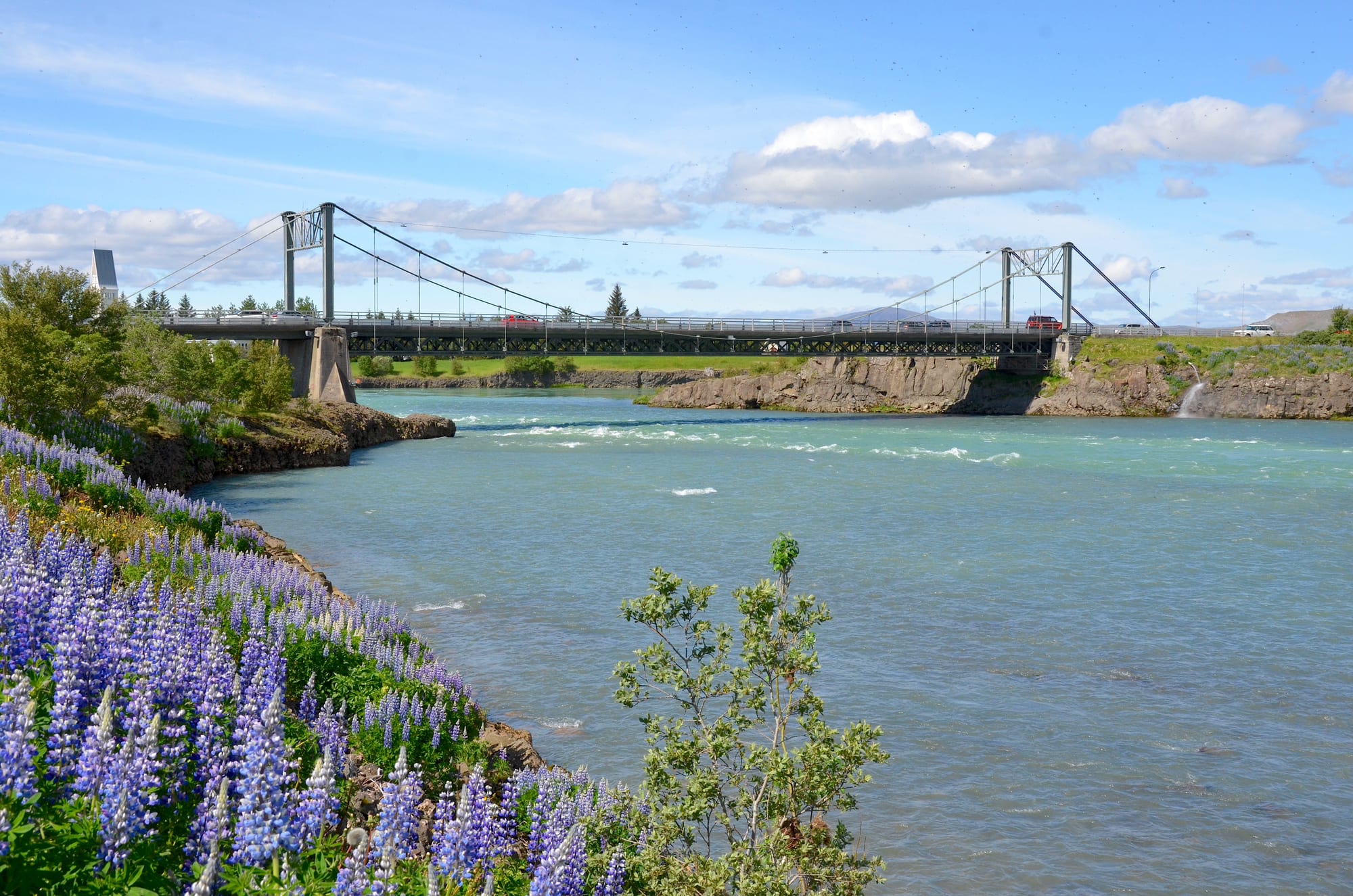
A suspension bridge spanning a fast turquoise river, with purple lupins in flower on the near bank

Reykjavík & the South, Iceland

Selfoss

The suspension bridge over the Ölfusá at Selfoss. (Olga Ernst / Wikimedia Commons · CC BY-SA 4.0)

The main town of Árborg, on the banks of the Ölfusá about 50 kilometres south-east of Reykjavík, where the Ring Road crosses Iceland's largest river by volume. It grew up around a bridge of 1891 and a dairy of 1931, and is now South Iceland's largest town, a fast-growing centre of commerce and a common base for the Golden Circle and the south coast.

Neighbourhoods

  • The new town centre and the bridge
    • First-time visitors
    • Best for food
    • Close to public transport

    A pedestrianised centre opened in 2021 right across from the bridge, beside the town hall, built from reconstructions of historic buildings from all over Iceland. Its largest building, a copy of the 1929 dairy, is a food hall, and the Ring Road and the main shopping streets run past it.

    Open in Maps
  • The riverbank and the church
    • Walks
    • Quiet and residential

    The town takes its name from the rapids below Selfoss church, called Selfoss for the seals that came up the river. The fast-flowing Ölfusá, Iceland's largest river by volume, runs past the town, and the Tryggvagarður garden and the area under the bridge are common places for events.

    Open in Maps
  • Eyrarbakki and Stokkseyri
    • Historic villages
    • Coast

    Two villages on the coast south of Selfoss, both part of Árborg. Eyrarbakki was for centuries the main port and trading centre of the south and keeps many renovated old houses; Stokkseyri, about 10 kilometres south-west of Selfoss, is smaller and quieter.

    Open in Maps

Things to do

In town

  • Ölfusá bridgelandmark

    The suspension bridge that made the town, the current one opened in December 1945 after the first, of 1891, collapsed under a milk truck in 1944.

    Open in Maps
  • Tryggvaskálilandmark

    The cabin built for the workers on the first bridge, the oldest building in Selfoss, named after Tryggvi Gunnarsson, the member of parliament who lobbied for the bridge; the national telephone service moved into it in 1909.

    Open in Maps
  • Bobby Fischer Centermuseum

    A small non-profit museum of memorabilia of the 1972 world chess champion, with a strong focus on his famous match with Boris Spassky in Reykjavík.

    Open in Maps
  • Laugardælir churchlandmark

    A country church just outside Selfoss, in whose cemetery Bobby Fischer was buried in 2008.

    Open in Maps

Walks and nature

  • Ingólfsfjalltrail

    A 551-metre flat-topped tuya west of the river, under which Ingólfur Arnarson, the first settler, is said to have spent the winter of 873–74.

    Open in Maps

Short trips from the town

  • Keriðviewpoint

    A volcanic crater lake in the Grímsnes area on the way to the Golden Circle, with a shallow lake that minerals colour aquamarine.

    Open in Maps
  • Eyrarbakki and the Árnesinga Folk Museummuseum

    The old trading village on the coast, whose oldest building, Húsið, a Norwegian kit house of 1765 and the oldest preserved timber dwelling in Iceland, now holds the Árnesinga Folk Museum.

    Open in Maps
  • Hveragerðiattraction

    The 'hot-spring yard' town on the Ring Road west of Selfoss, on the Varmá river, known for its geothermal greenhouses.

    Open in Maps
  • Urriðafossattraction

    A waterfall on the Þjórsá with the highest average flow of any in Iceland, about 360 cubic metres a second.

    Open in Maps

Seasonal events

  • Sumar á Selfossi (Summer in Selfoss)Early August

    The town's summer festival, held in early August.

Eat and drink

Long-standing places and food districts in Selfoss. Hours, ratings and directions come from your maps app, always current.

Selfoss food

  • The Old Dairy food hallmarket

    A food hall in the reconstructed 'Old Dairy' building, a copy of a dairy plant of 1929, at the heart of the new town centre.

    Open in Maps
  • Selfoss town centreneighborhood

    Restaurants, cafés and bakeries around the new centre and along the Ring Road through town, serving both locals and travellers heading for the south coast.

    Open in Maps

Experience Selfoss

History

The sagas say that Ingólfur Arnarson, the first settler, spent the winter of 873–74 under Ingólfsfjall, the mountain west of the Ölfusá, and Selfoss itself was settled by Þórir Ásason some time after 1000. For centuries it was farmland beside a dangerous river. The town owes its existence to a bridge: in the summer of 1891, after lobbying by Tryggvi Gunnarsson, a member of the Althing, the first suspension bridge over the Ölfusá was built here, and the crossing made the spot the natural service centre for the farming district around it. The cabin built for the bridge workers, Tryggvaskáli, is the oldest building in town and housed the telephone service from 1909.

Growth was slow at first. In 1900 Selfoss had about 40 inhabitants, but in 1931 two institutions arrived that shaped it — the dairy Mjólkurbú Flóamanna and the general store Kaupfélag Árnesinga — and by 1950 the population was around 1,000. During the Second World War British troops were stationed in the town to guard the strategic bridge. In 1944 the old bridge collapsed when a milk truck drove across it, and the present bridge opened in December 1945.

On 29 May 2008 a magnitude 6.3 earthquake struck near Selfoss, damaging buildings and roads and shaking the whole of southern Iceland. The town has since grown faster than almost anywhere in the country, more than doubling from about 4,500 residents in 2000. In 2021 a new pedestrianised town centre of reconstructed historic buildings opened beside the bridge, and a bypass with a new four-lane bridge is due by 2028.

Culture & Customs

Selfoss is a sporting town above all. Its handball club's men's team won its first national championship in May 2019, and the handballers Ómar Ingi Magnússon and Elvar Örn Jónsson were both born in the town. Thorir Hergeirsson, coach of Norway's women's national team, is also counted among its notable people. The women's football team won the Icelandic Cup in August 2019, and the men's team has played in the national leagues since 1966, with the local college working with the club as an academy for young players.

The town has an unexpected link with chess history. Bobby Fischer, the American who became world champion in 1972 after his match in Reykjavík, was buried in 2008 in the cemetery of Laugardælir church just outside Selfoss, and the small Bobby Fischer Center in town displays memorabilia of his life and his famous match with Boris Spassky.

Community life gathers by the river. The town's summer festival, Sumar á Selfossi, is held in early August, and the area under the Ölfusá bridge and the Tryggvagarður garden are common places for events. The new town centre, with its copies of old buildings from across Iceland, has become a meeting place in its own right, and its success led to a decision in 2022 to expand it with 40 more houses.

Daily Life

Selfoss had 10,420 residents in 2025, making it the largest town in South Iceland and the seat of the municipality of Árborg, which also takes in the coastal villages of Eyrarbakki and Stokkseyri. Its population has more than doubled since 2000, from around 4,500, and the capital is only 50 kilometres away over the Hellisheiði heath.

It is a centre of commerce and small industries, with low unemployment. The town grew as the service centre for the farming region around it, and the dairy and the general store founded here in 1931 helped it grow. Fjölbrautaskóli Suðurlands, known as FSu, is one of the largest colleges in the country.

Daily life is shaped by the road. The Ring Road runs straight through town and over the two-lane Ölfusá bridge, so traffic bound for the south coast passes through the centre, and Strætó buses link Selfoss with Reykjavík, the coastal villages and inland communities such as Laugarvatn, Reykholt and Flúðir. The new bypass and bridge due by 2028 are meant to take the through traffic out of the centre.

Food

Selfoss is dairy country. The town grew up partly around Mjólkurbú Flóamanna, the dairy firm founded in 1931, and the town grew as the service centre for the farming region around it. Skyr, the soft yoghurt-like cheese eaten with a spoon that was originally brought to Iceland from Norway, is the best known of the country's dairy foods.

The other foundations of the local table are those of Iceland as a whole: lamb, dairy and fish. Hangikjöt, smoked lamb, is often served in thin slices on flatkaka, a soft brown rye flatbread; rúgbrauð, the dense, dark and moist rye bread, is traditionally baked in pots or boxes set into the ground near hot springs; and kleina, a small knotted bun of fried dough, is a traditional pastry. In nearby Hveragerði, vegetables are grown in greenhouses under geothermal heat.

The town's newest food address is the food hall in the reconstructed Old Dairy building, a copy of a dairy plant of 1929 that was demolished in 1954, at the centre of the new town square. Around it and along the Ring Road through town are cafés, bakeries and restaurants serving locals and travellers on their way to the south coast.

Planning tools

Budget

Selfoss and the towns around it cost a little less than the capital, which is one reason many visitors use it as a base for the Golden Circle and the south coast. Prices are still high by most standards: restaurant meals, alcohol and tours add up, while supermarkets and the free sights along the river keep a day cheap. A hire car is the practical way to see the surrounding area.

Daily Budget Midrange
USD 280–520 (guesthouse or mid-range hotel, one restaurant meal a day, a hire car, one paid excursion)
Daily Budget Shoestring
USD 110–200 (hostel or campsite, supermarket food, buses or a shared car)

Fill up on supplies in Selfoss, the largest town in South Iceland, before heading out to the smaller villages and sights.

Best Time to Visit

June to August for long days and the Summer in Selfoss festival in early August. Winter brings short days and the chance of the northern lights on clear nights away from the town's lights, but weather can close Hellisheiði, the road over to Reykjavík.

Suggested Number of Days

The town itself needs about a day. As a base for the Golden Circle, the coastal villages and the south coast, three or four days are common, and winter weather may call for more.

First Visit
1 day
With Surroundings
3–4 days

Transportation

Selfoss is easy to get around on foot, and the Ring Road runs straight through the centre and over the two-lane bridge, which can make traffic slow; a bypass and a new four-lane bridge are due by 2028. Strætó buses run to Reykjavík, to Eyrarbakki and Stokkseyri on the coast, and on a limited service inland to Laugarvatn, Reykholt and Flúðir; many Golden Circle tours pass through.

A hire car gives far more freedom than the buses for the Golden Circle and the south coast; check road.is before crossing Hellisheiði in winter.

Airport & Station Connections

Selfoss is about 50 kilometres south-east of Reykjavík on the Ring Road, over the Hellisheiði heath and through Hveragerði. Strætó route 51 runs from the Mjódd interchange in Reykjavík through Hveragerði to Selfoss, roughly hourly on weekdays. From Keflavík International Airport most visitors drive.

Walkability

The centre, the bridge, the riverbank and the Bobby Fischer Center are all within a short walk of each other. Outlying sights, from Laugardælir to the coastal villages, need a car or a bus.

Safety

Iceland has almost no violent crime and is one of the safest countries in the world. Selfoss lies in an earthquake zone: a magnitude 6.3 quake on 29 May 2008 damaged buildings and roads in the town. The Ölfusá is Iceland's largest river by volume and runs fast through the town.

Keep children well back from the riverbank, and check the weather and road conditions before driving in winter. Check current official travel advice before travelling.

Climate

A cool, cloudy and changeable subpolar oceanic climate, much like the capital's. In Reykjavík, July and August are the warmest months and January and February the coldest.

Summer
cool — in Reykjavík temperatures usually move between 10 and 15°C and rarely pass 20°C
Winter
cold, dark and windy — in Reykjavík temperatures very rarely fall below −15°C

Local Customs

Tipping is not done in Iceland. At swimming pools, washing thoroughly before getting into the water is expected. Sport is a big part of local life, and handball and football matches draw the town together.

Respect private farmland around the town, stay on marked paths and never drive off-road.

Common Payment Methods

The currency is the Icelandic króna (ISK). Cards, including contactless, are used for everything, from parking to remote fuel pumps, and cash is almost never needed.