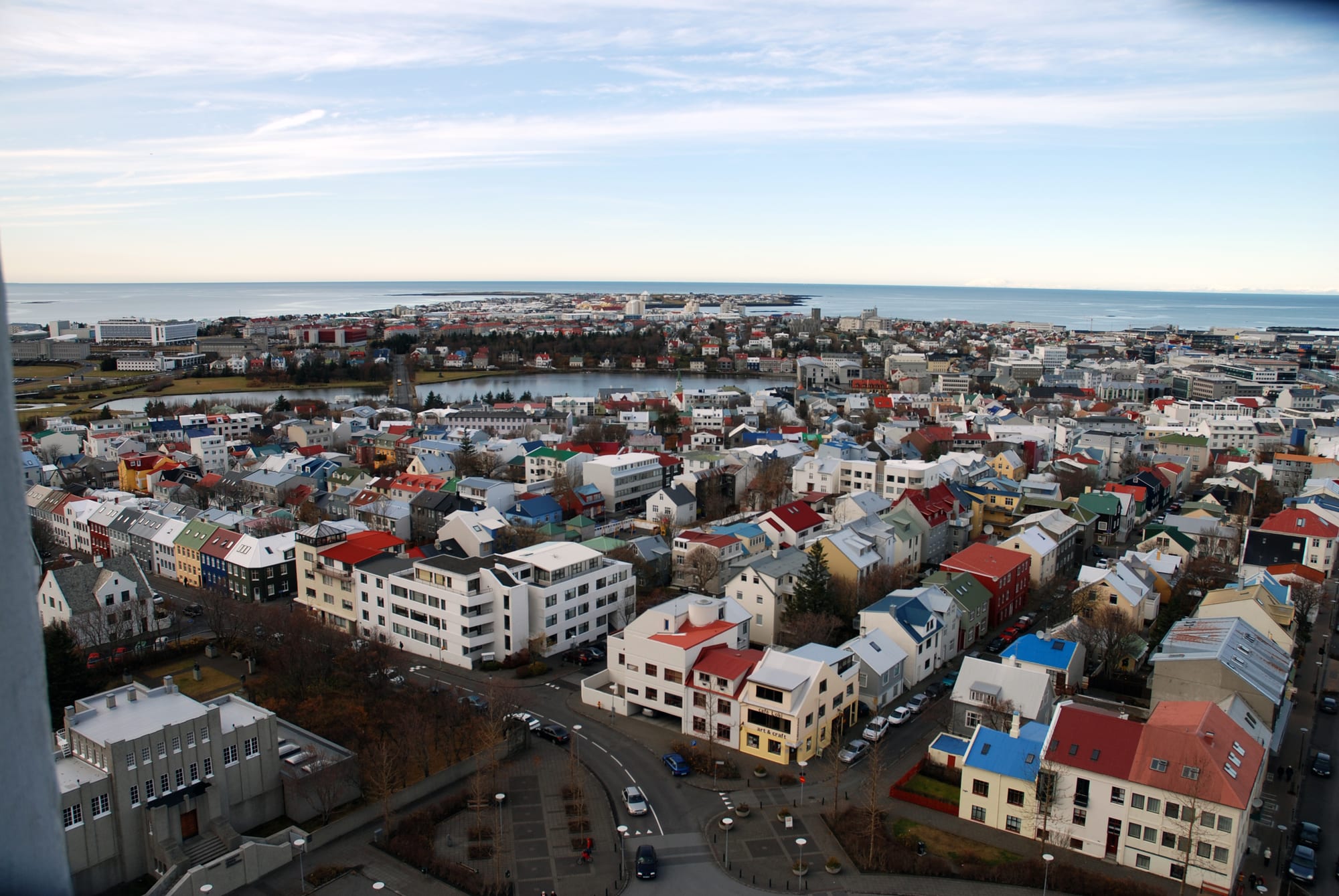
Rooftops of central Reykjavík in many colours, with the Tjörnin lake and the sea beyond under a pale sky

Reykjavík & the South, Iceland

Reykjavík

Central Reykjavík and the Tjörnin lake seen from the tower of Hallgrímskirkja. (allen watkin from London, UK / Wikimedia Commons · CC BY-SA 2.0)

The world's northernmost capital of a sovereign state, on the southern shore of Faxaflói bay. A farm said to be Iceland's first settlement, it became a chartered trading town only in 1786 and grew on trawler fishing into the seat of parliament and government. Today it is a small, geothermally heated city of coloured roofs, museums, pools and harbour boats.

Neighbourhoods

  • Miðborg (the city centre)
    • First-time visitors
    • Nightlife
    • Best for food

    The old centre between the harbour and Tjörnin, with the parliament house on Austurvöllur square, the city hall by the lake and Laugavegur, the main shopping street, climbing east. Skólavörðustígur runs up from Laugavegur to Hallgrímskirkja, and on Friday and Saturday nights the bars keep the streets full until late.

    Open in Maps
  • Old Harbour
    • Boat trips
    • Museums
    • Best for food

    The harbour by the city centre, built in the early 20th century and still used by trawlers, tour boats and smaller cruise ships. Whale-watching and puffin trips leave from Ægisgarður, and the Maritime Museum, the Hafnarhús art gallery and seafood cafés line the quays, with Harpa just to the east.

    Open in Maps
  • Vesturbær
    • Quiet and residential
    • Local life

    The district of eight neighbourhoods west of the city centre, home to the KR sports club and the Vesturbæjarlaug pool, an important community hub. It is mostly residential and quieter than the centre next door.

    Open in Maps
  • Laugardalur
    • Pools and sport
    • Families
    • Parks

    A district just east of the centre that holds the city's recreation in one place — the Laugardalslaug thermal baths, the national football stadium, the Laugardalshöll concert and sports hall, an ice rink and the botanic garden.

    Open in Maps
  • Hlíðar
    • Quiet and residential
    • Close to the centre

    A residential district of six neighbourhoods close to the centre, home ground of the Valur sports club. It is a place of flats and family houses rather than sights, and an easy walk or short bus ride from downtown.

    Open in Maps

Things to do

Famous landmarks

  • Hallgrímskirkjalandmark

    Iceland's largest church, 74.5 metres tall, designed by Guðjón Samúelsson to echo columnar basalt and built between 1945 and 1986; its tower gives the classic view over the city.

    Open in Maps
  • Harpalandmark

    The concert hall and conference centre on the harbour, opened in 2011, whose coloured glass façade was inspired by the basalt landscape.

    Open in Maps
  • Alþingishúsiðlandmark

    The 19th-century stone Parliament House on Austurvöllur square, where the Althing still holds its debates.

    Open in Maps
  • Reykjavík City Halllandmark

    The 1992 city hall by Studio Granda, standing at the edge of Tjörnin, with a large three-dimensional map of Iceland inside.

    Open in Maps
  • Höfðilandmark

    A house built in 1909, best known as the place where Reagan and Gorbachev met for the Reykjavík Summit in 1986.

    Open in Maps
  • The Sun Voyagerlandmark

    Jón Gunnar Árnason's sculpture beside the Sæbraut shore road, described by its maker as a dreamboat and an ode to the sun.

    Open in Maps

Museums

  • National Museum of Icelandmuseum

    Iceland's national museum, established in 1863, whose collections cover the country's history.

    Open in Maps
  • The Settlement Exhibitionmuseum

    The excavated ruins of a hall lived in from about 930 to 1000, shown where they were found, beside a wall dated to around 871.

    Open in Maps
  • Reykjavik Art Museummuseum

    Iceland's largest visual art institution, spread over three buildings; Hafnarhús by the old harbour shows works by Erró among its exhibitions.

    Open in Maps
  • Reykjavík Maritime Museummuseum

    The story of the fishing and seafaring that built the city, in a museum by the old harbour.

    Open in Maps
  • Perlanmuseum

    A glass dome on top of hot-water tanks on Öskjuhlíð hill, now a natural history museum with a planetarium aurora show and a man-made ice cave.

    Open in Maps
  • Árbæjarsafnmuseum

    The city's historical and open-air museum, giving an insight into how people in Reykjavík lived, worked and spent their free time in the past.

    Open in Maps

Pools, parks and the shore

  • Tjörninpark

    The small lake in the centre, ringed by the city hall and museums, where feeding the ducks and geese is such a habit that it has been called the biggest bread soup in the world.

    Open in Maps
  • Laugardalslaugattraction

    Iceland's largest conventional swimming pool complex, with an Olympic-size pool and hot pots — after the Blue Lagoon the most visited baths in Iceland.

    Open in Maps
  • Nauthólsvíkbeach

    A small seaside cove about 900 metres from Perlan, with a beach and an artificial hot spring that keeps the water inside the cove a few degrees warmer than the sea.

    Open in Maps
  • Reykjavík Botanic Gardenpark

    A garden in Laugardalur keeping more than 5,000 plant species in eight collections, with plenty of birdlife.

    Open in Maps
  • Sky Lagoonattraction

    A geothermal spa on the harbour at Kársnes in neighbouring Kópavogur, an alternative to the Blue Lagoon close to the city.

    Open in Maps

Walks and viewpoints

  • Viðeypark

    The largest island in Kollafjörður bay, reached by ferry, with the historic Viðeyjarstofa house and Yoko Ono's Imagine Peace Tower.

    Open in Maps
  • Gróttaviewpoint

    A tidal island with a lighthouse at the tip of Seltjarnarnes, reachable on foot at low tide and closed for nesting Arctic terns from 1 May to 15 July.

    Open in Maps
  • Esjatrail

    The 914-metre volcanic range about ten kilometres north of the city that fills the skyline and is a very popular area for hikers.

    Open in Maps

Short trips from the city

  • Þingvellirpark

    The national park in the rift valley where the Althing met in the open air from 930, with walks along the Almannagjá fault.

    Open in Maps
  • Blue Lagoonattraction

    The milky-blue geothermal spa among the lava at Svartsengi, about 20 kilometres from Keflavík International Airport.

    Open in Maps

Seasonal events

  • Reykjavík PrideAugust

    Held since 1999, it is now Iceland's biggest annual festival, with more than 100,000 people in the centre for the Pride Parade, Gleðigangan.

  • Menningarnótt (Culture Night)Late August

    A night of free concerts and events across the centre, held since 1996, usually on the first Saturday after 18 August.

  • Reykjavík International Film FestivalLate September to early October

    RIFF, an international film festival whose main prize, the Golden Puffin, goes to directors' first or second films.

  • Iceland AirwavesNovember

    A music festival showcasing new Icelandic and international acts in venues across the city since 1999, with Harpa among its venues.

Eat and drink

Long-standing places and food districts in Reykjavík. Hours, ratings and directions come from your maps app, always current.

Reykjavík classics

  • Bæjarins Beztu Pylsurrestaurant

    A hot dog stand in the city centre since 1937, selling lamb-based sausages with pork and beef, served with ketchup, sweet mustard, remoulade and fried and raw onion.

    Open in Maps
  • Sægreifinnrestaurant

    A simple seafood place in a harbour shed near the whale-watching kiosks, known for its lobster soup and grilled fish.

    Open in Maps
  • Dillrestaurant

    A New Nordic restaurant opened in 2009, the first in Iceland to win a Michelin star, in 2017.

    Open in Maps

Food streets and markets

  • Kolaportiðmarket

    Iceland's only flea market, normally open at weekends, selling second-hand goods and liquorice, with a food section where fishmongers sell fermented shark, dried cod and pickled herring.

    Open in Maps
  • Laugavegurneighborhood

    The old main shopping street, lined with restaurants, cafés and bars that stay busy late at weekends.

    Open in Maps
  • The Old Harbourneighborhood

    Fish restaurants and cafés in the converted sheds along the quays where the whale-watching boats tie up.

    Open in Maps

Experience Reykjavík

History

According to the Landnámabók, the medieval book of settlements, Iceland's settlement began here in 874, when Ingólfur Arnarson arrived from Norway. For more than 900 years afterwards there was no town, only a farm. In 1752 King Frederik V of Denmark gave the Reykjavík estate to the Innréttingar, a company led by Skúli Magnússon, which set up wool workshops and tried its hand at fisheries, sulphur mining, agriculture and shipbuilding. When the Danish Crown abolished its trade monopoly in 1786 and granted six communities trading charters, Reykjavík was one of them, and 1786 is regarded as the city's founding date.

The town became the national capital step by step. The Althing, which had met at Þingvellir until it was suspended, was re-established in Reykjavík in 1845 and gained limited legislative powers with the constitution of 1874. The post of mayor was created in 1907. By the 1920s and 1930s most of Iceland's growing trawler fleet sailed from Reykjavík and cod was its main industry, though the Great Depression brought unemployment and bitter labour disputes.

On 10 May 1940 four British warships anchored in the harbour, and for the rest of the war British and then American soldiers in the city numbered about as many as the residents. The British built Reykjavík Airport and the Americans the airfield at Keflavík. The republic followed in 1944, with the president's office in the city. Reagan and Gorbachev met at Höfði in 1986. A building boom in the 2000s was cut short by the 2008 financial crisis, but Harpa opened in 2011, and in 2010 the comedian Jón Gnarr, leader of the new Best Party, became mayor. The current mayor is Hildur Björnsdóttir.

Culture & Customs

Reykjavík was named a UNESCO City of Literature in 2011. Most of Iceland's writers live in the city, and it is the setting for most contemporary Icelandic fiction — a literary life that has grown with the city over the past century. Music is just as central. Iceland Airwaves has filled venues across the city since 1999, now in November, with Harpa among its venues, and smaller rooms such as Kex, Húrra, Gaukurinn and the experimental Mengi keep a live scene going all year, alongside the Icelandic Opera and the National Theatre.

The city's biggest gatherings are in August. Reykjavík Pride, first held in 1999, is now Iceland's largest annual festival, and its parade, Gleðigangan, the "march of joy", draws more than 100,000 people into the centre. Menningarnótt, Culture Night, started in 1996 and fills the streets with free concerts, usually on the first Saturday after 18 August. In 2013 the mayor, Jón Gnarr, asked the city council to end Reykjavík's twinning with Moscow in response to Russia's anti-gay laws.

Everyday social life runs through the geothermally heated pools, where people soak in the hot tubs and talk; Laugardalslaug alone had about 800,000 visits in 2010. Football clubs are tied to districts — KR to Vesturbær, Valur to Hlíðar, Þróttur to Laugardalur. Tipping is not done, first names are the norm, and feeding the ducks and geese at Tjörnin is a habit shared by children and adults alike.

Daily Life

The municipality of Reykjavík had about 140,000 residents on 1 January 2026, about 35 per cent of Iceland's population, and the wider Capital Region around 252,000. The city has changed fast: immigrants and their children made up 26.7 per cent of residents in 2026, against 2.9 per cent in 1998, and most foreign residents come from other European countries, many of them from the Eastern European states that joined the EU from 2004.

Reykjavík is the centre of the country's government, business and culture, and its old harbour still serves trawlers alongside tour boats and cruise ships, while Sundahöfn in the east is the country's largest cargo port. Tourists, students and other temporary residents sometimes outnumber locals in the centre. Volcanic heat runs the city: every building is heated by geothermal water, which also warms the public pools and the snow-melting pipes under the busiest streets and many private driveways.

Most people live in flats and houses in residential districts such as Vesturbær, Hlíðar and the newer suburbs to the east. Car ownership is among the highest in the world — 779 cars per 1,000 people in 2024 — and a rapid-bus network, Borgarlína, is planned to ease dependence on the car, with its first phase due in 2031. Whether to move the domestic airport, which takes up land close to the centre, has been debated for years with no decision.

Food

The city's best-known snack is the hot dog. Bæjarins Beztu Pylsur, "the town's best hot dogs", has been selling them from a stand in the centre since 1937: a sausage made mainly of lamb with pork and beef, served in a bun with ketchup, sweet mustard, remoulade and both crisp fried and raw onion. Bill Clinton's order of one with only mustard in 2004 became part of the stand's story.

Fish and lamb are the foundations of Icelandic cooking, and the harbour is the place for fish: Sægreifinn, in a quayside shed near the whale-watching kiosks, is known for lobster soup and grilled fish. At the Kolaportið flea market at weekends, fishmongers sell hákarl, the fermented shark, harðfiskur, dried cod, and pickled herring. Traditional foods are still part of everyday eating: skyr, a soft yoghurt-like cheese eaten with a spoon; rúgbrauð, a dense, dark and moist rye bread; hangikjöt, smoked lamb, often served in thin slices on flatkaka, a soft rye flatbread; and kleina, a small knotted bun of fried dough.

At the other end of the scale, the New Nordic restaurant Dill, opened in 2009, became the first in Iceland to win a Michelin star in 2017. Laugavegur and the streets around it hold most of the city's restaurants, cafés and bars, and at midwinter many Icelanders still gather for þorramatur, a buffet of cured meat and fish served with rúgbrauð and brennivín, an Icelandic akvavit.

Planning tools

Budget

Iceland is one of the most expensive countries in the world, and the capital region is its costliest corner. Rooms in the centre are the largest cost and climb through the summer, and restaurant meals and alcohol are costly. A car is not needed inside the city, which saves money, and the municipal pools, the harbour walks and many churches and public buildings cost little or nothing.

Daily Budget Midrange
USD 300–550 (guesthouse or mid-range hotel, one restaurant meal a day, museums and one boat trip)
Daily Budget Shoestring
USD 120–220 (hostel dorm, supermarket food, hot dogs and soup, buses and walking)

A pool session costs a fraction of a spa ticket; supermarkets such as Bónus and Krónan are the way to keep food costs down.

Best Time to Visit

June to August brings the long light nights, the most boat trips and the busiest streets; August adds Pride and Culture Night. September to March is darker, cheaper and quieter, with the film festival, Airwaves in November and a chance of the northern lights on clear nights away from the street lights.

Suggested Number of Days

Two to three days cover the city itself at an easy pace. Most visitors add a few more for day trips into the countryside, and winter weather and short daylight can make it sensible to allow a spare day.

First Visit
2–3 days
With Surroundings
4–6 days

Transportation

The centre is best on foot. Strætó runs the city's public buses, which reach the suburbs and neighbouring towns, and the same company runs longer routes east to Selfoss and north to Akranes. Car ownership is very high and the wider capital area is built around the car; a bus rapid transit system, Borgarlína, is planned, with a first phase due in 2031. Viðey is reached by a short ferry from the east of the city.

Evening and Sunday-morning bus services are thinner than on weekdays, so check the timetable before relying on a late bus.

Airport & Station Connections

Almost every visitor arrives at Keflavík International Airport, some 40 to 50 kilometres south-west of the city on the Reykjanes peninsula. Airport coaches and Strætó buses connect it with Reykjavík, and many people hire a car there. Reykjavík Airport, close to the city centre, handles domestic flights and some flights to Greenland. Larger cruise ships berth at Sundahöfn in the east of the city.

Walkability

Central Reykjavík is small and walkable: the harbour, Austurvöllur, Tjörnin, Laugavegur and Hallgrímskirkja are all within a short walk of each other, and the busiest pavements are kept clear of snow by geothermal heating pipes. Wind, rain and ice are the real obstacles. Laugardalur, Perlan and Höfði are further but still reachable on foot.

Safety

Iceland has almost no violent crime and is one of the safest countries in the world. Reykjavík is a very safe city. Late weekend nights around Laugavegur and Austurstræti are loud and crowded, and the hazards most visitors meet are the weather, icy pavements and the sea along the exposed shore paths.

Dress for wind and rain in every season, take care on icy streets in winter, and check the forecast before walks to Grótta or up Esja. Check current official travel advice before travelling.

Climate

A cool, cloudy and changeable climate — Reykjavík is one of the cloudiest and coldest capitals in the world, though milder than its latitude suggests. July and August are the warmest months, and January and February the coldest.

Summer
cool — temperatures usually move between 10 and 15°C and rarely pass 20°C; the record is 25.7°C, set in July 2008
Winter
dark, windy and wet, but temperatures very rarely fall below −15°C

Local Customs

Tipping is not part of the culture, in restaurants or anywhere else. At the pools, washing thoroughly before entering the water is expected and enforced. Icelanders go by first names. Feeding the birds at Tjörnin is a city habit.

Leave no tip; follow the pool attendants' instructions on washing; and keep to paths on Grótta and Viðey, where birds nest.

Common Payment Methods

The currency is the Icelandic króna (ISK). Cards, including contactless, are used for almost everything, and cash is almost never needed.